


Global Non Small Cell Lung Cancer Diagnostics Market
市场规模(十亿美元)
CAGR :
% 
 USD
2.39 Billion
USD
6.44 Billion
2025
2033
USD
2.39 Billion
USD
6.44 Billion
2025
2033
 Forecast Period Forecast Period |
2026 –2033 |
 Market Size (Base Year) Market Size (Base Year) |
USD 2.39 Billion |
 Market Size (Forecast Year) Market Size (Forecast Year) |
USD 6.44 Billion |
 CAGR CAGR |
% |
| Major Markets Players |
|
Global Non-Small Cell Lung Cancer Market, By Cancer Type (Lung Adenocarcinoma (LUAD), Lung Squamous Cell Carcinoma (LUSC), Large Cell Carcinoma And Others), Product (Reagents and Kits, Instruments, And Services And Softwares) Test(Imaging Test, Molecular Test, Biopsy, Sputum Cytology, Thoracentesis, Immunohistochemistry, And Others), End-User (Hospital, Clinical Laboratories, Academics And Others) Country (U.S., Mexico, Canada, France, Russia, Netherlands, U.K., Germany, Italy, Spain, Turkey, Belgium, Switzerland And Rest Of Europe, China, Thailand, Australia, Japan, South Korea, Singapore, Malaysia, Indonesia, Philippines, India, And Rest Of Asia-Pacific, South Africa Egypt, Saudi Arabia, UAE, Israel, And Rest Of Middle East And Africa, Brazil, Argentina Rest Of South America) Industry Trends And Forecast to 2028.
 Market Analysis and Insights: Global Non-Small Cell Lung Cancer Diagnostics Market
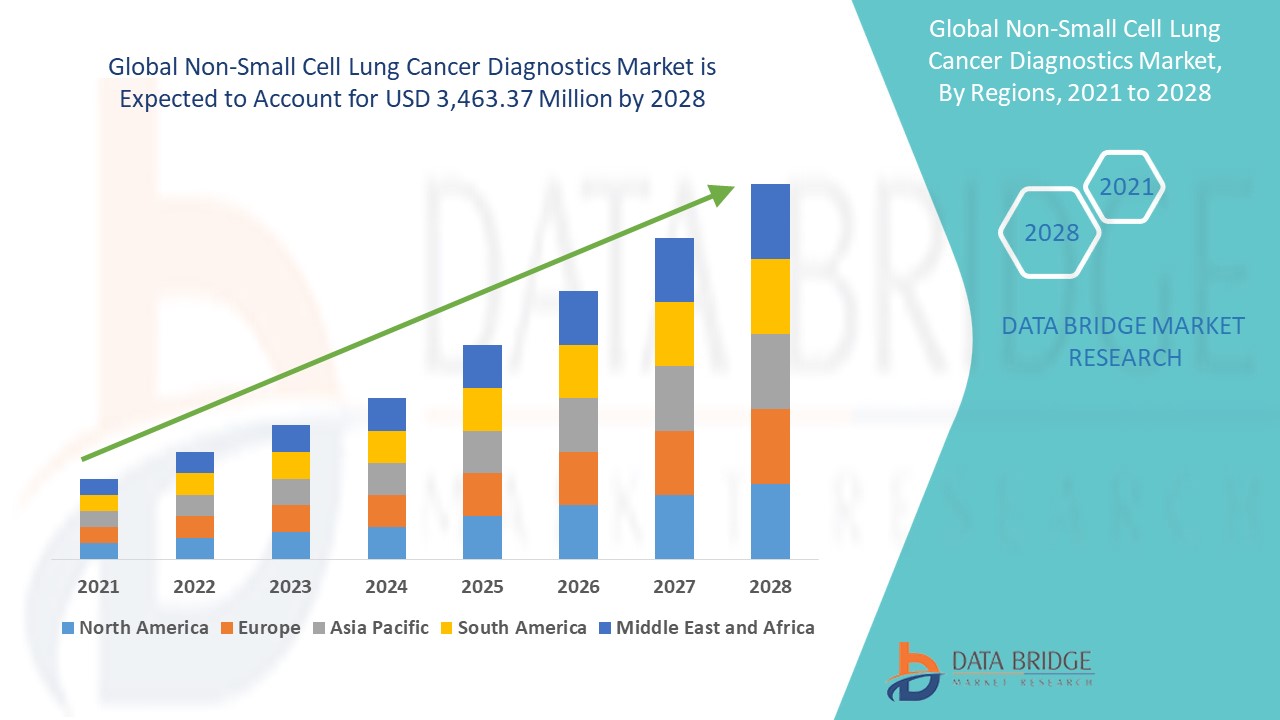
The global non-small cell lung cancer diagnostics market is expected to reach USD 3,463.37 million by 2028 from USD 1,291.66 million in 2020, growing at a steady CAGR of 13.2% in the forecast period of 2021 to 2028.
Non-small cell lung cancer is a disease in which malignant cells or cancer cells are formed in the tissues of the lungs. These are of different types, and each type has different cancer cells that grow and spread in different ways. The non-small cell lung cancer (NSCLC) types are squamous cell carcinoma, large cell carcinoma, and adenocarcinoma. In squamous cell carcinoma, the cancer forms in the thin, flat cells lining inside the lungs and is called epidermoid carcinoma. Large cell carcinoma cancer begins in several types of large cells. The adenocarcinoma type of cancer begins in the cells that line the alveoli and make substances such as mucus. One of the significant risks for non-small cell lung cancer (NSCLC) is that smoking and symptoms include a cough that doesn't go away and shortness of breath. Various tests are used, such as imaging tests, molecular tests, biopsies, and others, to diagnose and examine the cancer stage. Diagnosis is essential to identify the disease in time so that proper treatment could be given to patients.
The factors driving the growth of the non-small cell lung cancer diagnostics market are the usage of artificial intelligence and machine learning to improve the diagnostics procedures coupled with the rise in a number of geriatric population that is more susceptible to non-small cell lung cancer. On the other hand, the high cost of instrumentation and challenges associated with brand equity might hamper the growth of the non-small cell lung cancer diagnostics market.
The rising healthcare expenditure in developing regions will create opportunities for the non-small cell lung cancer diagnostics market. However, the high competition among market players is acting as one of the challenges to the growth non-small cell lung cancer diagnostics market.
The non-small cell lung cancer diagnostics market report provides details of market share, new developments, and product pipeline analysis, the impact of domestic and localized market players, analyses opportunities in terms of emerging revenue pockets, changes in market regulations, product approvals, strategic decisions, product launches, geographic expansions, and technological innovations in the market. To understand the analysis and the non-small cell lung cancer diagnostics market scenario, contact Data Bridge Market Research for an Analyst Brief. Our team will help you create a revenue impact solution to achieve your desired goal.
 Global Non-Small Cell Lung Cancer Diagnostics Market Scope And Market Size
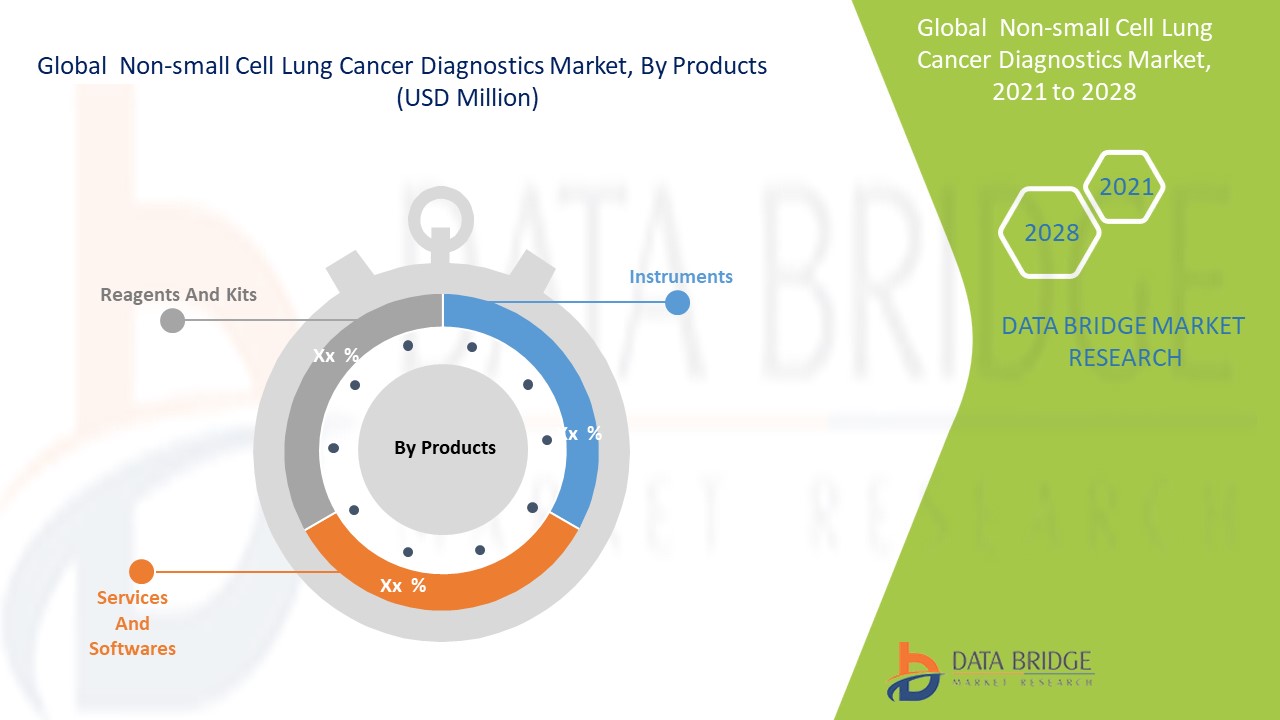
The global non-small cell lung cancer diagnostics market is segmented into four notable segments based on the cancer type, products, test, and end-user. The growth among segments helps you analyze niche pockets of growth and strategies to approach the market and determine your core application areas and the difference in your target markets.
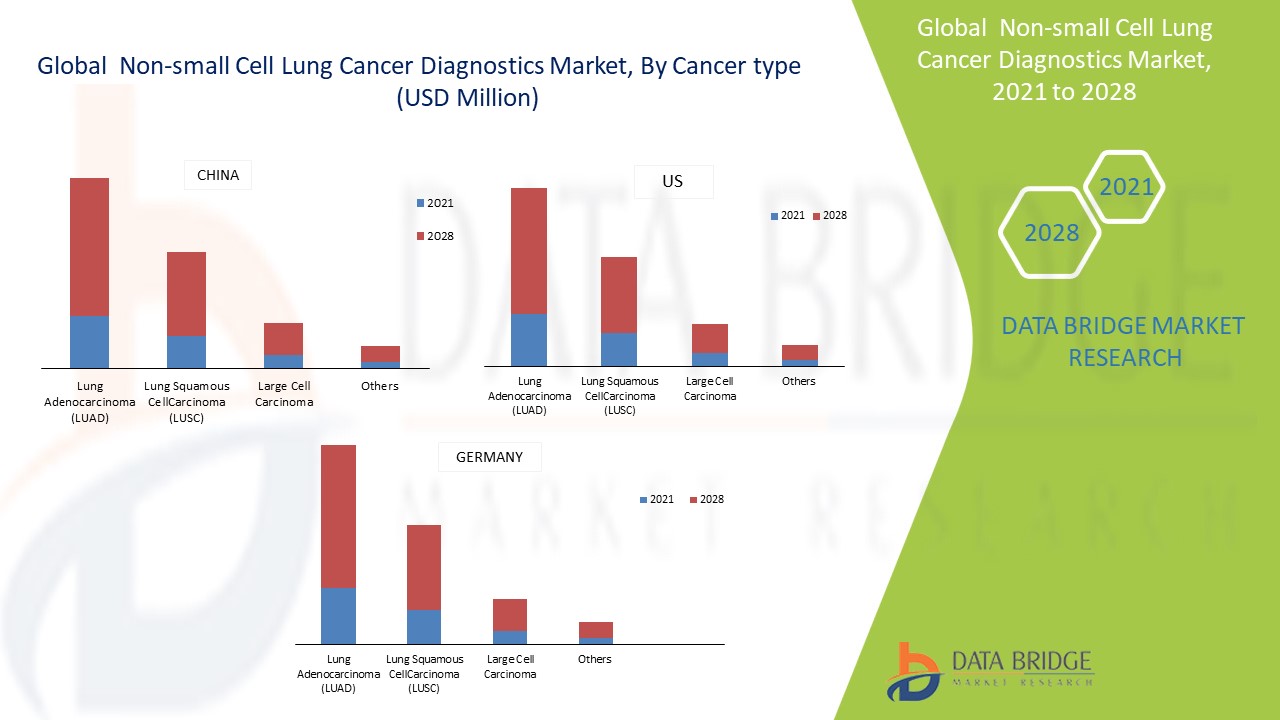
- On the basis of cancer type, the non-small cell lung cancer diagnostics market is segmented into lung adenocarcinoma (LUAD), lung squamous cell carcinoma (LUSC), large cell carcinoma, and others. In 2021, the lung adenocarcinoma (LUAD) segment is expected to dominate the non-small cell lung cancer diagnostics market due to the growing cases of lung adenocarcinoma worldwide.
- On the basis of products, the non-small cell lung cancer diagnostics market is segmented into reagents and kits, instruments and services, and software. In 2021, the instrument segment is expected to dominate the non-small cell lung cancer diagnostics market due to the rise in the usage of different instruments for diagnostic purposes in cancer.
- On the basis of tests, the non-small cell lung cancer diagnostics market is a segmented imaging test, molecular test, biopsy, sputum cytology, thoracentesis, immunohistochemistry, and others. In 2021, the molecular test segment is expected to dominate the non-small cell lung cancer diagnostics market due to the growing molecular test for diagnostic purposes.
- On the basis of end-users, the non-small cell lung cancer diagnostics market is segmented into hospitals, clinical laboratories, academics, and others. In 2021, the clinical laboratories segment is expected to dominate the non-small cell lung cancer diagnostics market due to the growing clinical research in cancer.
 Global Non-Small Cell Lung Cancer Diagnostics Market: Country Level Analysis
The global non-small cell lung cancer diagnostics market is segmented into four notable segments based on the cancer type, products, test, and end-user.
Countries covered in the global Non-small cell lung cancer diagnostics market report are the U.S., Mexico, Canada, France, Russia, Netherlands, U.K., Germany, Italy, Spain, Turkey, Belgium, Switzerland, and the rest of Europe, China, Thailand, Australia, Japan, South Korea, Singapore, Malaysia, Indonesia, Philippines, India, and rest of Asia-Pacific, South Africa Egypt, Saudi Arabia, UAE, Israel, and rest of the Middle East and Africa, Brazil, Argentina Rest of South America.
China, U.S., and Germany are dominating the global non-small cell lung cancer diagnostics market. The U.S. is expected to dominate the non-small cell lung cancer diagnostics market with the highest CAGR and highest market share due to growing cases of cancer. China is expected to dominate the non-small cell lung cancer diagnostics market due to the growing usage of artificial intelligence for diagnostic purposes. Germany is expected to dominate the non-small cell lung cancer diagnostics market due to the growing geriatric population that is more prone to developing lung cancer
The country section of the report also provides individual market impacting factors and changes in regulation in the market domestically that impact the current and future trends of the market. Data points such as new sales, replacement sales, country demographics, regulatory acts, and import-export tariffs are some of the major pointers used to forecast the market scenario for individual countries. Also, the presence and availability of Asia-Pacific brands and their challenges faced due to large or scarce competition from local and domestic brands, the impact of sales channels are considered while providing forecast analysis of the country data.
Rising Demand For Diagnostic In The Medical Setting
The global non-small cell lung cancer diagnostics market also provides you with detailed market analysis for every country's growth in the industry with sales, components sales, the impact of technological development in IORT, and changes in regulatory scenarios with their support for the IORT market. The data is available for the historic period 2010 to 2019.
Competitive Landscape And Global Non-Small Cell Lung Cancer Diagnostics Market Share Analysis
Global non-small cell lung cancer diagnostics market competitive landscape provides details by a competitor. Details included are company overview, company financials, revenue generated, market potential, investment in research and development, new market initiatives, India presence, production sites and facilities, company strengths and weaknesses, product launch, product trials pipelines, product approvals, patents, product width and breadth, application dominance, and technology lifeline curve. The above data points provided are only related to the companies' focus related to the non-small cell lung cancer diagnostics market.
Some of the major players operating in the non-small cell lung cancer diagnostics market are Abbott Laboratories, F. Hoffmann-La Roche Ltd, Agilent Technologies, Inc., QIAGEN, Thermo Fisher Scientific Inc., Quest Diagnostics Incorporated, NeoGenomics Laboratories, Inc., NanoString, Janssen Pharmaceutical NV, Inivata Ltd, bioMérieux SA, Biotheranostics, OncoCyte Corporation Inc., GENERAL ELECTRIC COMPANY, Eckert & Ziegler, Dr. Lal PathLabs, RIVERAIN TECHNOLOGIES, PlexBio Co., Ltd, Oncimmune, Biodesix. among others.
The global non-small cell lung cancer diagnostics market is fragmented, and the major players have used various strategies such as collaborations, recognitions, agreements, and others, to increase their footprints in the non-small cell lung cancer diagnostics market.
For instance,
- In March 2021, Agilent Technologies, Inc. acquired Resolution Bioscience for USD 550 million to strengthen its business in next-generation sequencing (NGS)-based oncology solutions.
- In May 2021, QIAGEN launched FDA approved therascreen KRAS RGQ PCR Kit, which aids in the identification of non-small cell lung cancer (NSCLC) in patients
- In June 2020, F. Hoffmann-La Roche Ltd launched an automated digital pathology algorithm, uPath PD-L1 (SP263) image analysis , to diagnose non-small cell lung cancer (NSCLC) and improve the speed and accuracy of diagnosis treatment
SKU-
Get online access to the report on the World's First Market Intelligence Cloud
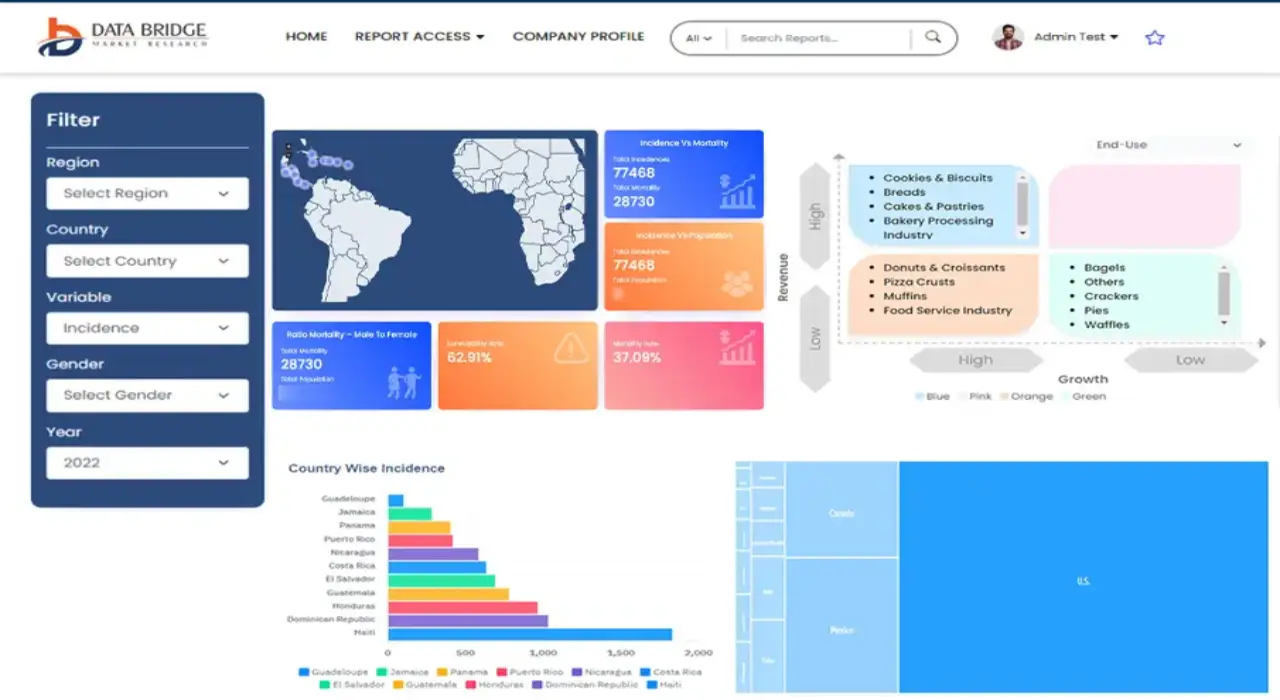
- Interactive Data Analysis Dashboard
- Company Analysis Dashboard for high growth potential opportunities
- Research Analyst Access for customization & queries
- Competitor Analysis with Interactive dashboard
- Latest News, Updates & Trend analysis
- Harness the Power of Benchmark Analysis for Comprehensive Competitor Tracking
研究方法
数据收集和基准年分析是使用具有大样本量的数据收集模块完成的。该阶段包括通过各种来源和策略获取市场信息或相关数据。它包括提前检查和规划从过去获得的所有数据。它同样包括检查不同信息源中出现的信息不一致。使用市场统计和连贯模型分析和估计市场数据。此外,市场份额分析和关键趋势分析是市场报告中的主要成功因素。要了解更多信息,请请求分析师致电或下拉您的询问。
DBMR 研究团队使用的关键研究方法是数据三角测量,其中包括数据挖掘、数据变量对市场影响的分析和主要(行业专家)验证。数据模型包括供应商定位网格、市场时间线分析、市场概览和指南、公司定位网格、专利分析、定价分析、公司市场份额分析、测量标准、全球与区域和供应商份额分析。要了解有关研究方法的更多信息,请向我们的行业专家咨询。
可定制
Data Bridge Market Research 是高级形成性研究领域的领导者。我们为向现有和新客户提供符合其目标的数据和分析而感到自豪。报告可定制,包括目标品牌的价格趋势分析、了解其他国家的市场(索取国家列表)、临床试验结果数据、文献综述、翻新市场和产品基础分析。目标竞争对手的市场分析可以从基于技术的分析到市场组合策略进行分析。我们可以按照您所需的格式和数据样式添加您需要的任意数量的竞争对手数据。我们的分析师团队还可以为您提供原始 Excel 文件数据透视表(事实手册)中的数据,或者可以帮助您根据报告中的数据集创建演示文稿。