


What is the Hemp Beer Market Size and Growth Rate?
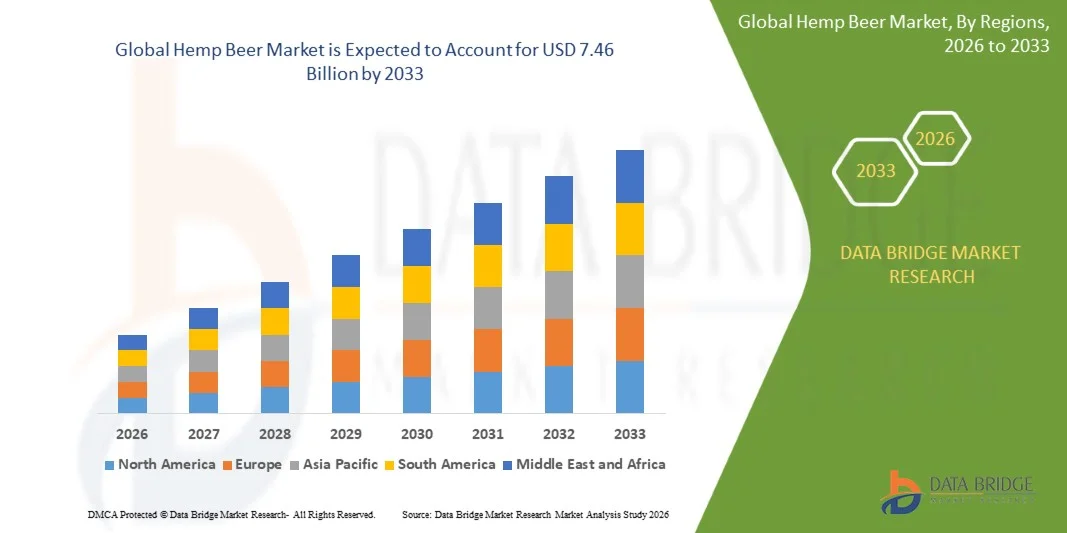
- As per Data Bridge Market Research analysis the hemp beer market was valued at USD 4.44 billion in 2025 and is projected to reach USD 7.46 billion by 2033, growing at a CAGR of 6.70% from 2026 to 2033.
- The market is experiencing steady growth driven by increasing consumer demand for craft and functional alcoholic beverages, rising interest in hemp-infused products, and expanding legalization and acceptance of hemp-derived ingredients across key markets.
- The growing popularity of premium craft beer, combined with increasing consumer preference for natural ingredients and innovative beverage formulations, is encouraging breweries to introduce hemp-based beer products, supporting sustained market expansion.
Market Size & Forecast
- Market Value (2025): USD 4.44 Billion
- Expected Market Value (2033): USD 7.46 Billion
- Forecast CAGR (2026–2033): 6.70%
- Leading Region in 2025: North America
- Fastest Growing Region: Asia-Pacific
What are the Major Takeaways of the Hemp Beer Market?
- North America dominated the hemp beer market with the largest revenue share in 2025, supported by favorable regulations for industrial hemp, a well-established craft brewing industry, and growing consumer demand for innovative alcoholic beverages.
- Asia-Pacific hemp beer market is expected to witness the fastest growth rate from 2026 to 2033, supported by rising disposable incomes, expanding urban populations, and increasing consumer exposure to premium craft beverages.
- The alcoholic segment held the largest market revenue share in 2025 driven by the growing popularity of craft beer, rising consumer acceptance of hemp-infused alcoholic beverages, and increasing product launches by breweries. Alcoholic hemp beer remains the preferred choice due to its established consumer base, wider retail availability, and expanding presence in bars, restaurants, and specialty beverage outlets.
- The non-alcoholic segment is projected to register the fastest growth at a CAGR from 2026 to 2033, driven by increasing consumer demand for alcohol-free functional beverages, growing health awareness, and the rising popularity of premium non-alcoholic craft beer. Expanding product innovation and the growing sober-curious movement are further supporting segment growth.
- The cannabidiol (CBD) segment held the largest market revenue share of in 2025 driven by favorable regulatory acceptance of hemp-derived CBD in several countries, increasing consumer preference for wellness-oriented beverages, and growing demand for non-psychoactive functional ingredients. CBD-based hemp beer is widely adopted due to its perceived relaxation benefits and broader commercial availability.
- The tetrahydrocannabinol (THC) segment is projected to register the fastest growth at a CAGR from 2026 to 2033, driven by expanding legalization of cannabis products in selected markets, increasing investment in cannabis beverage innovation, and rising demand for alternative recreational beverages. Product innovation and evolving regulations are expected to support continued segment expansion.
Report Scope and Hemp Beer Market Segmentation
|
Attributes |
Hemp Beer Key Market Insights |
|
Segments Covered |
|
|
Countries Covered |
North America
Europe
Asia-Pacific
Middle East and Africa
South America
|
|
Key Market Players |
|
|
Market Opportunities |
|
|
Value Added Data Infosets |
In addition to the insights on market scenarios such as market value, growth rate, segmentation, geographical coverage, and major players, the market reports curated by the Data Bridge Market Research also include in-depth expert analysis, pricing analysis, brand share analysis, consumer survey, demography analysis, supply chain analysis, value chain analysis, raw material/consumables overview, vendor selection criteria, PESTLE Analysis, Porter Analysis, and regulatory framework. |
What is the Key Trend in the Hemp Beer Market?
- Craft breweries are increasingly introducing hemp-infused beer varieties to differentiate their product portfolios, attract health-conscious consumers, and capitalize on growing demand for innovative alcoholic beverages made with natural and plant-based ingredients.
- For instance, in October 2024, Lucky Saint announced the launch of Lucky Saint Hazy IPA, brewed with hemp seeds to enhance flavor and texture while expanding its premium alcohol-free craft beer portfolio.
- Hemp seed ingredients are being incorporated into beer formulations to improve nutritional appeal, provide unique flavor profiles, and align with the rising consumer preference for clean-label and functional beverages.
- Racing breweries are also expanding premium and specialty beer offerings through limited-edition and seasonal hemp-based products to strengthen brand differentiation and consumer engagement.
- For instance, in 2024, Brasserie du Mont Blanc continued expanding its Verte au Chanvre (Hemp Beer) across European retail and hospitality channels, highlighting the growing commercialization of hemp-flavored craft beer.
- As consumer demand for premium craft beverages and plant-based ingredients continues to rise, breweries are expected to expand hemp beer innovation, reinforcing hemp-infused beer as a growing niche within the global craft beer industry.
What are the Key Drivers of the Hemp Beer Market?
- The expanding legalization of industrial hemp cultivation and the growing consumer preference for natural, sustainable, and functional beverages are significantly increasing demand for hemp-based alcoholic drinks across North America and Europe.
- For instance, in January 2025, Canopy Growth Corporation announced the continued expansion of its beverage innovation strategy through its cannabis and hemp beverage portfolio, reflecting growing investment in hemp-derived beverage categories as regulatory frameworks evolve.
- Rising consumer interest in premium craft beer, coupled with increasing awareness of hemp seed's nutritional profile, is encouraging breweries to diversify their product offerings with hemp-infused formulations.
- For instance, the Brewers Association continued reporting strong consumer demand for craft and specialty beer innovation during 2024, supporting breweries' investments in differentiated products, including botanical- and hemp-inspired beer styles.
- With improving regulatory acceptance and continuous investment in premium product innovation, hemp beer is expected to witness sustained growth, supported by expanding retail availability and evolving consumer preferences.
Which Factors are Challenging the Growth of the Hemp Beer Market?
- Regulatory uncertainty surrounding hemp-derived ingredients in alcoholic beverages continues to create compliance challenges for breweries operating across different countries and regions.
- Differences in permissible THC limits, labeling requirements, and food safety regulations increase product development complexity and restrict cross-border commercialization.
- For instance, in 2024, the U.S. Alcohol and Tobacco Tax and Trade Bureau (TTB) continued requiring brewers to obtain formula approval for alcoholic beverages containing hemp ingredients, highlighting the regulatory complexity associated with hemp beer commercialization.
- In addition, inconsistent consumer awareness and retailer hesitation regarding hemp-based alcoholic beverages continue to limit market penetration, particularly in regions with evolving regulatory frameworks.
- The fragmented regulatory landscape and compliance costs remain significant barriers for breweries seeking to scale hemp beer production globally, slowing new product launches and limiting broader market expansion despite increasing consumer interest.
How is the Hemp Beer Market Segmented?
The market is segmented on the basis of type, component, and distribution channel.
- By Type
On the basis of type, the hemp beer market is segmented into alcoholic and non-alcoholic. The alcoholic segment held the largest market revenue share in 2025 driven by the growing popularity of craft beer, rising consumer acceptance of hemp-infused alcoholic beverages, and increasing product launches by breweries. Alcoholic hemp beer remains the preferred choice due to its established consumer base, wider retail availability, and expanding presence in bars, restaurants, and specialty beverage outlets.
The non-alcoholic segment is projected to register the fastest growth at a CAGR from 2026 to 2033, driven by increasing consumer demand for alcohol-free functional beverages, growing health awareness, and the rising popularity of premium non-alcoholic craft beer. Expanding product innovation and the growing sober-curious movement are further supporting segment growth.
- By Component
On the basis of component, the hemp beer market is segmented into cannabidiol (CBD) and tetrahydrocannabinol (THC). The cannabidiol (CBD) segment held the largest market revenue share of in 2025 driven by favorable regulatory acceptance of hemp-derived CBD in several countries, increasing consumer preference for wellness-oriented beverages, and growing demand for non-psychoactive functional ingredients. CBD-based hemp beer is widely adopted due to its perceived relaxation benefits and broader commercial availability.
The tetrahydrocannabinol (THC) segment is projected to register the fastest growth at a CAGR from 2026 to 2033, driven by expanding legalization of cannabis products in selected markets, increasing investment in cannabis beverage innovation, and rising demand for alternative recreational beverages. Product innovation and evolving regulations are expected to support continued segment expansion.
- By Distribution Channel
On the basis of distribution channel, the hemp beer market is segmented into direct and indirect. The indirect segment held the largest market revenue share in 2025 driven by the extensive presence of supermarkets, liquor stores, specialty beverage retailers, and online retail platforms. Strong retail distribution networks and greater product accessibility continue to support the dominance of this segment across developed markets.
The direct segment is projected to register the fastest growth at a CAGR from 2026 to 2033, driven by increasing adoption of direct-to-consumer sales models, expanding brewery-owned online stores, and rising consumer demand for exclusive and limited-edition hemp beer products. Growing digital commerce and personalized customer engagement strategies are further accelerating segment growth.
Which Region Holds the Largest Share of the Hemp Beer Market?
- North America dominated the hemp beer market with the largest revenue share in 2025, supported by favorable regulations for industrial hemp, a well-established craft brewing industry, and growing consumer demand for innovative alcoholic beverages.
- Consumers across the region increasingly prefer premium craft beers infused with natural and plant-based ingredients, while breweries continue expanding their portfolios with hemp-based offerings. Strong retail distribution networks, rising disposable incomes, and increasing acceptance of hemp-derived ingredients further strengthen the region's market leadership.
U.S. Hemp Beer Market Insight
The U.S. hemp beer market captured the largest revenue share in 2025 within North America, fueled by the expanding craft beer industry and growing consumer interest in functional and botanical-infused beverages. Breweries are increasingly introducing hemp-infused beer varieties to meet changing consumer preferences for premium and differentiated products. In addition, the country's advanced brewing infrastructure, expanding e-commerce sales, and favorable industrial hemp regulations continue to support market growth.
Europe Hemp Beer Market Insight
Europe hemp beer market is expected to witness the fastest growth rate from 2026 to 2033, primarily driven by increasing demand for organic and sustainable beverages, growing popularity of craft beer, and rising consumer awareness regarding hemp-derived ingredients. The region's well-developed brewing industry and favorable regulatory environment for industrial hemp cultivation are encouraging product innovation. Increasing demand for premium beverages and expanding specialty retail channels are further supporting market expansion.
U.K. Hemp Beer Market Insight
The U.K. hemp beer market is expected to witness the fastest growth rate from 2026 to 2033, driven by rising consumer demand for craft beer, increasing preference for clean-label alcoholic beverages, and continuous product innovation by independent breweries. Growing interest in sustainable brewing practices and botanical ingredients is encouraging breweries to introduce hemp-based beer variants. The country's strong retail and hospitality sectors are also contributing to market growth.
Germany Hemp Beer Market Insight
Germany hemp beer market is expected to witness the fastest growth rate from 2026 to 2033, fueled by the country's strong brewing heritage, growing demand for specialty beers, and increasing consumer preference for natural beverage ingredients. Germany's advanced brewing technologies and emphasis on premium-quality beer production continue to encourage innovation in hemp-infused beer products. Rising demand for organic beverages is further supporting market expansion.
Asia-Pacific Hemp Beer Market Insight
The Asia-Pacific hemp beer market is expected to witness the fastest growth rate from 2026 to 2033, supported by rising disposable incomes, expanding urban populations, and increasing consumer exposure to premium craft beverages. Growing awareness of hemp-derived ingredients, improving regulatory frameworks in selected countries, and rapid expansion of the food and beverage industry are driving demand. Increasing investments in craft brewing and premium alcoholic beverages are expected to further accelerate market growth across the region.
Japan Hemp Beer Market Insight
Japan hemp beer market is expected to witness the fastest growth rate from 2026 to 2033 due to the country's growing premium beverage culture, rising demand for innovative craft beers, and increasing consumer preference for unique flavor profiles. Japanese consumers are showing greater interest in high-quality specialty beverages, encouraging breweries to introduce hemp-infused beer products. Continuous innovation in premium brewing techniques is expected to further support market growth.
China Hemp Beer Market Insight
The China hemp beer market accounted for the largest market revenue share in Asia-Pacific in 2025, attributed to the country's expanding middle-class population, increasing consumption of premium alcoholic beverages, and rapidly growing craft beer industry. Rising urbanization, expanding modern retail infrastructure, and growing consumer interest in innovative beverage products are supporting the adoption of hemp beer. The presence of large-scale beverage manufacturers and increasing investment in premium beer production continue to drive market growth in China.
Which are the Top Companies in Hemp Beer Market?
The hemp beer industry is primarily led by well-established companies, including:
- Canopy Growth Corporation (Canada)
- Heineken N.V. (Netherlands)
- Tilray Brands, Inc. (Canada)
- CERIA Brewing Company (U.S.)
- Two Roots Brewing Co. (U.S.)
- Keef Brands (U.S.)
- BevCanna Enterprises Inc. (Canada)
- Sprig Products LLC (U.S.)
- Coalition Brewing Co. Ltd. (U.K.)
- dupetit Natural Products GmbH (Germany)
- Anheuser-Busch Companies LLC (Belgium)
- Green Times Brewing (U.K.)
- New Belgium Brewing Company, Inc. (U.S.)
- Headflyer Brewing (U.S.)
- Bell's Brewery, Inc. (U.S.)

- Interactive Data Analysis Dashboard
- Company Analysis Dashboard for high growth potential opportunities
- Research Analyst Access for customization & queries
- Competitor Analysis with Interactive dashboard
- Latest News, Updates & Trend analysis
- Harness the Power of Benchmark Analysis for Comprehensive Competitor Tracking
Global Hemp Beer Market, Supply Chain Analysis and Ecosystem Framework
To support market growth and help clients navigate the impact of geopolitical shifts, DBMR has integrated in-depth supply chain analysis into its Global Hemp Beer Market research reports. This addition empowers clients to respond effectively to global changes affecting their industries. The supply chain analysis section includes detailed insights such as Global Hemp Beer Market consumption and production by country, price trend analysis, the impact of tariffs and geopolitical developments, and import and export trends by country and HSN code. It also highlights major suppliers with data on production capacity and company profiles, as well as key importers and exporters. In addition to research, DBMR offers specialized supply chain consulting services backed by over a decade of experience, providing solutions like supplier discovery, supplier risk assessment, price trend analysis, impact evaluation of inflation and trade route changes, and comprehensive market trend analysis.
Data collection and base year analysis are done using data collection modules with large sample sizes. The stage includes obtaining market information or related data through various sources and strategies. It includes examining and planning all the data acquired from the past in advance. It likewise envelops the examination of information inconsistencies seen across different information sources. The market data is analysed and estimated using market statistical and coherent models. Also, market share analysis and key trend analysis are the major success factors in the market report. To know more, please request an analyst call or drop down your inquiry.
The key research methodology used by DBMR research team is data triangulation which involves data mining, analysis of the impact of data variables on the market and primary (industry expert) validation. Data models include Vendor Positioning Grid, Market Time Line Analysis, Market Overview and Guide, Company Positioning Grid, Patent Analysis, Pricing Analysis, Company Market Share Analysis, Standards of Measurement, Global versus Regional and Vendor Share Analysis. To know more about the research methodology, drop in an inquiry to speak to our industry experts.
Data Bridge Market Research is a leader in advanced formative research. We take pride in servicing our existing and new customers with data and analysis that match and suits their goal. The report can be customized to include price trend analysis of target brands understanding the market for additional countries (ask for the list of countries), clinical trial results data, literature review, refurbished market and product base analysis. Market analysis of target competitors can be analyzed from technology-based analysis to market portfolio strategies. We can add as many competitors that you require data about in the format and data style you are looking for. Our team of analysts can also provide you data in crude raw excel files pivot tables (Fact book) or can assist you in creating presentations from the data sets available in the report.













