


North America Skin Packaging for Fresh Meat Market
Market Size in USD Billion
CAGR :
% 
 USD
170.41 Million
USD
251.78 Million
2025
2033
USD
170.41 Million
USD
251.78 Million
2025
2033
 予測期間 予測期間 |
2026 –2033 |
 市場規模(基準年) 市場規模(基準年) |
USD 170.41 Million |
 Market Size (Forecast Year) Market Size (Forecast Year) |
USD 251.78 Million |
 CAGR CAGR |
% |
| Major Markets Players |
|
North America Skin Packaging for Fresh Meat Market Segmentation, By Type (Carded Thermoformable Skin Packaging and Non-carded Thermoformable Skin Packaging), Material (Plastic, Paper and Paperboard, and Others), Heat Seal Coating (Water-Based, Solvent-Based, and Others), Air-Fill (Vacuum Fill and Non-Vacuum Fill), Function (Preserve & Protect, Fit For Purpose, Regulatory Labelling, Presentation, and Others), Nature (Microwavable and Non-Microwavable), End Use (Meat, Poultry, and Seafood)- Industry Trends and Forecast to 2033
North America Skin Packaging for Fresh Meat Market Size
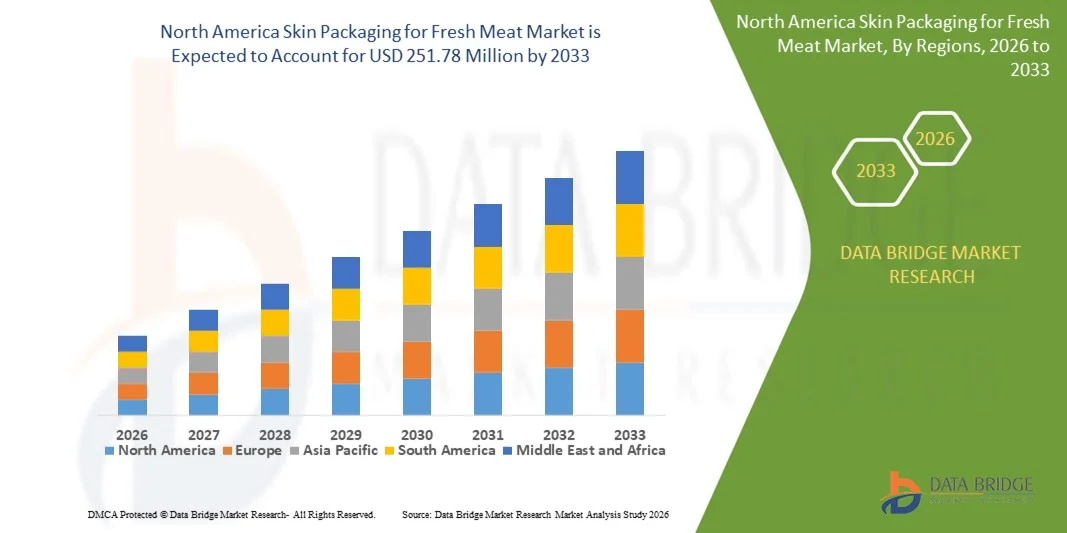
- The North America skin packaging for fresh meat market size was valued at USD 170.41 million in 2025 and is expected to reach USD 251.78 million by 2033, at a CAGR of 5.00% during the forecast period
- The market growth is largely fuelled by rising demand for extended shelf life and improved product visibility in fresh meat packaging, as skin packaging helps preserve freshness while enhancing on-shelf appeal
- Increasing consumption of fresh and premium meat products, along with growing preference for leak-proof and vacuum-sealed packaging formats, is supporting steady market expansion
North America Skin Packaging for Fresh Meat Market Analysis
- The market is witnessing consistent growth due to the ability of skin packaging to tightly conform to meat products, reducing oxygen exposure and maintaining product quality over longer periods
- Skin packaging is increasingly preferred over conventional packaging formats as it enhances hygiene, minimizes drip loss, and improves consumer confidence in product safety and freshness
- U.S. skin packaging for fresh meat market dominated in 2025, driven by high consumption of fresh beef, poultry, and pork, along with widespread adoption of advanced packaging technologies. Meat processors and retailers increasingly prefer skin packaging to extend shelf life, enhance product visibility, and meet strict food safety regulations
- Canada is expected to witness the highest compound annual growth rate (CAGR) in the North America skin packaging for fresh meat market due to increasing demand for fresh and premium meat products, expansion of organized retail, and rising focus on shelf-life extension and sustainable packaging solutions
- The non-carded thermoformable skin packaging segment held the largest market revenue share in 2025 driven by its extensive use in fresh meat packaging, cost efficiency, and strong compatibility with automated packaging lines. This type enables tight film adhesion around meat cuts, improving freshness retention and reducing purge. It is widely adopted by large meat processors and retailers due to its scalability and consistent sealing performance. In addition, non-carded formats support high-volume production while maintaining product visibility and hygiene
Report Scope and North America Skin Packaging for Fresh Meat Market Segmentation
|
Attributes |
North America Skin Packaging for Fresh Meat Key Market Insights |
|
Segments Covered |
|
|
Countries Covered |
North America
|
|
Key Market Players |
|
|
Market Opportunities |
|
|
Value Added Data Infosets |
In addition to the insights on market scenarios such as market value, growth rate, segmentation, geographical coverage, and major players, the market reports curated by the Data Bridge Market Research also include in-depth expert analysis, pricing analysis, brand share analysis, consumer survey, demography analysis, supply chain analysis, value chain analysis, raw material/consumables overview, vendor selection criteria, PESTLE Analysis, Porter Analysis, and regulatory framework. |
North America Skin Packaging for Fresh Meat Market Trends
Rising Demand for Extended Shelf Life and Premium Product Presentation
- The increasing focus on maintaining freshness and visual appeal of fresh meat products is significantly shaping the skin packaging for fresh meat market, as retailers and consumers prefer packaging solutions that preserve quality while enhancing product appearance. Skin packaging is gaining strong adoption due to its ability to tightly seal meat products, reduce oxygen exposure, and extend shelf life without the use of preservatives. This trend is strengthening its use across retail and foodservice channels, encouraging packaging manufacturers to develop advanced films and sealing technologies
- Growing consumption of fresh, chilled, and premium meat products is accelerating the demand for skin packaging in supermarkets and specialty meat stores. Consumers are increasingly drawn to leak-proof, vacuum-sealed packs that offer clear visibility of meat cuts while ensuring hygiene and safety. This has prompted meat processors to adopt skin packaging to meet evolving consumer expectations and reduce spoilage-related losses
- Premiumization trends in the meat industry are influencing purchasing decisions, with brands emphasizing quality, freshness, and aesthetic appeal. Skin packaging supports these objectives by improving on-shelf differentiation and enabling branding opportunities through clear films and attractive tray designs. These factors are helping manufacturers strengthen brand positioning, increase consumer trust, and improve repeat purchase rates in competitive retail environments
- For instance, in 2024, major meat processors and retail chains in developed markets expanded the use of skin packaging for fresh beef, poultry, and pork products to improve shelf presentation and reduce food waste. These packaging upgrades were introduced in response to rising demand for premium fresh meat, with products distributed through large-format retailers and specialty outlets. The enhanced packaging also supported sustainability messaging by lowering product spoilage and return rates
- While adoption of skin packaging for fresh meat continues to rise, sustained market growth depends on cost optimization, material innovation, and compatibility with existing processing lines. Packaging manufacturers are focusing on developing recyclable and thinner films, improving sealing efficiency, and ensuring performance consistency to support wider adoption across small and large meat processors
North America Skin Packaging for Fresh Meat Market Dynamics
Driver
Growing Demand for Freshness Preservation and Leak-Proof Packaging
- Rising demand for packaging solutions that extend shelf life and maintain meat quality is a major driver for the skin packaging for fresh meat market. Skin packaging minimizes air contact and securely holds products in place, reducing microbial growth and drip loss. This helps meat processors and retailers meet food safety standards while improving product durability during storage and transportation
- Expanding retail distribution of fresh meat through supermarkets and hypermarkets is supporting market growth, as these channels require packaging formats that enhance product visibility and reduce handling losses. Skin packaging allows retailers to display fresh meat for longer periods without compromising appearance, supporting efficient inventory management and reduced waste
- Meat processors and packaging companies are actively promoting skin-packaged fresh meat through product innovation, improved tray designs, and compatibility with automated packing lines. These efforts are supported by retailer demand for high-performance packaging and increasing consumer preference for hygienic, tamper-resistant formats, encouraging collaboration between packaging suppliers and meat processors
- For instance, in 2023, leading packaging solution providers partnered with fresh meat processors to introduce high-barrier skin packaging films for beef and poultry products. These solutions helped improve shelf life and visual appeal, resulting in higher sales conversion and reduced product returns for retailers. Sustainability benefits such as lower food waste were also highlighted to strengthen adoption
- Although strong demand for freshness-preserving packaging supports market growth, continued expansion depends on balancing performance with cost efficiency. Investments in advanced materials, scalable production, and integration with high-speed packaging equipment will be essential to maintain competitiveness and meet rising global demand
Restraint/Challenge
Higher Packaging Costs And Material Sustainability Concerns
- The relatively higher cost of skin packaging systems and specialized films compared to conventional tray and overwrap packaging remains a key challenge for market growth. Advanced materials, vacuum equipment, and sealing technologies contribute to increased upfront and operational costs, which can limit adoption among small and mid-sized meat processors
- Sustainability concerns related to plastic usage and recyclability also pose challenges, as skin packaging often relies on multi-layer films that are difficult to recycle. Increasing regulatory scrutiny and consumer pressure for eco-friendly packaging solutions are pushing manufacturers to rethink material choices, adding complexity to product development
- Operational and technical challenges further impact adoption, as skin packaging requires precise temperature control, film compatibility, and skilled handling to ensure consistent sealing and product quality. Any deviation can result in seal failure, reduced shelf life, or product rejection, increasing operational risk for processors
- For instance, in 2024, several small-scale meat processors reported slower adoption of skin packaging due to high equipment costs and limited access to recyclable film options. Concerns around compliance with emerging sustainability regulations and the need for technical expertise also affected investment decisions, particularly among cost-sensitive operators
- Addressing these challenges will require innovation in recyclable and mono-material films, cost-effective machinery, and technical support for processors. Collaboration between packaging manufacturers, meat processors, and material suppliers will be critical to reduce costs, improve sustainability, and unlock the long-term growth potential of the skin packaging for fresh meat market
North America Skin Packaging for Fresh Meat Market Scope
The market is segmented on the basis of type, material, heat seal coating, air-fill, function, nature, and end use.
- By Type
On the basis of type, the North America skin packaging for fresh meat market is segmented into Carded Thermoformable Skin Packaging and Non-carded Thermoformable Skin Packaging. The non-carded thermoformable skin packaging segment held the largest market revenue share in 2025 driven by its extensive use in fresh meat packaging, cost efficiency, and strong compatibility with automated packaging lines. This type enables tight film adhesion around meat cuts, improving freshness retention and reducing purge. It is widely adopted by large meat processors and retailers due to its scalability and consistent sealing performance. In addition, non-carded formats support high-volume production while maintaining product visibility and hygiene.
The carded thermoformable skin packaging segment is expected to witness steady growth from 2026 to 2033 supported by rising demand for premium and branded fresh meat products. This format offers enhanced presentation and additional space for branding and regulatory information. It is increasingly used in specialty retail and value-added meat offerings where visual differentiation is important. Growing focus on premiumization and product storytelling is further supporting adoption of carded formats.
- By Material
On the basis of material, the North America skin packaging for fresh meat market is segmented into Plastic, Paper and Paperboard, and Others. The plastic segment accounted for the largest share in 2025 owing to its excellent barrier properties, flexibility, and durability. Plastic materials provide strong oxygen and moisture barriers, which are critical for extending shelf life of fresh meat products. Their transparency also enhances product visibility, supporting consumer purchasing decisions. In addition, plastic materials are compatible with vacuum skin packaging systems and high-speed processing lines.
The paper and paperboard segment is expected to witness the fastest growth from 2026 to 2033 driven by increasing emphasis on sustainable and recyclable packaging solutions. Manufacturers are developing paper-based trays with barrier coatings to reduce plastic usage while maintaining functional performance. Rising regulatory pressure and consumer preference for eco-friendly packaging are further encouraging innovation in this segment. These materials are gaining traction particularly in premium and sustainability-focused retail channels.
- By Heat Seal Coating
On the basis of heat seal coating, the North America skin packaging for fresh meat market is segmented into Water-Based, Solvent-Based, and Others. The water-based heat seal coating segment dominated the market in 2025 due to its low environmental impact and suitability for food-contact applications. These coatings offer effective sealing performance while supporting sustainability goals and regulatory compliance. They are widely preferred by packaging manufacturers aiming to reduce VOC emissions. In addition, water-based coatings provide good adhesion across various packaging substrates.
The solvent-based segment is expected to witness the fastest growth from 2026 to 2033 supported by its strong bonding strength and performance in high-barrier applications. However, its adoption is increasingly influenced by environmental regulations and sustainability concerns. Manufacturers are selectively using solvent-based coatings in applications where higher sealing strength is required. Ongoing innovation is focused on reducing environmental impact while maintaining performance.
- By Air-Fill
On the basis of air-fill, the North America skin packaging for fresh meat market is segmented into Vacuum Fill and Non-Vacuum Fill. The vacuum fill segment held the largest market share in 2025 driven by its effectiveness in removing oxygen and extending shelf life of fresh meat products. Vacuum skin packaging helps inhibit microbial growth and reduce drip loss, improving overall product quality. This format is widely used in retail and foodservice channels to ensure freshness during distribution and storage. It also supports reduced food waste and improved inventory management.
The non-vacuum fill segment is expected to witness the fastest growth from 2026 to 2033, particularly in applications with shorter shelf life requirements. This segment benefits from lower packaging and equipment costs, making it suitable for smaller processors. It is commonly used in local and regional distribution channels where rapid product turnover is expected. Ease of processing and cost efficiency continue to support its adoption.
- By Function
On the basis of function, the North America skin packaging for fresh meat market is segmented into Preserve & Protect, Fit For Purpose, Regulatory Labelling, Presentation, and Others. The preserve & protect segment accounted for the largest share in 2025 as maintaining freshness and safety is the primary objective in fresh meat packaging. Skin packaging provides strong protection against contamination, physical damage, and moisture loss. This function is critical for meeting food safety standards and extending product shelf life. It also supports efficient cold chain management.
The presentation segment is expected to witness the fastest growth from 2026 to 2033 driven by increasing emphasis on visual appeal and premium positioning. Skin packaging enhances product aesthetics by clearly displaying meat cuts and reducing package clutter. This function supports brand differentiation and improves on-shelf visibility in competitive retail environments. Growing consumer preference for visually appealing fresh meat products is further driving this segment.
- By Nature
On the basis of nature, the North America skin packaging for fresh meat market is segmented into Microwavable and Non-Microwavable. The non-microwavable segment dominated the market in 2025 as most fresh meat products are intended for cooking after removal from packaging. This segment benefits from simpler material structures and lower production costs. It is widely adopted across traditional fresh meat retail formats. Strong demand for raw and minimally processed meat products continues to support this segment.
The microwavable segment is expected to witness the fastest growth from 2026 to 2033 supported by rising demand for convenience-oriented and ready-to-cook meat products. Urbanization and changing lifestyles are encouraging adoption of packaging that supports quick meal preparation. Packaging manufacturers are developing heat-resistant materials compatible with microwave heating. This segment is gaining traction particularly among younger consumers and working households.
- By End Use
On the basis of end use, the North America skin packaging for fresh meat market is segmented into Meat, Poultry, and Seafood. The meat segment held the largest revenue share in 2025 driven by high global consumption of beef, pork, and lamb. Skin packaging is extensively used to enhance freshness, reduce spoilage, and improve presentation of red meat products. The segment benefits from strong retail demand and established cold chain infrastructure. Premium meat offerings further support adoption of advanced skin packaging solutions.
The poultry segment is expected to witness the fastest growth from 2026 to 2033 supported by rising consumption of chicken and turkey. Poultry products have shorter shelf life, increasing the need for effective packaging solutions such as vacuum skin packaging. Growing demand for hygienic and leak-proof packaging is driving adoption in this segment. Expansion of organized retail and foodservice channels is further supporting market growth.
North America Skin Packaging for Fresh Meat Market Regional Analysis
- U.S. skin packaging for fresh meat market dominated in 2025, driven by high consumption of fresh beef, poultry, and pork, along with widespread adoption of advanced packaging technologies. Meat processors and retailers increasingly prefer skin packaging to extend shelf life, enhance product visibility, and meet strict food safety regulations
- Strong presence of organized retail, well-developed cold chain infrastructure, and advanced meat processing facilities further support market leadership
- In addition, rising consumer preference for premium, leak-proof, and hygienically packaged fresh meat continues to reinforce dominance
Canada Skin Packaging for Fresh Meat Market Insight
The Canada skin packaging for fresh meat market is expected to witness the fastest growth from 2026 to 2033, supported by rising demand for fresh and chilled meat products and expansion of modern retail formats. Increasing focus on food safety, shelf-life extension, and reduction of food waste is driving adoption of skin packaging solutions. Retailers are emphasizing premium presentation and sustainable packaging practices, further boosting demand. Investments in advanced meat processing and packaging infrastructure are also contributing to strong market growth.
North America Skin Packaging for Fresh Meat Market Share
The North America skin packaging for fresh meat industry is primarily led by well-established companies, including:
- Sealed Air Corporation (U.S.)
- Berry Global Group (U.S.)
- Amcor (U.S.)
- Winpak Ltd. (Canada)
- Dow Inc. (U.S.)
- Sonoco Products Company (U.S.)
- Graphic Packaging International (U.S.)
- Bemis Company (U.S.)
- ProAmpac (U.S.)
- Reynolds Consumer Products (U.S.)
- Coveris Holdings (U.S.)
- Anchor Packaging (U.S.)
- Pactiv Evergreen (U.S.)
- Clysar LLC (U.S.)
- Printpack Inc. (U.S.)
SKU-
世界初のマーケットインテリジェンスクラウドに関するレポートにオンラインでアクセスする
- インタラクティブなデータ分析ダッシュボード
- 成長の可能性が高い機会のための企業分析ダッシュボード
- カスタマイズとクエリのためのリサーチアナリストアクセス
- インタラクティブなダッシュボードによる競合分析
- 最新ニュース、更新情報、トレンド分析
- 包括的な競合追跡のためのベンチマーク分析のパワーを活用
調査方法
データ収集と基準年分析は、大規模なサンプル サイズのデータ収集モジュールを使用して行われます。この段階では、さまざまなソースと戦略を通じて市場情報または関連データを取得します。過去に取得したすべてのデータを事前に調査および計画することも含まれます。また、さまざまな情報ソース間で見られる情報の不一致の調査も含まれます。市場データは、市場統計モデルと一貫性モデルを使用して分析および推定されます。また、市場シェア分析と主要トレンド分析は、市場レポートの主要な成功要因です。詳細については、アナリストへの電話をリクエストするか、お問い合わせをドロップダウンしてください。
DBMR 調査チームが使用する主要な調査方法は、データ マイニング、データ変数が市場に与える影響の分析、および一次 (業界の専門家) 検証を含むデータ三角測量です。データ モデルには、ベンダー ポジショニング グリッド、市場タイムライン分析、市場概要とガイド、企業ポジショニング グリッド、特許分析、価格分析、企業市場シェア分析、測定基準、グローバルと地域、ベンダー シェア分析が含まれます。調査方法について詳しくは、お問い合わせフォームから当社の業界専門家にご相談ください。
カスタマイズ可能
Data Bridge Market Research は、高度な形成的調査のリーダーです。当社は、既存および新規のお客様に、お客様の目標に合致し、それに適したデータと分析を提供することに誇りを持っています。レポートは、対象ブランドの価格動向分析、追加国の市場理解 (国のリストをお問い合わせください)、臨床試験結果データ、文献レビュー、リファービッシュ市場および製品ベース分析を含めるようにカスタマイズできます。対象競合他社の市場分析は、技術ベースの分析から市場ポートフォリオ戦略まで分析できます。必要な競合他社のデータを、必要な形式とデータ スタイルでいくつでも追加できます。当社のアナリスト チームは、粗い生の Excel ファイル ピボット テーブル (ファクト ブック) でデータを提供したり、レポートで利用可能なデータ セットからプレゼンテーションを作成するお手伝いをしたりすることもできます。