


Middle East And Africa Protective Gloves Market
Taille du marché en milliards USD
TCAC :
% 
 USD
1.27 Billion
USD
2.10 Billion
2025
2033
USD
1.27 Billion
USD
2.10 Billion
2025
2033
 Période de prévision Période de prévision |
2026 –2033 |
 Taille du marché (année de référence) Taille du marché (année de référence) |
USD 1.27 Billion |
 Taille du marché (année de prévision) Taille du marché (année de prévision) |
USD 2.10 Billion |
 TCAC TCAC |
% |
| Principaux acteurs du marché |
|
Middle East and Africa Protective Gloves Market Segmentation, By Product (Nitrile Gloves, Latex Gloves, Vinyl Gloves, Puncture Resistant Gloves, Polyethylene Gloves, Cotton Fabric Gloves, Butyl Gloves, Aluminized Gloves, Neoprene Gloves, Kevlar Gloves, Leather Gloves and Others), Type (Disposable and Reusable), Application (Biological, Chemical, Mechanical, Thermal, Anti-Static, and Others), Distribution Channel (Retail, and Direct Sales/B2B), End User (Healthcare, Food and Beverages, Oil & Gas, Transportation, Fire Protection, Construction, Manufacturing, Sports, Military, Mining, and Others) - Industry Trends and Forecast to 2033
Middle East and Africa Protective Gloves Market Size
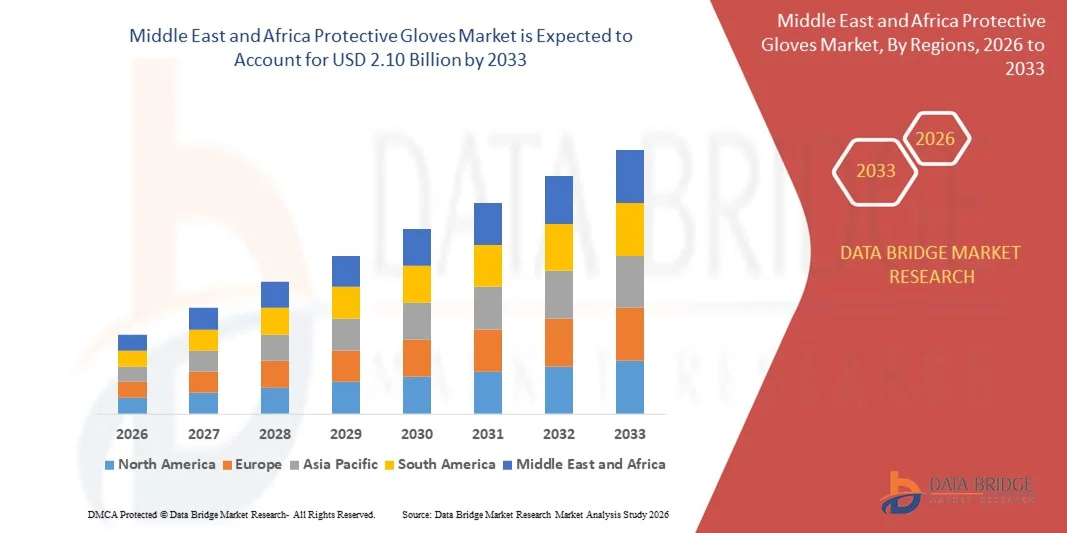
- The Middle East and Africa protective gloves market size was valued at USD 1.27 billion in 2025 and is expected to reach USD 2.10 billion by 2033, at a CAGR of 6.40% during the forecast period
- The market growth is largely fuelled by stringent workplace safety regulations across industrial, healthcare, and chemical sectors, coupled with rising employer focus on worker protection and compliance
- Increasing healthcare expenditure and the sustained use of protective gloves in hospitals, clinics, and laboratories for infection prevention are further supporting market expansion
Middle East and Africa Protective Gloves Market Analysis
- The market is characterised by consistent demand driven by regulatory mandates, high safety standards, and strong end-user awareness regarding hand protection in hazardous working environments
- Technological advancements in glove materials, such as enhanced durability, comfort, and chemical resistance, are improving product performance and encouraging replacement demand
- U.A.E. dominated the protective gloves market in the Middle East, driven by strong construction activity and expanding oil & gas operations. Large-scale infrastructure projects continue to generate consistent demand for industrial safety equipment. Strict workplace safety regulations and compliance requirements support high glove adoption.
- Saudi Arabia is expected to witness the highest compound annual growth rate (CAGR) in the Middle East and Africa protective gloves market due to rapid industrial expansion under Vision 2030 initiatives. Growth in construction, manufacturing, and energy sectors, rising investments in healthcare infrastructure, and increased enforcement of occupational safety regulations are driving accelerated market adoption
- The nitrile gloves segment held the largest market revenue share in 2025 driven by their superior chemical resistance, durability, and latex-free properties, making them widely preferred across healthcare, manufacturing, and chemical handling applications. Nitrile gloves are commonly adopted due to their balance of protection, comfort, and regulatory acceptance
Report Scope and Middle East and Africa Protective Gloves Market Segmentation
|
Attributes |
Middle East and Africa Protective Gloves Key Market Insights |
|
Segments Covered |
|
|
Countries Covered |
Middle East and Africa
|
|
Key Market Players |
|
|
Market Opportunities |
|
|
Value Added Data Infosets |
In addition to the insights on market scenarios such as market value, growth rate, segmentation, geographical coverage, and major players, the market reports curated by the Data Bridge Market Research also include import export analysis, production capacity overview, production consumption analysis, price trend analysis, climate change scenario, supply chain analysis, value chain analysis, raw material/consumables overview, vendor selection criteria, PESTLE Analysis, Porter Analysis, and regulatory framework. |
Middle East and Africa Protective Gloves Market Trends
Rising Focus on Workplace Safety and Hygiene Standards
- The increasing emphasis on worker safety and hygiene across industries is significantly shaping the protective gloves market, as employers prioritize compliance with occupational safety standards and risk mitigation. Protective gloves are gaining widespread adoption due to their ability to reduce exposure to chemicals, biological agents, cuts, and abrasions, while supporting safe working environments. This trend is strengthening demand across healthcare, manufacturing, food processing, construction, and chemical industries, encouraging manufacturers to innovate with improved materials and ergonomic designs
- Growing awareness regarding infection prevention, cross-contamination control, and personal protection has accelerated the use of disposable and reusable protective gloves in healthcare, food handling, and laboratory applications. End users are increasingly seeking gloves that offer enhanced barrier protection, comfort, and durability, prompting manufacturers to focus on material innovation such as nitrile, latex alternatives, and biodegradable options
- Safety regulations and corporate compliance policies are influencing purchasing decisions, with organizations emphasizing certified products, consistent quality, and reliable supply. These factors are helping suppliers strengthen long-term contracts and brand trust, while also driving the adoption of standards-based testing and quality assurance practices. Companies are increasingly highlighting compliance credentials and performance attributes in marketing strategies to differentiate offerings
- For instance, major manufacturers expanded their protective glove portfolios by introducing powder-free, allergy-safe, and high-dexterity variants designed for medical, industrial, and food contact applications. These launches were aimed at addressing rising demand for safer and more hygienic protective equipment, with strong uptake across institutional and commercial procurement channels
- While demand for protective gloves continues to rise, sustained market growth depends on continuous material innovation, cost control, and maintaining consistent performance under diverse working conditions. Manufacturers are also focusing on automation, supply chain resilience, and product customization to meet evolving safety requirements and volume demand
Middle East and Africa Protective Gloves Market Dynamics
Driver
Growing Emphasis on Occupational Safety and Regulatory Compliance
- Increasing enforcement of workplace safety regulations and standards is a key driver for the protective gloves market. Employers are mandating the use of protective gloves to reduce injury risks, prevent contamination, and ensure compliance with health and safety guidelines. This is encouraging manufacturers to develop gloves that meet specific industry certifications and performance benchmarks
- Expanding applications across healthcare, industrial manufacturing, construction, food processing, and chemical handling are supporting market growth. Protective gloves help enhance worker safety, hygiene, and operational efficiency, enabling organizations to minimize downtime and liability while maintaining productivity. The growing complexity of industrial processes further reinforces the need for specialized protective gloves
- Employers and institutional buyers are actively investing in protective glove solutions through bulk procurement, long-term supply agreements, and safety training initiatives. These efforts are supported by rising awareness of employee well-being and risk management, and they also encourage collaboration between glove manufacturers, distributors, and safety solution providers to improve product performance and user compliance
- For instance, leading end-use industries increased adoption of cut-resistant, chemical-resistant, and disposable protective gloves to address evolving safety needs and stricter compliance requirements. These initiatives supported product differentiation, improved safety outcomes, and reinforced the importance of personal protective equipment in daily operations
- Although regulatory and safety-driven demand supports market expansion, continued growth will depend on balancing cost, comfort, and protection levels. Investment in advanced materials, sustainable alternatives, and scalable manufacturing processes will be critical to meet rising global demand and maintain competitive positioning
Restraint/Challenge
Price Sensitivity and Environmental Concerns Related to Disposable Gloves
- The cost of high-quality protective gloves, particularly specialized and certified variants, remains a challenge for price-sensitive buyers. Fluctuating raw material prices and rising production costs can impact affordability, especially for small and medium enterprises with limited safety budgets. This can slow adoption in cost-conscious sectors
- Environmental concerns associated with single-use and disposable gloves are also restraining market growth. Increasing scrutiny around waste generation and disposal practices is prompting some end users to reconsider usage volumes or seek reusable alternatives. Limited recycling options and lack of awareness about sustainable glove solutions further compound this challenge
- Supply chain disruptions and demand volatility can affect product availability and pricing stability. Dependence on specific raw materials and global sourcing networks increases exposure to shortages and lead time uncertainties. Companies must invest in diversified sourcing, inventory management, and localized production to mitigate these risks
- For instance, industrial and institutional buyers reported challenges related to rising glove costs and waste management requirements, leading to selective usage policies and extended replacement cycles. These factors affected procurement volumes and encouraged evaluation of alternative protective solutions
- Addressing these challenges will require innovation in cost-effective materials, development of eco-friendly and recyclable glove options, and improved awareness of long-term safety and sustainability benefits. Collaboration between manufacturers, employers, and regulatory bodies will be essential to unlock sustained growth in the protective gloves market
Middle East and Africa Protective Gloves Market Scope
The market is segmented on the basis of product, type, application, distribution channel, and end user.
- By Product
On the basis of product, the Middle East and Africa protective gloves market is segmented into Nitrile Gloves, Latex Gloves, Vinyl Gloves, Puncture Resistant Gloves, Polyethylene Gloves, Cotton Fabric Gloves, Butyl Gloves, Aluminized Gloves, Neoprene Gloves, Kevlar Gloves, Leather Gloves, and Others. The nitrile gloves segment held the largest market revenue share in 2025 driven by their superior chemical resistance, durability, and latex-free properties, making them widely preferred across healthcare, manufacturing, and chemical handling applications. Nitrile gloves are commonly adopted due to their balance of protection, comfort, and regulatory acceptance.
The puncture resistant gloves segment is expected to witness strong growth from 2026 to 2033, driven by increasing safety requirements in construction, manufacturing, mining, and mechanical applications. These gloves are gaining popularity for their enhanced protection against sharp objects and mechanical hazards, supporting their growing use in high-risk work environments.
- By Type
On the basis of type, the Middle East and Africa protective gloves market is segmented into Disposable and Reusable. The disposable gloves segment accounted for the larger market share in 2025 supported by high usage in healthcare, food handling, and laboratory applications where hygiene and contamination control are critical. Disposable gloves offer convenience, ease of replacement, and compliance with safety protocols.
The reusable gloves segment is expected to witness strong growth from 2026 to 2033 due to rising demand from industrial, construction, and chemical sectors where durability and long-term cost efficiency are prioritized. Reusable gloves are increasingly preferred for applications requiring repeated use and higher mechanical or thermal resistance.
- By Application
On the basis of application, the market is segmented into Biological, Chemical, Mechanical, Thermal, Anti-Static, and Others. The biological application segment held the largest revenue share in 2025 driven by extensive use of protective gloves for infection control, hygiene maintenance, and contamination prevention in healthcare and food processing environments.
The chemical segment is expected to witness strong growth from 2026 to 2033 supported by increasing industrial activity and stricter workplace safety regulations. Gloves designed for chemical and mechanical protection are widely adopted to reduce occupational hazards and improve worker safety.
- By Distribution Channel
On the basis of distribution channel, the Middle East and Africa protective gloves market is segmented into Retail and Direct Sales/B2B. The direct sales and B2B segment dominated the market in 2025 driven by bulk procurement by hospitals, manufacturing facilities, construction companies, and industrial enterprises. This channel offers consistent supply, cost advantages, and customized product specifications.
The retail segment is expected to witness strong growth from 2026 to 2033 due to rising demand from small businesses, individual users, and sports or household applications. Increased availability of protective gloves through specialty stores and online platforms is supporting this growth.
- By End User
On the basis of end user, the market is segmented into Healthcare, Food and Beverages, Oil & Gas, Transportation, Fire Protection, Construction, Manufacturing, Sports, Military, Mining, and Others. The healthcare segment accounted for the largest market share in 2025 driven by high consumption of disposable gloves for medical examinations, surgical procedures, and infection prevention practices.
The construction segment is projected to witness strong growth from 2026 to 2033 due to rising emphasis on worker safety and compliance with occupational safety standards. Increased use of mechanical, thermal, and puncture resistant gloves in these industries is supporting sustained demand growth.
Middle East and Africa Protective Gloves Market Regional Analysis
- U.A.E. dominated the protective gloves market in the Middle East, driven by strong construction activity and expanding oil & gas operations. Large-scale infrastructure projects continue to generate consistent demand for industrial safety equipment. Strict workplace safety regulations and compliance requirements support high glove adoption.
- The healthcare sector also contributes significantly due to rising hygiene standards. In addition, high per-capita spending on safety solutions reinforces market dominance
Saudi Arabia Protective Gloves Market Insight
Saudi Arabia is projected to witness strong growth from 2026 to 2033 in the Middle East and Africa protective gloves market, driven by rapid industrial expansion under Vision 2030 initiatives. Growth in construction, manufacturing, and energy sectors is increasing the need for worker safety solutions. Rising investments in healthcare infrastructure are further boosting glove demand. Increased enforcement of occupational safety regulations supports market growth. Moreover, growing awareness of personal protective equipment is accelerating adoption across industries.
Middle East and Africa Protective Gloves Market Share
The Middle East and Africa protective gloves industry is primarily led by well-established companies, including:
• Saudi Industrial Latex Products (Saudi Arabia)
• Arabian Medical Products Manufacturing Company (Saudi Arabia)
• Modern Eastern (Saudi Arabia)
• Gulf Guard Safety Products (U.A.E.)
• Medline Gulf (U.A.E.)
• Fine Hygienic Holding (Jordan)
• Al Hayat Medical Supplies (U.A.E.)
• Safex Industrial Solutions (U.A.E.)
• National Medical Products Company (Saudi Arabia)
• Al Jeel Medical & Trading (Saudi Arabia)
• Aspen Pharmacare (South Africa)
• Adcock Ingram (South Africa)
• Dromex (South Africa)
• Medicom Africa (South Africa)
• Julphar Gulf Pharmaceutical Industries (U.A.E.)
SKU-
Accédez en ligne au rapport sur le premier cloud mondial de veille économique
- Tableau de bord d'analyse de données interactif
- Tableau de bord d'analyse d'entreprise pour les opportunités à fort potentiel de croissance
- Accès d'analyste de recherche pour la personnalisation et les requêtes
- Analyse de la concurrence avec tableau de bord interactif
- Dernières actualités, mises à jour et analyse des tendances
- Exploitez la puissance de l'analyse comparative pour un suivi complet de la concurrence
Méthodologie de recherche
La collecte de données et l'analyse de l'année de base sont effectuées à l'aide de modules de collecte de données avec des échantillons de grande taille. L'étape consiste à obtenir des informations sur le marché ou des données connexes via diverses sources et stratégies. Elle comprend l'examen et la planification à l'avance de toutes les données acquises dans le passé. Elle englobe également l'examen des incohérences d'informations observées dans différentes sources d'informations. Les données de marché sont analysées et estimées à l'aide de modèles statistiques et cohérents de marché. De plus, l'analyse des parts de marché et l'analyse des tendances clés sont les principaux facteurs de succès du rapport de marché. Pour en savoir plus, veuillez demander un appel d'analyste ou déposer votre demande.
La méthodologie de recherche clé utilisée par l'équipe de recherche DBMR est la triangulation des données qui implique l'exploration de données, l'analyse de l'impact des variables de données sur le marché et la validation primaire (expert du secteur). Les modèles de données incluent la grille de positionnement des fournisseurs, l'analyse de la chronologie du marché, l'aperçu et le guide du marché, la grille de positionnement des entreprises, l'analyse des brevets, l'analyse des prix, l'analyse des parts de marché des entreprises, les normes de mesure, l'analyse globale par rapport à l'analyse régionale et des parts des fournisseurs. Pour en savoir plus sur la méthodologie de recherche, envoyez une demande pour parler à nos experts du secteur.
Personnalisation disponible
Data Bridge Market Research est un leader de la recherche formative avancée. Nous sommes fiers de fournir à nos clients existants et nouveaux des données et des analyses qui correspondent à leurs objectifs. Le rapport peut être personnalisé pour inclure une analyse des tendances des prix des marques cibles, une compréhension du marché pour d'autres pays (demandez la liste des pays), des données sur les résultats des essais cliniques, une revue de la littérature, une analyse du marché des produits remis à neuf et de la base de produits. L'analyse du marché des concurrents cibles peut être analysée à partir d'une analyse basée sur la technologie jusqu'à des stratégies de portefeuille de marché. Nous pouvons ajouter autant de concurrents que vous le souhaitez, dans le format et le style de données que vous recherchez. Notre équipe d'analystes peut également vous fournir des données sous forme de fichiers Excel bruts, de tableaux croisés dynamiques (Fact book) ou peut vous aider à créer des présentations à partir des ensembles de données disponibles dans le rapport.