


Global Rice Transplanter Market
Taille du marché en milliards USD
TCAC :
% 
 USD
1.65 Billion
USD
2.59 Billion
2025
2033
USD
1.65 Billion
USD
2.59 Billion
2025
2033
 Période de prévision Période de prévision |
2026 –2033 |
 Taille du marché (année de référence) Taille du marché (année de référence) |
USD 1.65 Billion |
 Taille du marché (année de prévision) Taille du marché (année de prévision) |
USD 2.59 Billion |
 TCAC TCAC |
% |
| Principaux acteurs du marché |
|
Global Rice Transplanter Market Segmentation, By Product Type (Ride-on Rice Transplanter and Walking Rice Transplanter) - Industry Trends and Forecast to 2033
What is the Global Rice Transplanter Market Size and Growth Rate?
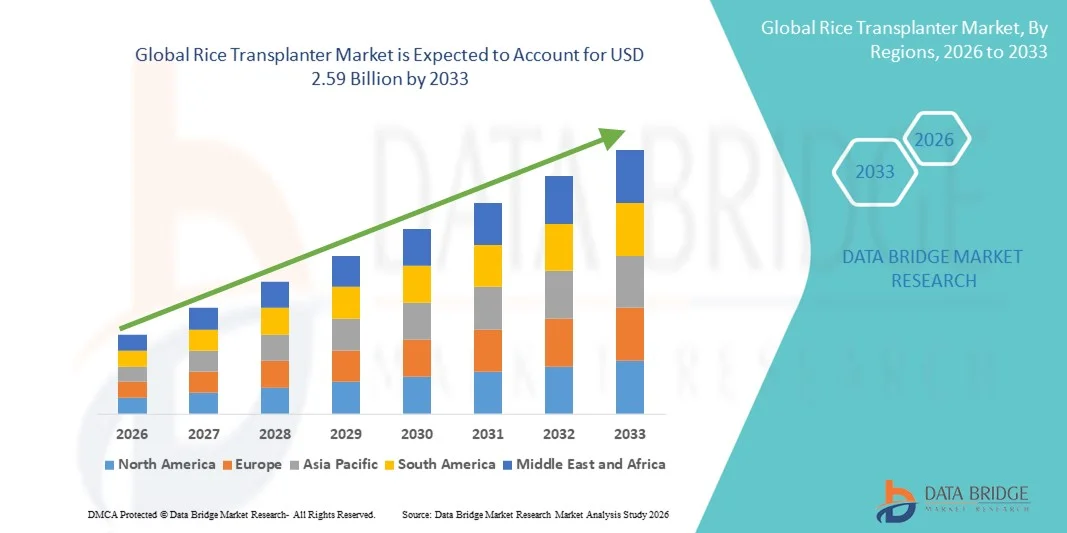
- The global rice transplanter market size was valued at USD 1.65 billion in 2025 and is expected to reach USD 2.59 billion by 2033, at a CAGR of5.8% during the forecast period
- Major factors that are expected to boost the growth of the rice transplanter market in the forecast period are the change towards mechanization. Furthermore, the product innovation is further anticipated to propel the growth of the rice transplanter market. Moreover, the rise in the need for food because of the increase in population around the world is further estimated to cushion the growth of the rice transplanter market
What are the Major Takeaways of Rice Transplanter Market?
- The rise in the price of the machine and even higher maintenance cost is further projected to impede the growth of the rice transplanter market in the timeline period
- In addition, the increase in the alertness amongst the farmers regarding smart farming will further provide potential opportunities for the growth of the rice transplanter market in the coming years
- Asia-Pacific dominated the rice transplanter market with the largest revenue share of 38.54% in 2025, driven by the region’s heavy dependence on rice as a staple food crop and the widespread adoption of mechanized rice farming across China, India, Japan, Southeast Asia, and South Korea
- North America is expected to register the fastest CAGR of 10.58% from 2026 to 2033, driven by increasing mechanization in specialty and commercial rice farming, rising labor costs, and growing adoption of advanced agricultural machinery
- The Walking Rice Transplanter segment dominated the market with an estimated 58.6% share in 2025, primarily due to its affordability, compact size, and suitability for small and fragmented landholdings
Report Scope and Rice Transplanter Market Segmentation
|
Attributes |
Rice Transplanter Key Market Insights |
|
Segments Covered |
|
|
Countries Covered |
North America
Europe
Asia-Pacific
Middle East and Africa
South America
|
|
Key Market Players |
|
|
Market Opportunities |
|
|
Value Added Data Infosets |
In addition to the insights on market scenarios such as market value, growth rate, segmentation, geographical coverage, and major players, the market reports curated by the Data Bridge Market Research also include in-depth expert analysis, pricing analysis, brand share analysis, consumer survey, demography analysis, supply chain analysis, value chain analysis, raw material/consumables overview, vendor selection criteria, PESTLE Analysis, Porter Analysis, and regulatory framework. |
What is the Key Trend in the Rice Transplanter Market?
Increasing Shift Toward High-Efficiency, Compact, and Mechanized Rice Transplanters
- The rice transplanter market is witnessing growing adoption of compact, high-speed, and fuel-efficient machines designed to improve planting accuracy, reduce labor dependency, and enhance productivity in paddy cultivation
- Manufacturers are introducing multi-row, lightweight, and ergonomically designed rice transplanters equipped with improved seedling handling, adjustable row spacing, and higher planting speeds
- Rising demand for cost-effective, easy-to-operate, and field-deployable mechanized solutions is accelerating adoption among small and medium-scale farmers
- For instance, companies such as Kubota, Yanmar, CLAAS, and Mahindra have launched advanced walk-behind and riding-type rice transplanters with improved engine efficiency and reduced maintenance needs
- Increasing focus on reducing crop establishment time, minimizing seedling damage, and improving yield uniformity is driving the shift toward mechanized rice transplanting
- As labor shortages intensify and farm mechanization expands, Rice Transplanters will remain critical for improving efficiency, productivity, and sustainability in rice farming
What are the Key Drivers of Rice Transplanter Market?
- Rising labor shortages and increasing agricultural wage costs are driving demand for mechanized rice transplanting solutions
- For instance, in 2024–2025, manufacturers such as Kubota, Mahindra & Mahindra, and Yanmar expanded their rice transplanter portfolios to cater to smallholder and large-scale farms
- Growing adoption of precision farming practices and government initiatives promoting farm mechanization are boosting market growth across Asia-Pacific and emerging economies
- Advancements in engine performance, seedling tray design, and machine durability have improved operational efficiency and ease of use
- Increasing rice consumption, population growth, and pressure to enhance crop yields are supporting long-term demand
- Backed by subsidies, rural mechanization programs, and agricultural modernization efforts, the Rice Transplanter market is expected to witness steady long-term growth
Which Factor is Challenging the Growth of the Rice Transplanter Market?
- High initial investment costs associated with advanced and multi-row rice transplanters limit adoption among small and marginal farmers
- For instance, during 2024–2025, rising steel prices, engine component costs, and supply chain disruptions increased manufacturing expenses for several global vendors
- Limited awareness and lack of technical training among farmers in developing regions hinder efficient machine utilization
- Small and fragmented landholdings restrict the adoption of larger riding-type transplanters
- Dependence on seasonal demand and uneven availability of after-sales service creates operational challenges
- To overcome these barriers, manufacturers and governments are focusing on affordable models, financing options, rental services, and farmer training programs to expand global adoption of Rice Transplanters
How is the Rice Transplanter Market Segmented?
The market is segmented on the basis of product type.
- By Product Type
On the basis of product type, the Rice Transplanter market is segmented into Ride-on Rice Transplanters and Walking Rice Transplanters. The Walking Rice Transplanter segment dominated the market with an estimated 58.6% share in 2025, primarily due to its affordability, compact size, and suitability for small and fragmented landholdings. These machines are widely adopted by small and marginal farmers across Asia-Pacific, as they require lower capital investment, offer ease of operation, and are well-suited for wet and uneven paddy fields. Walking rice transplanters are commonly used in regions with labor shortages but limited mechanization budgets, making them a preferred choice for traditional rice-growing economies.
The Ride-on Rice Transplanter segment is expected to grow at the fastest CAGR from 2026 to 2033, driven by increasing farm mechanization, rising labor costs, and expanding adoption by medium- and large-scale farms. Ride-on models offer higher planting speed, multi-row capacity, reduced operator fatigue, and improved productivity, making them ideal for commercial farming operations. Growing government subsidies and modernization initiatives are further accelerating adoption of ride-on rice transplanters globally.
Which Region Holds the Largest Share of the Rice Transplanter Market?
- Asia-Pacific dominated the rice transplanter market with the largest revenue share of 38.54% in 2025, driven by the region’s heavy dependence on rice as a staple food crop and the widespread adoption of mechanized rice farming across China, India, Japan, Southeast Asia, and South Korea. High labor intensity in paddy cultivation, increasing labor shortages, and strong government support for farm mechanization continue to fuel demand for rice transplanters across small, medium, and large-scale farms
- Leading manufacturers in Asia-Pacific are introducing advanced ride-on and walking rice transplanters with higher row capacity, improved fuel efficiency, precision planting depth, and reduced crop damage, strengthening the region’s technological leadership. Continuous investment in agricultural modernization, smart farming practices, and rural mechanization programs supports long-term market expansion
- Large paddy cultivation areas, strong domestic manufacturing bases, favorable subsidy schemes, and high farmer awareness further reinforce Asia-Pacific’s dominance in the global rice transplanter market
China Rice Transplanter Market Insight
China holds the largest share within Asia-Pacific due to its vast rice cultivation area and strong government push toward agricultural mechanization. Rising rural labor shortages, increasing farm consolidation, and subsidies for modern farm equipment are accelerating adoption of rice transplanters. Strong domestic manufacturing capabilities and continuous innovation in multi-row, fuel-efficient, and high-precision transplanters further strengthen China’s market leadership.
India Rice Transplanter Market Insight
India is a major growth contributor, supported by increasing labor scarcity, rising wages, and government-led mechanization schemes such as subsidies and custom hiring centers. Growing adoption of rice transplanters in key paddy-producing states is improving planting efficiency and reducing cultivation costs. Expanding awareness among small and medium farmers and rising demand for walking-type transplanters are driving steady market growth.
Japan Rice Transplanter Market Insight
Japan demonstrates stable demand due to its highly mechanized agricultural sector and aging farming population. Farmers prefer technologically advanced, precision rice transplanters that ensure uniform planting and high productivity. Strong focus on quality rice production, continuous equipment upgrades, and dominance of domestic manufacturers support consistent adoption of premium and automated rice transplanters across the country.
South Korea Rice Transplanter Market Insight
South Korea contributes significantly through widespread mechanization of rice farming and strong government support for modern agricultural practices. Limited arable land and labor shortages are driving adoption of efficient, compact rice transplanters. Technological advancements, high farmer awareness, and preference for durable and precise equipment support sustained demand in both small-scale and commercial paddy farming.
North America Rice Transplanter Market
North America is expected to register the fastest CAGR of 10.58% from 2026 to 2033, driven by increasing mechanization in specialty and commercial rice farming, rising labor costs, and growing adoption of advanced agricultural machinery. Expanding precision farming practices and investments in modern farm equipment are accelerating demand for high-efficiency rice transplanters across the U.S. and Canada.
U.S. Rice Transplanter Market Insight
The U.S. represents the fastest-growing market in North America, driven by rising labor costs, increasing mechanization, and adoption of precision agriculture in commercial rice farms. Expanding rice cultivation in states such as Arkansas and California is boosting demand for efficient planting equipment. Investments in advanced farm machinery and focus on productivity enhancement are accelerating rice transplanter adoption.
Canada Rice Transplanter Market Insight
Canada shows emerging growth, supported by increasing mechanization trends and adoption of advanced agricultural equipment. Although rice cultivation is limited, technological spillover from precision farming and farm automation is encouraging adoption in niche applications. Strong emphasis on efficiency, labor optimization, and modern farming practices is expected to gradually support market expansion.
Which are the Top Companies in Rice Transplanter Market?
The rice transplanter industry is primarily led by well-established companies, including:
- Deere & Company (U.S.)
- Kubota Corporation (Japan)
- Mahindra & Mahindra Ltd (India)
- CLAAS KGaA mbH (Germany)
- Yanmar Co., Ltd (Japan)
- TYM Corporation (South Korea)
- Jiangsu World Agriculture Machinery Co., Ltd (China)
- Mitsubishi Mahindra Agricultural Machinery Co., Ltd (Japan)
- Jiangsu Changfa Agricultural Equipment Co., Ltd (China)
- Shandong Fuerwo Agricultural Equipment Co., Ltd (China)
- Changzhou Dongfeng Agricultural Machinery (China)
- ISEKI & CO., LTD (Japan)
- Kukje Machinery Co., Ltd (South Korea)
- YANMAR HOLDINGS Co., Ltd (Japan)
- Greaves Cotton Limited (India)
- China Renowed Supplier of Food Processing Machinery (China)
- TNAU – Tamil Nadu Agricultural University (India)
- Redlands (U.K.)
- S.K. ENGINEERING AND STEEL FABRICATION (India)
- LEMKEN GmbH & Co. KG (Germany)
What are the Recent Developments in Global Rice Transplanter Market?
- In June 2024, Mahindra launched the 6RO Paddy Walker, a new rice transplanter engineered to enhance paddy cultivation efficiency through stable seedling placement, consistent seedling feed, and precise horizontal control, supporting improved crop growth and yield. This launch is expected to significantly reduce labor costs and boost overall productivity in Indian paddy farming
- In June 2024, Mahindra introduced the Mahindra 6RO Paddy Walker as a compact, manually operated rice transplanter capable of transplanting six rows simultaneously, with a design optimized for accurate planting even in small and constrained fields. This development strengthens mechanization adoption among small and medium-scale farmers
- In April 2024, AGCO announced the launch of its new brand PTx, integrating Precision Planting technology with its joint venture with Trimble, PTx Trimble, to accelerate and unify precision agriculture solutions across its machinery portfolio. This strategic move is expected to influence future advancements in smart and technology-enabled rice transplanters
- In October 2022, Kubota launched the Agri-Robo Rice Transplanter, developed by its R&D team and young innovators, offering expert full-field autonomous planting that reduces manual effort and labor requirements. This innovation marked a key step toward automation-driven efficiency in rice transplantation
SKU-
Accédez en ligne au rapport sur le premier cloud mondial de veille économique
- Tableau de bord d'analyse de données interactif
- Tableau de bord d'analyse d'entreprise pour les opportunités à fort potentiel de croissance
- Accès d'analyste de recherche pour la personnalisation et les requêtes
- Analyse de la concurrence avec tableau de bord interactif
- Dernières actualités, mises à jour et analyse des tendances
- Exploitez la puissance de l'analyse comparative pour un suivi complet de la concurrence
Méthodologie de recherche
La collecte de données et l'analyse de l'année de base sont effectuées à l'aide de modules de collecte de données avec des échantillons de grande taille. L'étape consiste à obtenir des informations sur le marché ou des données connexes via diverses sources et stratégies. Elle comprend l'examen et la planification à l'avance de toutes les données acquises dans le passé. Elle englobe également l'examen des incohérences d'informations observées dans différentes sources d'informations. Les données de marché sont analysées et estimées à l'aide de modèles statistiques et cohérents de marché. De plus, l'analyse des parts de marché et l'analyse des tendances clés sont les principaux facteurs de succès du rapport de marché. Pour en savoir plus, veuillez demander un appel d'analyste ou déposer votre demande.
La méthodologie de recherche clé utilisée par l'équipe de recherche DBMR est la triangulation des données qui implique l'exploration de données, l'analyse de l'impact des variables de données sur le marché et la validation primaire (expert du secteur). Les modèles de données incluent la grille de positionnement des fournisseurs, l'analyse de la chronologie du marché, l'aperçu et le guide du marché, la grille de positionnement des entreprises, l'analyse des brevets, l'analyse des prix, l'analyse des parts de marché des entreprises, les normes de mesure, l'analyse globale par rapport à l'analyse régionale et des parts des fournisseurs. Pour en savoir plus sur la méthodologie de recherche, envoyez une demande pour parler à nos experts du secteur.
Personnalisation disponible
Data Bridge Market Research est un leader de la recherche formative avancée. Nous sommes fiers de fournir à nos clients existants et nouveaux des données et des analyses qui correspondent à leurs objectifs. Le rapport peut être personnalisé pour inclure une analyse des tendances des prix des marques cibles, une compréhension du marché pour d'autres pays (demandez la liste des pays), des données sur les résultats des essais cliniques, une revue de la littérature, une analyse du marché des produits remis à neuf et de la base de produits. L'analyse du marché des concurrents cibles peut être analysée à partir d'une analyse basée sur la technologie jusqu'à des stratégies de portefeuille de marché. Nous pouvons ajouter autant de concurrents que vous le souhaitez, dans le format et le style de données que vous recherchez. Notre équipe d'analystes peut également vous fournir des données sous forme de fichiers Excel bruts, de tableaux croisés dynamiques (Fact book) ou peut vous aider à créer des présentations à partir des ensembles de données disponibles dans le rapport.