


Global Internal Nasal Dilator Market
Marktgröße in Milliarden USD
CAGR :
% 
 USD
75.04 Billion
USD
95.94 Billion
2025
2033
USD
75.04 Billion
USD
95.94 Billion
2025
2033
 Prognosezeitraum Prognosezeitraum |
2026 –2033 |
 Marktgröße (Basisjahr) Marktgröße (Basisjahr) | USD 75.04 Billion |
 Marktgröße (Prognosejahr) Marktgröße (Prognosejahr) | USD 95.94 Billion |
 CAGR CAGR |
% |
| Wichtige Marktteilnehmer |
|
Global Internal Nasal Dilator Market Segmentation, By Type (Polymer and Polymer + Alloy), Application (Snoring, Sleep Apnea, Deviated Septum, Sinusitis, and Chronic Stuffy Nose), Usability (Reusable and Single Use), End User (Hospitals Pharmacies, Retail Pharmacies, and Online Pharmacies) - Industry Trends and Forecast to 2033
Internal Nasal Dilator Market Size
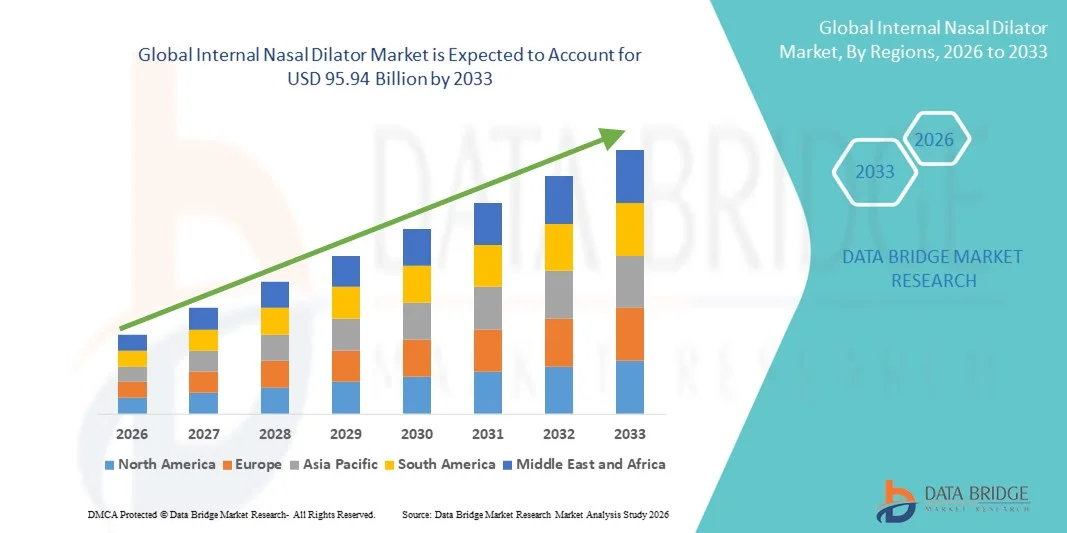
- The global internal nasal dilator market size was valued at USD 75.04 billion in 2025 and is expected to reach USD 95.94 billion by 2033, at a CAGR of 3.12% during the forecast period
- The market growth is largely fueled by the rising prevalence of nasal congestion, sleep-related breathing disorders, and respiratory discomfort caused by allergies, pollution, and lifestyle changes, leading to increased adoption of non-invasive breathing aids across both clinical and home-care settings
- Furthermore, growing consumer preference for drug-free, user-friendly, and reusable solutions for improving airflow and sleep quality is establishing internal nasal dilators as an effective alternative to medicated nasal products. These converging factors are accelerating the uptake of internal nasal dilator solutions, thereby significantly boosting the industry’s growth
Internal Nasal Dilator Market Analysis
- Internal nasal dilators, designed to improve nasal airflow by mechanically expanding the nasal passages, are increasingly important non-invasive solutions for managing nasal congestion, snoring, sleep-disordered breathing, and exercise-induced breathing difficulties across home-care and clinical settings
- The rising demand for internal nasal dilators is primarily driven by the growing prevalence of allergic rhinitis, sleep apnea, chronic nasal congestion, and consumer preference for drug-free, reusable, and easy-to-use breathing aids that enhance comfort and sleep quality
- North America dominated the internal nasal dilator market with the largest revenue share of approximately 38.5% in 2025, supported by high awareness of sleep health, widespread adoption of non-pharmacological respiratory aids, strong retail and e-commerce penetration, and increasing diagnosis rates of snoring and mild sleep apnea, particularly in the U.S.
- Asia-Pacific is expected to be the fastest-growing region in the internal nasal dilator market during the forecast period, driven by rising air pollution levels, increasing incidence of respiratory disorders, growing health consciousness, and expanding access to affordable consumer healthcare products in countries such as China, India, and Japan
- The polymer segment dominated the largest market revenue share of approximately 61.4% in 2025, driven by its lightweight nature, high flexibility, and superior user comfort. Polymer-based internal nasal dilators are widely preferred due to their soft texture, hypoallergenic properties, and reduced risk of nasal irritation during prolonged use
Report Scope and Internal Nasal Dilator Market Segmentation
|
Attributes |
Internal Nasal Dilator Key Market Insights |
|
Segments Covered |
|
|
Countries Covered |
North America
Europe
Asia-Pacific
Middle East and Africa
South America
|
|
Key Market Players |
|
|
Market Opportunities |
|
|
Value Added Data Infosets |
In addition to the insights on market scenarios such as market value, growth rate, segmentation, geographical coverage, and major players, the market reports curated by the Data Bridge Market Research also include in-depth expert analysis, patient epidemiology, pipeline analysis, pricing analysis, and regulatory framework. |
Internal Nasal Dilator Market Trends
Improved Breathing Comfort Through Product Innovation
- A significant and accelerating trend in the global internal nasal dilator market is the growing focus on ergonomic design, medical-grade materials, and user comfort, aimed at improving nasal airflow for individuals suffering from nasal congestion, snoring, sleep apnea, and exercise-induced breathing difficulties. Manufacturers are increasingly emphasizing discreet, lightweight, and reusable designs to enhance daily and nighttime usability
- For instance, Rhinomed Ltd. has expanded its internal nasal dilator portfolio with clinically validated products designed to improve nasal airflow without medication, gaining traction among consumers seeking non-invasive breathing solutions for sleep and sports performance
- Advancements in material science have enabled the development of soft, hypoallergenic silicone nasal dilators that adapt comfortably to nasal anatomy while maintaining structural integrity during prolonged use. These innovations help reduce irritation and improve patient compliance, especially among first-time users
- The rising awareness of sleep health, athletic performance optimization, and non-drug respiratory aids is further encouraging the adoption of internal nasal dilators across both medical and consumer wellness segments
- This shift toward comfort-focused, clinically supported, and aesthetically discreet nasal dilators is reshaping consumer expectations, prompting companies to invest in product refinement, clinical testing, and broader distribution through pharmacies and online platforms
- As a result, demand for internal nasal dilators is steadily increasing across home-use, sports, and sleep-related applications, particularly among consumers seeking affordable and non-invasive respiratory support solutions
Internal Nasal Dilator Market Dynamics
Driver
Rising Prevalence of Nasal Congestion, Sleep Disorders, and Preference for Non-Invasive Solutions
- The growing incidence of nasal obstruction, allergic rhinitis, snoring, and mild sleep apnea, along with increasing awareness of sleep quality and respiratory health, is a key driver boosting demand for internal nasal dilators globally
- For instance, the increasing diagnosis of sleep-related breathing disorders and lifestyle-related nasal congestion has led healthcare professionals and consumers to adopt drug-free, mechanical nasal airflow solutions, supporting market growth
- Internal nasal dilators offer advantages such as immediate relief, ease of use, portability, and absence of side effects, making them an attractive alternative to nasal sprays or surgical interventions
- In addition, the rising popularity of sports and fitness activities has expanded the use of nasal dilators among athletes seeking improved oxygen intake and endurance during training and competition
- The expanding availability of internal nasal dilators through retail pharmacies, e-commerce platforms, and direct-to-consumer channels is further accelerating adoption across both developed and emerging markets
Restraint/Challenge
User Discomfort Concerns and Limited Awareness in Developing Regions
- Despite growing adoption, initial discomfort, improper fit, and adaptation challenges among first-time users remain key barriers to widespread acceptance of internal nasal dilators. Some users discontinue use due to unfamiliar sensation or perceived inconvenience
- For instance, consumer feedback and clinical observations indicate that poorly fitted or low-quality nasal dilators can cause irritation or inadequate airflow improvement, negatively impacting repeat usage and brand trust
- Limited awareness regarding the benefits of internal nasal dilators, particularly in price-sensitive and developing regions, further restrains market penetration compared to more familiar remedies such as nasal sprays
- In addition, the presence of low-cost, unregulated products in the market can undermine consumer confidence and affect overall product credibility
- Overcoming these challenges will require enhanced product education, ergonomic design improvements, clinical validation, and affordable pricing strategies, which are critical for sustained growth in the global Internal Nasal Dilator market
Internal Nasal Dilator Market Scope
The market is segmented on the basis of type, application, usability, and end user.
- By Type
On the basis of type, the Internal Nasal Dilator market is segmented into Polymer and Polymer + Alloy. The polymer segment dominated the largest market revenue share of approximately 61.4% in 2025, driven by its lightweight nature, high flexibility, and superior user comfort. Polymer-based internal nasal dilators are widely preferred due to their soft texture, hypoallergenic properties, and reduced risk of nasal irritation during prolonged use. These dilators are easy to manufacture, cost-effective, and suitable for mass production, making them highly accessible across retail and online channels. Their compatibility with reusable and single-use designs further strengthens demand. Increasing consumer preference for non-invasive, comfortable breathing aids for snoring and nasal congestion supports segment dominance. Polymer dilators also offer better adaptability to different nasal anatomies, improving airflow efficiency. Growing awareness of sleep-related breathing disorders and rising self-care adoption further contribute to sustained revenue leadership.
The polymer + alloy segment is expected to witness the fastest CAGR of approximately 9.8% from 2026 to 2033, driven by increasing demand for enhanced durability and shape retention. These hybrid dilators combine flexibility with structural strength, ensuring consistent nasal expansion during sleep or physical activity. Their superior longevity makes them attractive for reusable applications, especially among chronic sleep apnea and sinusitis patients. Growing innovation in medical-grade alloys and ergonomic designs is boosting adoption. Higher acceptance among premium product users and athletes further accelerates growth. Expanding online availability and product differentiation are supporting faster market penetration.
- By Application
On the basis of application, the Internal Nasal Dilator market is segmented into Snoring, Sleep Apnea, Deviated Septum, Sinusitis, Chronic Stuffy Nose, and Others. The snoring segment accounted for the largest market revenue share of approximately 42.6% in 2025, driven by the high global prevalence of snoring and growing consumer awareness regarding sleep quality. Internal nasal dilators are widely adopted as a non-invasive, drug-free solution to improve nasal airflow and reduce snoring. Rising lifestyle-related factors such as obesity, smoking, and stress contribute to increased snoring incidence. Easy over-the-counter availability and strong marketing through digital platforms support adoption. Consumers increasingly prefer self-managed solutions over clinical interventions. The affordability and immediate relief provided by nasal dilators further reinforce segment dominance. Growing demand among middle-aged and elderly populations also contributes significantly.
The sleep apnea segment is projected to grow at the fastest CAGR of approximately 10.5% from 2026 to 2033, driven by rising diagnosis rates of obstructive sleep apnea worldwide. Increasing awareness about the long-term health risks associated with untreated sleep apnea is encouraging early intervention. Internal nasal dilators are gaining traction as complementary or alternative solutions to CPAP devices, particularly for mild cases. Growth in sleep clinics and home-based sleep monitoring is further boosting adoption. Technological advancements and improved clinical validation are supporting rapid growth. Rising healthcare expenditure and preventive care focus accelerate this segment.
- By Usability
On the basis of usability, the Internal Nasal Dilator market is segmented into Reusable and Single Use. The reusable segment dominated the market with a revenue share of approximately 58.9% in 2025, supported by cost efficiency and long-term usability. Consumers increasingly prefer reusable dilators due to their durability and reduced replacement frequency. These products are particularly favored by chronic users suffering from long-term nasal congestion or sleep disorders. Improved cleaning and hygiene designs have enhanced user confidence. Rising environmental awareness is also shifting preference toward reusable solutions. Availability of premium reusable designs further strengthens segment dominance. Healthcare professionals often recommend reusable options for continuous use.
The single-use segment is expected to register the fastest CAGR of approximately 9.3% from 2026 to 2033, driven by convenience and hygiene benefits. Single-use dilators are widely adopted by travelers, first-time users, and patients requiring short-term relief. Their disposable nature reduces infection risk, making them suitable for hospital and emergency settings. Increasing preference for hassle-free medical devices is boosting demand. Expanding distribution through pharmacies and online platforms supports growth. Rising awareness of infection control practices further accelerates adoption.
- By End User
On the basis of end user, the Internal Nasal Dilator market is segmented into Hospital Pharmacies, Retail Pharmacies, and Online Pharmacies. The retail pharmacies segment held the largest market revenue share of approximately 46.2% in 2025, driven by easy accessibility and consumer trust. Retail pharmacies serve as the primary point of purchase for over-the-counter nasal dilators. Pharmacist recommendations play a key role in influencing buying decisions. Strong physical presence and immediate product availability support dominance. Consumers prefer retail pharmacies for first-time purchases and professional guidance. The wide product variety offered further strengthens this segment.
The online pharmacies segment is anticipated to grow at the fastest CAGR of approximately 11.1% from 2026 to 2033, driven by increasing e-commerce adoption and digital health awareness. Online platforms offer convenience, discreet purchasing, and competitive pricing. Rising smartphone penetration and improved logistics are accelerating online sales. Subscription-based purchasing models further boost demand. Strong product reviews and digital marketing enhance consumer confidence. Expansion in emerging markets significantly supports rapid growth.
Internal Nasal Dilator Market Regional Analysis
- North America dominated the internal nasal dilator market with the largest revenue share of approximately 38.5% in 2025, supported by high awareness of sleep health, widespread adoption of non-pharmacological respiratory aids, and strong retail and e-commerce penetration
- Consumers in the region increasingly prefer drug-free solutions for managing snoring, nasal congestion, and mild sleep apnea, driving steady demand for internal nasal dilators
- The market is further supported by increasing diagnosis rates of sleep-related breathing disorders, a well-established healthcare infrastructure, and high spending on preventive and home-based healthcare products, reinforcing North America’s market leadership
U.S. Internal Nasal Dilator Market Insight
The U.S. internal nasal dilator market accounted for the largest revenue share of approximately 81% within North America in 2025, driven by rising prevalence of snoring, sleep apnea, allergic rhinitis, and chronic nasal congestion. High consumer awareness regarding sleep quality and its impact on overall health has accelerated adoption of internal nasal dilators as a convenient, non-invasive solution. Strong availability through retail pharmacies, online platforms, and sleep clinics further supports market growth. Additionally, increasing preference for self-care products and growing recommendations by healthcare professionals for mild respiratory conditions continue to propel demand across the U.S. market.
Europe Internal Nasal Dilator Market Insight
The Europe internal nasal dilator market is projected to grow at a steady CAGR during the forecast period, driven by rising awareness of sleep disorders and respiratory health. Increasing incidence of nasal congestion caused by seasonal allergies, pollution, and lifestyle factors is encouraging the use of nasal dilators. European consumers show strong preference for non-medicated, reusable healthcare devices. Growth is further supported by expanding distribution through pharmacies and online health platforms, along with rising focus on sleep wellness and preventive care across the region.
U.K. Internal Nasal Dilator Market Insight
The U.K. internal nasal dilator market is expected to grow at a notable CAGR, supported by increasing awareness of snoring and sleep apnea and a growing emphasis on sleep hygiene. Rising cases of nasal obstruction due to allergies and sinus conditions are driving adoption. Consumers increasingly favor internal nasal dilators as an affordable and easy-to-use alternative to pharmaceutical treatments. Strong penetration of e-commerce and retail pharmacy networks further enhances product accessibility, supporting market expansion.
Germany Internal Nasal Dilator Market Insight
The Germany internal nasal dilator market is anticipated to expand at a considerable CAGR, driven by high health awareness and strong demand for medically validated, non-drug respiratory aids. German consumers place significant emphasis on product safety, comfort, and reusability. Increasing prevalence of sleep-related breathing issues and chronic nasal congestion is supporting adoption. Well-developed healthcare infrastructure and widespread pharmacy availability further contribute to market growth.
Asia-Pacific Internal Nasal Dilator Market Insight
The Asia-Pacific internal nasal dilator market is expected to register the fastest CAGR during the forecast period, driven by rising air pollution levels, increasing incidence of respiratory disorders, and growing health consciousness. Rapid urbanization and lifestyle changes in countries such as China, India, and Japan are contributing to higher rates of nasal congestion and sleep disturbances. Expanding access to affordable consumer healthcare products and growing online pharmacy penetration are accelerating adoption. Government initiatives promoting preventive healthcare further support strong regional growth.
Japan Internal Nasal Dilator Market Insight
The Japan internal nasal dilator market is gaining strong momentum, supported by the country’s aging population and high prevalence of sleep-related disorders. Japanese consumers actively seek compact, comfortable, and non-invasive healthcare solutions. Internal nasal dilators are increasingly adopted for managing snoring and nasal airflow obstruction. Strong consumer awareness, combined with advanced healthcare standards and widespread retail availability, continues to drive market expansion in Japan.
China Internal Nasal Dilator Market Insight
The China internal nasal dilator market held the largest revenue share within Asia-Pacific in 2025, driven by rapid urbanization, rising pollution levels, and increasing incidence of respiratory and sleep-related conditions. Growing middle-class population and rising health awareness are accelerating demand for affordable, non-pharmaceutical breathing aids. Strong domestic manufacturing capabilities and extensive online
Internal Nasal Dilator Market Share
The Internal Nasal Dilator industry is primarily led by well-established companies, including:
• Rhinomed Ltd. (Australia)
• WoodyKnows (China)
• HealthRight Products (U.S.)
• Airing Inc. (U.S.)
• Glidewell Laboratories (U.S.)
• Medinose (Israel)
• Breathe Right (U.S.)
• NeilMed Pharmaceuticals (U.S.)
• Equate (U.S.)
• Vicks (U.S.)
• SnoreCare (U.K.)
• RespLabs (U.S.)
Latest Developments in Global Internal Nasal Dilator Market
- In August 2023, Rhinomed Limited reported continued strong performance and retail expansion of its Mute internal nasal dilator product line, with the brand growing significantly in the U.S. and Australian markets and supporting broader adoption of internal nasal breathing aids for snoring and sleep support. This reflected increasing consumer demand and retail availability of internal nasal dilator solutions
- In September 2023, NasalAir launched a new range of eco-friendly internal nasal dilators made from biodegradable materials, targeting environmentally conscious consumers and contributing to sustainability trends in respiratory wellness products
- In October 2023, the U.S. FDA approved a novel internal nasal dilator design promising improved airflow and comfort, which is expected to encourage further product innovation and differentiation across the internal nasal dilator segment
- In April 2024, Intake Breathing (U.S.) introduced its Intake Breathing Nasal Dilator, a two-part system featuring medical-grade adhesive tabs and a magnetic band that gently widens nasal passages, increasing airflow by up to 80 % more than traditional nasal solutions and offering extended relief through sleep or physical activity
- In April 2024, Integra Life Sciences completed the acquisition of Johnson & Johnson’s Acclarent division, strengthening its ear, nose, and throat (ENT) portfolio and enhancing its position in the internal nasal dilator market, complementing its broader surgical instruments and respiratory device offerings
SKU-
Erhalten Sie Online-Zugriff auf den Bericht zur weltweit ersten Market Intelligence Cloud
- Interaktives Datenanalyse-Dashboard
- Unternehmensanalyse-Dashboard für Chancen mit hohem Wachstumspotenzial
- Zugriff für Research-Analysten für Anpassungen und Abfragen
- Konkurrenzanalyse mit interaktivem Dashboard
- Aktuelle Nachrichten, Updates und Trendanalyse
- Nutzen Sie die Leistungsfähigkeit der Benchmark-Analyse für eine umfassende Konkurrenzverfolgung
Forschungsmethodik
Die Datenerfassung und Basisjahresanalyse werden mithilfe von Datenerfassungsmodulen mit großen Stichprobengrößen durchgeführt. Die Phase umfasst das Erhalten von Marktinformationen oder verwandten Daten aus verschiedenen Quellen und Strategien. Sie umfasst die Prüfung und Planung aller aus der Vergangenheit im Voraus erfassten Daten. Sie umfasst auch die Prüfung von Informationsinkonsistenzen, die in verschiedenen Informationsquellen auftreten. Die Marktdaten werden mithilfe von marktstatistischen und kohärenten Modellen analysiert und geschätzt. Darüber hinaus sind Marktanteilsanalyse und Schlüsseltrendanalyse die wichtigsten Erfolgsfaktoren im Marktbericht. Um mehr zu erfahren, fordern Sie bitte einen Analystenanruf an oder geben Sie Ihre Anfrage ein.
Die wichtigste Forschungsmethodik, die vom DBMR-Forschungsteam verwendet wird, ist die Datentriangulation, die Data Mining, die Analyse der Auswirkungen von Datenvariablen auf den Markt und die primäre (Branchenexperten-)Validierung umfasst. Zu den Datenmodellen gehören ein Lieferantenpositionierungsraster, eine Marktzeitlinienanalyse, ein Marktüberblick und -leitfaden, ein Firmenpositionierungsraster, eine Patentanalyse, eine Preisanalyse, eine Firmenmarktanteilsanalyse, Messstandards, eine globale versus eine regionale und Lieferantenanteilsanalyse. Um mehr über die Forschungsmethodik zu erfahren, senden Sie eine Anfrage an unsere Branchenexperten.
Anpassung möglich
Data Bridge Market Research ist ein führendes Unternehmen in der fortgeschrittenen formativen Forschung. Wir sind stolz darauf, unseren bestehenden und neuen Kunden Daten und Analysen zu bieten, die zu ihren Zielen passen. Der Bericht kann angepasst werden, um Preistrendanalysen von Zielmarken, Marktverständnis für zusätzliche Länder (fordern Sie die Länderliste an), Daten zu klinischen Studienergebnissen, Literaturübersicht, Analysen des Marktes für aufgearbeitete Produkte und Produktbasis einzuschließen. Marktanalysen von Zielkonkurrenten können von technologiebasierten Analysen bis hin zu Marktportfoliostrategien analysiert werden. Wir können so viele Wettbewerber hinzufügen, wie Sie Daten in dem von Ihnen gewünschten Format und Datenstil benötigen. Unser Analystenteam kann Ihnen auch Daten in groben Excel-Rohdateien und Pivot-Tabellen (Fact Book) bereitstellen oder Sie bei der Erstellung von Präsentationen aus den im Bericht verfügbaren Datensätzen unterstützen.