


Global Microwavable Food Container Market
حجم السوق بالمليار دولار أمريكي
CAGR :
% 
 USD
6.24 Billion
USD
13.29 Billion
2025
2033
USD
6.24 Billion
USD
13.29 Billion
2025
2033
 فترة التنبؤ فترة التنبؤ |
2026 –2033 |
 حجم السوق (السنة الأساسية) حجم السوق (السنة الأساسية) |
USD 6.24 Billion |
 حجم السوق (سنة التنبؤ) حجم السوق (سنة التنبؤ) |
USD 13.29 Billion |
 CAGR CAGR |
% |
| اللاعبين الرئيسيين في الأسواق |
|
Global Microwavable Food Container Market Segmentation, By Material (Glass and Ceramics, Paper and paperboard, Polymer, Metal, and Others Edible Materials), Application (Fresh Prepared Foods, Frozen Foods, Shelf Stable Meals, Ready to Eat, and Others)- Industry Trends and Forecast to 2033
Microwavable Food Container Market Size
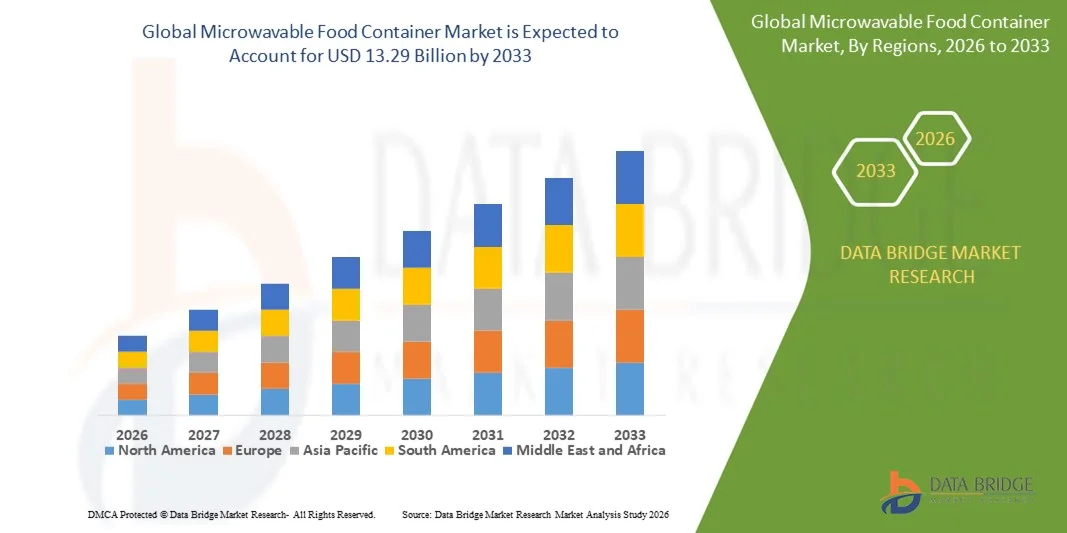
- The global microwavable food container market size was valued at USD 6.24 billion in 2025 and is expected to reach USD 13.29 billion by 2033, at a CAGR of 9.90% during the forecast period
- The market growth is largely fuelled by the rising demand for convenient and ready-to-eat meals, increasing urbanization, and changing lifestyles
- Growing consumer preference for sustainable, reusable, and BPA-free containers is also driving adoption
Microwavable Food Container Market Analysis
- The market is witnessing increased innovation in materials such as polypropylene, polyethylene, and biodegradable plastics to ensure safety, heat resistance, and environmental sustainability
- Manufacturers are focusing on product differentiation through design, durability, stackability, and multi-functionality to cater to evolving consumer preferences and enhance convenience
- North America dominated the microwavable food container market with the largest revenue share of 35.87% in 2025, driven by growing demand for convenient meal solutions, busy lifestyles, and increasing consumption of ready-to-eat and takeaway foods
- Asia-Pacific region is expected to witness the highest growth rate in the global microwavable food container market, driven by increasing demand for ready-to-eat and frozen foods, rapid expansion of foodservice and takeaway sectors, and growing awareness of sustainable and safe packaging materials
- The polymer segment held the largest market revenue share in 2025, driven by its lightweight, durable, and heat-resistant properties. Polymer containers are widely preferred for household, retail, and foodservice applications due to their affordability, reusability, and compatibility with microwave heating, making them a popular choice among consumers and manufacturers
Report Scope and Microwavable Food Container Market Segmentation
|
Attributes |
Microwavable Food Container Key Market Insights |
|
Segments Covered |
|
|
Countries Covered |
North America
Europe
Asia-Pacific
Middle East and Africa
South America
|
|
Key Market Players |
|
|
Market Opportunities |
|
|
Value Added Data Infosets |
In addition to the insights on market scenarios such as market value, growth rate, segmentation, geographical coverage, and major players, the market reports curated by the Data Bridge Market Research also include in-depth expert analysis, pricing analysis, brand share analysis, consumer survey, demography analysis, supply chain analysis, value chain analysis, raw material/consumables overview, vendor selection criteria, PESTLE Analysis, Porter Analysis, and regulatory framework. |
Microwavable Food Container Market Trends
Rising Demand for Convenience and Sustainable Packaging
- The growing focus on convenience and ready-to-eat meals is significantly shaping the microwavable food container market, as consumers increasingly prefer containers that are safe, durable, and suitable for reheating. Microwavable containers are gaining traction due to their ability to maintain food quality, prevent contamination, and simplify meal preparation. This trend strengthens their adoption across foodservice, retail, and household applications, encouraging manufacturers to innovate with versatile and heat-resistant designs
- Increasing awareness around sustainability and eco-friendly packaging has accelerated the demand for reusable, recyclable, and BPA-free microwavable containers. Environmentally conscious consumers are actively seeking products that reduce plastic waste and support responsible consumption, prompting brands to prioritize sustainable sourcing and production processes. This has also led to collaborations between packaging manufacturers and food brands to enhance functionality and environmental impact
- Convenience and sustainability trends are influencing purchasing decisions, with manufacturers emphasizing stackable designs, leak-proof sealing, and microwave-safe materials. These factors are helping brands differentiate products in a competitive market and build consumer trust, while also driving adoption of certifications for food safety and environmental standards. Companies are increasingly using marketing campaigns to highlight these benefits and reinforce brand positioning
- For instance, in 2024, Tupperware in the U.S. and Lock & Lock in South Korea expanded their product portfolios by incorporating microwavable containers with eco-friendly materials and innovative designs. These launches were introduced in response to rising consumer preference for convenience and sustainable packaging, with distribution across retail, online, and foodservice channels. The products were also marketed as safe and environmentally responsible choices, enhancing brand loyalty and repeat purchases among target audiences
- While demand for microwavable containers is growing, sustained market expansion depends on continuous R&D, cost-effective production, and maintaining quality and heat-resistance standards. Manufacturers are also focusing on improving scalability, supply chain reliability, and developing innovative solutions that balance convenience, durability, and sustainability for broader adoption
Microwavable Food Container Market Dynamics
Driver
Growing Preference for Convenience and Sustainable Packaging
- Rising consumer demand for convenient, ready-to-eat, and reheatable meals is a major driver for the microwavable food container market. Manufacturers are increasingly producing containers that meet safety standards, microwave resistance, and leak-proof requirements, supporting functional and versatile packaging solutions. This trend is also driving innovation in materials and designs to enhance product differentiation
- Expanding applications in households, food delivery, takeaway services, and ready-to-eat packaged foods are influencing market growth. Microwavable containers help maintain food quality, simplify meal preparation, and improve portability while meeting consumer expectations for convenience and hygiene. The increasing adoption of home-cooked and pre-packaged meals globally further reinforces this trend
- Foodservice and retail manufacturers are actively promoting microwavable container-based solutions through product innovation, marketing campaigns, and certification labels. These efforts are supported by the growing consumer preference for safe, eco-friendly, and convenient packaging, and they also encourage partnerships between packaging suppliers and food brands to enhance performance and sustainability
- For instance, in 2023, Pyrex in the U.S. and Sistema in New Zealand reported increased incorporation of microwavable containers in retail and foodservice offerings. This expansion followed higher consumer demand for BPA-free, reusable, and heat-resistant containers, driving repeat purchases and product differentiation. Both companies also highlighted sustainability and safety in marketing campaigns to strengthen consumer trust and brand loyalty
- Although rising convenience and sustainability trends support growth, wider adoption depends on cost optimization, material availability, and scalable production processes. Investment in supply chain efficiency, advanced material technology, and eco-friendly manufacturing will be critical for meeting global demand and maintaining competitive advantage
Restraint/Challenge
Higher Cost And Limited Awareness Compared To Conventional Packaging
- The relatively higher cost of microwavable containers compared to conventional disposable packaging remains a key challenge, limiting adoption among price-sensitive consumers and smaller foodservice operators. Higher raw material costs, complex heat-resistant designs, and regulatory compliance contribute to elevated pricing. In addition, inconsistent awareness of eco-friendly and microwave-safe benefits can further affect market penetration
- Consumer and manufacturer awareness remains uneven, particularly in developing markets where demand for convenient and sustainable packaging is still emerging. Limited understanding of functional benefits and proper usage restricts adoption across certain product categories. This also leads to slower innovation uptake in emerging economies where educational initiatives on safe and reusable containers are minimal
- Supply chain and distribution challenges also impact market growth, as microwavable containers require adherence to quality standards and safe handling during transport. Logistical complexities, such as maintaining product integrity and preventing contamination, increase operational costs. Companies must invest in efficient packaging, storage, and distribution networks to ensure product quality
- For instance, in 2024, distributors in India and Indonesia supplying ready-to-eat and takeaway brands reported slower uptake due to higher prices and limited awareness of functional advantages compared to conventional containers. This affected shelf space allocation and visibility in retail and foodservice channels, delaying adoption
- Overcoming these challenges will require cost-efficient production, expanded distribution networks, and focused educational initiatives for manufacturers, foodservice operators, and consumers. Collaboration with retailers, certification bodies, and sustainability programs can help unlock the long-term growth potential of the global microwavable food container market. Furthermore, developing cost-competitive and innovative designs while emphasizing safety and environmental benefits will be essential for widespread adoption
Microwavable Food Container Market Scope
The microwavable food container market is segmented on the basis of material and application.
- By Material
On the basis of material, the market is segmented into glass and ceramics, paper and paperboard, polymer, metal, and other edible materials. The polymer segment held the largest market revenue share in 2025, driven by its lightweight, durable, and heat-resistant properties. Polymer containers are widely preferred for household, retail, and foodservice applications due to their affordability, reusability, and compatibility with microwave heating, making them a popular choice among consumers and manufacturers.
The glass and ceramics segment is expected to witness the fastest growth rate from 2026 to 2033, driven by increasing consumer preference for sustainable, reusable, and BPA-free materials. These containers are favored for their ability to maintain food quality, resist odors, and provide eco-friendly alternatives to single-use plastics, supporting rising demand for environmentally conscious packaging solutions.
- By Application
On the basis of application, the market is segmented into fresh prepared foods, frozen foods, shelf-stable meals, ready-to-eat, and others. The ready-to-eat segment held the largest revenue share in 2025, fueled by growing consumer demand for convenience, time-saving meal solutions, and on-the-go eating options. Ready-to-eat microwavable containers are increasingly adopted in retail, online food delivery, and meal prep services, offering portability, safety, and ease of reheating.
The frozen foods segment is expected to witness the fastest growth rate from 2026 to 2033, driven by rising consumption of frozen meals, snacks, and vegetables across households and commercial foodservice outlets. Frozen food containers with microwave-safe features ensure food safety, quality preservation, and convenient reheating, enhancing consumer adoption and supporting market expansion.
Microwavable Food Container Market Regional Analysis
- North America dominated the microwavable food container market with the largest revenue share of 35.87% in 2025, driven by growing demand for convenient meal solutions, busy lifestyles, and increasing consumption of ready-to-eat and takeaway foods
- Consumers in the region highly value microwave-safe, reusable, and eco-friendly containers that ensure food safety, ease of reheating, and portability
- This widespread adoption is further supported by high disposable incomes, urbanization, and the growing preference for home-cooked and on-the-go meals, establishing microwavable containers as a favored solution for both households and foodservice providers
U.S. Microwavable Food Container Market Insight
The U.S. microwavable food container market captured the largest revenue share in 2025 within North America, fueled by increasing demand for convenience foods, ready-to-eat meals, and sustainable packaging solutions. Consumers are prioritizing containers that are heat-resistant, durable, and safe for repeated use. The growing trend of meal prep, online food delivery, and packaged convenience foods further propels market growth. In addition, manufacturers are focusing on recyclable and BPA-free materials to meet regulatory standards and sustainability goals, enhancing adoption across households and commercial kitchens.
Europe Microwavable Food Container Market Insight
The Europe microwavable food container market is expected to witness the fastest growth rate from 2026 to 2033, driven by rising urbanization, changing lifestyles, and increasing demand for convenient and ready-to-heat meals. European consumers are highly conscious about safety, environmental impact, and product quality. The market is expanding across retail, foodservice, and online platforms, with manufacturers emphasizing eco-friendly and reusable materials to meet evolving consumer expectations.
U.K. Microwavable Food Container Market Insight
The U.K. microwavable food container market is expected to witness the fastest growth rate from 2026 to 2033, fueled by the increasing popularity of ready-to-eat meals, meal prep trends, and sustainable packaging solutions. Consumers prefer containers that are microwave-safe, durable, and recyclable. The growing e-commerce penetration, coupled with a rise in takeaway and home-delivered meal services, is driving adoption. Manufacturers are also innovating with biodegradable and plant-based materials to appeal to environmentally conscious consumers.
Germany Microwavable Food Container Market Insight
The Germany microwavable food container market is expected to witness the fastest growth rate from 2026 to 2033, driven by strong demand for sustainable, reusable, and heat-resistant containers. The market is supported by increasing urbanization, busy lifestyles, and consumer preference for convenient meal solutions. Foodservice providers and retailers are adopting microwavable containers for frozen, ready-to-eat, and fresh prepared foods. Manufacturers are also focusing on eco-friendly innovations, high-quality materials, and regulatory compliance to enhance consumer trust and market expansion.
Asia-Pacific Microwavable Food Container Market Insight
The Asia-Pacific microwavable food container market is expected to witness the fastest growth rate from 2026 to 2033, driven by rising disposable incomes, urbanization, and growing demand for convenience foods in countries such as China, Japan, and India. The region's expanding processed and ready-to-eat food sector is boosting the adoption of microwavable containers. In addition, increasing awareness of food safety and sustainability is prompting manufacturers to innovate with reusable, microwave-safe, and eco-friendly materials, making these containers widely accessible across households and foodservice channels.
Japan Microwavable Food Container Market Insight
The Japan microwavable food container market is expected to witness the fastest growth rate from 2026 to 2033, due to the country’s high urban population, busy lifestyles, and preference for ready-to-eat and takeaway meals. Consumers highly value microwave-safe, reusable, and space-efficient containers. Manufacturers are focusing on high-quality, durable, and eco-friendly materials to meet regulatory requirements and consumer expectations. The growing integration of meal kits, home-delivered meals, and convenience food options is further driving market adoption.
China Microwavable Food Container Market Insight
The China microwavable food container market accounted for the largest market revenue share in Asia-Pacific in 2025, attributed to the country’s growing middle class, rapid urbanization, and increasing consumption of convenience foods. Microwave-safe containers are increasingly adopted in households, retail, and foodservice settings for fresh prepared, frozen, and ready-to-eat meals. The rise of e-commerce, online food delivery, and ready-meal platforms, along with a focus on sustainable and reusable packaging materials, is significantly driving market growth in China.
Microwavable Food Container Market Share
The Microwavable Food Container industry is primarily led by well-established companies, including:
• Amcor Plc (Australia)
• Sonoco Products Company (U.S.)
• Graphic Packaging International, LLC (U.S.)
• Berry Global Inc. (U.S.)
• Associated Packaging, Inc. (U.S.)
• Treo (India)
• Silgan Holdings Inc (U.S.)
• Huhtamäki Oyj (Finland)
• WestRock Company (U.S.)
• Agropak (India)
• Harwal Group of Companies (India)
• AgropSignoraware (India)
• Coveris (Austria)
• myborosil (India)
• Ecoware (India)
• ROYAL TRADING COMPANY (U.A.E.)
• Royal Touch Plastics (U.A.E.)
• Woveshwar Moulds (India)
• PMMIMedia Group (India)
• Dinearth Eco Friendly Tableware (India)
SKU-
احصل على إمكانية الوصول عبر الإنترنت إلى التقرير الخاص بأول سحابة استخبارات سوقية في العالم
- لوحة معلومات تحليل البيانات التفاعلية
- لوحة معلومات تحليل الشركة للفرص ذات إمكانات النمو العالية
- إمكانية وصول محلل الأبحاث للتخصيص والاستعلامات
- تحليل المنافسين باستخدام لوحة معلومات تفاعلية
- آخر الأخبار والتحديثات وتحليل الاتجاهات
- استغل قوة تحليل المعايير لتتبع المنافسين بشكل شامل
منهجية البحث
يتم جمع البيانات وتحليل سنة الأساس باستخدام وحدات جمع البيانات ذات أحجام العينات الكبيرة. تتضمن المرحلة الحصول على معلومات السوق أو البيانات ذات الصلة من خلال مصادر واستراتيجيات مختلفة. تتضمن فحص وتخطيط جميع البيانات المكتسبة من الماضي مسبقًا. كما تتضمن فحص التناقضات في المعلومات التي شوهدت عبر مصادر المعلومات المختلفة. يتم تحليل بيانات السوق وتقديرها باستخدام نماذج إحصائية ومتماسكة للسوق. كما أن تحليل حصة السوق وتحليل الاتجاهات الرئيسية هي عوامل النجاح الرئيسية في تقرير السوق. لمعرفة المزيد، يرجى طلب مكالمة محلل أو إرسال استفسارك.
منهجية البحث الرئيسية التي يستخدمها فريق بحث DBMR هي التثليث البيانات والتي تتضمن استخراج البيانات وتحليل تأثير متغيرات البيانات على السوق والتحقق الأولي (من قبل خبراء الصناعة). تتضمن نماذج البيانات شبكة تحديد موقف البائعين، وتحليل خط زمني للسوق، ونظرة عامة على السوق ودليل، وشبكة تحديد موقف الشركة، وتحليل براءات الاختراع، وتحليل التسعير، وتحليل حصة الشركة في السوق، ومعايير القياس، وتحليل حصة البائعين على المستوى العالمي مقابل الإقليمي. لمعرفة المزيد عن منهجية البحث، أرسل استفسارًا للتحدث إلى خبراء الصناعة لدينا.
التخصيص متاح
تعد Data Bridge Market Research رائدة في مجال البحوث التكوينية المتقدمة. ونحن نفخر بخدمة عملائنا الحاليين والجدد بالبيانات والتحليلات التي تتطابق مع هدفهم. ويمكن تخصيص التقرير ليشمل تحليل اتجاه الأسعار للعلامات التجارية المستهدفة وفهم السوق في بلدان إضافية (اطلب قائمة البلدان)، وبيانات نتائج التجارب السريرية، ومراجعة الأدبيات، وتحليل السوق المجدد وقاعدة المنتج. ويمكن تحليل تحليل السوق للمنافسين المستهدفين من التحليل القائم على التكنولوجيا إلى استراتيجيات محفظة السوق. ويمكننا إضافة عدد كبير من المنافسين الذين تحتاج إلى بيانات عنهم بالتنسيق وأسلوب البيانات الذي تبحث عنه. ويمكن لفريق المحللين لدينا أيضًا تزويدك بالبيانات في ملفات Excel الخام أو جداول البيانات المحورية (كتاب الحقائق) أو مساعدتك في إنشاء عروض تقديمية من مجموعات البيانات المتوفرة في التقرير.