

What is the Middle East and Africa Sludge Treatment Chemicals Market Size and Growth Rate?
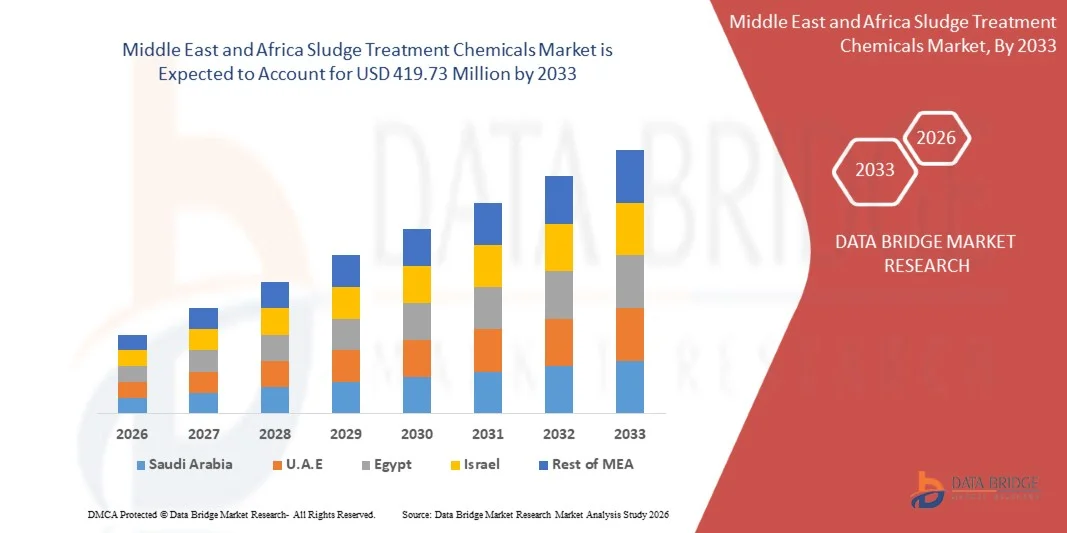
- As per Data Bridge Market Research Analysis the Middle East and Africa sludge treatment chemicals market size was valued at USD 259.40 million in 2025 and is expected to reach USD 419.73 million by 2033, at a CAGR of 6.20% during the forecast period
- The market growth is largely fuelled by the increasing investments in wastewater treatment infrastructure across industrial and municipal sectors, driven by rising environmental regulations and water scarcity concerns in the region
- The expansion of oil & gas, mining, and chemical industries is further accelerating demand for efficient sludge management solutions, as these sectors generate high volumes of industrial wastewater requiring advanced treatment chemicals
Market Size & Forecast
- Middle East and Africa Market Value (2025): USD 259.40 million
- Expected Market Value (2033): USD 419.73 million
- Forecast CAGR (2026–2033): 6.20%
Middle East and Africa Sludge Treatment Chemicals Market Analysis
- The market is witnessing steady growth due to stricter environmental compliance standards and growing government initiatives focused on sustainable water management and pollution control
- Increasing adoption of advanced sludge dewatering and conditioning chemicals in power generation, municipal wastewater plants, and industrial facilities is enhancing operational efficiency and supporting market expansion
- U.A.E. sludge treatment chemicals market captured the largest revenue share in 2025 within the Middle East and Africa region, fueled by strong investments in advanced wastewater treatment infrastructure and sustainable water management initiatives
- South Africa is expected to witness the highest compound annual growth rate (CAGR) in the Middle East and Africa sludge treatment chemicals market due to rising investments in mining, industrial wastewater treatment, and municipal sanitation infrastructure. Increasing government initiatives for water reuse, environmental protection, and improved wastewater management systems are further driving demand for sludge treatment chemicals across the country
- The flocculants segment held the largest market revenue share in 2025 driven by their extensive use in enhancing sludge dewatering efficiency and improving solid-liquid separation across municipal and industrial wastewater treatment plants. Flocculants are widely preferred due to their effectiveness in reducing sludge volume and lowering overall disposal costs, making them a critical component in large-scale treatment operations
Report Scope and Middle East and Africa Sludge Treatment Chemicals Market Segmentation
|
Attributes |
Middle East and Africa Sludge Treatment Chemicals Key Market Insights |
|
Segments Covered |
|
|
Countries Covered |
North America
Europe
Asia-Pacific
Middle East and Africa
South America
|
|
Key Market Players |
|
|
Market Opportunities |
|
|
Value Added Data Infosets |
|
What is the Key Trend in the Middle East and Africa Sludge Treatment Chemicals Market?
“Increasing Focus On Sustainable Wastewater Treatment Solutions”
• The growing emphasis on environmental sustainability and water conservation is significantly shaping the Middle East and Africa sludge treatment chemicals market, as governments and industries increasingly adopt advanced chemical solutions to manage sludge efficiently and reduce environmental pollution. Sludge treatment chemicals are gaining traction due to their ability to enhance dewatering, improve sludge stability, and reduce disposal costs while supporting regulatory compliance
• Rising investments in municipal wastewater treatment infrastructure and industrial effluent management are accelerating the demand for sludge treatment chemicals across the region. Rapid urbanization and industrial expansion are driving higher wastewater generation, prompting authorities to implement modern treatment technologies that improve operational efficiency and support sustainable water reuse initiatives
• Increasing awareness regarding environmental protection, water scarcity, and circular economy practices is influencing the adoption of sludge treatment chemicals in oil & gas, mining, power, and chemical industries. Governments and private players are prioritizing eco-friendly treatment processes, encouraging innovation in biodegradable and high-performance chemical formulations
• For instance, in 2024, Saudi Arabia and the U.A.E. expanded wastewater treatment projects by integrating advanced sludge conditioning and dewatering chemicals across municipal and industrial facilities. These initiatives were aimed at improving water reuse efficiency and reducing environmental impact, with deployment across large-scale treatment plants and industrial zones
• While demand for sludge treatment chemicals is increasing, sustained market growth depends on technological advancements, cost optimization, and improved chemical efficiency. Manufacturers are focusing on developing high-performance formulations that enhance treatment effectiveness while reducing environmental footprint and operational costs
Middle East and Africa Sludge Treatment Chemicals Market Dynamics
Driver
“Growing Industrialization And Expansion Of Wastewater Treatment Infrastructure”
• Rapid industrialization across oil & gas, mining, power generation, and manufacturing sectors is a major driver for the sludge treatment chemicals market. Increasing wastewater generation from these industries is creating strong demand for efficient sludge management solutions that improve treatment efficiency and support environmental compliance
• Governments across the Middle East and Africa region are heavily investing in wastewater treatment infrastructure development to address water scarcity challenges and promote sustainable water reuse. These investments are significantly boosting the adoption of advanced sludge treatment chemicals in municipal and industrial applications
• Growing regulatory pressure for wastewater discharge standards and environmental protection is encouraging industries to adopt chemical-based sludge treatment processes. This is driving innovation in high-performance flocculants, coagulants, and conditioning agents that enhance sludge handling efficiency
• For instance, in 2023, the U.A.E. and South Africa implemented upgraded wastewater treatment projects incorporating advanced sludge dewatering chemicals in municipal plants and industrial zones. These projects were driven by increasing demand for water recycling and stricter environmental compliance requirements, supporting operational efficiency and sustainability goals
• Although industrial expansion supports market growth, adoption levels depend on cost efficiency, chemical availability, and infrastructure readiness. Continuous investment in research, supply chain optimization, and localized production will be essential for long-term market development
Restraint/Challenge
“High Operational Costs And Limited Technical Awareness”
• The high cost of advanced sludge treatment chemicals compared to conventional treatment methods remains a key challenge in the Middle East and Africa region. Expensive raw materials, import dependency, and complex formulation processes contribute to increased operational costs, limiting adoption in price-sensitive markets
• Limited technical awareness and expertise regarding advanced sludge treatment solutions also restrict market penetration, particularly in developing economies. Many end users still rely on traditional sludge management methods due to insufficient knowledge of chemical-based treatment benefits and operational efficiencies
• Infrastructure limitations and inconsistent regulatory enforcement across certain countries further hinder market expansion. Inadequate wastewater treatment facilities and lack of standardized guidelines create barriers to widespread adoption of advanced chemical solutions
• For instance, in 2024, several municipal wastewater facilities in Egypt and Nigeria reported slower adoption of advanced sludge treatment chemicals due to budget constraints and limited awareness of performance benefits compared to conventional methods. Dependence on imported chemicals also increased overall treatment costs, affecting procurement decisions
• Addressing these challenges will require cost-effective product development, improved technical training, and stronger collaboration between governments and chemical manufacturers. Expanding local production capabilities and enhancing awareness programs will be critical to unlocking long-term growth in the regional sludge treatment chemicals market
Middle East and Africa Sludge Treatment Chemicals Market Scope
The market is segmented on the basis of type, treatment, and end user.
• By Type
On the basis of type, the Middle East and Africa sludge treatment chemicals market is segmented into flocculants, coagulants, disinfectants, defoamers, and activated carbon. The flocculants segment held the largest market revenue share in 2025 driven by their extensive use in enhancing sludge dewatering efficiency and improving solid-liquid separation across municipal and industrial wastewater treatment plants. Flocculants are widely preferred due to their effectiveness in reducing sludge volume and lowering overall disposal costs, making them a critical component in large-scale treatment operations.
The coagulants segment is expected to witness the fastest growth rate from 2026 to 2033, driven by increasing demand for efficient particle destabilization and improved sludge settling performance in industrial wastewater treatment processes. Coagulants are increasingly being adopted in oil & gas, mining, and chemical industries to enhance treatment efficiency and comply with stringent environmental regulations.
• By Treatment
On the basis of treatment, the market is segmented into primary, secondary, and tertiary. The primary treatment segment held the largest market revenue share in 2025 driven by its widespread application in initial sludge separation and removal of suspended solids in municipal and industrial wastewater treatment systems. Primary treatment processes are essential for reducing pollutant load and improving downstream treatment efficiency, making them a key step in sludge management operations.
The tertiary treatment segment is expected to witness the fastest growth rate from 2026 to 2033, driven by increasing demand for advanced purification and water reuse applications. Tertiary treatment processes are gaining traction in water-scarce regions across the Middle East and Africa due to their ability to produce high-quality effluent suitable for reuse in industrial and municipal applications.
• By End User
On the basis of end user, the market is segmented into automotive, oil and gas, metal processing, food and beverage, pulp and paper, personal care and chemicals, electronics, paint and coatings, mining, and others. The oil and gas segment held the largest market revenue share in 2025 driven by high wastewater generation from upstream and downstream operations and the need for efficient sludge handling in refining and extraction processes. Sludge treatment chemicals are extensively used to ensure regulatory compliance and operational efficiency in this sector.
The mining segment is expected to witness the fastest growth rate from 2026 to 2033, driven by increasing mining activities and the generation of large volumes of industrial wastewater requiring advanced sludge treatment solutions. Growing emphasis on sustainable mining practices and environmental protection is further accelerating the adoption of chemical-based sludge management systems in the region.
Middle East and Africa Sludge Treatment Chemicals Market Regional Analysis
- U.A.E. sludge treatment chemicals market captured the largest revenue share in 2025 within the Middle East and Africa region, fueled by strong investments in advanced wastewater treatment infrastructure and sustainable water management initiatives
- The country’s focus on water reuse, smart city development, and environmental sustainability is significantly driving the adoption of high-performance sludge treatment chemicals across municipal and industrial facilities
- Rapid expansion of oil & gas, petrochemical, and construction activities is further increasing wastewater generation, supporting market growth
- In addition, the integration of advanced treatment technologies and strict environmental regulations is enhancing operational efficiency and accelerating demand for chemical-based sludge management solutions
South Africa Sludge Treatment Chemicals Market Insight
South Africa sludge treatment chemicals market is expected to witness the fastest growth rate from 2026 to 2033, driven by rapid urbanization, increasing population, and rising demand for improved wastewater treatment infrastructure across developing economies. The growing need for effective sludge management in municipal and industrial sectors is significantly supporting market expansion, particularly in countries such as South Africa, Nigeria, and Egypt.
Middle East and Africa Sludge Treatment Chemicals Market Share
The Middle East and Africa sludge treatment chemicals industry is primarily led by well-established companies, including:
• Saudi Basic Industries Corporation (SABIC) (Saudi Arabia)
• Saudi Aramco (Saudi Arabia)
• Advanced Petrochemical Company (Saudi Arabia)
• Saudi Kayan Petrochemical Company (Saudi Arabia)
• Saudi International Petrochemical Company (SIPCHEM) (Saudi Arabia)
• Tasnee (Saudi Arabia)
• NAMA Chemicals (Saudi Arabia)
• Petro Rabigh (Saudi Arabia)
• Borouge (U.A.E.)
• Abu Dhabi National Oil Company (ADNOC) (U.A.E.)
• Metito (U.A.E.)
• Orascom Construction (Egypt)
• Egyptian Petrochemicals Company (Egypt)
• Alexandria Fertilizers Company (Egypt)
• Sasol (South Africa)

- Interactive Data Analysis Dashboard
- Company Analysis Dashboard for high growth potential opportunities
- Research Analyst Access for customization & queries
- Competitor Analysis with Interactive dashboard
- Latest News, Updates & Trend analysis
- Harness the Power of Benchmark Analysis for Comprehensive Competitor Tracking
Middle East And Africa Sludge Treatment Market, Supply Chain Analysis and Ecosystem Framework
To support market growth and help clients navigate the impact of geopolitical shifts, DBMR has integrated in-depth supply chain analysis into its Middle East And Africa Sludge Treatment Market research reports. This addition empowers clients to respond effectively to global changes affecting their industries. The supply chain analysis section includes detailed insights such as Middle East And Africa Sludge Treatment Market consumption and production by country, price trend analysis, the impact of tariffs and geopolitical developments, and import and export trends by country and HSN code. It also highlights major suppliers with data on production capacity and company profiles, as well as key importers and exporters. In addition to research, DBMR offers specialized supply chain consulting services backed by over a decade of experience, providing solutions like supplier discovery, supplier risk assessment, price trend analysis, impact evaluation of inflation and trade route changes, and comprehensive market trend analysis.
Data collection and base year analysis are done using data collection modules with large sample sizes. The stage includes obtaining market information or related data through various sources and strategies. It includes examining and planning all the data acquired from the past in advance. It likewise envelops the examination of information inconsistencies seen across different information sources. The market data is analysed and estimated using market statistical and coherent models. Also, market share analysis and key trend analysis are the major success factors in the market report. To know more, please request an analyst call or drop down your inquiry.
The key research methodology used by DBMR research team is data triangulation which involves data mining, analysis of the impact of data variables on the market and primary (industry expert) validation. Data models include Vendor Positioning Grid, Market Time Line Analysis, Market Overview and Guide, Company Positioning Grid, Patent Analysis, Pricing Analysis, Company Market Share Analysis, Standards of Measurement, Global versus Regional and Vendor Share Analysis. To know more about the research methodology, drop in an inquiry to speak to our industry experts.
Data Bridge Market Research is a leader in advanced formative research. We take pride in servicing our existing and new customers with data and analysis that match and suits their goal. The report can be customized to include price trend analysis of target brands understanding the market for additional countries (ask for the list of countries), clinical trial results data, literature review, refurbished market and product base analysis. Market analysis of target competitors can be analyzed from technology-based analysis to market portfolio strategies. We can add as many competitors that you require data about in the format and data style you are looking for. Our team of analysts can also provide you data in crude raw excel files pivot tables (Fact book) or can assist you in creating presentations from the data sets available in the report.













