Middle East And Africa Molecular Diagnostics Market
Market Size in USD Billion
CAGR :
% 
 USD
1.16 Billion
USD
1.86 Billion
2025
2033
USD
1.16 Billion
USD
1.86 Billion
2025
2033
 Forecast Period Forecast Period |
2026 –2033 |
 Market Size (Base Year) Market Size (Base Year) |
USD 1.16 Billion |
 Market Size (Forecast Year) Market Size (Forecast Year) |
USD 1.86 Billion |
 CAGR CAGR |
% |
| Major Markets Players |
|
Middle East and Africa Molecular Diagnostics Market Size
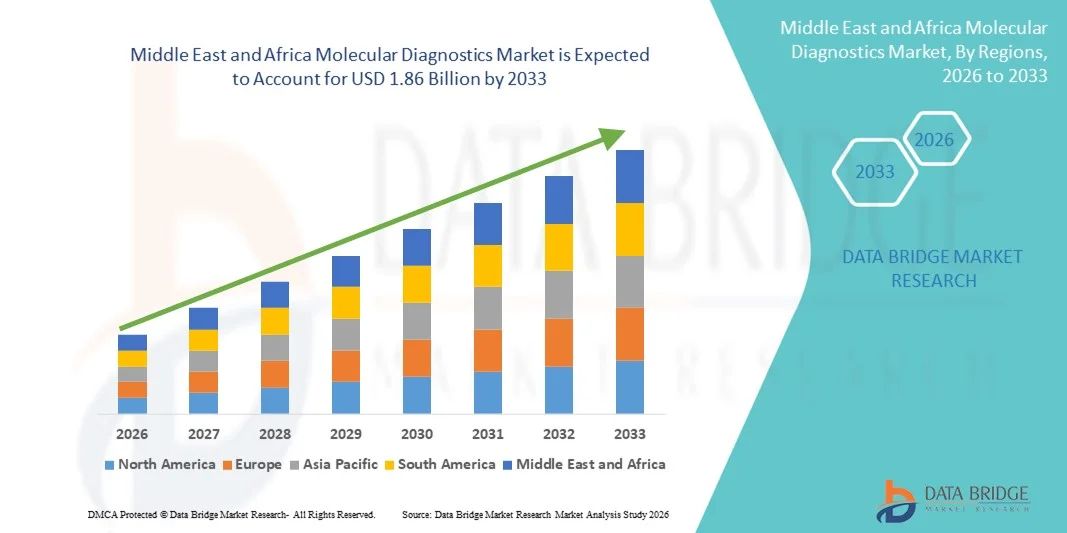
- The Middle East and Africa molecular diagnostics market size was valued at USD 1.16 billion in 2025 and is expected to reach USD 1.86 billion by 2033, at a CAGR of 6.1% during the forecast period
- The market growth is primarily driven by increasing prevalence of infectious diseases, genetic disorders, and chronic conditions, combined with advancements in molecular testing technologies such as PCR, next-generation sequencing, and isothermal amplification methods across hospitals, diagnostic labs, and point-of-care settings
- Moreover, rising healthcare investments, growing awareness of early disease detection, and government initiatives to improve laboratory infrastructure are positioning molecular diagnostics as a crucial tool for timely and accurate patient diagnosis. These factors are accelerating adoption, thereby significantly enhancing the market's growth trajectory in the MEA region
Middle East and Africa Molecular Diagnostics Market Analysis
- Molecular diagnostics, encompassing advanced technologies for detecting DNA, RNA, and protein biomarkers, are increasingly critical in hospitals, clinical laboratories, and academic research centers across MEA countries due to their high accuracy, rapid results, and role in personalized medicine
- The growing demand for molecular diagnostics is primarily driven by rising prevalence of infectious diseases, cancer, and genetic disorders, along with increasing adoption of technologies such as PCR-based methods, next-generation sequencing (NGS), and microarray platforms, which enable faster and more precise diagnosis
- United Arab Emirates (UAE) dominated the MEA molecular diagnostics market with the largest revenue share of 22.4% in 2025, supported by government initiatives to strengthen healthcare infrastructure, expand molecular testing capabilities, and improve disease surveillance, along with significant investments in state-of-the-art diagnostic instruments and reagents
- South Africa is expected to be the fastest-growing country in the MEA molecular diagnostics market during the forecast period due to rising healthcare expenditure, improved access to laboratory facilities, and growing awareness of early disease detection and precision medicine
- Reagents & kits segment dominated the molecular diagnostics market with a market share of 48.3% in 2025, driven by increasing demand for high-quality consumables, cost-effective solutions for PCR, NGS, and infectious disease testing, and ongoing public health programs requiring standardized diagnostic kits
Report Scope and Middle East and Africa Molecular Diagnostics Market Segmentation
|
Attributes |
Middle East and Africa Molecular Diagnostics Key Market Insights |
|
Segments Covered |
|
|
Countries Covered |
Middle East and Africa
|
|
Key Market Players |
|
|
Market Opportunities |
|
|
Value Added Data Infosets |
In addition to the insights on market scenarios such as market value, growth rate, segmentation, geographical coverage, and major players, the market reports curated by the Data Bridge Market Research also include in-depth expert analysis, patient epidemiology, pipeline analysis, pricing analysis, and regulatory framework |
Middle East and Africa Molecular Diagnostics Market Trends
Advancements in Rapid and Point-of-Care Testing
- A notable and accelerating trend in the MEA molecular diagnostics market is the growing adoption of rapid and point-of-care (POC) testing platforms, enabling faster diagnosis and treatment decisions, particularly in remote or under-served areas
- For instance, Cepheid’s GeneXpert system has been increasingly deployed in South Africa and Nigeria to provide rapid TB and COVID-19 testing at decentralized locations, reducing turnaround times from days to hours
- Integration of POC molecular diagnostics with digital reporting and mobile health platforms is enabling real-time disease surveillance and epidemiological tracking across hospitals and clinics, improving patient management
- Technological advances, such as microfluidics and lab-on-a-chip solutions, are enhancing test sensitivity and specificity while minimizing sample volume and operational complexity
- This trend towards more portable, accurate, and connected molecular testing solutions is reshaping expectations for healthcare delivery, pushing companies such as Roche Diagnostics and Abbott to develop compact, high-throughput instruments suitable for MEA healthcare settings
- The demand for rapid, easy-to-use, and decentralized molecular diagnostics is increasing rapidly across both public health programs and private clinical laboratories, driven by the need for timely disease detection and monitoring
- Collaboration between diagnostic companies and local governments to deploy mobile and community-based testing units is further driving adoption in rural and hard-to-reach areas, increasing access to molecular diagnostics across the region
Middle East and Africa Molecular Diagnostics Market Dynamics
Driver
Rising Prevalence of Infectious Diseases and Chronic Conditions
- The increasing incidence of infectious diseases such as HIV, TB, hepatitis, and COVID-19, alongside rising cases of cancer and genetic disorders, is a significant driver of molecular diagnostics adoption across MEA healthcare facilities
- For instance, in 2025, Saudi Arabia expanded national TB screening programs by integrating PCR-based molecular tests in clinical laboratories to improve early detection and treatment outcomes
- Molecular diagnostics provide rapid, accurate, and sensitive detection, enabling timely clinical decision-making, better patient outcomes, and efficient disease management
- Growing investments in advanced laboratory infrastructure, supported by government healthcare initiatives in countries such as UAE and Egypt, are facilitating the adoption of sophisticated molecular testing platforms
- Increasing awareness among clinicians and patients regarding the benefits of early diagnosis and personalized medicine is further accelerating the uptake of molecular diagnostics technologies in both hospital and private laboratory settings
- Expanding public health programs, rising healthcare expenditure, and increasing adoption of advanced diagnostic platforms are collectively propelling market growth across the MEA region
- Private healthcare providers in MEA are increasingly partnering with global diagnostic companies to implement cutting-edge molecular technologies, creating new market opportunities and driving overall adoption
- Emergence of molecular testing for non-communicable diseases such as cardiovascular and neurological disorders is expanding applications, contributing to market growth beyond infectious disease diagnostics
Restraint/Challenge
High Cost of Instruments and Skilled Workforce Shortage
- The relatively high cost of molecular diagnostic instruments, consumables, and maintenance, compared to traditional diagnostic methods, poses a significant adoption challenge in price-sensitive MEA markets
- For instance, high costs of NGS platforms and associated reagents in Egypt and Nigeria limit accessibility in smaller clinics and rural healthcare settings, slowing widespread penetration
- A shortage of trained laboratory personnel and technical expertise to operate complex molecular diagnostic platforms further restricts market growth, particularly in sub-Saharan African countries
- Challenges around regulatory approvals, quality control, and standardization of molecular tests across multiple MEA countries add complexity to product launch and market entry strategies
- Addressing these challenges requires investments in workforce training, cost-effective testing solutions, and robust regulatory frameworks to facilitate reliable diagnostics adoption
- While prices of some POC and simplified molecular testing kits are gradually decreasing, the premium for advanced technologies and limited local expertise continue to restrict rapid and uniform adoption across the region
- Inconsistent supply chains for reagents and kits in certain MEA countries cause delays and limit test availability, creating operational hurdles for laboratories and hospitals
- Limited awareness among smaller clinics and rural healthcare providers about advanced molecular diagnostics reduces adoption potential, highlighting the need for education and outreach programs
Middle East and Africa Molecular Diagnostics Market Scope
The market is segmented on the basis of products, technology, application, and end user.
- By Products
On the basis of products, the MEA molecular diagnostics market is segmented into reagents & kits, instruments, and services & softwares. The Reagents & Kits segment dominated the market with the largest revenue share of 48.3% in 2025, driven by the rising need for consumables for PCR-based testing, NGS, infectious disease panels, and oncology diagnostics. Laboratories across UAE, Saudi Arabia, and South Africa prioritize high-quality reagents to ensure reliable and accurate results, especially for high-throughput applications. The demand is also fueled by government-supported public health programs targeting TB, HIV, and COVID-19 testing, which rely heavily on standardized kits. In addition, reagents and kits are relatively easier to deploy across decentralized and point-of-care facilities, making them the backbone of molecular diagnostics operations in MEA.
The Instruments segment is anticipated to witness the fastest CAGR of 10.2% from 2026 to 2033, driven by the adoption of advanced platforms such as automated PCR systems, NGS sequencers, and microarray analyzers. Countries such as Saudi Arabia and UAE are investing in high-throughput instruments to strengthen hospital and clinical laboratory capabilities. The growth is also supported by rising demand for rapid diagnostic technologies in oncology and infectious disease management, coupled with increasing adoption in private and public hospitals for precision medicine initiatives. Instruments segment growth is further enhanced by collaborations between global diagnostic companies and local healthcare providers to deploy modern lab infrastructure.
- By Technology
On the basis of technology, the market is segmented into Mass Spectrometry (MS), Capillary Electrophoresis, Next Generation Sequencing (NGS), Chips and Microarray, Polymerase Chain Reaction (PCR)-Based Methods, Cytogenetics, In Situ Hybridization (ISH or FISH), Molecular Imaging, and Others. The PCR-Based Methods segment dominated the market with a 50.6% revenue share in 2025, due to its widespread application in infectious disease detection, oncology, and prenatal testing. PCR remains the gold standard for rapid, sensitive, and specific detection of pathogens and genetic markers. Hospitals and clinical laboratories across UAE, Egypt, and Nigeria heavily rely on PCR platforms for TB, COVID-19, and hepatitis screening. The segment’s dominance is also reinforced by availability of cost-effective kits, growing awareness about early diagnosis, and government-led disease surveillance programs.
The Next Generation Sequencing (NGS) segment is expected to witness the fastest growth rate of 11.5% CAGR from 2026 to 2033, driven by increasing adoption in oncology, pharmacogenomics, and rare disease testing. NGS technology enables comprehensive genomic profiling, guiding personalized therapy decisions and research applications. GCC countries, particularly Saudi Arabia and UAE, are actively expanding NGS infrastructure in hospitals and academic centers. The growing focus on precision medicine and investments in high-throughput sequencing platforms is further accelerating growth in this segment.
- By Application
On the basis of application, the market is segmented into oncology, pharmacogenomics, microbiology, prenatal tests, tissue typing, blood screening, cardiovascular diseases, neurological diseases, infectious diseases, and others. The Infectious Diseases segment dominated the market with a 46.5% revenue share in 2025, driven by the high prevalence of TB, HIV, hepatitis, and COVID-19 in MEA countries. Governments in South Africa, Nigeria, and Egypt have implemented large-scale screening programs using molecular diagnostics, increasing the consumption of reagents and testing services. Infectious disease testing also benefits from point-of-care deployment in clinics and mobile labs, improving accessibility in remote areas. The segment remains a critical focus for public health initiatives, ensuring sustained demand and market leadership.
The Oncology segment is expected to witness the fastest CAGR of 12.1% from 2026 to 2033, fueled by growing cancer prevalence, rising awareness of early diagnosis, and adoption of molecular testing for targeted therapies. NGS, PCR, and microarray technologies are increasingly used for tumor profiling, mutation detection, and monitoring treatment response. UAE and Saudi Arabia are investing in oncology-focused molecular diagnostics in tertiary care hospitals and academic research centers. Expansion of personalized medicine initiatives and increasing private healthcare investments are key drivers for the rapid growth of this segment.
- By End User
On the basis of end user, the market is segmented into hospitals, clinical laboratories, and academics. The Hospitals segment dominated the market with a 51.2% revenue share in 2025, owing to high patient volumes, large-scale adoption of molecular diagnostics for infectious disease, oncology, and prenatal testing, and investments in advanced lab infrastructure. Major hospitals in UAE, Saudi Arabia, and South Africa are increasingly integrating molecular testing into routine diagnostics for faster turnaround and improved patient care. Hospitals also prefer comprehensive solutions that include instruments, reagents, and software, creating a one-stop demand for vendors.
The Clinical Laboratories segment is expected to witness the fastest CAGR of 10.8% from 2026 to 2033, driven by the rise of private diagnostic chains, specialized laboratories, and point-of-care testing facilities in urban centers. Countries such as Nigeria, Egypt, and South Africa are witnessing an increase in private labs offering high-throughput molecular testing for infectious diseases, oncology, and pharmacogenomics. Growing collaborations between international diagnostic companies and local laboratories, coupled with outsourcing of molecular testing services, are accelerating adoption and market growth in this segment.
Middle East and Africa Molecular Diagnostics Market Regional Analysis
- United Arab Emirates (UAE) dominated the MEA molecular diagnostics market with the largest revenue share of 22.4% in 2025, supported by government initiatives to strengthen healthcare infrastructure, expand molecular testing capabilities, and improve disease surveillance, along with significant investments in state-of-the-art diagnostic instruments and reagents
- Healthcare providers and laboratories in the UAE prioritize the adoption of PCR, NGS, and point-of-care molecular testing platforms due to the high prevalence of infectious diseases, rising demand for oncology diagnostics, and the need for rapid, accurate results for both routine and specialized testing
- This strong market position is further supported by the country’s high healthcare expenditure, technologically advanced population, and growing focus on precision medicine, establishing molecular diagnostics as a critical tool for patient management and public health programs in both private and public sectors
The UAE Molecular Diagnostics Market Insight
The UAE molecular diagnostics market captured the largest revenue share of 22.4% in 2025, fueled by extensive investments in healthcare infrastructure, advanced laboratory facilities, and government-led initiatives to expand molecular testing capabilities. Hospitals and clinical laboratories in the UAE are increasingly adopting PCR, NGS, and point-of-care platforms for infectious diseases, oncology, and prenatal testing. The growing focus on precision medicine, combined with high healthcare expenditure and a technologically advanced population, is accelerating the adoption of molecular diagnostics across both public and private sectors. Moreover, collaborations between international diagnostic companies and local hospitals are enhancing accessibility and deployment of cutting-edge diagnostic solutions.
Saudi Arabia Molecular Diagnostics Market Insight
The Saudi Arabia molecular diagnostics market held the second-largest revenue share of 20.8% in 2025, supported by nationwide programs for early disease detection and the adoption of high-throughput molecular testing platforms. Hospitals and diagnostic laboratories in the country are increasingly implementing PCR, NGS, and microarray technologies for oncology, infectious disease, and pharmacogenomics applications. Rising investments in healthcare infrastructure, along with government initiatives to strengthen laboratory networks, are driving market growth. Furthermore, growing awareness of early diagnosis and personalized medicine is stimulating demand across both hospital and private laboratory segments.
South Africa Molecular Diagnostics Market Insight
The South Africa molecular diagnostics market is emerging as the fastest-growing country in MEA, with a projected CAGR of 9.3%, driven by rising awareness of early disease detection and expanding clinical laboratory infrastructure. The country is witnessing increasing deployment of point-of-care and decentralized molecular testing platforms, particularly for infectious diseases such as HIV and TB. Government initiatives supporting disease surveillance programs, coupled with the growth of private diagnostic chains, are facilitating market expansion. Furthermore, adoption of high-throughput instruments in tertiary care hospitals and research centers is increasing the overall testing capacity and efficiency.
Egypt Molecular Diagnostics Market Insight
The Egypt molecular diagnostics market accounted for 12.7% of the MEA market in 2025, fueled by government-led initiatives to improve infectious disease screening and laboratory diagnostics. Hospitals and clinical laboratories are investing in PCR and NGS technologies to meet growing demand for rapid, accurate, and reliable testing. Expanding private healthcare services, rising awareness of early detection, and collaborations with international diagnostic companies are contributing to market growth. In addition, increasing prevalence of infectious diseases and oncology cases is driving the adoption of molecular diagnostics across urban and semi-urban regions.
Middle East and Africa Molecular Diagnostics Market Share
The Middle East and Africa Molecular Diagnostics industry is primarily led by well-established companies, including:
- Abbott (U.S.)
- BIOMÉRIEUX (France)
- Thermo Fisher Scientific Inc. (U.S.)
- Bio-Rad Laboratories, Inc. (U.S.)
- Meridian Bioscience, Inc. (U.S.)
- Illumina, Inc. (U.S.)
- Siemens Healthineers AG (Germany)
- Hologic, Inc. (U.S.)
- Agilent Technologies, Inc. (U.S.)
- BD (U.S.)
- DiaSorin S.p.A. (Italy)
- Quidel Corporation (U.S.)
- SD Biosensor, Inc. (South Korea)
- Mindray Medical International (China)
- Astragene (U.A.E.)
- Euroimmun Medizinische Labordiagnostika AG (Germany)
- F. Hoffmann-La Roche Ltd. (Switzerland)
- QIAGEN (Netherlands)
- Danaher (U.S.)
What are the Recent Developments in Middle East and Africa Molecular Diagnostics Market?
- In March 2025, Illumina and Africa CDC renewed their partnership to integrate pathogen genomics and bioinformatics into routine public health surveillance in Africa, advancing rapid infectious disease response capabilities and bolstering molecular diagnostics infrastructure across the continent
- In December 2024, Abbott partnered with ISN to transform private healthcare testing in Nigeria, launching a strategic initiative to deploy 50 m‑PIMA™ diagnostic machines across private healthcare facilities to enhance access to molecular and point‑of‑care diagnostics, making advanced testing more affordable and sustainable for laboratories nationwide
- In December 2024, the Presidential Initiative for Unlocking Healthcare Value Chains (PVAC) signed an MoU with Abbott Rapid Diagnostics to localize rapid diagnostic test production in Nigeria, aimed at increasing locally produced molecular diagnostic kits and reducing reliance on imports a move expected to improve availability and affordability of rapid tests in West Africa.
- In September 2024, Roche launched the cobas Respiratory flex test, the first molecular diagnostic assay using its proprietary TAGS (Temperature‑Activated Generation of Signal) technology enabling simultaneous PCR‑based detection of up to 12 respiratory pathogens from a single sample, enhancing high‑throughput testing capacity across diagnostic labs
- In April 2024, the Africa CDC initiated two landmark genomic surveillance and molecular diagnostics projects the Integrated Genomic Surveillance & Data Sharing Platform (IGS) and Integrated Genomic Surveillance for Outbreak Detection (DETECT) to strengthen multi‑pathogen detection, antimicrobial resistance (AMR) genomic surveillance, and rapid data exchange across African Union member states
SKU-
Get online access to the report on the World's First Market Intelligence Cloud
- Interactive Data Analysis Dashboard
- Company Analysis Dashboard for high growth potential opportunities
- Research Analyst Access for customization & queries
- Competitor Analysis with Interactive dashboard
- Latest News, Updates & Trend analysis
- Harness the Power of Benchmark Analysis for Comprehensive Competitor Tracking
Research Methodology
Data collection and base year analysis are done using data collection modules with large sample sizes. The stage includes obtaining market information or related data through various sources and strategies. It includes examining and planning all the data acquired from the past in advance. It likewise envelops the examination of information inconsistencies seen across different information sources. The market data is analysed and estimated using market statistical and coherent models. Also, market share analysis and key trend analysis are the major success factors in the market report. To know more, please request an analyst call or drop down your inquiry.
The key research methodology used by DBMR research team is data triangulation which involves data mining, analysis of the impact of data variables on the market and primary (industry expert) validation. Data models include Vendor Positioning Grid, Market Time Line Analysis, Market Overview and Guide, Company Positioning Grid, Patent Analysis, Pricing Analysis, Company Market Share Analysis, Standards of Measurement, Global versus Regional and Vendor Share Analysis. To know more about the research methodology, drop in an inquiry to speak to our industry experts.
Customization Available
Data Bridge Market Research is a leader in advanced formative research. We take pride in servicing our existing and new customers with data and analysis that match and suits their goal. The report can be customized to include price trend analysis of target brands understanding the market for additional countries (ask for the list of countries), clinical trial results data, literature review, refurbished market and product base analysis. Market analysis of target competitors can be analyzed from technology-based analysis to market portfolio strategies. We can add as many competitors that you require data about in the format and data style you are looking for. Our team of analysts can also provide you data in crude raw excel files pivot tables (Fact book) or can assist you in creating presentations from the data sets available in the report.