


Infusion Pump System, Accessories and Software Market Size
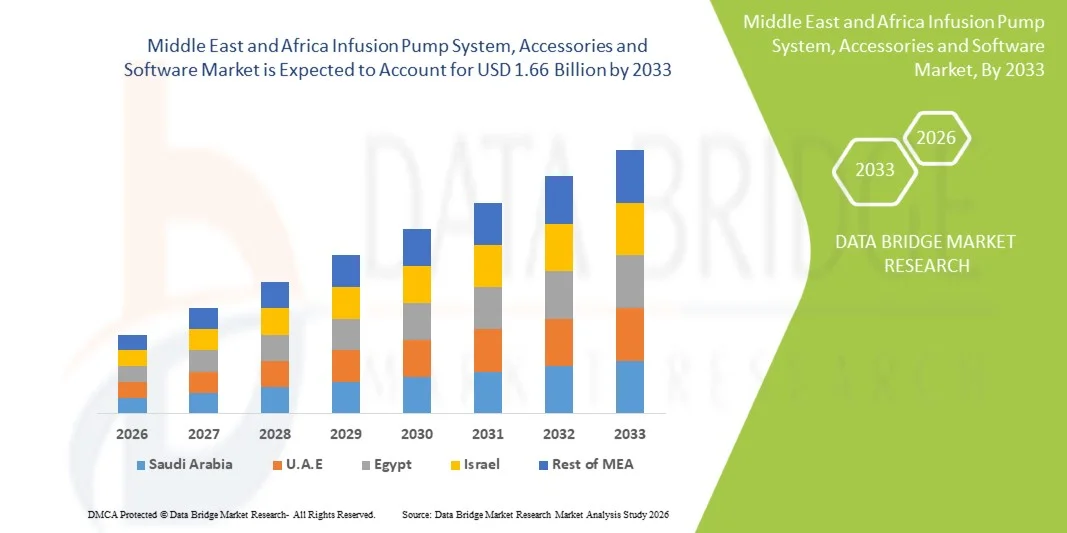
- The Middle East-Africa Infusion Pump System, Accessories and Software market size was valued at USD 1.23 billion in 2025and is expected to reach USD 1.66 billion by 2033, at a CAGR of 3.85% during the forecast period
- The market growth is largely fueled by the increasing prevalence of chronic diseases and continuous advancements in infusion technologies, leading to enhanced precision, safety, and efficiency in drug delivery across healthcare settings
- Furthermore, rising demand for patient-centric care, improved medication management, and integration of digital health solutions is establishing infusion pump systems, accessories, and software as essential tools in modern healthcare. These converging factors are accelerating the adoption of infusion pump solutions, thereby significantly boosting the industry's growth
Infusion Pump System, Accessories and Software Market Analysis
- Infusion pump systems, along with their associated accessories and software, are increasingly vital components of modern healthcare delivery across hospitals, ambulatory care centers, and home care settings due to their ability to ensure precise, controlled, and continuous administration of medications, fluids, and nutrients
- The escalating demand for infusion pump systems, accessories, and software is primarily fueled by the rising prevalence of chronic diseases, increasing geriatric population, growing need for home-based care, and heightened focus on patient safety and medication accuracy
- Saudi Arabia dominated the infusion pump system, accessories and software market with the largest revenue share in 2025, supported by well-established healthcare infrastructure, significant government investments in healthcare modernization, and increasing adoption of advanced medical technologies across hospitals and specialty clinics
- A.E is expected to be the fastest growing region in the infusion pump system, accessories and software market during the forecast period due to rapid healthcare expansion, rising medical tourism, and strong focus on digital health transformation and smart healthcare solutions
- The infusion pump systems segment dominated the largest market revenue share of 52.8% in 2025, driven by the increasing prevalence of chronic diseases requiring continuous drug delivery, such as diabetes, cancer, and cardiovascular disorders
Report Scope and Infusion Pump System, Accessories and Software Market Segmentation
|
Attributes |
Infusion Pump System, Accessories and Software Key Market Insights |
|
Segments Covered |
|
|
Countries Covered |
Middle East and Africa · Saudi Arabia · U.A.E. · South Africa · Egypt · Israel · Rest of Middle East and Africa |
|
Key Market Players |
· Baxter International Inc. (U.S.) · B. Braun Melsungen AG (Germany) · Fresenius SE & Co. KGaA (Germany) · ICU Medical, Inc. (U.S.) · Medtronic plc (Ireland) · BD (U.S.) · Smiths Medical (U.K.) · Moog Inc. (U.S.) · Terumo Corporation (Japan) · Nipro Corporation (Japan) · Insulet Corporation (U.S.) · Ypsomed Holding AG (Switzerland) · Roche Holding AG (Switzerland) · Micrel Medical Devices SA (Greece) · Zyno Medical (U.S.) · CareFusion (U.S.) · Mindray Medical International Limited (China) · Shenzhen Medcaptain Medical Technology Co., Ltd. (China) · Arcomed AG (Switzerland) · Vygon Group (France) |
|
Market Opportunities |
· Expansion of Home Healthcare and Remote Patient Monitoring · Integration of Smart Technologies and Digital Health Solutions |
|
Value Added Data Infosets |
In addition to the insights on market scenarios such as market value, growth rate, segmentation, geographical coverage, and major players, the market reports curated by the Data Bridge Market Research also include in-depth expert analysis, patient epidemiology, pipeline analysis, pricing analysis, and regulatory framework. |
Infusion Pump System, Accessories and Software Market Trends
“Advancements in Smart Infusion Technologies and Integrated Healthcare Systems”
- A significant and accelerating trend in the Middle East-Africa Infusion Pump System, Accessories and Software market is the increasing adoption of smart infusion technologies, connectivity-enabled devices, and integrated medication management systems aimed at enhancing patient safety and clinical efficiency. This evolution is significantly improving accuracy in drug delivery and reducing medication errors across healthcare settings
- For instance, modern infusion pumps equipped with dose error reduction systems (DERS) and drug libraries are being widely deployed in hospitals to ensure precise medication administration and minimize adverse events. Similarly, volumetric and syringe infusion pumps with programmable features are increasingly used in intensive care units and neonatal care
- Integration of infusion systems with hospital information systems (HIS) and electronic health records (EHR) is enabling real-time monitoring, automated documentation, and improved workflow management. For instance, connected infusion platforms allow clinicians to track infusion parameters remotely and adjust dosages based on patient-specific requirements. Furthermore, wireless-enabled systems support centralized control and analytics-driven decision-making in clinical environments
- The growing use of ambulatory infusion pumps for home healthcare and chronic disease management is facilitating greater patient mobility and reducing hospital stays. Through portable and user-friendly devices, patients can receive continuous therapies such as chemotherapy, insulin, or pain management outside traditional clinical settings
- This trend toward more efficient, connected, and patient-centric infusion solutions is fundamentally reshaping expectations for medication delivery systems. Consequently, companies such as Baxter International, B. Braun, and Fresenius Kabi are focusing on advanced infusion platforms and safety-enhanced accessories
- The demand for infusion pump systems, accessories, and software that offer improved safety, interoperability, and ease of use is growing rapidly across hospitals, clinics, and home care settings in the Middle East and Africa, as healthcare providers increasingly prioritize quality care delivery and operational efficiency
Infusion Pump System, Accessories and Software Market Dynamics
Driver
“Rising Burden of Chronic Diseases and Expanding Healthcare Infrastructure”
- The increasing prevalence of chronic diseases such as diabetes, cancer, and cardiovascular conditions, coupled with expanding healthcare infrastructure in the Middle East and Africa, is a significant driver for the infusion pump market
- For instance, growing investments in hospital expansion projects and critical care facilities across countries such as Saudi Arabia, the UAE, and South Africa are increasing the adoption of advanced infusion systems for accurate drug delivery
- Rising demand for continuous and controlled drug administration in intensive care units, oncology departments, and surgical settings is further supporting market growth
- Furthermore, the growing shift toward home-based care and outpatient treatment models is increasing the demand for portable and easy-to-use infusion pumps
- The availability of technologically advanced infusion devices and supportive government initiatives aimed at improving healthcare access are key factors propelling market expansion in the region
Restraint/Challenge
“High Equipment Costs, Maintenance Requirements, and Limited Skilled Workforce”
- One of the key challenges in the infusion pump system, accessories and software market is the high cost of advanced infusion devices, along with ongoing maintenance and calibration requirements, which can limit adoption in resource-constrained settings
- For instance, smaller hospitals and clinics in parts of Africa may face budget constraints that restrict procurement of advanced smart infusion pumps and associated software systems
- Limited availability of trained healthcare professionals to operate and manage infusion systems effectively can also impact optimal utilization and patient safety
- Infrastructure challenges, including inconsistent power supply and limited digital connectivity in certain regions, may further hinder seamless integration of advanced infusion technologies
- Addressing these challenges through cost-effective device innovation, training programs for healthcare professionals, and improved infrastructure support will be essential for sustained market growth in the Middle East and Africa
Infusion Pump System, Accessories and Software Market Scope
The market is segmented on the basis of type, application, end-user, and distribution channel.
- By Type
On the basis of type, the Middle East-Africa Infusion Pump System, Accessories and Software market is segmented into infusion pump systems, infusion pump accessories, and infusion pump management software. The infusion pump systems segment dominated the largest market revenue share of 52.8% in 2025, driven by the increasing prevalence of chronic diseases requiring continuous drug delivery, such as diabetes, cancer, and cardiovascular disorders. These systems are widely used across hospitals and home healthcare settings due to their accuracy in delivering fluids, medications, and nutrients. Technological advancements such as smart infusion pumps with dose error reduction systems (DERS) have further strengthened adoption. Growing investments in healthcare infrastructure across Middle East and Africa also support segment growth. In addition, the rising geriatric population and demand for minimally invasive treatment options contribute to dominance. Integration with digital health platforms and monitoring systems enhances usability. Government initiatives to improve patient safety also promote adoption. Increasing awareness among healthcare providers about advanced infusion technologies is another key factor. The availability of portable and user-friendly devices further boosts usage.
The infusion pump accessories segment is expected to witness the fastest CAGR of 9.6% from 2026 to 2033, driven by the recurring demand for consumables such as IV sets, catheters, and tubing. Accessories are essential for the functioning of infusion systems, ensuring consistent demand regardless of device replacement cycles. The rising number of surgical procedures and hospital admissions increases the need for these components. Growth in home healthcare and ambulatory care settings also boosts demand for easy-to-use accessories. Manufacturers are focusing on developing disposable and infection-resistant accessories, improving safety and efficiency. Regulatory emphasis on reducing hospital-acquired infections further supports segment expansion. Increasing use of multi-line infusion setups also drives accessory demand. Cost-effectiveness and frequent replacement cycles make this segment highly lucrative. Expansion of distribution networks in emerging economies enhances accessibility. Continuous innovation in materials and compatibility features further accelerates growth.
- By Application
On the basis of application, the market is segmented into general infusion, pain and anaesthesia management, insulin infusion, enteral infusion, chemotherapy, diabetes, gastroenterology, pediatrics/neonatology, hematology, and others. The general infusion segment held the largest market revenue share of around 34.5% in 2025, driven by its widespread use in routine medical treatments including hydration, antibiotics, and nutrient delivery. This segment benefits from high patient volumes across hospitals and clinics, making it a fundamental component of healthcare delivery. The increasing number of inpatient admissions and surgical procedures further boosts demand. General infusion systems are widely adopted due to their versatility and cost-effectiveness. Growth in emergency care services and critical care units also contributes to dominance. Rising healthcare expenditure in Middle East and Africa enhances accessibility to infusion therapies. The expansion of hospital infrastructure and ICU capacities further supports growth. Technological improvements in infusion accuracy and safety features strengthen adoption. Increased focus on patient safety and medication accuracy also drives demand. Continuous need for fluid management in chronic disease treatment ensures sustained growth.
The chemotherapy segment is projected to witness the fastest CAGR of 10.8% from 2026 to 2033, driven by the increasing incidence of cancer and growing demand for targeted drug delivery systems. Infusion pumps play a critical role in administering chemotherapy drugs with precision and controlled dosing. Rising awareness about cancer treatment and improving access to oncology care in emerging regions support growth. Government initiatives and investments in cancer care infrastructure further boost adoption. The shift toward outpatient chemotherapy treatments increases demand for portable infusion systems. Technological advancements such as programmable pumps enhance treatment efficiency and patient comfort. Increasing collaborations between healthcare providers and pharmaceutical companies also drive innovation. Growth in personalized medicine and targeted therapies further accelerates segment expansion. Expanding oncology centers across Middle East and Africa contributes to demand. Improved reimbursement policies in certain regions also support market growth.
- By End-User
On the basis of end-user, the market is segmented into hospitals and clinics, ambulatory centers, home healthcare, and other end users. The hospitals and clinics segment dominated the market with a revenue share of 58.2% in 2025, driven by the high volume of inpatient treatments and availability of advanced healthcare infrastructure. Hospitals are primary centers for infusion therapy, especially for critical care, surgeries, and chronic disease management. The presence of skilled healthcare professionals and advanced monitoring systems enhances adoption of infusion pumps. Increasing hospital admissions due to chronic and infectious diseases further boosts demand. Government investments in public healthcare facilities across the region also support growth. Hospitals benefit from bulk procurement and integration of advanced infusion technologies. Expansion of ICU units and emergency care services further strengthens the segment. Rising medical tourism in certain Middle Eastern countries contributes to higher utilization. Adoption of smart infusion systems for patient safety also drives demand. Continuous need for precise drug delivery ensures sustained dominance.
The home healthcare segment is expected to witness the fastest CAGR of 11.3% from 2026 to 2033, driven by the growing preference for at-home treatment and cost-effective care solutions. Patients with chronic conditions increasingly prefer home-based infusion therapies to reduce hospital visits. Advancements in portable and user-friendly infusion devices enable safe use outside clinical settings. Rising geriatric population and long-term care needs further support growth. Increasing awareness about home healthcare services and supportive reimbursement policies boost adoption. Telehealth integration allows remote monitoring of infusion therapies, enhancing safety. The COVID-19 pandemic has accelerated the shift toward decentralized healthcare delivery. Growth in self-administration therapies also contributes to expansion. Availability of trained home healthcare professionals improves patient confidence. Continuous innovation in compact and wearable infusion devices further drives segment growth.
- By Distribution Channel
On the basis of distribution channel, the market is segmented into public and private. The public segment accounted for the largest market revenue share of nearly 61.7% in 2025, driven by government-funded healthcare systems and large-scale procurement of infusion devices in public hospitals. Public healthcare facilities serve a significant portion of the population in Middle East and Africa, ensuring consistent demand. Government initiatives to improve healthcare accessibility and infrastructure support segment growth. Bulk purchasing agreements and tenders further strengthen the dominance of public distribution. Expansion of public hospitals and clinics in rural and urban areas enhances market penetration. Increasing focus on affordable healthcare solutions drives adoption through public channels. Public sector investments in advanced medical equipment also contribute to growth. Support from international health organizations further boosts procurement. The rising burden of chronic diseases necessitates continuous supply of infusion devices. Strong regulatory frameworks ensure quality and safety in public distribution systems.
The private segment is projected to witness the fastest CAGR of 10.1% from 2026 to 2033, driven by the rapid expansion of private hospitals, specialty clinics, and diagnostic centers. Private healthcare providers are increasingly investing in advanced infusion technologies to enhance patient care and operational efficiency. Growing medical tourism in the Middle East significantly boosts demand in private facilities. Higher patient spending capacity and preference for premium healthcare services also support growth. Private players often adopt innovative and technologically advanced devices faster than public institutions. Increasing partnerships with global medical device companies enhance product availability. Expansion of private insurance coverage further drives patient access to advanced treatments. The rise of specialized treatment centers contributes to increased demand for infusion systems. Flexibility in procurement and faster decision-making processes support market expansion. Continuous focus on quality care and patient satisfaction further accelerates growth.
Infusion Pump System, Accessories and Software Market Regional Analysis
- The Middle East Infusion Pump System, Accessories and Software market is projected to expand at a substantial CAGR throughout the forecast period, primarily driven by increasing healthcare investments, rising prevalence of chronic diseases, and the growing demand for advanced drug delivery systems
- Governments across the region are focusing on healthcare modernization and infrastructure development, which is accelerating the adoption of infusion pump systems in hospitals and specialty care settings
- In addition, the increasing emphasis on patient safety, accuracy in medication delivery, and integration of smart healthcare technologies is further supporting market growth across the region
Saudi Arabia Infusion Pump System, Accessories and Software Market Insight
Saudi Arabia infusion pump system, accessories and software market dominated the infusion pump system, accessories and software market with the largest revenue share in 2025, supported by well-established healthcare infrastructure, significant government investments in healthcare modernization, and increasing adoption of advanced medical technologies across hospitals and specialty clinics. The country’s Vision 2030 initiative is playing a crucial role in transforming healthcare services, leading to increased deployment of infusion systems for critical care, oncology, and home healthcare applications. Furthermore, the rising burden of chronic diseases such as diabetes and cardiovascular conditions is driving demand for reliable and efficient infusion devices.
U.A.E Infusion Pump System, Accessories and Software Market Insight
The U.A.E infusion pump system, accessories and software market is expected to grow at the fastest CAGR during the forecast period due to rapid healthcare expansion, rising medical tourism, and a strong focus on digital health transformation and smart healthcare solutions. The country is witnessing increasing adoption of technologically advanced infusion systems integrated with software solutions for real-time monitoring and precision dosing. In addition, the presence of world-class healthcare facilities, favorable government initiatives, and growing demand for high-quality patient care are significantly contributing to the market’s growth trajectory.
Infusion Pump System, Accessories and Software Market Share
The Infusion Pump System, Accessories and Software industry is primarily led by well-established companies, including:
- Baxter International Inc. (U.S.)
- Braun Melsungen AG (Germany)
- Fresenius SE & Co. KGaA (Germany)
- ICU Medical, Inc. (U.S.)
- Medtronic plc (Ireland)
- BD (U.S.)
- Smiths Medical (U.K.)
- Moog Inc. (U.S.)
- Terumo Corporation (Japan)
- Nipro Corporation (Japan)
- Insulet Corporation (U.S.)
- Ypsomed Holding AG (Switzerland)
- Roche Holding AG (Switzerland)
- Micrel Medical Devices SA (Greece)
- Zyno Medical (U.S.)
- CareFusion (U.S.)
- Mindray Medical International Limited (China)
- Shenzhen Medcaptain Medical Technology Co., Ltd. (China)
- Arcomed AG (Switzerland)
- Vygon Group (France)
Latest Developments in Middle East-Africa Infusion Pump System, Accessories and Software Market
- In June 2021, Becton, Dickinson and Company (BD) expanded availability of its Alaris infusion pump systems and related software solutions across parts of the Middle East and Africa following regulatory clearances and healthcare digitization initiatives, aiming to enhance medication safety and centralized infusion management in hospitals
- In September 2021, Fresenius Kabi strengthened its presence in the Middle East by expanding distribution of its Agilia infusion pump systems, designed to improve dosing accuracy and support critical care infusion therapy across regional hospitals
- In May 2022, ICU Medical announced continued global rollout of its Plum 360 infusion system with DoseIQ safety software, including expansion into select Middle East healthcare facilities, supporting advanced drug library integration and error reduction in infusion delivery
- In October 2022, B. Braun Melsungen AG expanded its infusion therapy portfolio across Africa with increased deployment of Space infusion pumps and related accessories, supporting safer intravenous therapy and improved interoperability with hospital IT systems
- In March 2023, Mindray Medical International Limited introduced upgraded infusion pump systems and monitoring software solutions in Middle Eastern markets, focusing on smart connectivity, real-time monitoring, and integration with hospital information systems
- In July 2023, healthcare providers in Saudi Arabia and United Arab Emirates increased adoption of smart infusion pumps with integrated drug libraries and wireless connectivity, driven by national digital health transformation programs and patient safety initiatives
- In February 2024, Becton, Dickinson and Company (BD) announced international expansion of its BD Alaris System software enhancements, including improved interoperability and cybersecurity features, supporting hospitals in the Middle East and Africa transitioning toward connected infusion ecosystems
- In June 2024, World Health Organization highlighted the importance of safe infusion practices and smart infusion technologies in African healthcare systems as part of broader patient safety and medication error reduction initiatives, reinforcing demand for advanced infusion pump systems and accessories
- In January 2025, regional healthcare investments across the Middle East accelerated procurement of ambulatory and volumetric infusion pumps, particularly in oncology, critical care, and home infusion settings, reflecting growing demand for portable and patient-centric infusion solutions
- In April 2025, B. Braun Melsungen AG continued expansion of its infusion therapy training and support programs in Africa, focusing on safe device usage, digital integration, and clinical workflow optimization, strengthening adoption of infusion pump systems and accessories across emerging healthcare markets

- Interactive Data Analysis Dashboard
- Company Analysis Dashboard for high growth potential opportunities
- Research Analyst Access for customization & queries
- Competitor Analysis with Interactive dashboard
- Latest News, Updates & Trend analysis
- Harness the Power of Benchmark Analysis for Comprehensive Competitor Tracking
Data collection and base year analysis are done using data collection modules with large sample sizes. The stage includes obtaining market information or related data through various sources and strategies. It includes examining and planning all the data acquired from the past in advance. It likewise envelops the examination of information inconsistencies seen across different information sources. The market data is analysed and estimated using market statistical and coherent models. Also, market share analysis and key trend analysis are the major success factors in the market report. To know more, please request an analyst call or drop down your inquiry.
The key research methodology used by DBMR research team is data triangulation which involves data mining, analysis of the impact of data variables on the market and primary (industry expert) validation. Data models include Vendor Positioning Grid, Market Time Line Analysis, Market Overview and Guide, Company Positioning Grid, Patent Analysis, Pricing Analysis, Company Market Share Analysis, Standards of Measurement, Global versus Regional and Vendor Share Analysis. To know more about the research methodology, drop in an inquiry to speak to our industry experts.
Data Bridge Market Research is a leader in advanced formative research. We take pride in servicing our existing and new customers with data and analysis that match and suits their goal. The report can be customized to include price trend analysis of target brands understanding the market for additional countries (ask for the list of countries), clinical trial results data, literature review, refurbished market and product base analysis. Market analysis of target competitors can be analyzed from technology-based analysis to market portfolio strategies. We can add as many competitors that you require data about in the format and data style you are looking for. Our team of analysts can also provide you data in crude raw excel files pivot tables (Fact book) or can assist you in creating presentations from the data sets available in the report.













