Global Wi Fi Semiconductor Chipset Market
Market Size in USD Billion
CAGR :
% 
 USD
18.00 Billion
USD
22.98 Billion
2025
2033
USD
18.00 Billion
USD
22.98 Billion
2025
2033
 Forecast Period Forecast Period |
2026 –2033 |
 Market Size (Base Year) Market Size (Base Year) |
USD 18.00 Billion |
 Market Size (Forecast Year) Market Size (Forecast Year) |
USD 22.98 Billion |
 CAGR CAGR |
% |
| Major Markets Players |
|
Wi-Fi Semiconductor Chipset Market Size
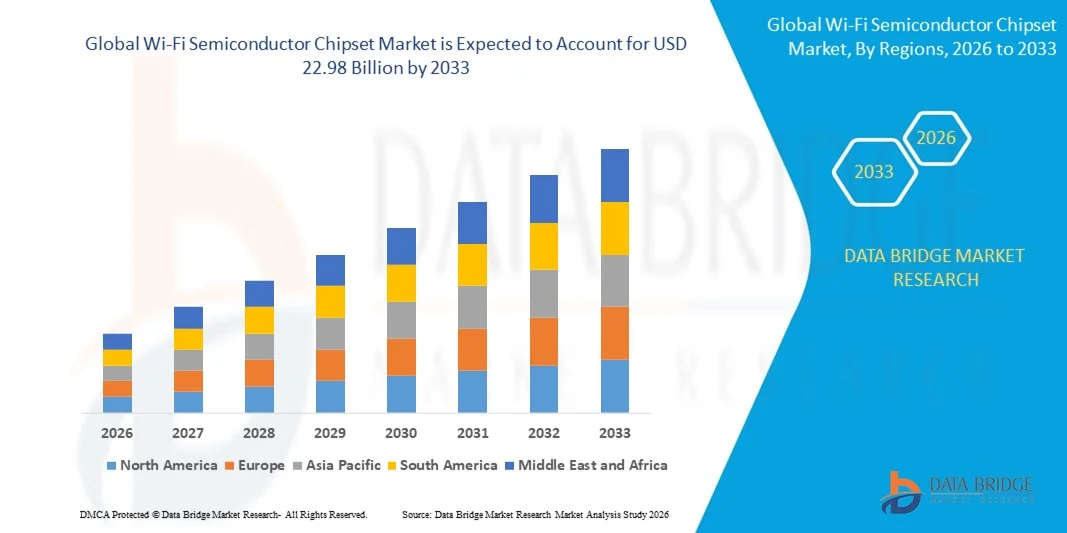
- The global Wi-Fi semiconductor chipset market size was valued at USD 18.00 billion in 2025 and is expected to reach USD 22.98 billion by 2033, at a CAGR of 3.10% during the forecast period
- The market growth is primarily driven by the increasing adoption of connected devices and smart home technologies, which require high-speed, reliable, and low-latency wireless connectivity. Rising digitalization across residential, commercial, and industrial environments is boosting demand for advanced Wi‑Fi semiconductor chipsets to support seamless data transmission and network efficiency
- Furthermore, growing consumer and enterprise demand for energy-efficient, secure, and integrated wireless solutions is propelling the development and deployment of next-generation Wi‑Fi standards such as Wi‑Fi 6, 6E, and 7. These converging trends are accelerating chipset adoption across smartphones, IoT devices, smart appliances, and industrial applications, thereby significantly contributing to market growth
Wi-Fi Semiconductor Chipset Market Analysis
- Wi‑Fi semiconductor chipsets form the backbone of wireless communication for a wide range of devices, including smartphones, tablets, routers, smart home products, and IoT systems, enabling high-speed connectivity, low latency, and secure data transfer. Their integration is essential for modern connected environments where reliability and performance are critical
- The escalating demand for Wi‑Fi chipsets is primarily driven by the proliferation of smart devices, increasing deployment of wireless networks in commercial and residential spaces, and rising consumer preference for seamless connectivity and high-performance networking. The need for efficient, secure, and scalable solutions continues to reinforce the market’s expansion
- North America dominated the Wi-Fi semiconductor chipset market with a share of 42.5% in 2025, due to strong demand for high-speed wireless connectivity across consumer electronics, enterprise networking, and smart home ecosystems
- Asia-Pacific is expected to be the fastest growing region in the Wi-Fi semiconductor chipset market during the forecast period due to rapid urbanization, expanding consumer electronics production, and rising internet penetration
- Wi-Fi & WLAN chipset technology segment dominated the market with a market share of 47.3% in 2025, due to its strong connectivity performance and compatibility with existing network infrastructure. This technology supports continuous connectivity and enables advanced features such as remote access and cloud-based management
Report Scope and Wi-Fi Semiconductor Chipset Market Segmentation
|
Attributes |
Wi-Fi Semiconductor Chipset Key Market Insights |
|
Segments Covered |
|
|
Countries Covered |
North America
Europe
Asia-Pacific
Middle East and Africa
South America
|
|
Key Market Players |
|
|
Market Opportunities |
|
|
Value Added Data Infosets |
In addition to the insights on market scenarios such as market value, growth rate, segmentation, geographical coverage, and major players, the market reports curated by the Data Bridge Market Research also include in-depth expert analysis, geographically represented company-wise production and capacity, network layouts of distributors and partners, detailed and updated price trend analysis and deficit analysis of supply chain and demand. |
Wi-Fi Semiconductor Chipset Market Trends
Rising Adoption of Wi‑Fi 6/6E and Wi‑Fi 7 Standards
- A key trend in the Wi‑Fi semiconductor chipset market is the accelerating adoption of Wi‑Fi 6/6E and Wi‑Fi 7 standards, driven by the increasing need for higher data speeds, lower latency, and better network efficiency across consumer and enterprise applications. This trend is shaping next-generation connectivity solutions and enabling seamless communication across smart devices, IoT ecosystems, and enterprise networks
- For instance, Qualcomm and Broadcom have introduced Wi‑Fi 6E and Wi‑Fi 7 chipsets that support multi-gigabit speeds, enhanced spectral efficiency, and improved device density management. These chipsets are being integrated into smartphones, laptops, routers, and access points to deliver robust connectivity and superior user experiences
- The rollout of Wi‑Fi 7 is gaining momentum as industries seek ultra-low latency for real-time applications such as cloud gaming, AR/VR, and industrial automation. Chipsets supporting these standards are becoming critical for next-gen network deployments that require reliable high-speed connections
- Smart home ecosystems are increasingly leveraging advanced Wi‑Fi chipsets to enable inter-device communication, smart appliance integration, and seamless media streaming. This is boosting the demand for Wi‑Fi semiconductor solutions optimized for low power consumption and high throughput
- Enterprise networks are upgrading to Wi‑Fi 6/6E and preparing for Wi‑Fi 7 to accommodate growing device density and bandwidth-intensive applications. The deployment of these advanced chipsets is enhancing network resilience, security, and performance in offices, campuses, and public hotspots
- Global adoption of high-speed wireless connectivity in sectors such as healthcare, manufacturing, and retail is driving demand for sophisticated Wi‑Fi chipsets. These components are becoming foundational for building connected environments that rely on uninterrupted and high-capacity network access
Wi-Fi Semiconductor Chipset Market Dynamics
Driver
Growing Demand for Connected Devices and Smart Home Solutions
- The surge in connected devices across consumer, industrial, and enterprise segments is significantly driving the demand for advanced Wi‑Fi semiconductor chipsets that provide reliable, high-speed connectivity. These chipsets are enabling smart homes, IoT devices, and enterprise networks to operate seamlessly under increasingly heavy traffic loads
- For instance, MediaTek supplies Wi‑Fi 6 and Wi‑Fi 6E chipsets that power smart TVs, routers, and IoT hubs, allowing households to manage multiple devices efficiently while ensuring low latency and high throughput. These chipsets are pivotal in supporting integrated home automation and entertainment systems
- The proliferation of IoT devices in industries such as manufacturing and logistics is increasing the need for chipsets capable of handling dense networks with low latency. Wi‑Fi semiconductor solutions are central to enabling automated operations, remote monitoring, and real-time data exchange
- Smartphones, laptops, and wearable devices are increasingly adopting Wi‑Fi 6/6E chipsets to enhance performance, battery efficiency, and multi-device connectivity. This trend is reinforcing chipset demand across global consumer electronics markets
- The expansion of smart city initiatives, including connected lighting, surveillance, and public Wi‑Fi networks, is further boosting the requirement for high-performance Wi‑Fi chipsets. These components provide scalable, reliable, and secure wireless communication essential for urban digital infrastructures
Restraint/Challenge
High R&D Costs and Complex Integration Requirements
- The Wi‑Fi semiconductor chipset market faces challenges due to high research and development costs associated with designing cutting-edge chipsets that meet advanced connectivity standards. Developing Wi‑Fi 6/6E and Wi‑Fi 7 chipsets requires significant investment in silicon design, testing, and certification processes, which increases overall cost structures
- For instance, Qualcomm invests heavily in R&D for next-generation Wi‑Fi chipsets, integrating features such as multi-link operation, OFDMA enhancements, and low-power design. These complex development processes demand advanced engineering expertise and extensive validation cycles
- Integrating Wi‑Fi chipsets into diverse devices requires careful optimization to balance performance, power efficiency, and thermal management. This integration complexity can extend product development timelines and increase manufacturing costs
- The reliance on advanced semiconductor fabrication nodes and specialized RF components adds supply chain complexity and cost pressures. Manufacturers must carefully manage sourcing, yield, and quality control to deliver high-performance chipsets consistently
- The market continues to experience constraints in scaling next-generation Wi‑Fi solutions while maintaining cost-effectiveness and compatibility across various device ecosystems. These challenges compel chipset developers to innovate efficiently while navigating high operational and integration expenses
Wi-Fi Semiconductor Chipset Market Scope
The market is segmented on the basis of application and technology.
- By Application
On the basis of application, the smart lock market is segmented into mobile device applications, media & entertainment applications, and automation applications. The mobile device applications segment dominated the market with the largest revenue share in 2025, driven by the widespread use of smartphones for lock control, monitoring, and remote access management. Users increasingly prefer mobile-based interfaces due to their convenience, real-time notifications, and seamless integration with smart home platforms.
The automation applications segment is expected to witness the fastest growth from 2026 to 2033, supported by rising adoption of connected home and building automation systems. Automation-focused deployments enable centralized access control, scheduling, and integration with other smart devices, enhancing operational efficiency and security across residential and commercial environments.
- By Technology
On the basis of technology, the smart lock market is segmented into Wi-Fi & WLAN chipset technology, wireless display & video chipset technology, ZigBee chipset technology, and mobile WiMAX chipset technology. The Wi-Fi & WLAN chipset technology segment accounted for the largest market revenue share of 47.3% in 2025, owing to its strong connectivity performance and compatibility with existing network infrastructure. This technology supports continuous connectivity and enables advanced features such as remote access and cloud-based management.
The ZigBee chipset technology segment is projected to grow at the fastest rate during the forecast period, driven by its low power consumption and suitability for mesh networking within smart home ecosystems. Its ability to support reliable device-to-device communication makes it increasingly attractive for scalable and energy-efficient smart lock deployments.
Wi-Fi Semiconductor Chipset Market Regional Analysis
- North America dominated the Wi-Fi semiconductor chipset market with the largest revenue share of 42.5% in 2025, driven by strong demand for high-speed wireless connectivity across consumer electronics, enterprise networking, and smart home ecosystems
- The region benefits from early adoption of advanced networking standards, widespread deployment of connected devices, and continuous investments in next-generation Wi-Fi technologies
- This dominance is further supported by the presence of leading chipset manufacturers, robust R&D activities, and high penetration of broadband and cloud-based services across residential and commercial sectors
U.S. Wi-Fi Semiconductor Chipset Market Insight
The U.S. Wi-Fi semiconductor chipset market accounted for the largest revenue share in 2025 within North America, supported by rapid adoption of smart devices, strong enterprise networking demand, and continuous upgrades to Wi-Fi infrastructure. Growing deployment of Wi-Fi 6 and Wi-Fi 6E across homes, offices, and public spaces is significantly driving chipset demand. In addition, the expansion of IoT, cloud computing, and data-intensive applications continues to reinforce market growth.
Europe Wi-Fi Semiconductor Chipset Market Insight
The Europe Wi-Fi semiconductor chipset market is expected to grow at a steady CAGR during the forecast period, driven by increasing digitalization, rising adoption of smart homes, and expansion of industrial automation. Strong regulatory support for connected infrastructure and growing investments in broadband and wireless communication networks are accelerating chipset adoption. Demand remains strong across consumer electronics, enterprise networking, and automotive connectivity applications.
U.K. Wi-Fi Semiconductor Chipset Market Insight
The U.K. Wi-Fi semiconductor chipset market is projected to witness notable growth during the forecast period, fueled by rising penetration of connected devices and increasing reliance on wireless networking solutions. The growth of remote working, smart homes, and digital entertainment platforms is driving demand for reliable and high-performance Wi-Fi chipsets. Continuous upgrades to networking infrastructure further support market expansion.
Germany Wi-Fi Semiconductor Chipset Market Insight
The Germany Wi-Fi semiconductor chipset market is anticipated to expand at a considerable CAGR, supported by strong industrial connectivity requirements and advancements in smart manufacturing. Germany’s emphasis on Industry 4.0, combined with growing adoption of connected devices in automotive and industrial sectors, is boosting demand for advanced Wi-Fi solutions. The focus on secure, high-efficiency communication technologies further strengthens market growth.
Asia-Pacific Wi-Fi Semiconductor Chipset Market Insight
The Asia-Pacific Wi-Fi semiconductor chipset market is expected to grow at the fastest CAGR of 23.4% from 2026 to 2033, driven by rapid urbanization, expanding consumer electronics production, and rising internet penetration. Increasing adoption of smart homes, IoT devices, and wireless broadband services across emerging economies is accelerating demand. The region’s strong semiconductor manufacturing base also enhances supply and cost competitiveness.
Japan Wi-Fi Semiconductor Chipset Market Insight
The Japan Wi-Fi semiconductor chipset market is gaining traction due to the country’s advanced technology ecosystem and strong demand for high-performance wireless communication. Growth is supported by increasing deployment of connected consumer electronics, smart appliances, and enterprise networking solutions. Japan’s focus on innovation and next-generation connectivity continues to drive chipset adoption.
China Wi-Fi Semiconductor Chipset Market Insight
The China Wi-Fi semiconductor chipset market held the largest revenue share in Asia-Pacific in 2025, driven by large-scale production of consumer electronics and rapid expansion of wireless infrastructure. Strong domestic manufacturing capabilities, growing smart home adoption, and government initiatives supporting digital connectivity are key growth drivers. The increasing rollout of advanced Wi-Fi standards further accelerates market expansion in China.
Wi-Fi Semiconductor Chipset Market Share
The Wi-Fi semiconductor chipset industry is primarily led by well-established companies, including:
- Microchip Technology Inc. (U.S.)
- Broadcom Inc. (U.S.)
- Intel Corporation (U.S.)
- Marvell Technology, Inc. (U.S.)
- MediaTek Inc. (Taiwan)
- Qualcomm Technologies, Inc. (U.S.)
- Texas Instruments Incorporated (U.S.)
- Realtek Semiconductor Corp. (Taiwan)
- Infineon Technologies AG (Germany)
- NXP Semiconductors N.V. (Netherlands)
- Espressif Systems Shanghai Co., Ltd. (China)
- STMicroelectronics N.V. (Switzerland)
Latest Developments in Global Wi-Fi Semiconductor Chipset Market
- In January 2026, MediaTek unveiled its Filogic 8000 Wi‑Fi 8 chipset platform, designed to support next‑generation Wi‑Fi 8 standards. The chipset enhances network reliability, offers ultra-low latency, and significantly increases bandwidth, enabling high-performance applications in gaming, streaming, and enterprise environments. This launch strengthens MediaTek’s position in the premium Wi‑Fi segment and drives adoption of future-ready wireless infrastructure across both consumer and industrial markets
- In January 2024, Ceva launched the next-generation RivieraWaves Wi‑Fi 7 IP platform targeting high-end consumer and industrial applications. Leveraging the full IEEE 802.11be standard, it delivers premium throughput, low-latency performance, and enhanced network efficiency. This platform accelerates the deployment of Wi‑Fi 7 technology, supporting smart home ecosystems, connected industrial devices, and high-bandwidth applications, thereby boosting overall market growth
- In November 2023, MediaTek released its flagship Dimensity 9300 chipset, featuring an embedded AI processor, APU 790, to optimize device performance and energy efficiency. By integrating advanced Wi‑Fi connectivity with AI capabilities, this chipset improves multitasking, network management, and device responsiveness, reinforcing the adoption of smart and high-performance mobile devices in both consumer and enterprise sectors
- In June 2023, Nordic Semiconductor introduced its low-cost, low-power Wi‑Fi 6 chip, nRF7001, designed specifically for IoT applications operating on the 2.4 GHz band. This chipset enables affordable, energy-efficient wireless connectivity for smart devices, sensors, and small-scale IoT deployments, expanding Wi‑Fi adoption in resource-constrained and battery-powered applications
- In August 2022, Nordic Semiconductor launched its first Wi‑Fi chip, the nRF7002, aimed at ultra-low-power IoT devices. By providing reliable Wi‑Fi connectivity in compact and energy-efficient form factors, this product established Nordic’s presence in the Wi‑Fi semiconductor market and catalyzed the growth of IoT ecosystems requiring seamless wireless communication
SKU-
Get online access to the report on the World's First Market Intelligence Cloud
- Interactive Data Analysis Dashboard
- Company Analysis Dashboard for high growth potential opportunities
- Research Analyst Access for customization & queries
- Competitor Analysis with Interactive dashboard
- Latest News, Updates & Trend analysis
- Harness the Power of Benchmark Analysis for Comprehensive Competitor Tracking
Global Wi Fi Semiconductor Chipset Market, Supply Chain Analysis and Ecosystem Framework
To support market growth and help clients navigate the impact of geopolitical shifts, DBMR has integrated in-depth supply chain analysis into its Global Wi Fi Semiconductor Chipset Market research reports. This addition empowers clients to respond effectively to global changes affecting their industries. The supply chain analysis section includes detailed insights such as Global Wi Fi Semiconductor Chipset Market consumption and production by country, price trend analysis, the impact of tariffs and geopolitical developments, and import and export trends by country and HSN code. It also highlights major suppliers with data on production capacity and company profiles, as well as key importers and exporters. In addition to research, DBMR offers specialized supply chain consulting services backed by over a decade of experience, providing solutions like supplier discovery, supplier risk assessment, price trend analysis, impact evaluation of inflation and trade route changes, and comprehensive market trend analysis.
Research Methodology
Data collection and base year analysis are done using data collection modules with large sample sizes. The stage includes obtaining market information or related data through various sources and strategies. It includes examining and planning all the data acquired from the past in advance. It likewise envelops the examination of information inconsistencies seen across different information sources. The market data is analysed and estimated using market statistical and coherent models. Also, market share analysis and key trend analysis are the major success factors in the market report. To know more, please request an analyst call or drop down your inquiry.
The key research methodology used by DBMR research team is data triangulation which involves data mining, analysis of the impact of data variables on the market and primary (industry expert) validation. Data models include Vendor Positioning Grid, Market Time Line Analysis, Market Overview and Guide, Company Positioning Grid, Patent Analysis, Pricing Analysis, Company Market Share Analysis, Standards of Measurement, Global versus Regional and Vendor Share Analysis. To know more about the research methodology, drop in an inquiry to speak to our industry experts.
Customization Available
Data Bridge Market Research is a leader in advanced formative research. We take pride in servicing our existing and new customers with data and analysis that match and suits their goal. The report can be customized to include price trend analysis of target brands understanding the market for additional countries (ask for the list of countries), clinical trial results data, literature review, refurbished market and product base analysis. Market analysis of target competitors can be analyzed from technology-based analysis to market portfolio strategies. We can add as many competitors that you require data about in the format and data style you are looking for. Our team of analysts can also provide you data in crude raw excel files pivot tables (Fact book) or can assist you in creating presentations from the data sets available in the report.