Global Website Builder Tool Market
Market Size in USD Billion
CAGR :
% 
 USD
14.34 Billion
USD
98.94 Billion
2025
2033
USD
14.34 Billion
USD
98.94 Billion
2025
2033
 Forecast Period Forecast Period |
2026 –2033 |
 Market Size (Base Year) Market Size (Base Year) |
USD 14.34 Billion |
 Market Size (Forecast Year) Market Size (Forecast Year) |
USD 98.94 Billion |
 CAGR CAGR |
% |
| Major Markets Players |
|
Website Builder Tool Market Size
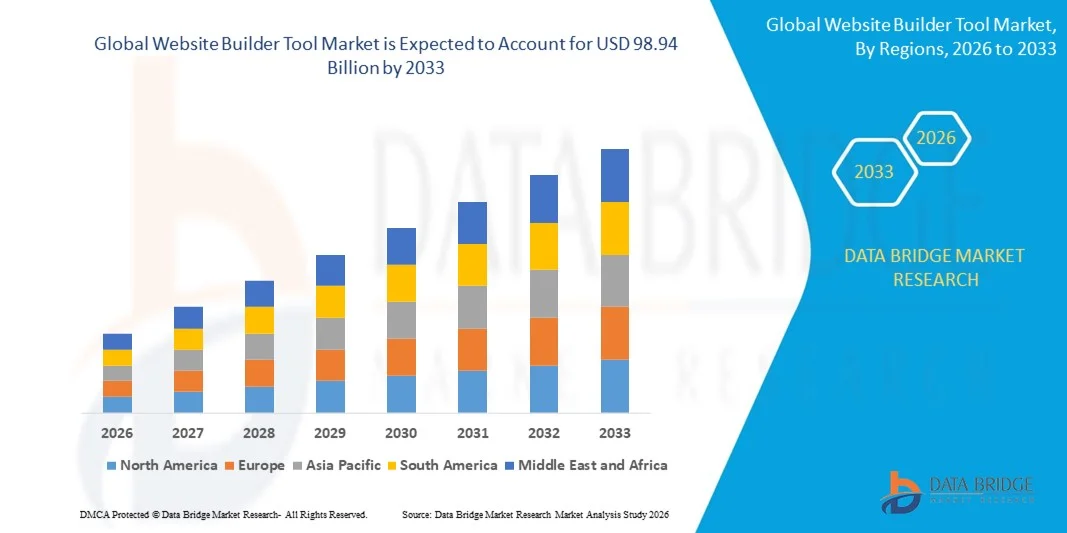
- The global website builder tool market size was valued at USD 14.34 billion in 2025 and is expected to reach USD 98.94 billion by 2033, at a CAGR of 27.30% during the forecast period
- The market growth is largely fueled by the rising adoption of digital platforms by small and medium enterprises and continuous technological advancements in website building tools, enabling faster, easier, and more cost-effective online presence creation for businesses and individuals
- Furthermore, growing consumer demand for user-friendly, customizable, and integrated solutions for websites, e-commerce, and mobile applications is establishing website builder tools as essential platforms for digital transformation. These converging factors are accelerating adoption across startups, SMEs, and freelancers, thereby significantly boosting the industry’s growth
Website Builder Tool Market Analysis
- Website builder tools, offering intuitive, no-code platforms for creating and managing websites, are increasingly vital for businesses seeking to establish a professional online presence quickly and efficiently. They provide features such as drag-and-drop editors, templates, e-commerce integration, SEO tools, and mobile responsiveness, catering to both technical and non-technical users
- The escalating demand for website builder tools is primarily fueled by the widespread digitalization of businesses, increasing online commerce activities, and a growing preference for easy-to-use platforms that reduce dependence on professional web developers, enabling rapid deployment of customized websites
- North America dominated the website builder tool market with a share of around 40% in 2025, due to growing digitalization among businesses, increasing adoption of online platforms, and rising awareness of DIY website creation tools
- Asia-Pacific is expected to be the fastest growing region in the website builder tool market during the forecast period due to rising digital adoption, urbanization, and growth of e-commerce in countries such as China, India, and Japan
- PC website builders segment dominated the market with a market share of 52.4% in 2025, due to its advanced design capabilities, drag-and-drop editors, and support for complex website structures. PC builders provide customization options, third-party integrations, and SEO tools, making them preferred by businesses and professional developers
Report Scope and Website Builder Tool Market Segmentation
|
Attributes |
Website Builder Tool Key Market Insights |
|
Segments Covered |
|
|
Countries Covered |
North America
Europe
Asia-Pacific
Middle East and Africa
South America
|
|
Key Market Players |
|
|
Market Opportunities |
|
|
Value Added Data Infosets |
In addition to the insights on market scenarios such as market value, growth rate, segmentation, geographical coverage, and major players, the market reports curated by the Data Bridge Market Research also include in-depth expert analysis, geographically represented company-wise production and capacity, network layouts of distributors and partners, detailed and updated price trend analysis and deficit analysis of supply chain and demand. |
Website Builder Tool Market Trends
Rising Adoption of AI-Powered and No-Code Website Builders
- A significant trend in the website builder tool market is the increasing adoption of AI-powered and no-code platforms, driven by the growing demand for faster, more intuitive website creation processes that reduce dependency on professional developers. This trend is enhancing accessibility for small businesses, startups, and individual creators seeking to establish a strong online presence quickly
- For instance, Wix and Squarespace provide AI-driven design assistants and drag-and-drop interfaces that allow users to build fully functional websites with minimal coding knowledge. Such solutions are empowering non-technical users to launch professional-grade websites, accelerating digital transformation across multiple sectors
- The integration of machine learning and automation in website builders is improving personalization and user experience, where tools can suggest layouts, content placement, and SEO optimization based on industry trends. This trend is shaping smarter platforms that adapt to user preferences and market dynamics
- E-commerce adoption is influencing the market as website builders increasingly include AI-enhanced product recommendations, payment integration, and inventory management features. Platforms such as Shopify are expanding AI functionalities to optimize online storefront performance and conversion rates
- SMEs and freelancers are increasingly leveraging no-code solutions to reduce time-to-market for digital campaigns, enhancing operational efficiency while lowering costs. The trend is positioning website builder tools as essential instruments for agile business strategies
- The rise of mobile-first website development is driving platforms to integrate AI and responsive design capabilities that automatically adapt content across devices. This trend supports enhanced customer engagement and reinforces the market’s shift toward more intelligent, user-centric web solutions
Website Builder Tool Market Dynamics
Driver
Growing Demand for Fast, Cost-Effective Digital Presence Solutions
- The rising need for rapid and budget-friendly digital presence is fueling the adoption of website builder tools that combine speed, scalability, and affordability, enabling businesses to reach audiences efficiently without large IT teams
- For instance, WordPress.com and GoDaddy Website Builder offer affordable subscription plans with pre-designed templates and AI-assisted tools, allowing businesses to establish online visibility quickly. These platforms reduce reliance on custom development, helping companies save both time and cost
- Startups and SMEs are seeking platforms that support multi-functional capabilities, such as integrated SEO, analytics, and e-commerce modules, driving overall adoption of website builders. The accessibility of these all-in-one solutions encourages smaller enterprises to compete effectively in digital spaces
- The increasing reliance on online marketing and virtual engagement has accelerated the demand for tools that allow rapid content updates, design iterations, and scalability without significant technical investment
- The growing expectation for professional, visually appealing, and interactive websites at reduced costs continues to drive market growth. Organizations prioritize platforms that enable a strong online presence efficiently, reinforcing sustained demand for advanced website builder tools
Restraint/Challenge
Increasing Competition from Open-Source and Free Website Platforms
- The website builder tool market faces challenges from the growing availability of open-source platforms and free website solutions, which provide substantial flexibility and zero or minimal cost options for users
- For instance, WordPress.org and Joomla allow users to build highly customized websites with extensive plugin ecosystems at no licensing cost. These platforms attract a large user base, making it difficult for subscription-based website builders to maintain market share
- Free and open-source platforms require minimal upfront investment, which can reduce the perceived value of paid website builder tools. Users often prefer self-hosted solutions to avoid recurring subscription fees
- The abundance of open-source themes, templates, and community support lowers the entry barrier for website creation, creating strong competition for commercial website builder platforms
- Market growth is constrained by the need to differentiate offerings through advanced AI, customer support, and integrated services. Companies must balance innovation and affordability to attract and retain users while mitigating competitive threats
Website Builder Tool Market Scope
The market is segmented on the basis of type and application.
- By Type
On the basis of type, the website builder tool market is segmented into PC website builders and mobile website builders. The PC website builders segment dominated the market with the largest revenue share of 52.4% in 2025, driven by its advanced design capabilities, drag-and-drop editors, and support for complex website structures. PC builders provide customization options, third-party integrations, and SEO tools, making them preferred by businesses and professional developers. The segment also benefits from compatibility with multiple operating systems and the ability to handle large-scale websites with multimedia content. Users prioritize PC builders for flexibility, templates, and analytics features that enhance website performance.
The mobile website builders segment is anticipated to witness the fastest growth rate of 23.1% from 2026 to 2033, fueled by rising smartphone use and demand for on-the-go website creation. Mobile builders allow users to design and publish websites directly from mobile devices, appealing to freelancers, small businesses, and individuals. For instance, platforms such as Wix and Squarespace offer mobile-first tools that simplify website creation and support e-commerce and social media integration. The convenience, intuitive interfaces, and prebuilt templates continue to drive adoption in this segment.
- By Application
On the basis of application, the website builder tool market is segmented into personal websites, school or college websites, business websites, and others. The business websites segment dominated the market with the largest revenue share in 2025, driven by the need for companies to establish online presence and engage customers digitally. Business users leverage website builders for rapid deployment, cost-effective solutions, and features such as analytics, SEO optimization, and multi-language support, enhancing website reach and performance. Professional, responsive websites build brand credibility and attract online traffic, sustaining growth in this segment.
The personal websites segment is expected to witness the fastest CAGR from 2026 to 2033, fueled by rising individual content creation, personal branding, and portfolio development. Platforms such as WordPress and Weebly provide intuitive tools that allow bloggers, freelancers, and creators to launch websites efficiently. Growing social media integration, interest in online self-promotion, and demand for visually appealing sites continue to drive adoption in this segment.
Website Builder Tool Market Regional Analysis
- North America dominated the website builder tool market with the largest revenue share of around 40% in 2025, driven by growing digitalization among businesses, increasing adoption of online platforms, and rising awareness of DIY website creation tools
- Consumers in the region value the convenience, extensive templates, and easy integration offered by website builder tools with other digital platforms such as e-commerce, analytics, and marketing software
- This widespread adoption is further supported by high internet penetration, a technology-savvy population, and growing demand for cost-effective online presence solutions, establishing website builder tools as a preferred choice for small and medium enterprises, educational institutions, and personal users
U.S. Website Builder Tool Market Insight
The U.S. website builder tool market captured the largest revenue share in 2025 within North America, fueled by rapid digitization of businesses and a strong startup ecosystem. Consumers increasingly seek platforms that enable quick deployment of websites without technical expertise. The growing demand for integrated e-commerce solutions, SEO tools, and mobile-responsive designs further drives market expansion. In addition, adoption of cloud-based platforms such as Wix, Squarespace, and Shopify is significantly contributing to the market growth.
Europe Website Builder Tool Market Insight
The Europe website builder tool market is projected to expand at a substantial CAGR during the forecast period, primarily driven by digital transformation initiatives and the growing need for professional online presence among SMEs. For instance, platforms such as Jimdo are enabling businesses to launch websites rapidly, enhancing accessibility and affordability. Rising urbanization, coupled with the preference for multi-lingual and region-specific templates, is fostering adoption across commercial and creative sectors. The market is experiencing notable growth in both new enterprises and digital revamps of existing businesses.
U.K. Website Builder Tool Market Insight
The U.K. website builder tool market is expected to grow at a noteworthy CAGR during the forecast period, driven by increasing adoption of online retail and e-commerce platforms. Concerns regarding competition and brand visibility are encouraging businesses to choose intuitive website solutions. The U.K.’s robust digital infrastructure, strong e-commerce ecosystem, and high adoption of SaaS solutions are anticipated to continue stimulating market growth.
Germany Website Builder Tool Market Insight
The Germany website builder tool market is anticipated to expand at a considerable CAGR, fueled by growing awareness of digital marketing and demand for efficient online presence solutions. Platforms offering GDPR-compliant website management and secure hosting are increasingly preferred. Germany’s emphasis on innovation, sustainability, and technologically advanced solutions promotes adoption, particularly among SMEs and tech-driven startups. Integration with marketing automation, analytics, and CRM systems is becoming increasingly prevalent.
Asia-Pacific Website Builder Tool Market Insight
The Asia-Pacific website builder tool market is poised to grow at the fastest CAGR during the forecast period of 2026 to 2033, driven by rising digital adoption, urbanization, and growth of e-commerce in countries such as China, India, and Japan. The region's increasing inclination towards online businesses, supported by government initiatives promoting digital entrepreneurship, is driving adoption. Moreover, APAC’s emergence as a hub for SaaS development and availability of affordable tools is expanding accessibility to a broader consumer base.
Japan Website Builder Tool Market Insight
The Japan website builder tool market is gaining momentum due to the country’s technologically advanced environment and high demand for efficient online solutions. Businesses and freelancers increasingly adopt platforms integrating design, e-commerce, and analytics capabilities. The growing trend of smart workplaces and connected digital services is propelling the market. In addition, Japan’s aging population is fostering demand for simplified, easy-to-use website creation tools for small businesses and independent professionals.
China Website Builder Tool Market Insight
The China website builder tool market accounted for the largest revenue share in Asia Pacific in 2025, attributed to rapid urbanization, expanding SMEs, and high internet penetration. For instance, platforms such as Weebly and Shopify localized for China are gaining popularity among businesses seeking fast and cost-effective digital presence solutions. The government’s support for digital entrepreneurship, alongside competitive pricing and strong domestic SaaS providers, is driving market growth. China’s push towards smart cities and online business expansion continues to fuel adoption.
Website Builder Tool Market Share
The website builder tool industry is primarily led by well-established companies, including:
- Wix (U.S.)
- Automattic Inc. (U.S.)
- Square, Inc. (U.S.)
- Duda (U.S.)
- Squarespace, Inc. (U.S.)
- Sitey (U.S.)
- Jimdo (Germany)
- GoDaddy Operating Company, LLC (U.S.)
- Bluehost Inc. (U.S.)
- Simbla Inc. (U.S.)
- Zoho Corporation Pvt. Ltd. (India)
Latest Developments in Global Website Builder Tool Market
- In July 2025, Appy Pie enhanced its AI website builder by integrating advanced features designed to support businesses across multiple verticals, enabling users to generate tailored websites through simple text or voice prompts. This development strengthens Appy Pie’s position in the website builder market by addressing demand for AI-driven, easy-to-use platforms that accelerate digital adoption among small and medium enterprises
- In July 2025, Wix launched its AI Site Generator, allowing customers to define objectives and automatically produce a complete website, including homepage, internal pages, text, images, and business-specific modules for events and reservations. This innovation positions Wix as a leader in AI-powered website creation, enhancing user productivity and expanding adoption among users seeking fully automated, customized digital solutions
- In September 2024, GoDaddy announced the integration of its popular content design app into its websites + marketing platform, offering seamless content creation and website management. This move strengthens GoDaddy’s competitive edge in the website builder market by providing users with an all-in-one solution that simplifies website creation and marketing, thereby increasing platform stickiness and adoption
- In September 2024, Mono Solutions partnered with Lokale Internetwerbung GmBH & Co. KG to integrate Mono Websites into their proprietary toolbox. This partnership expands Mono’s reach in the European website builder market, enhancing its visibility and enabling agencies to offer streamlined website creation services within an established ecosystem
- In August 2024, Wix introduced a native mobile app builder that allows users to create and customize apps without coding. This strategic addition enhances Wix’s market position by catering to growing demand for mobile-first solutions and empowering businesses to extend their digital presence across both websites and apps with minimal technical expertise
SKU-
Get online access to the report on the World's First Market Intelligence Cloud
- Interactive Data Analysis Dashboard
- Company Analysis Dashboard for high growth potential opportunities
- Research Analyst Access for customization & queries
- Competitor Analysis with Interactive dashboard
- Latest News, Updates & Trend analysis
- Harness the Power of Benchmark Analysis for Comprehensive Competitor Tracking
Global Website Builder Tool Market, Supply Chain Analysis and Ecosystem Framework
To support market growth and help clients navigate the impact of geopolitical shifts, DBMR has integrated in-depth supply chain analysis into its Global Website Builder Tool Market research reports. This addition empowers clients to respond effectively to global changes affecting their industries. The supply chain analysis section includes detailed insights such as Global Website Builder Tool Market consumption and production by country, price trend analysis, the impact of tariffs and geopolitical developments, and import and export trends by country and HSN code. It also highlights major suppliers with data on production capacity and company profiles, as well as key importers and exporters. In addition to research, DBMR offers specialized supply chain consulting services backed by over a decade of experience, providing solutions like supplier discovery, supplier risk assessment, price trend analysis, impact evaluation of inflation and trade route changes, and comprehensive market trend analysis.
Research Methodology
Data collection and base year analysis are done using data collection modules with large sample sizes. The stage includes obtaining market information or related data through various sources and strategies. It includes examining and planning all the data acquired from the past in advance. It likewise envelops the examination of information inconsistencies seen across different information sources. The market data is analysed and estimated using market statistical and coherent models. Also, market share analysis and key trend analysis are the major success factors in the market report. To know more, please request an analyst call or drop down your inquiry.
The key research methodology used by DBMR research team is data triangulation which involves data mining, analysis of the impact of data variables on the market and primary (industry expert) validation. Data models include Vendor Positioning Grid, Market Time Line Analysis, Market Overview and Guide, Company Positioning Grid, Patent Analysis, Pricing Analysis, Company Market Share Analysis, Standards of Measurement, Global versus Regional and Vendor Share Analysis. To know more about the research methodology, drop in an inquiry to speak to our industry experts.
Customization Available
Data Bridge Market Research is a leader in advanced formative research. We take pride in servicing our existing and new customers with data and analysis that match and suits their goal. The report can be customized to include price trend analysis of target brands understanding the market for additional countries (ask for the list of countries), clinical trial results data, literature review, refurbished market and product base analysis. Market analysis of target competitors can be analyzed from technology-based analysis to market portfolio strategies. We can add as many competitors that you require data about in the format and data style you are looking for. Our team of analysts can also provide you data in crude raw excel files pivot tables (Fact book) or can assist you in creating presentations from the data sets available in the report.