


What is the Global Water Electrolysis Machine Market Size and Growth Rate?
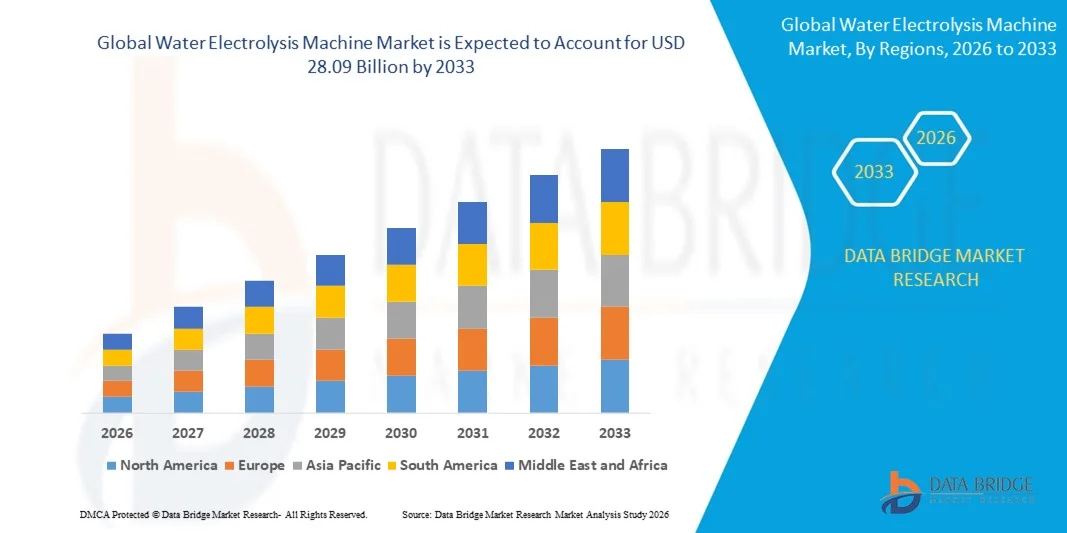
- As per Data Bridge Market Research Analysis the global water electrolysis machine market size was valued at USD 15.87 billion in 2025 and is expected to reach USD 28.09 billion by 2033, at a CAGR of 7.40% during the forecast period
- The rise in the demand for carbon-free source of energy across the globe acts as one of the major factors driving the growth of water electrolysis machine market
- The continuous technological advancements and innovations focused on the production of hydrogen in the most sustainable and environment-friendly manner owning to the increasing interest toward hydrogen, and increase in the chemical industries across different countries accelerate the market growth
Market Size & Forecast
- Global Market Value (2025): USD 15.87 billion
- Expected Market Value (2033): USD 28.09 billion
- Forecast CAGR (2026–2033): 7.40%
What are the Major Takeaways of Water Electrolysis Machine Market?
- The rise in demand for carbon-free source of energy, and increase in private investments and favorable government policies towards sustainable and renewable energy sources, and the application of hydrogen in various industries, including steel, electronics & semiconductors, electronics, power generation, chemicals, petroleum, and pharmaceuticals, further influence the market
- Additionally, demand across diverse range of industries, rise in environmental concerns, and rise in chemical industries positively affect the water electrolysis machine market
- North America dominated the water electrolysis machine market with a 40.8% revenue share in 2025, driven by strong investments in green hydrogen infrastructure, expanding renewable energy capacity, and large-scale decarbonization initiatives across the U.S. and Canada
- Asia-Pacific is projected to register the fastest CAGR of 9.6% from 2026 to 2033, driven by rapid renewable energy expansion, national hydrogen roadmaps, and increasing industrial decarbonization targets across China, Japan, India, South Korea, and Australia
- The Alkaline Water Electrolysis segment dominated the market with a 44.6% share in 2025, owing to its technological maturity, lower capital cost, and strong suitability for large-scale industrial hydrogen production
Report Scope and Water Electrolysis Machine Market Segmentation
|
Attributes |
Water Electrolysis Machine Key Market Insights |
|
Segments Covered |
|
|
Countries Covered |
North America
Europe
Asia-Pacific
Middle East and Africa
South America
|
|
Key Market Players |
|
|
Market Opportunities |
|
|
Value Added Data Infosets |
|
What is the Key Trend in the Water Electrolysis Machine Market?
Accelerating Transition Toward High-Efficiency, Modular, and Green Hydrogen–Focused Electrolysis Systems
- The water electrolysis machines market is witnessing strong adoption of high-efficiency alkaline, PEM, and SOEC systems designed to support large-scale green hydrogen production for mobility, refining, ammonia, and industrial decarbonization
- Manufacturers are introducing containerized, modular, and megawatt-to-gigawatt-scale electrolyzers with improved energy efficiency, lower stack degradation rates, and flexible renewable energy integration
- Growing demand for renewable-powered hydrogen generation is driving installations across industrial clusters, hydrogen hubs, and power-to-X projects worldwide
- For instance, companies such as Nel Hydrogen, Siemens Energy, ITM Power, and thyssenkrupp have expanded their electrolyzer portfolios with higher-capacity systems, automated stack manufacturing, and integrated balance-of-plant solutions
- Increasing focus on reducing Levelized Cost of Hydrogen (LCOH) and improving system durability is accelerating the shift toward advanced membrane materials and scalable plant designs
- As global economies prioritize decarbonization and net-zero targets, water electrolysis machines will remain vital for enabling clean hydrogen ecosystems and renewable energy storage solutions
What are the Key Drivers of Water Electrolysis Machine Market?
- Rising demand for green hydrogen to decarbonize hard-to-abate sectors such as steel, chemicals, refining, and heavy transport is significantly boosting electrolyzer deployment
- For instance, in 2025, leading players such as Cummins Inc., Air Products, and Toshiba Energy Systems & Solutions Corporation expanded hydrogen infrastructure projects and electrolyzer production capacities to support industrial-scale applications
- Growing investments in hydrogen hubs, renewable integration, and government-backed incentive programs across Europe, Asia-Pacific, and North America are accelerating market growth
- Advancements in electrode materials, membrane durability, stack optimization, and system automation have enhanced efficiency, reliability, and operational flexibility
- Rising adoption of fuel cell vehicles, green ammonia production, and power grid balancing solutions is creating sustained demand for high-capacity water electrolysis systems
- Supported by strong policy frameworks, carbon reduction commitments, and expanding renewable energy capacity, the Water Electrolysis Machines market is expected to witness robust long-term expansion
Which Factor is Challenging the Growth of the Water Electrolysis Machine Market?
- High capital costs associated with large-scale electrolyzer systems, balance-of-plant infrastructure, and renewable power integration limit adoption among small and mid-sized industrial users
- For instance, during 2024–2025, fluctuations in raw material prices such as nickel, platinum-group metals, and specialized membranes increased manufacturing costs for several global suppliers
- Technical challenges related to stack longevity, efficiency degradation, and intermittent renewable power input increase operational complexity and maintenance requirements
- Limited hydrogen transport and storage infrastructure in emerging economies slows commercialization and widespread deployment
- Competition from alternative hydrogen production methods, including blue hydrogen and methane reforming with carbon capture, creates economic and strategic uncertainties
- To address these challenges, companies are focusing on cost reduction through gigafactory-scale production, material innovation, digital monitoring systems, and strategic public–private partnerships to accelerate global adoption of Water Electrolysis Machines
How is the Water Electrolysis Machine Market Segmented?
The market is segmented on the basis of type, input power, hydrogen production, and end use.
- By Type
On the basis of type, the water electrolysis machine market is segmented into Proton Exchange Membrane (PEM), Alkaline Water Electrolysis, and Others. The Alkaline Water Electrolysis segment dominated the market with a 44.6% share in 2025, owing to its technological maturity, lower capital cost, and strong suitability for large-scale industrial hydrogen production. Alkaline systems are widely deployed in chemical processing, refineries, and fertilizer plants due to their durability and cost-efficiency. Their proven operational stability and ability to support continuous hydrogen output make them a preferred choice for established hydrogen projects.
The Proton Exchange Membrane (PEM) segment is projected to grow at the fastest CAGR from 2026 to 2033, driven by rising demand for high-purity hydrogen, compact system design, and better compatibility with intermittent renewable energy sources. Faster response times, higher current densities, and increasing deployment in green hydrogen and mobility projects are accelerating PEM adoption globally.
- By Input Power
On the basis of input power, the market is segmented into Below 5 MW, 5–10 MW, and Above 10 MW. The 5–10 MW segment dominated the market with a 41.2% share in 2025, supported by increasing deployment of mid-scale hydrogen production facilities across industrial clusters and hydrogen hubs. These systems offer an optimal balance between scalability, capital investment, and operational efficiency, making them suitable for refineries, ammonia production, and distributed energy projects. Their modular structure enables phased capacity expansion while maintaining cost control.
The Above 10 MW segment is expected to grow at the fastest CAGR from 2026 to 2033, propelled by large-scale green hydrogen initiatives, gigafactory-scale electrolyzer manufacturing, and government-backed decarbonization programs. Rising investments in utility-scale renewable energy integration and power-to-X projects are accelerating demand for high-capacity electrolysis plants worldwide.
- By Hydrogen Production
On the basis of hydrogen production, the market is segmented into Below 500 L/Hr, 500–2000 L/Hr, and Above 2000 L/Hr. The Above 2000 L/Hr segment dominated the market with a 46.3% share in 2025, driven by strong demand from large industrial users such as refineries, steel plants, and chemical manufacturers. High-capacity systems support continuous hydrogen supply, improve operational efficiency, and reduce per-unit production costs, making them ideal for commercial-scale applications.
The 500–2000 L/Hr segment is projected to grow at the fastest CAGR from 2026 to 2033, supported by expanding adoption among medium-sized industries, decentralized hydrogen projects, and pilot-scale green hydrogen plants. Increasing demand for on-site hydrogen generation in emerging economies and industrial parks is strengthening growth prospects for mid-range production systems.
- By End Use
On the basis of end use, the water electrolysis machine market is segmented into Chemical, Petroleum, Pharmaceuticals, Power Plants, Electronics & Semiconductors, Steel Plants, and Others. The Chemical segment dominated the market with a 38.7% share in 2025, owing to extensive hydrogen usage in ammonia production, methanol synthesis, and other industrial chemical processes. Growing emphasis on green ammonia and low-carbon feedstock production further strengthens electrolyzer deployment within chemical manufacturing facilities.
The Steel Plants segment is expected to grow at the fastest CAGR from 2026 to 2033, driven by increasing adoption of hydrogen-based direct reduced iron (DRI) technology and global decarbonization initiatives. As steel producers transition toward low-carbon manufacturing processes, demand for large-scale water electrolysis systems is anticipated to rise significantly over the forecast period.
Which Region Holds the Largest Share of the Water Electrolysis Machine Market?
- North America dominated the water electrolysis machine market with a 40.8% revenue share in 2025, driven by strong investments in green hydrogen infrastructure, expanding renewable energy capacity, and large-scale decarbonization initiatives across the U.S. and Canada. Growing deployment of electrolyzers in refining, ammonia production, mobility, and energy storage projects continues to fuel regional demand. Government-backed hydrogen hubs and supportive policy frameworks further accelerate commercialization of water electrolysis systems
- Leading companies in North America are introducing advanced modular and high-capacity electrolyzer systems with improved efficiency, automated stack manufacturing, and integrated balance-of-plant solutions, strengthening the region’s competitive position. Continuous investment in clean energy innovation and hydrogen mobility drives long-term market expansion
- Strong R&D ecosystems, availability of project financing, and expanding public–private partnerships further reinforce North America’s leadership in large-scale hydrogen production infrastructure
U.S. Water Electrolysis Machine Market Insight
The U.S. is the largest contributor in North America, supported by federal clean hydrogen incentives, rapid renewable energy integration, and expanding industrial decarbonization programs. Increasing development of green ammonia, sustainable aviation fuel, hydrogen-powered transport, and grid-balancing solutions intensifies demand for high-capacity water electrolysis systems. Presence of large energy companies, advanced manufacturing capabilities, and multiple hydrogen hub projects further drives domestic market growth.
Canada Water Electrolysis Machine Market Insight
Canada contributes significantly to regional growth, driven by strong hydroelectric resources, expanding green hydrogen export strategies, and rising investment in clean industrial technologies. Electrolyzers are increasingly deployed for ammonia production, heavy transport fuel, and power-to-X applications. Supportive provincial policies, skilled engineering expertise, and cross-border hydrogen collaboration initiatives strengthen adoption across the country.
Asia-Pacific Water Electrolysis Machine Market
Asia-Pacific is projected to register the fastest CAGR of 9.6% from 2026 to 2033, driven by rapid renewable energy expansion, national hydrogen roadmaps, and increasing industrial decarbonization targets across China, Japan, India, South Korea, and Australia. Large-scale manufacturing ecosystems, cost-competitive production capabilities, and rising hydrogen demand in steel, chemicals, and mobility sectors accelerate electrolyzer deployment. Growing investments in solar, wind, and hybrid renewable projects further stimulate regional market growth.
China Water Electrolysis Machine Market Insight
China is the largest contributor to Asia-Pacific due to massive renewable installations, strong electrolyzer manufacturing capacity, and government-backed hydrogen demonstration projects. Expansion of green steel, ammonia, and heavy transport applications significantly boosts domestic demand for high-capacity electrolysis systems.
Japan Water Electrolysis Machine Market Insight
Japan shows steady growth supported by its long-term hydrogen strategy, fuel cell vehicle adoption, and industrial decarbonization initiatives. Increasing collaboration between energy companies and technology providers strengthens deployment of advanced PEM and alkaline systems.
India Water Electrolysis Machine Market Insight
India is emerging as a major growth hub, driven by its National Green Hydrogen Mission, expanding solar capacity, and rising industrial hydrogen demand. Increasing pilot projects and domestic electrolyzer manufacturing initiatives accelerate market penetration.
South Korea Water Electrolysis Machine Market Insight
South Korea contributes significantly due to strong hydrogen mobility programs, fuel cell development, and large-scale clean energy investments. Continuous innovation in electrolyzer efficiency and hydrogen infrastructure supports sustained regional expansion.
Which are the Top Companies in Water Electrolysis Machine Market?
The water electrolysis machine industry is primarily led by well-established companies, including:
- thyssenkrupp AG (Germany)
- Siemens (Germany)
- Air Products and Chemicals, Inc. (U.S.)
- Cummins Inc. (U.S.)
- Asahi Kasei Corporation (Japan)
- Nel Hydrogen (Norway)
- Elogen (France)
- Guangzhou C&E Environmental Technology Co., Ltd (China)
- Eneco Holdings, Inc. (Japan)
- Enagic Co., Ltd. (Japan)
- Erredue SPA (Italy)
- Hitachi Zosen Corporation (Japan)
- Peak Scientific Instruments (U.K.)
- KOBELCO ECO-SOLUTIONS Co.,Ltd. (Japan)
- Teledyne Technologies (U.S.)
- Toshiba Energy Systems & Solutions Corporation (Japan)
- Proton OnSite (U.S.)
What are the Recent Developments in Global Water Electrolysis Machine Market?
- In July 2023, ITM Power plc announced that its newly formed subsidiary, ITM Power Germany GmbH, would officially begin operations in October 2023 in Linden near Frankfurt, expanding its footprint in Germany and across Europe. This strategic expansion strengthens the company’s role in supplying PEM-based large-scale electrolysers for ongoing and upcoming green hydrogen projects across the region, reinforcing its competitive position in the European hydrogen market
- In April 2023, Siemens Energy AG declared that manufacturing of electrolysis modules, or stacks, would start at its multi-gigawatt electrolyzer production facility in Berlin, with plans to scale capacity to three gigawatts annually by 2025. In partnership with Air Liquide, the company aims to address accelerating global demand for green hydrogen solutions, marking a major step toward large-scale industrial hydrogen deployment
- In November 2022, Asahi Kasei Corporation initiated construction of a pilot hydrogen production test facility using alkaline water electrolysis at its Kawasaki Works in Japan. The prototype plant, designed with multiple electrolyzer modules, will support trials for power fluctuation responsiveness and long-term durability, positioning the company to scale up electrolysis systems in response to rising global hydrogen demand

- Interactive Data Analysis Dashboard
- Company Analysis Dashboard for high growth potential opportunities
- Research Analyst Access for customization & queries
- Competitor Analysis with Interactive dashboard
- Latest News, Updates & Trend analysis
- Harness the Power of Benchmark Analysis for Comprehensive Competitor Tracking
Global Water Electrolysis Machine Market, Supply Chain Analysis and Ecosystem Framework
To support market growth and help clients navigate the impact of geopolitical shifts, DBMR has integrated in-depth supply chain analysis into its Global Water Electrolysis Machine Market research reports. This addition empowers clients to respond effectively to global changes affecting their industries. The supply chain analysis section includes detailed insights such as Global Water Electrolysis Machine Market consumption and production by country, price trend analysis, the impact of tariffs and geopolitical developments, and import and export trends by country and HSN code. It also highlights major suppliers with data on production capacity and company profiles, as well as key importers and exporters. In addition to research, DBMR offers specialized supply chain consulting services backed by over a decade of experience, providing solutions like supplier discovery, supplier risk assessment, price trend analysis, impact evaluation of inflation and trade route changes, and comprehensive market trend analysis.
Data collection and base year analysis are done using data collection modules with large sample sizes. The stage includes obtaining market information or related data through various sources and strategies. It includes examining and planning all the data acquired from the past in advance. It likewise envelops the examination of information inconsistencies seen across different information sources. The market data is analysed and estimated using market statistical and coherent models. Also, market share analysis and key trend analysis are the major success factors in the market report. To know more, please request an analyst call or drop down your inquiry.
The key research methodology used by DBMR research team is data triangulation which involves data mining, analysis of the impact of data variables on the market and primary (industry expert) validation. Data models include Vendor Positioning Grid, Market Time Line Analysis, Market Overview and Guide, Company Positioning Grid, Patent Analysis, Pricing Analysis, Company Market Share Analysis, Standards of Measurement, Global versus Regional and Vendor Share Analysis. To know more about the research methodology, drop in an inquiry to speak to our industry experts.
Data Bridge Market Research is a leader in advanced formative research. We take pride in servicing our existing and new customers with data and analysis that match and suits their goal. The report can be customized to include price trend analysis of target brands understanding the market for additional countries (ask for the list of countries), clinical trial results data, literature review, refurbished market and product base analysis. Market analysis of target competitors can be analyzed from technology-based analysis to market portfolio strategies. We can add as many competitors that you require data about in the format and data style you are looking for. Our team of analysts can also provide you data in crude raw excel files pivot tables (Fact book) or can assist you in creating presentations from the data sets available in the report.













