


Vital Signs Monitoring Equipment Market Size
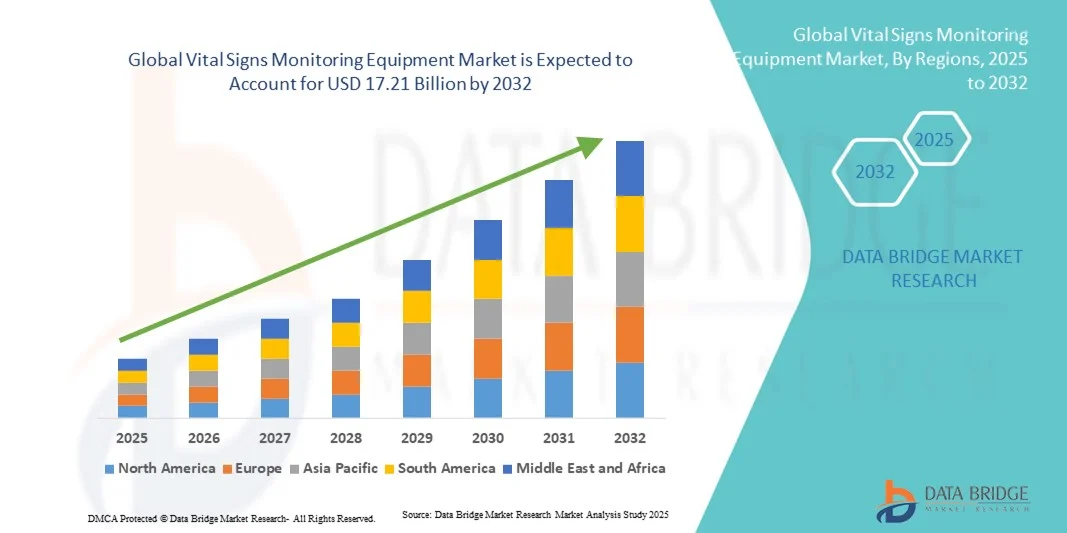
- The global vital signs monitoring equipment market size was valued at USD 9.86 billion in 2024 and is expected to reach USD 17.21 billion by 2032, at a CAGR of 7.21% during the forecast period
- The market expansion is supported by rapid technological advancements in wearable devices, remote patient monitoring systems, and IoT-enabled healthcare solutions, which are enhancing the accuracy, convenience, and accessibility of vital signs monitoring
- In addition, the growing adoption of telehealth services, hospital modernization initiatives, and rising consumer preference for home-based health monitoring solutions are further fueling demand. These factors collectively reinforce vital signs monitoring equipment as an essential component of modern healthcare delivery, thereby driving robust industry growth globally
Vital Signs Monitoring Equipment Market Analysis
- Vital signs monitoring equipment, encompassing devices such as blood pressure monitors, pulse oximeters, thermometers, and wearable health trackers, is becoming an essential component of modern healthcare systems in hospitals, clinics, and home-based care due to its ability to provide continuous, real-time health data and improve patient outcomes
- The rising demand for remote patient monitoring, telehealth services, and home healthcare solutions is primarily driving market growth, alongside increasing awareness of preventive healthcare, aging populations, and the growing prevalence of chronic diseases worldwide
- North America dominated the vital signs monitoring equipment market with the largest revenue share of 41.8% in 2024, supported by advanced healthcare infrastructure, high adoption of digital health technologies, and significant investment in connected and AI-enabled medical devices, particularly in the U.S., where hospitals and consumers are rapidly embracing wearable and IoT-based monitoring solutions
- Asia-Pacific is expected to be the fastest-growing region during the forecast period due to rising healthcare expenditures, expanding home healthcare services, and increasing penetration of digital health technologies in urban and semi-urban areas
- Blood pressure monitoring devices dominated the market with a market share of 49% in 2024, driven by their widespread use in both clinical and home settings, affordability, and ease of integration into digital health ecosystems
Report Scope and Vital Signs Monitoring Equipment Market Segmentation
|
Attributes |
Vital Signs Monitoring Equipment Key Market Insights |
|
Segments Covered |
|
|
Countries Covered |
North America
Europe
Asia-Pacific
Middle East and Africa
South America
|
|
Key Market Players |
|
|
Market Opportunities |
|
|
Value Added Data Infosets |
In addition to the insights on market scenarios such as market value, growth rate, segmentation, geographical coverage, and major players, the market reports curated by the Data Bridge Market Research also include in-depth expert analysis, pricing analysis, brand share analysis, consumer survey, demography analysis, supply chain analysis, value chain analysis, raw material/consumables overview, vendor selection criteria, PESTLE Analysis, Porter Analysis, and regulatory framework. |
Vital Signs Monitoring Equipment Market Trends
Integration of AI and Wearable Connectivity
- A significant and accelerating trend in the global vital signs monitoring equipment market is the integration of AI algorithms with wearable devices and IoT-enabled health platforms, enhancing real-time health tracking and predictive analytics
- For instance, the Withings ScanWatch monitors heart rate and oxygen levels while using AI to detect irregular rhythms, providing actionable insights directly to the user and healthcare providers
- AI-enabled devices can learn individual health patterns to deliver personalized alerts for potential anomalies, such as irregular heartbeats or sudden blood pressure spikes, improving preventive care
- Wearable connectivity allows seamless data sharing with smartphones, cloud platforms, and telehealth systems, enabling centralized monitoring and remote patient management from a single interface
- This trend towards intelligent, connected, and personalized monitoring systems is reshaping consumer expectations for home and clinical healthcare, prompting companies such as Omron Healthcare to develop AI-assisted wearable monitors for continuous vital sign tracking
- The demand for devices offering predictive analytics, real-time alerts, and easy integration with health management apps is growing rapidly across both personal and clinical healthcare settings
Vital Signs Monitoring Equipment Market Dynamics
Driver
Rising Chronic Diseases and Preventive Healthcare Awareness
- The increasing prevalence of chronic diseases such as hypertension, diabetes, and cardiovascular disorders, coupled with growing awareness of preventive healthcare, is a major driver of market demand
- For instance, in March 2024, iHealth Labs launched a new range of connected blood pressure monitors targeting patients with chronic conditions, emphasizing ease of monitoring at home
- As consumers and healthcare providers recognize the benefits of continuous monitoring for early intervention, demand for accurate and reliable vital signs equipment rises
- In addition, the growing adoption of telemedicine and remote patient monitoring platforms is reinforcing the need for home-based vital signs tracking devices that seamlessly integrate with digital health ecosystems
- The convenience of real-time data, alerts, and cloud-based tracking encourages both clinical and personal users to adopt wearable and connected vital signs monitoring solutions, driving global market growth
- Rising healthcare digitization initiatives by governments and private players are accelerating the deployment of smart health monitoring infrastructure
- Increasing affordability and accessibility of portable monitoring devices are enabling greater adoption among aging populations and rural healthcare setups
Restraint/Challenge
Device Accuracy Concerns and Regulatory Hurdles
- Concerns regarding the accuracy and reliability of wearable or home-based vital signs monitors pose a significant challenge to market expansion, particularly for medical-grade applications
- For instance, reports of inaccurate oxygen saturation readings in certain low-cost pulse oximeters have made some consumers and healthcare providers hesitant to rely solely on home monitoring devices
- Ensuring device accuracy through rigorous clinical validation, calibration, and adherence to regulatory standards is crucial for gaining user trust and broad market acceptance
- In addition, regulatory compliance with agencies such as the FDA, CE, and local health authorities can be time-consuming and costly, creating barriers for new entrants and innovative devices
- While technological advancements are improving accuracy, high device costs and regulatory complexities can still limit adoption, especially in emerging markets or for budget-conscious consumers
- Overcoming these challenges through validated clinical performance, clear regulatory approvals, and consumer education is essential for wider adoption and sustained market growth
- Data privacy concerns and potential cybersecurity threats in connected monitoring systems may hinder patient and institutional confidence in digital health adoption
- Limited interoperability between devices from different manufacturers restricts seamless data exchange, reducing the efficiency of integrated remote patient monitoring solution
Vital Signs Monitoring Equipment Market Scope
The market is segmented on the basis of product type and end-use.
- By Product Type
On the basis of product type, the vital signs monitoring equipment market is segmented into temperature monitoring devices, blood pressure monitors, and pulse oximeters. Blood Pressure Monitors dominated the market with the largest revenue share of 49% in 2024, driven by the growing prevalence of hypertension and cardiovascular disorders globally. The widespread adoption of digital and wearable blood pressure monitoring devices in both clinical and home settings has significantly enhanced accessibility and accuracy of readings. Technological innovations such as Bluetooth connectivity, data synchronization with smartphones, and AI-powered trend analysis are increasing device appeal among consumers. The segment also benefits from the rising emphasis on preventive care and routine health tracking, particularly among the aging population. Moreover, major manufacturers such as Omron Healthcare and Withings are introducing compact, portable devices designed for continuous monitoring, further expanding market penetration. Hospitals and home healthcare providers asuch as are prioritizing these devices due to their ease of use and real-time data reporting capabilities.
Pulse Oximeters are anticipated to witness the fastest growth rate of 8.6% from 2025 to 2032, fueled by increasing awareness of oxygen saturation monitoring and the surge in respiratory diseases such as COPD and sleep apnea. The COVID-19 pandemic has accelerated the adoption of pulse oximeters among both patients and healthcare professionals for early detection of hypoxemia. Growing availability of affordable fingertip and wearable models with integrated mobile applications supports at-home health management. Furthermore, advancements in sensor accuracy and miniaturization technology are broadening their usage in telehealth and fitness applications. The expanding role of connected oximeters in remote patient monitoring programs and integration with AI-based diagnostic tools is expected to further drive the segment’s rapid growth globally.
- By End-Use
On the basis of end-use, the market is segmented into hospitals, physician’s offices, home healthcare, ambulatory centers, emergency care centers, and others. Hospitals dominated the global market with the largest revenue share of 46.8% in 2024, owing to the high patient inflow, increased adoption of multiparameter monitoring systems, and the rising need for continuous surveillance in critical care units. Hospitals utilize advanced monitoring systems for real-time data analysis, early intervention, and integrated electronic health record (EHR) management. Increasing healthcare infrastructure investments and digitization in both developed and developing regions are reinforcing hospital-based demand. The growing number of surgeries, intensive care admissions, and chronic disease treatments further supports strong utilization rates. Moreover, leading manufacturers are partnering with healthcare systems to integrate AI-enabled and cloud-connected vital signs monitors, enhancing diagnostic accuracy and workflow efficiency within hospital environments.
Home Healthcare is projected to be the fastest-growing end-use segment, registering a CAGR of 9.2% from 2025 to 2032, driven by the shift toward patient-centric care and the rising aging population seeking convenient monitoring solutions. Increasing adoption of portable, wireless, and smartphone-compatible devices enables individuals to track health parameters such as heart rate, blood pressure, and temperature from home. For instance, companies such as iHealth Labs and Philips have launched user-friendly, app-integrated monitoring kits designed for non-clinical users. The expansion of telehealth services and reimbursement support for remote patient monitoring are further accelerating adoption. In addition, growing awareness of preventive healthcare and chronic disease management at home is encouraging consumers to invest in personal vital signs monitoring systems, making this the most dynamic segment in the forecast period.
Vital Signs Monitoring Equipment Market Regional Analysis
- North America dominated the vital signs monitoring equipment market with the largest revenue share of 41.8% in 2024, supported by advanced healthcare infrastructure, high adoption of digital health technologies, and significant investment in connected and AI-enabled medical devices, particularly in the U.S., where hospitals and consumers are rapidly embracing wearable and IoT-based monitoring solutions
- Consumers and healthcare providers in the region prioritize the convenience, accuracy, and connectivity offered by AI-enabled and wearable vital signs monitoring devices that seamlessly integrate with telehealth platforms and electronic health records
- This widespread adoption is further supported by favorable reimbursement policies, growing prevalence of chronic diseases such as hypertension and diabetes, and rising demand for home-based patient monitoring solutions
U.S. Vital Signs Monitoring Equipment Market Insight
The U.S. vital signs monitoring equipment market captured the largest revenue share of 80.2% in 2024 within North America, driven by the rapid adoption of remote patient monitoring systems and wearable health technologies. Consumers and healthcare providers are increasingly embracing connected devices for continuous tracking of parameters such as blood pressure, heart rate, and oxygen saturation. The strong integration of telehealth services and government support for digital healthcare transformation are further accelerating market expansion. Moreover, leading players such as GE HealthCare, Medtronic, and Omron are investing heavily in AI-enabled, cloud-connected monitoring systems to enhance patient outcomes and diagnostic efficiency. The combination of high healthcare spending, a growing elderly population, and the increasing focus on chronic disease management continues to fuel robust market growth across both clinical and homecare settings.
Europe Vital Signs Monitoring Equipment Market Insight
The Europe vital signs monitoring equipment market is projected to expand at a substantial CAGR throughout the forecast period, primarily driven by an aging population, increasing healthcare investments, and growing awareness of preventive health monitoring. The region’s strong regulatory framework and emphasis on quality healthcare services are fostering demand for clinically validated monitoring devices. European consumers are progressively adopting wearable and home-based health trackers for continuous monitoring, particularly in countries such as Germany, France, and the U.K. Moreover, hospitals and clinics across Europe are integrating connected monitoring systems with electronic health records to streamline patient management. The growing shift toward remote patient monitoring and early disease detection is expected to further strengthen the region’s market position in the coming years.
U.K. Vital Signs Monitoring Equipment Market Insight
The U.K. vital signs monitoring equipment market is anticipated to grow at a noteworthy CAGR during the forecast period, driven by the increasing adoption of digital health tools and telemedicine platforms. The National Health Service (NHS) initiatives promoting home-based monitoring and chronic disease management are boosting demand for portable and connected devices. Concerns regarding hypertension, obesity, and cardiovascular conditions are encouraging greater use of blood pressure monitors and pulse oximeters in households. In addition, the country’s tech-driven healthcare infrastructure supports seamless data integration between devices and medical professionals. Growing consumer awareness and government support for remote healthcare models are expected to sustain strong market growth across both public and private healthcare sectors.
Germany Vital Signs Monitoring Equipment Market Insight
The Germany vital signs monitoring equipment market is expected to expand at a considerable CAGR during the forecast period, fueled by the country’s advanced healthcare infrastructure and emphasis on innovation and preventive medicine. German hospitals and clinics are increasingly adopting AI-powered monitoring devices and cloud-based systems to improve patient management and operational efficiency. The country’s focus on data security and compliance with stringent medical device regulations ensures high-quality standards in vital signs monitoring solutions. Rising demand for wearable health trackers and home-based monitoring devices, particularly among the elderly, is also driving market adoption. Moreover, Germany’s ongoing investments in digital healthcare transformation and smart hospital initiatives are expected to propel steady market growth.
Asia-Pacific Vital Signs Monitoring Equipment Market Insight
The Asia-Pacific vital signs monitoring equipment market is poised to grow at the fastest CAGR of 9.8% during the forecast period (2025–2032), driven by rising healthcare awareness, increasing chronic disease incidence, and expanding telemedicine adoption. Countries such as China, Japan, and India are witnessing a surge in demand for affordable, portable, and connected monitoring devices. Government initiatives promoting digital healthcare infrastructure and home-based care are further boosting the regional market. Moreover, the region’s growing role as a manufacturing hub for medical devices is enhancing product accessibility and affordability. The combination of technological innovation, urbanization, and increased healthcare investments positions Asia-Pacific as a key growth engine in the global market.
Japan Vital Signs Monitoring Equipment Market Insight
The Japan vital signs monitoring equipment market is gaining momentum due to its aging population, advanced healthcare technology ecosystem, and high adoption of wearable health devices. The market’s growth is supported by strong integration of vital signs monitoring solutions with smart hospitals and homecare systems. For instance, leading Japanese firms are developing compact, AI-enabled monitoring devices designed to provide accurate, continuous health data for elderly patients. The emphasis on preventive care and remote health management aligns with Japan’s national healthcare goals, promoting widespread adoption. In addition, collaborations between healthcare institutions and tech companies are enhancing innovation in data-driven patient monitoring.
India Vital Signs Monitoring Equipment Market Insight
The India vital signs monitoring equipment market accounted for the largest market revenue share in Asia-Pacific in 2024, supported by rapid digitalization of healthcare, expanding middle-class population, and government-backed initiatives promoting telehealth and smart hospitals. Rising awareness of lifestyle-related diseases is driving demand for home-based monitoring devices such as blood pressure monitors and pulse oximeters. The market is also benefiting from the growing presence of domestic manufacturers offering affordable and locally produced monitoring solutions. Moreover, the integration of mobile health applications and wearable technologies is enabling greater access to real-time health tracking in both urban and rural regions. India’s fast-paced healthcare transformation and increasing telemedicine adoption are expected to sustain its strong market growth trajectory.
Vital Signs Monitoring Equipment Market Share
The Vital Signs Monitoring Equipment industry is primarily led by well-established companies, including:
- VitalSigns Corp (Taiwan)
- Sempulse (U.S.)
- cosinuss (Germany)
- Vitasigns (U.S.)
- Vios Medical (U.S.)
- Sotera Digital Health (U.S.)
- CardiacSense Ltd (Israel)
- Opto Circuits India Ltd (India)
- Spacelabs Healthcare (U.S.)
- Advanced Energy (U.S.)
- Welch Allyn, Inc (U.S.)
- Physio-Control (U.S.)
- GE Healthcare (U.S.)
- NIHON KOHDEN CORPORATION (Japan)
- Drägerwerk AG & Co. KGaA (Germany)
- Masimo (U.S.)
- Nonin Medical, Inc. (U.S.)
- Omron Healthcare (Japan)
What are the Recent Developments in Global Vital Signs Monitoring Equipment Market?
- In September 2025, Baxter launched the Welch Allyn Connex 360 Vital Signs Monitor, a next-generation connected device that captures multiple vitals (BP, temperature, pulse, and SpO₂) and pushes data to EMRs via Baxter’s DeviceBridge platform
- In June 2025, Cardinal Health introduced the Kendall DL Multi System, a single-point monitoring cable and lead-wire system capable of continuous monitoring of cardiac activity, blood oxygen, and temperature from admission through discharge
- In February 2025, German startup smedo announced a contactless vital signs monitoring system mounted beneath a mattress, using AI and micro-vibrations to measure heart rate, respiration, and blood pressure, eliminating the need for wearable sensors
- In May 2024, Sempulse achieved U.S. FDA 510(k) clearance for its Halo Vital Signs Monitoring System, enabling commercial deployment of its wearable, behind-ear biosensor for continuous vital signs monitoring
- In November 2023, researchers revealed an ingestible electronic sensor capsule (size of a multivitamin) capable of measuring heart rate and respiratory rate from inside the body, aiming at applications such as sleep apnea monitoring and opioid overdose detection

- Interactive Data Analysis Dashboard
- Company Analysis Dashboard for high growth potential opportunities
- Research Analyst Access for customization & queries
- Competitor Analysis with Interactive dashboard
- Latest News, Updates & Trend analysis
- Harness the Power of Benchmark Analysis for Comprehensive Competitor Tracking
Data collection and base year analysis are done using data collection modules with large sample sizes. The stage includes obtaining market information or related data through various sources and strategies. It includes examining and planning all the data acquired from the past in advance. It likewise envelops the examination of information inconsistencies seen across different information sources. The market data is analysed and estimated using market statistical and coherent models. Also, market share analysis and key trend analysis are the major success factors in the market report. To know more, please request an analyst call or drop down your inquiry.
The key research methodology used by DBMR research team is data triangulation which involves data mining, analysis of the impact of data variables on the market and primary (industry expert) validation. Data models include Vendor Positioning Grid, Market Time Line Analysis, Market Overview and Guide, Company Positioning Grid, Patent Analysis, Pricing Analysis, Company Market Share Analysis, Standards of Measurement, Global versus Regional and Vendor Share Analysis. To know more about the research methodology, drop in an inquiry to speak to our industry experts.
Data Bridge Market Research is a leader in advanced formative research. We take pride in servicing our existing and new customers with data and analysis that match and suits their goal. The report can be customized to include price trend analysis of target brands understanding the market for additional countries (ask for the list of countries), clinical trial results data, literature review, refurbished market and product base analysis. Market analysis of target competitors can be analyzed from technology-based analysis to market portfolio strategies. We can add as many competitors that you require data about in the format and data style you are looking for. Our team of analysts can also provide you data in crude raw excel files pivot tables (Fact book) or can assist you in creating presentations from the data sets available in the report.













