Global Virtual Events Platform Market
Market Size in USD Billion
CAGR :
% 
 USD
219.58 Billion
USD
1,165.41 Billion
2025
2033
USD
219.58 Billion
USD
1,165.41 Billion
2025
2033
 Forecast Period Forecast Period |
2026 –2033 |
 Market Size (Base Year) Market Size (Base Year) |
USD 219.58 Billion |
 Market Size (Forecast Year) Market Size (Forecast Year) |
USD 1,165.41 Billion |
 CAGR CAGR |
% |
| Major Markets Players |
|
What is the Global Virtual Events Platform Market Size and Growth Rate?
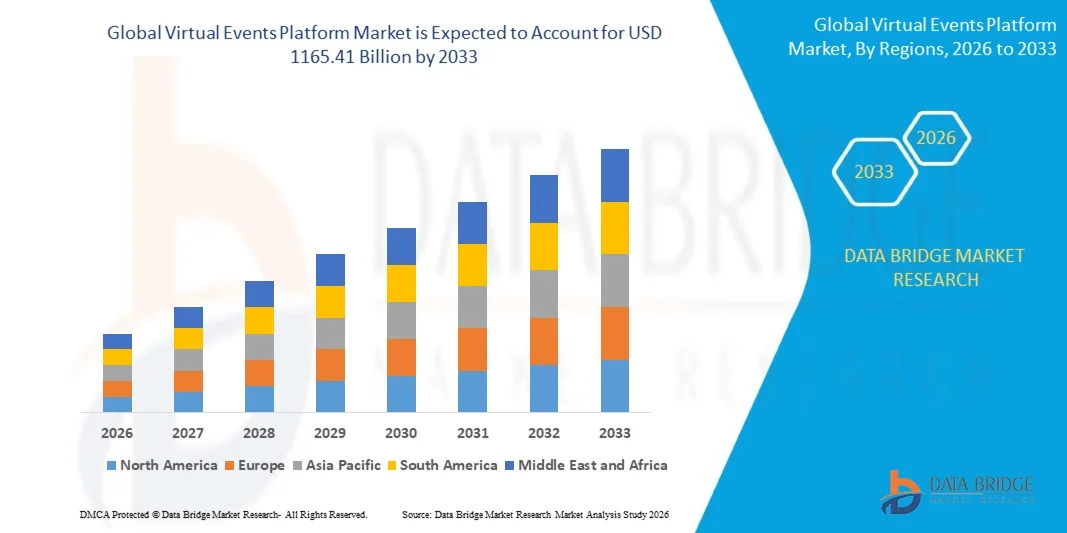
- The global virtual events platform market size was valued at USD 219.58 billion in 2025 and is expected to reach USD 1165.41 billion by 2033, at a CAGR of23.20% during the forecast period
- Increasing popularity of unified communication as a service (UCaaS) among enterprises, corporates, education institutes, and various other organizations across industries, increasing adoption of virtual event platforms in the healthcare industry to conduct medical conferences and seminars
What are the Major Takeaways of Virtual Events Platform Market?
- Rising demand of VR and AR technologies across business, growing digitalization and increase in the work-from-home (WFH) policy, rise in number of event management companies, time saving and cost-effective alternative for organizers as well as participants are some of the major as well as vital factors which will such asly to augment the growth of the virtual events platform market
- On the other hand, surging levels of investment for the development of advanced infrastructure along with growing number of technological advancements which will further contribute by generating massive opportunities that will lead to the growth of the virtual events platform market
- North America dominated the virtual events platform market with a 35.25% revenue share in 2025, driven by early technology adoption, strong digital infrastructure, and high demand for enterprise-grade virtual and hybrid event solutions across the U.S. and Canada
- Asia-Pacific is projected to register the fastest CAGR of 9.65% from 2026 to 2033, driven by rapid digitalization, expanding internet penetration, and growing adoption of virtual and hybrid events across China, Japan, India, South Korea, and Southeast Asia
- The Software segment dominated the market with a 68.3% share in 2025, driven by widespread adoption of cloud-based virtual event platforms offering features such as live streaming, attendee engagement tools, virtual booths, analytics dashboards, and third-party integrations
Report Scope and Virtual Events Platform Market Segmentation
|
Attributes |
Virtual Events Platform Key Market Insights |
|
Segments Covered |
|
|
Countries Covered |
North America
Europe
Asia-Pacific
Middle East and Africa
South America
|
|
Key Market Players |
|
|
Market Opportunities |
|
|
Value Added Data Infosets |
In addition to the insights on market scenarios such as market value, growth rate, segmentation, geographical coverage, and major players, the market reports curated by the Data Bridge Market Research also include in-depth expert analysis, pricing analysis, brand share analysis, consumer survey, demography analysis, supply chain analysis, value chain analysis, raw material/consumables overview, vendor selection criteria, PESTLE Analysis, Porter Analysis, and regulatory framework. |
What is the Key Trend in the Virtual Events Platform Market?
“Increasing Shift Toward Integrated, Scalable, and AI-Driven Virtual Events Platforms”
- The virtual events platform market is witnessing strong adoption of cloud-based, modular, and highly scalable platforms designed to support virtual, hybrid, and large-scale online events
- Platform providers are introducing AI-powered networking, real-time analytics, virtual booths, and interactive engagement tools to enhance attendee experience and organizer efficiency
- Growing demand for cost-effective, easy-to-deploy, and globally accessible event solutions is driving adoption across corporate conferences, trade shows, product launches, and educational events
- For instance, companies such as Cvent, Zoom, Microsoft, Whova, and vFairs have enhanced their platforms with advanced analytics, audience matchmaking, live polling, and seamless third-party integrations
- Increasing need for data-driven insights, attendee personalization, and real-time engagement measurement is accelerating the shift toward integrated, all-in-one virtual event ecosystems
- As organizations prioritize global reach, flexibility, and digital engagement, virtual events platforms will remain central to modern event delivery strategies
What are the Key Drivers of Virtual Events Platform Market?
- Rising demand for scalable, cost-efficient, and flexible event solutions that reduce travel, venue, and operational costs
- For instance, in 2024–2025, leading providers such as Cvent, Hubilo, and InEvent expanded platform capabilities with AI-based analytics, CRM integrations, and enhanced attendee tracking
- Growing adoption of hybrid work models, remote collaboration, and digital marketing strategies across enterprises, education, and associations is boosting platform demand globally
- Advancements in cloud computing, AI, data analytics, and video streaming technologies have improved platform performance, security, and user experience
- Rising focus on measurable ROI, attendee insights, and lead generation is increasing adoption among corporate and B2B event organizers
- Supported by sustained investments in digital infrastructure and enterprise software, the Virtual Events Platform market is expected to witness strong long-term growth
Which Factor is Challenging the Growth of the Virtual Events Platform Market?
- High subscription and customization costs associated with premium virtual event platforms limit adoption among small organizations and budget-constrained event planners
- For instance, during 2024–2025, increasing cloud infrastructure expenses and data security requirements raised platform operating costs for several vendors
- Complexity in platform setup, integration with CRM and marketing tools, and event customization increases the need for technical expertise and training
- Limited digital adoption and connectivity challenges in emerging markets can restrict platform reach and performance
- Competition from video conferencing tools, in-house event solutions, and low-cost platforms creates pricing pressure and reduces differentiation
- To address these challenges, providers are focusing on simplified user interfaces, flexible pricing models, AI-driven automation, and enhanced customer support to expand global adoption of Virtual Events Platforms
How is the Virtual Events Platform Market Segmented?
The market is segmented on the basis of solution, enterprise size, and end user.
- By Solution
On the basis of solution, the virtual events platform market is segmented into Software and Service. The Software segment dominated the market with a 68.3% share in 2025, driven by widespread adoption of cloud-based virtual event platforms offering features such as live streaming, attendee engagement tools, virtual booths, analytics dashboards, and third-party integrations. Enterprises and event organizers increasingly prefer software solutions due to scalability, ease of deployment, and recurring subscription-based pricing models. Continuous feature upgrades, AI-driven networking, and real-time data analytics further strengthen software adoption.
The Service segment is expected to grow at the fastest CAGR from 2026 to 2033, supported by rising demand for platform customization, technical support, event production services, and post-event analytics. As hybrid and large-scale global events become more complex, organizations increasingly rely on managed services to ensure seamless execution and higher attendee engagement.
- By Enterprise Size
Based on enterprise size, the virtual events platform market is segmented into Small and Medium Enterprises (SMEs) and Large Enterprises. The Large Enterprise segment held the largest market share of 61.5% in 2025, driven by high event volumes, larger budgets, and strong focus on data-driven marketing, lead generation, and global audience engagement. Large organizations extensively use advanced platforms integrated with CRM, marketing automation, and analytics tools to support conferences, product launches, and corporate events.
The SME segment is projected to grow at the fastest CAGR from 2026 to 2033, supported by increasing availability of cost-effective, easy-to-use platforms and flexible pricing models. Growing adoption of digital marketing, remote collaboration, and virtual networking tools among startups and mid-sized businesses is accelerating SME participation in virtual and hybrid events.
- By End User
On the basis of end user, the virtual events platform market is segmented into Enterprise/Corporates, Event Management Agencies, Academic Institutions, Trade Show Organizers, and Others. The Enterprise/Corporates segment dominated the market with a 45.7% share in 2025, driven by extensive use of virtual platforms for internal meetings, global conferences, training programs, and marketing events. Corporates benefit from scalability, global reach, and measurable ROI offered by advanced virtual event platforms.
The Trade Show Organizers segment is expected to grow at the fastest CAGR from 2026 to 2033, driven by rising adoption of virtual and hybrid trade shows to expand audience reach, reduce logistical costs, and enhance exhibitor visibility. Increased demand for interactive booths, real-time analytics, and global networking capabilities is accelerating platform adoption across trade show organizers worldwide.
Which Region Holds the Largest Share of the Virtual Events Platform Market?
- North America dominated the virtual events platform market with a 35.25% revenue share in 2025, driven by early technology adoption, strong digital infrastructure, and high demand for enterprise-grade virtual and hybrid event solutions across the U.S. and Canada. The region hosts a large number of corporate headquarters, event management firms, and technology providers that extensively utilize virtual platforms for conferences, product launches, training programs, and trade shows. High penetration of cloud computing, AI-driven analytics, and advanced streaming technologies continues to support large-scale virtual event deployment
- Leading players in North America continuously introduce feature-rich platforms offering real-time engagement tools, advanced networking, data analytics, and seamless CRM integrations, strengthening regional market leadership
- Strong presence of skilled digital talent, mature SaaS ecosystems, and sustained enterprise IT spending further reinforce North America’s dominance
U.S. Virtual Events Platform Market Insight
The U.S. is the largest contributor within North America, supported by widespread adoption of virtual and hybrid events across corporates, technology firms, academic institutions, and trade show organizers. High demand for scalable platforms capable of hosting global audiences, interactive sessions, and data-driven attendee insights drives market growth. Presence of major platform providers, strong startup ecosystems, and continuous innovation in AI-powered engagement and event analytics further accelerates adoption.
Canada Virtual Events Platform Market Insight
Canada contributes significantly to regional growth, driven by increasing digital transformation initiatives, rising corporate adoption of remote collaboration tools, and growing use of virtual platforms in education and government events. Universities, professional associations, and event agencies increasingly rely on virtual events to expand reach and reduce costs. Supportive innovation policies and strong digital infrastructure enhance market penetration.
Asia-Pacific Virtual Events Platform Market
Asia-Pacific is projected to register the fastest CAGR of 9.65% from 2026 to 2033, driven by rapid digitalization, expanding internet penetration, and growing adoption of virtual and hybrid events across China, Japan, India, South Korea, and Southeast Asia. Increasing corporate globalization, rising startup ecosystems, and cost-effective event hosting solutions accelerate demand. Growth in online education, virtual trade fairs, and cross-border business events further strengthens regional expansion.
China Virtual Events Platform Market Insight
China leads Asia-Pacific growth due to large-scale enterprise adoption, expanding digital ecosystems, and strong government support for online platforms. Growing demand for virtual exhibitions, corporate events, and digital conferences drives platform usage. Local platform providers and large user bases further support market expansion.
Japan Virtual Events Platform Market Insight
Japan shows steady growth supported by advanced digital infrastructure, strong corporate culture, and rising adoption of hybrid business events. Demand for reliable, high-quality virtual platforms for conferences, exhibitions, and training programs continues to increase.
India Virtual Events Platform Market Insight
India is emerging as a key growth hub, driven by rapid digital adoption, expanding startup culture, and increasing use of virtual platforms by enterprises, educational institutions, and event agencies. Cost efficiency and scalability remain major adoption drivers.
South Korea Virtual Events Platform Market Insight
South Korea contributes significantly due to strong technology adoption, high internet penetration, and growing demand for immersive virtual experiences. Corporate events, virtual expos, and online education platforms continue to fuel sustained market growth.
Which are the Top Companies in Virtual Events Platform Market?
The virtual events platform industry is primarily led by well-established companies, including:
- 6Connex (U.S.)
- BigMarker (U.S.)
- Cvent Inc. (U.S.)
- Hubilo Technologies Inc. (U.S.)
- Intrado, Inc. (U.S.)
- Livestorm SAS (France)
- Pathable, Inc. (U.S.)
- Planning Pod (U.S.)
- Skift Inc. (U.S.)
- meeytoo conferencing GmbH (Germany)
- V2, LLC. (U.S.)
- vFairs (U.A.E.)
- Whova (U.S.)
- Microsoft (U.S.)
- Cisco (U.S.)
- Zoom Video Communications, Inc. (U.S.)
- Evenium (France)
- SpotMe (Switzerland)
- Hubb (U.S.)
- InEvent, Inc. (U.S.)
- Cadence (U.S.)
- KitApps, Inc. (U.S.)
- Boomset, Inc. (U.S.)
- Kestone (U.K.)
What are the Recent Developments in Global Virtual Events Platform Market?
- In September 2024, Vosmos Events launched a suite of AI-powered solutions designed to transform virtual events, streamline planning, management, and audience engagement, featuring tools such as VIRSA for smart matchmaking, VosmosGPT for easy event setup, and vClip for automated video editing, marking a significant step toward intelligent event automation and enhanced attendee experiences
- In September 2024, Zoom Video Communications, Inc. partnered with Mitel to enhance business communication solutions, integrating Zoom’s video conferencing capabilities with Mitel’s communication systems for seamless connectivity and improved virtual meeting experiences, strengthening collaboration tools for corporate and event environments globally
- In July 2024, Martiz Holdings, Inc. acquired Convention Data Services (CDS) from Freeman, a leading registration and lead services provider, to expand its portfolio and client base in the trade show and association events sector, reinforcing its market presence and service offerings in the global events industry
SKU-
Get online access to the report on the World's First Market Intelligence Cloud
- Interactive Data Analysis Dashboard
- Company Analysis Dashboard for high growth potential opportunities
- Research Analyst Access for customization & queries
- Competitor Analysis with Interactive dashboard
- Latest News, Updates & Trend analysis
- Harness the Power of Benchmark Analysis for Comprehensive Competitor Tracking
Global Virtual Events Platform Market, Supply Chain Analysis and Ecosystem Framework
To support market growth and help clients navigate the impact of geopolitical shifts, DBMR has integrated in-depth supply chain analysis into its Global Virtual Events Platform Market research reports. This addition empowers clients to respond effectively to global changes affecting their industries. The supply chain analysis section includes detailed insights such as Global Virtual Events Platform Market consumption and production by country, price trend analysis, the impact of tariffs and geopolitical developments, and import and export trends by country and HSN code. It also highlights major suppliers with data on production capacity and company profiles, as well as key importers and exporters. In addition to research, DBMR offers specialized supply chain consulting services backed by over a decade of experience, providing solutions like supplier discovery, supplier risk assessment, price trend analysis, impact evaluation of inflation and trade route changes, and comprehensive market trend analysis.
Research Methodology
Data collection and base year analysis are done using data collection modules with large sample sizes. The stage includes obtaining market information or related data through various sources and strategies. It includes examining and planning all the data acquired from the past in advance. It likewise envelops the examination of information inconsistencies seen across different information sources. The market data is analysed and estimated using market statistical and coherent models. Also, market share analysis and key trend analysis are the major success factors in the market report. To know more, please request an analyst call or drop down your inquiry.
The key research methodology used by DBMR research team is data triangulation which involves data mining, analysis of the impact of data variables on the market and primary (industry expert) validation. Data models include Vendor Positioning Grid, Market Time Line Analysis, Market Overview and Guide, Company Positioning Grid, Patent Analysis, Pricing Analysis, Company Market Share Analysis, Standards of Measurement, Global versus Regional and Vendor Share Analysis. To know more about the research methodology, drop in an inquiry to speak to our industry experts.
Customization Available
Data Bridge Market Research is a leader in advanced formative research. We take pride in servicing our existing and new customers with data and analysis that match and suits their goal. The report can be customized to include price trend analysis of target brands understanding the market for additional countries (ask for the list of countries), clinical trial results data, literature review, refurbished market and product base analysis. Market analysis of target competitors can be analyzed from technology-based analysis to market portfolio strategies. We can add as many competitors that you require data about in the format and data style you are looking for. Our team of analysts can also provide you data in crude raw excel files pivot tables (Fact book) or can assist you in creating presentations from the data sets available in the report.