


Veterinary X-Ray Market Analysis
The veterinary X-ray market has seen significant growth, driven by the increasing demand for advanced diagnostic tools in animal healthcare. As pet ownership rises globally, so does the emphasis on pet health and wellness, boosting the adoption of sophisticated imaging systems. The market spans applications for small animals, livestock, and exotic species, addressing conditions such as fractures, tumors, and organ abnormalities. Technological advancements have revolutionized the market, with the transition from analog to digital radiography offering enhanced image quality, reduced processing time, and easier image sharing. Portable X-ray systems have gained popularity, particularly in rural and field settings, enabling veterinarians to deliver prompt care. Integration of artificial intelligence (AI) for image analysis is emerging, aiding in quicker and more accurate diagnoses. The market is also supported by growing investments in veterinary clinics and hospitals, particularly in developed regions. However, high equipment costs and a lack of trained professionals in some areas remain challenges. Overall, the veterinary X-ray market is poised for robust growth, driven by innovation and rising awareness about advanced veterinary care.
Veterinary X-Ray Market Size
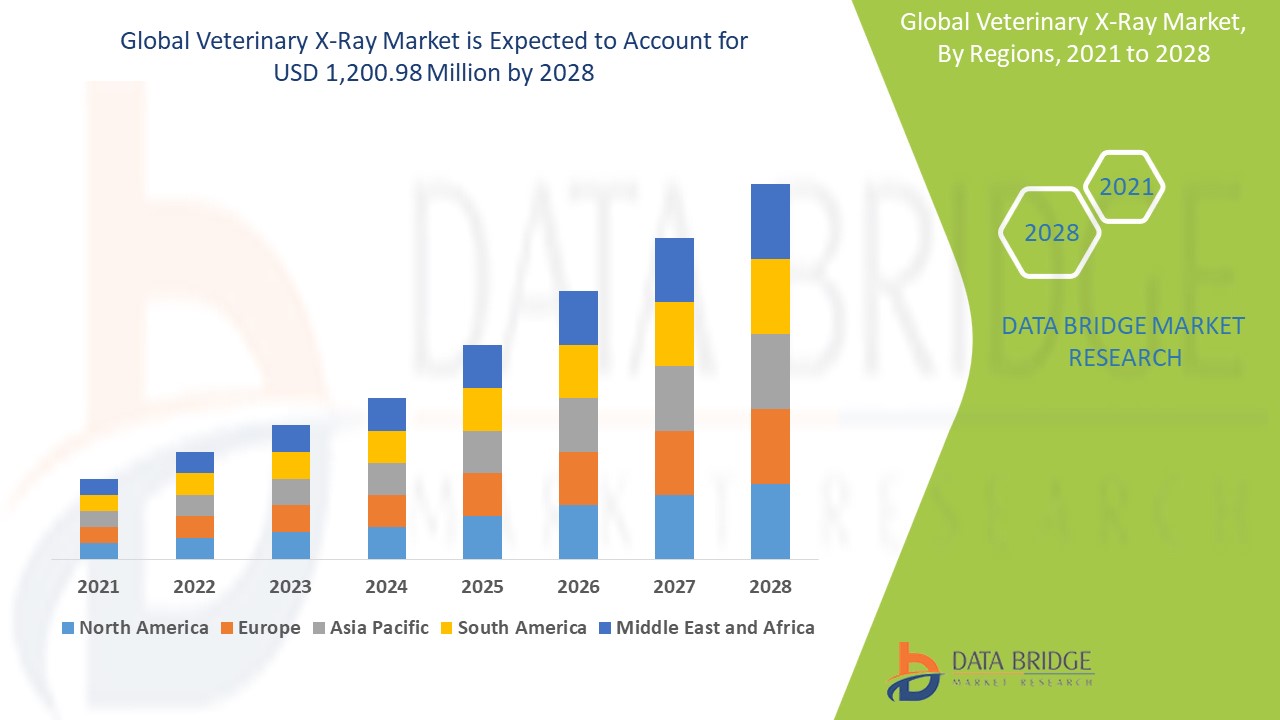
The global Veterinary X-Ray market size was valued at USD 915.19 million in 2024 and is projected to reach USD 1576.00 million by 2032, with a CAGR of 7.03 % during the forecast period of 2025 to 2032. In addition to the insights on market scenarios such as market value, growth rate, segmentation, geographical coverage, and major players, the market reports curated by the Data Bridge Market Research also include depth expert analysis, patient epidemiology, pipeline analysis, pricing analysis, and regulatory framework.
Veterinary X-Ray Market Trends
“Growing Adoption of Digital Radiography”
The veterinary X-ray market is experiencing a significant shift with the growing adoption of digital radiography. This trend is driven by the demand for faster, higher-quality imaging with reduced radiation exposure for both animals and veterinary professionals. Digital X-rays offer superior image clarity and faster processing times compared to traditional film-based systems, making it easier for veterinarians to make quick and accurate diagnoses. For instance, portable digital X-ray systems are becoming increasingly popular in emergency and rural veterinary practices, allowing veterinarians to perform diagnostic imaging at the point of care. These systems are particularly useful in fieldwork for large animals such as horses and cattle, where immediate diagnosis can be critical for effective treatment. The ability to store, share, and analyze digital images further enhances the efficiency of veterinary clinics, supporting better decision-making and improving overall animal care. This technological advancement is expected to drive the growth of the veterinary X-ray market in the coming years.
Report Scope and Veterinary X-Ray Market Segmentation
|
Attributes |
Veterinary X-Ray Key Market Insights |
|
Segments Covered |
|
|
Countries Covered |
U.S., Canada and Mexico in North America, Germany, France, U.K., Netherlands, Switzerland, Belgium, Russia, Italy, Spain, Turkey, Rest of Europe in Europe, China, Japan, India, South Korea, Singapore, Malaysia, Australia, Thailand, Indonesia, Philippines, Rest of Asia-Pacific (APAC) in the Asia-Pacific (APAC), Saudi Arabia, U.A.E., South Africa, Egypt, Israel, Rest of Middle East and Africa (MEA) as a part of Middle East and Africa (MEA), Brazil, Argentina and Rest of South America as part of South America |
|
Key Market Players |
IDEXX (U.S.), FUJIFILM Corporation (Japan), Sedecal (Spain), Agfa-Gevaert Group (Belgium), Sound (U.S.), Canon U.S.A., Inc. (U.S.), PIXXGEN (South Korea), EXAMION (Germany), Konica Minolta Healthcare Americas, Inc. (U.S.), Heska Corporation (U.S.), Avante Animal Health (U.S.), ALCEN (France), Oehm und Rehbein GmbH (Germany), Diagnostic Imaging Systems (U.S.), MinXray Inc. (U.S.), IMV Imaging (U.K.), HiTech International (India), Comeselectro SNC (Italy), Carestream Health (U.S.), Dristech, LLC (U.S.), and Control-X Medical cPlc (Hungary) |
|
Market Opportunities |
|
|
Value Added Data Infosets |
In addition to the insights on market scenarios such as market value, growth rate, segmentation, geographical coverage, and major players, the market reports curated by the Data Bridge Market Research also include depth expert analysis, patient epidemiology, pipeline analysis, pricing analysis, and regulatory framework. |
Veterinary X-Ray Market Definition
Veterinary X-ray refers to the use of X-ray technology in veterinary medicine to capture detailed images of the internal structures of animals for diagnostic purposes. X-rays are a form of electromagnetic radiation that pass through the body, creating an image of bones, tissues, and organs. This imaging technique is essential for diagnosing various conditions such as fractures, infections, tumors, and other abnormalities in animals, including pets, livestock, and wildlife.
Veterinary X-Ray Market Dynamics
Drivers
- Increasing Pet Ownership
Increasing pet ownership is a major driver of the veterinary X-ray market, especially in developed countries where pets are increasingly seen as family members. As pet owners become more invested in the health and well-being of their animals, the demand for advanced diagnostic tools, such as veterinary X-rays, grows. X-ray systems are crucial for diagnosing conditions such as bone fractures, tumors, and internal organ diseases, which are common in pets. For instance, the rising popularity of digital X-ray systems has made it easier for veterinarians to quickly detect and treat these conditions. In the U.S., where pet ownership has reached nearly 70% of households, veterinary clinics are increasingly investing in these technologies to meet the growing demand for comprehensive and accurate care. This trend of increased pet ownership, combined with a greater awareness of the importance of diagnostic imaging, directly drives the expansion of the veterinary X-ray market, as more pet owners seek advanced treatments for their animals.
- Rising Awareness of Animal Health
Rising awareness of animal health is a key driver in the veterinary X-ray market, as more pet owners seek to ensure the well-being of their animals. With the growing recognition that early detection of health issues can significantly improve outcomes, there is an increased demand for accurate diagnostic tools such as X-rays. This is especially true for diagnosing conditions such as fractures, tumors, and internal organ diseases, which are common in pets. For instance, in cases of trauma or suspected cancer, veterinarians often rely on X-ray imaging to identify and assess the extent of injuries or tumors, enabling timely treatment. As pet owners become more knowledgeable about animal health and the importance of preventative care, the demand for advanced diagnostic technologies, such as digital veterinary X-ray systems, has surged. This shift towards more proactive pet healthcare directly contributes to the growth of the veterinary X-ray market, as pet owners prioritize accurate and efficient diagnostics for their animals.
Opportunities
- Rising Technological Advancements in Veterinary Imaging
Technological advancements in veterinary imaging, particularly the shift from traditional film-based radiography to digital X-ray systems, present a significant market opportunity. Digital X-rays offer faster image acquisition, clearer diagnostic images, and reduced radiation exposure, which enhances the safety of both animals and veterinary professionals. For instance, the adoption of direct digital radiography (DR) in veterinary practices has revolutionized diagnostics by providing high-resolution images almost instantly, allowing veterinarians to make faster decisions. These systems also facilitate easy image sharing, enabling remote consultations and improving collaboration across veterinary teams. An instance of this technology's impact is seen in veterinary emergency care, where quick and precise imaging is essential for diagnosing trauma or internal bleeding. As more veterinary clinics transition to digital systems for their efficiency, cost-effectiveness, and patient safety benefits, the demand for these advanced imaging technologies is expected to continue growing, creating a substantial market opportunity for innovation and expansion in the veterinary X-ray sector.
- Growing Veterinary Services Market
The growing veterinary services market represents a significant opportunity for the veterinary X-ray sector, driven by the expansion of veterinary clinics, hospitals, and emergency services, particularly in emerging markets. As pet ownership and livestock management rise in regions such as Asia-Pacific and Latin America, the demand for advanced diagnostic tools, including veterinary X-ray systems, has increased. For instance, in countries such as China and India, where the pet care industry is booming, veterinary clinics are increasingly investing in state-of-the-art imaging technology to meet the needs of a more health-conscious pet owner demographic. In addition, the growth of rural and mobile veterinary services has spurred the adoption of portable X-ray machines, allowing for immediate diagnostics in remote areas. This expansion of veterinary infrastructure in emerging markets is creating a robust market opportunity for companies offering advanced imaging solutions, as veterinary professionals seek reliable, efficient tools to provide high-quality care for animals across diverse settings.
Restraints/Challenges
- High Cost of Advanced X-ray Systems
The high cost of advanced X-ray systems presents a significant challenge in the veterinary X-ray market, particularly for smaller veterinary clinics or practices in developing regions. Advanced systems, such as digital X-ray or computed radiography (CR) systems, can cost tens of thousands of dollars, making them inaccessible to many practitioners. For instance, a complete VXR Veterinary X-ray Room by FUJIFILM can be a considerable investment, deterring small animal hospitals from adopting such technologies. This cost barrier limits the widespread implementation of high-quality imaging solutions, especially in emerging markets where cost-consciousness is a major factor. The initial investment in purchasing the equipment, coupled with maintenance costs and the need for periodic upgrades, makes it difficult for veterinary professionals to keep up with technological advancements. As a result, many veterinary practices continue to rely on traditional, lower-cost diagnostic methods, hindering the growth and adoption of advanced X-ray systems. This high cost acts as a major market challenge, restricting accessibility to cutting-edge diagnostic tools and impeding market expansion.
- Lack of Trained Professionals
The lack of trained professionals is a significant challenge facing the veterinary X-ray market, as the effective use of advanced imaging technologies requires specialized knowledge and skills. Veterinary radiologists and technicians must be proficient in operating complex X-ray systems, interpreting detailed images, and ensuring proper safety protocols are followed, particularly regarding radiation exposure. For instance, even with the introduction of high-quality systems such as Fujifilm's VXR Veterinary X-ray Room, the lack of skilled personnel in regions with limited access to specialized education and training programs creates a bottleneck in adoption. Many smaller veterinary clinics, particularly in rural or emerging markets, struggle to find qualified professionals capable of handling sophisticated diagnostic equipment. This shortage of trained professionals leads to underutilization of advanced technologies and potentially compromised diagnostic accuracy, limiting the market's overall growth and effectiveness. The lack of trained professionals remains a market challenge, hindering the adoption and full potential of veterinary X-ray systems across various regions.
This market report provides details of new recent developments, trade regulations, import-export analysis, production analysis, value chain optimization, market share, impact of domestic and localized market players, analyses opportunities in terms of emerging revenue pockets, changes in market regulations, strategic market growth analysis, market size, category market growths, application niches and dominance, product approvals, product launches, geographic expansions, technological innovations in the market. To gain more info on the market contact Data Bridge Market Research for an Analyst Brief, our team will help you take an informed market decision to achieve market growth.
Veterinary X-Ray Market Scope
The market is segmented on the basis of type, technology, mobility, animal type, application, and end user. The growth amongst these segments will help you analyse meagre growth segments in the industries and provide the users with a valuable market overview and market insights to help them make strategic decisions for identifying core market applications.
Type
- Digital X-ray Systems
- Analog X-ray Systems
Technology
- Computed Radiography Systems
- Direct Radiography Systems
- Film-Based Radiography Systems
Mobility
- Stationary X-ray Systems
- Portable X-ray Systems
Animal Type
- Small Companion Animals
- Large Animals
Application
- Orthopedics and Trauma
- Dental Applications
- Oncology
- Others
End User
- Veterinary Hospitals and Academic Institutes
- Veterinary Clinics
Veterinary X-Ray Market Regional Analysis
The market is analysed and market size insights and trends are provided by country, type, technology, mobility, animal type, application, and end user as referenced above.
The countries covered in the market report are U.S., Canada and Mexico in North America, Germany, France, U.K., Netherlands, Switzerland, Belgium, Russia, Italy, Spain, Turkey, Rest of Europe in Europe, China, Japan, India, South Korea, Singapore, Malaysia, Australia, Thailand, Indonesia, Philippines, Rest of Asia-Pacific (APAC) in the Asia-Pacific (APAC), Saudi Arabia, U.A.E., South Africa, Egypt, Israel, Rest of Middle East and Africa (MEA) as a part of Middle East and Africa (MEA), Brazil, Argentina and Rest of South America as part of South America.
North America dominates the veterinary X-ray market, driven by a significant rise in pet adoption rates and increased awareness of animal health. In addition, the growing emphasis on pet healthcare has led to higher healthcare expenditure in the animal health sector, supporting market growth. Advanced veterinary infrastructure and widespread availability of innovative X-ray systems further contribute to the region's leadership. This strong market position is bolstered by a robust network of veterinary hospitals and clinics adopting modern diagnostic technologies.
Asia-Pacific is anticipated to experience substantial growth in the veterinary X-ray market during the forecast period from 2025 to 2032. This expansion is fueled by increasing investments from companies aiming to strengthen their presence in the region, driven by a rapidly growing demand for veterinary products. The availability of affordable animal health solutions and the rising awareness of pet healthcare further support market development. In addition, improvements in veterinary infrastructure and expanding access to modern diagnostic technologies contribute to the region’s accelerated growth trajectory.
The country section of the report also provides individual market impacting factors and changes in regulation in the market domestically that impacts the current and future trends of the market. Data points such as down-stream and upstream value chain analysis, technical trends and porter's five forces analysis, case studies are some of the pointers used to forecast the market scenario for individual countries. Also, the presence and availability of global brands and their challenges faced due to large or scarce competition from local and domestic brands, impact of domestic tariffs and trade routes are considered while providing forecast analysis of the country data.
Veterinary X-Ray Market Share
The market competitive landscape provides details by competitor. Details included are company overview, company financials, revenue generated, market potential, investment in research and development, new market initiatives, global presence, production sites and facilities, production capacities, company strengths and weaknesses, product launch, product width and breadth, application dominance. The above data points provided are only related to the companies' focus related to market.
Veterinary X-Ray Market Leaders Operating in the Market Are:
- IDEXX (U.S.)
- FUJIFILM Corporation (Japan)
- Sedecal (Spain)
- Agfa-Gevaert Group (Belgium)
- Sound (U.S.)
- Canon U.S.A., Inc. (U.S.)
- PIXXGEN (South Korea)
- EXAMION (Germany)
- Konica Minolta Healthcare Americas, Inc. (U.S.)
- Heska Corporation (U.S.)
- Avante Animal Health (U.S.)
- ALCEN (France)
- Oehm und Rehbein GmbH (Germany)
- Diagnostic Imaging Systems (U.S.)
- MinXray Inc. (U.S.)
- IMV Imaging (U.K.)
- HiTech International (India)
- Comeselectro SNC (Italy)
- Carestream Health (U.S.)
- Dristech, LLC (U.S.)
- Control-X Medical cPlc (Hungary)
Latest Developments in Veterinary X-Ray Market
- In February 2024, SignalPET introduced SignalSTAT, an advanced AI-driven veterinary X-ray interpretation solution designed to provide rapid and comprehensive care. The platform offers 24/7 availability with a guaranteed 45-minute turnaround for critical or urgent cases, combining cutting-edge AI technology with expert human oversight
- In February 2024, IONETIX collaborated with Provision Diagnostic Imaging in Knoxville, Tennessee, to utilize N-13 Ammonia manufactured on-site for advanced diagnostic imaging. Provision Diagnostic Imaging is a leading outpatient diagnostic center in the East Tennessee region known for pioneering medical diagnostics technologies
- In March 2023, Zoetis Services LLC expanded its multi-purpose diagnostics platform, “Vetscan Imagyst,” with the addition of AI-based dermatology and equine fecal egg count (FEC) analysis applications, enhancing its testing capabilities and diagnostic offerings
- In July 2021, IDEXX Laboratories, Inc. acquired ezyVet, a cloud-based practice information management system (PIMS), to offer a comprehensive range of solutions for veterinary hospitals, corporate groups, universities, and other institutions, improving customer service and operational efficiency
- In December 2021, Fujifilm India Pvt Ltd partnered with A’alda Vet India Pvt Ltd to enhance pet healthcare facilities in India. Fujifilm provided innovative medical and screening equipment to the DCC (Dogs, Cats & Companions) Animal Hospital, a flagship initiative aimed at improving veterinary care
- In February 2021, FUJIFILM Medical Systems launched its first complete VXR Veterinary X-Ray Room, designed to offer veterinarians an affordable, versatile, and easy-to-install solution for high-quality, low-dose X-rays

- Interactive Data Analysis Dashboard
- Company Analysis Dashboard for high growth potential opportunities
- Research Analyst Access for customization & queries
- Competitor Analysis with Interactive dashboard
- Latest News, Updates & Trend analysis
- Harness the Power of Benchmark Analysis for Comprehensive Competitor Tracking
Data collection and base year analysis are done using data collection modules with large sample sizes. The stage includes obtaining market information or related data through various sources and strategies. It includes examining and planning all the data acquired from the past in advance. It likewise envelops the examination of information inconsistencies seen across different information sources. The market data is analysed and estimated using market statistical and coherent models. Also, market share analysis and key trend analysis are the major success factors in the market report. To know more, please request an analyst call or drop down your inquiry.
The key research methodology used by DBMR research team is data triangulation which involves data mining, analysis of the impact of data variables on the market and primary (industry expert) validation. Data models include Vendor Positioning Grid, Market Time Line Analysis, Market Overview and Guide, Company Positioning Grid, Patent Analysis, Pricing Analysis, Company Market Share Analysis, Standards of Measurement, Global versus Regional and Vendor Share Analysis. To know more about the research methodology, drop in an inquiry to speak to our industry experts.
Data Bridge Market Research is a leader in advanced formative research. We take pride in servicing our existing and new customers with data and analysis that match and suits their goal. The report can be customized to include price trend analysis of target brands understanding the market for additional countries (ask for the list of countries), clinical trial results data, literature review, refurbished market and product base analysis. Market analysis of target competitors can be analyzed from technology-based analysis to market portfolio strategies. We can add as many competitors that you require data about in the format and data style you are looking for. Our team of analysts can also provide you data in crude raw excel files pivot tables (Fact book) or can assist you in creating presentations from the data sets available in the report.













