Global Ventilated Seats Market
Market Size in USD Billion
CAGR :
% 
 USD
10.35 Billion
USD
15.64 Billion
2025
2033
USD
10.35 Billion
USD
15.64 Billion
2025
2033
 Forecast Period Forecast Period |
2026 –2033 |
 Market Size (Base Year) Market Size (Base Year) |
USD 10.35 Billion |
 Market Size (Forecast Year) Market Size (Forecast Year) |
USD 15.64 Billion |
 CAGR CAGR |
% |
| Major Markets Players |
|
Ventilated Seats Market Size
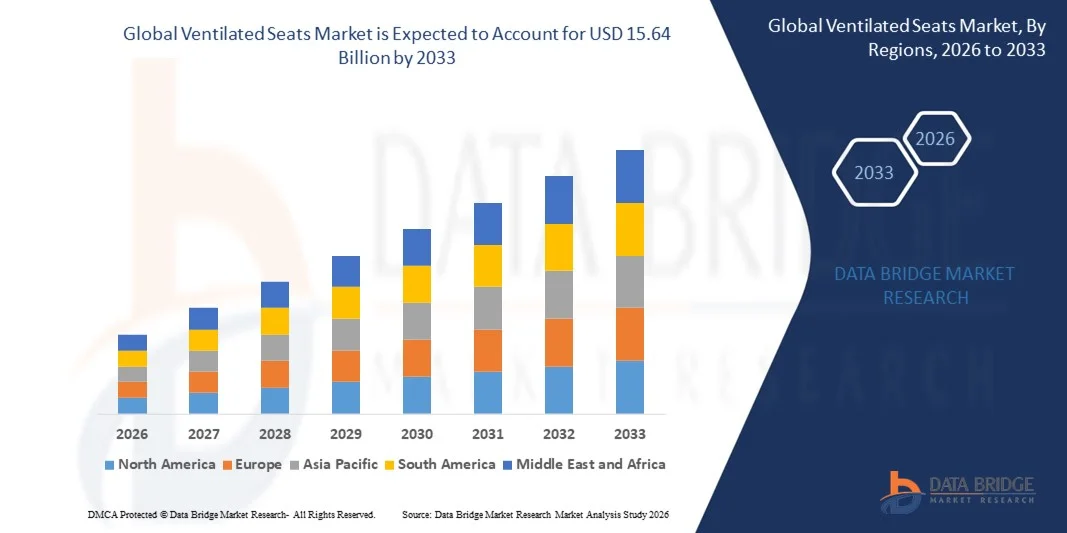
- The global ventilated seats market size was valued at USD 10.35 billion in 2025 and is expected to reach USD 15.64 billion by 2033, at a CAGR of 5.30% during the forecast period
- The market growth is largely fuelled by increasing consumer demand for enhanced comfort and luxury features in vehicles, particularly in premium and mid-range segments
- Rising adoption of electric and autonomous vehicles, which emphasize passenger comfort and advanced interior features, is further driving market expansion
Ventilated Seats Market Analysis
- The ventilated seats market is witnessing steady growth due to the rising focus on passenger comfort, health, and overall in-cabin experience. Technological advancements, such as multi-zone ventilation and integration with smart climate control systems, are further promoting adoption
- Automotive manufacturers are increasingly incorporating ventilated seats in sedans, SUVs, and electric vehicles to differentiate their offerings and enhance market competitiveness
- North America dominated the ventilated seats market with the largest revenue share of 38.50% in 2025, driven by rising consumer preference for in-vehicle comfort, premium automotive features, and climate-adaptive seating solutions
- Asia-Pacific region is expected to witness the highest growth rate in the global ventilated seats market, driven by increasing urbanization, rising disposable incomes, growing EV adoption, and expansion of automotive manufacturing and seating system suppliers in countries such as China, Japan, and India
- The passenger car segment held the largest market revenue share in 2025 driven by rising consumer preference for enhanced comfort features in personal vehicles. Passenger cars with ventilated seats offer improved cabin comfort in hot climates, making them a popular choice among premium and mid-segment buyers. Increasing disposable income and rising awareness about in-car comfort are further supporting market growth. In addition, automotive manufacturers are focusing on introducing ventilated seats in more affordable models to expand their consumer base
Report Scope and Ventilated Seats Market Segmentation
|
Attributes |
Ventilated Seats Key Market Insights |
|
Segments Covered |
|
|
Countries Covered |
|
|
Key Market Players |
|
|
Market Opportunities |
|
|
Value Added Data Infosets |
In addition to the market insights such as market value, growth rate, market segments, geographical coverage, market players, and market scenario, the market report curated by the Data Bridge Market Research team includes in-depth expert analysis, import/export analysis, pricing analysis, production consumption analysis, and pestle analysis. |
Ventilated Seats Market Trends
Rising Demand for Enhanced Comfort and Luxury Features
- Growing focus on passenger comfort and in-cabin experience is significantly shaping the ventilated seats market, as consumers increasingly prefer vehicles with improved ergonomics and advanced climate control features. Ventilated seats are gaining traction due to their ability to enhance thermal comfort, reduce sweating, and improve overall driving experience without compromising interior aesthetics. This trend strengthens their adoption across passenger cars, SUVs, and luxury vehicles, encouraging manufacturers to innovate with new seat designs and integrated climate solutions
- Increasing awareness around health, wellness, and ergonomics has accelerated the demand for ventilated seats in premium and mid-range vehicles. Consumers and fleet operators are actively seeking vehicles equipped with advanced seating technologies, prompting brands to integrate ventilated systems with seat adjustment, heating, and cooling functionalities
- Comfort and convenience trends are influencing purchasing decisions, with automotive manufacturers emphasizing ergonomic design, customizable airflow, and climate-responsive features. These factors help brands differentiate vehicles in a competitive market, while also enhancing passenger satisfaction and loyalty
- For instance, in 2024, BMW in Germany and Lexus in Japan expanded their vehicle lineups by incorporating ventilated seats in sedans, SUVs, and electric vehicles. These launches were introduced in response to rising consumer preference for enhanced comfort, with availability across dealerships and online channels. The seats were also marketed as premium features, improving brand perception and repeat purchases among target audiences
- While demand for ventilated seats is growing, sustained market expansion depends on continuous R&D, cost-effective integration, and maintaining performance comparable to conventional seating solutions. Manufacturers are also focusing on improving scalability, compatibility with electric and autonomous vehicles, and developing innovative designs that balance comfort, energy efficiency, and aesthetics for broader adoption
Ventilated Seats Market Dynamics
Driver
Rising Demand for Enhanced Comfort and Premium Vehicle Features
- Increasing consumer demand for comfortable, ergonomic, and climate-controlled seating is a major driver for the ventilated seats market. Automotive manufacturers are increasingly incorporating ventilated systems to enhance passenger satisfaction, improve brand perception, and comply with premium vehicle standards
- Expanding applications in sedans, SUVs, electric vehicles, and luxury vehicles are influencing market growth. Ventilated seats help regulate temperature, improve air circulation, and enhance driving comfort while maintaining aesthetic and design quality, enabling manufacturers to meet consumer expectations for high-end and comfortable offerings
- Automotive companies are actively promoting ventilated seat-equipped models through marketing campaigns, product innovation, and partnerships with seat component suppliers. These efforts are supported by growing consumer preference for health-oriented, comfortable, and luxury features, and they encourage adoption across both mass-market and premium vehicles
- For instance, in 2023, Mercedes-Benz in Germany and Ford in the U.S. reported increased incorporation of ventilated seats in SUVs and electric vehicle models. This expansion followed higher consumer demand for comfort, premium features, and customizable climate control, driving repeat purchases and vehicle differentiation. Both companies highlighted ergonomic and health benefits in marketing campaigns to strengthen consumer trust and brand loyalty
- Although rising comfort and luxury trends support growth, wider adoption depends on cost optimization, production scalability, and integration with existing vehicle architectures. Investment in supply chain efficiency, advanced seat materials, and climate-responsive technology will be critical for meeting global demand and maintaining competitive advantage
Restraint/Challenge
Higher Cost And Limited Awareness Compared To Standard Seats
- The relatively higher cost of ventilated seats compared to standard seating remains a key challenge, limiting adoption among price-sensitive consumers and budget vehicle segments. Higher material costs, advanced cooling mechanisms, and integration with electronic control systems contribute to elevated pricing
- Consumer and manufacturer awareness remains uneven, particularly in developing markets where demand for luxury and premium features is still emerging. Limited understanding of functional benefits restricts adoption across certain vehicle segments. This also leads to slower integration uptake in emerging economies where awareness campaigns are minimal
- Supply chain and integration challenges also impact market growth, as ventilated seats require sourcing from specialized suppliers and adherence to quality standards. Logistical complexities and additional installation requirements increase operational costs. Companies must invest in component sourcing, assembly optimization, and efficient distribution networks to maintain product integrity
- For instance, in 2024, automotive distributors in India and Southeast Asia supplying vehicles such as Toyota and Nissan reported slower uptake due to higher prices and limited awareness of functional advantages compared to standard seats. Integration with electric vehicle architectures and climate control systems were additional barriers. These factors also prompted some manufacturers to limit availability of ventilated seat options, affecting visibility and adoption
- Overcoming these challenges will require cost-efficient production, expanded distribution networks, and focused educational initiatives for consumers and dealers. Collaboration with seat suppliers, automotive OEMs, and marketing agencies can help unlock the long-term growth potential of the global ventilated seats market. Furthermore, developing cost-competitive solutions and strengthening marketing strategies around comfort, health, and luxury benefits will be essential for widespread adoption
Ventilated Seats Market Scope
The market is segmented on the basis of vehicle type, propulsion, sales channel, ventilation type, material type, and technology.
- By Vehicle Type
On the basis of vehicle type, the ventilated seats market is segmented into passenger car, light commercial vehicle, and heavy commercial vehicle. The passenger car segment held the largest market revenue share in 2025 driven by rising consumer preference for enhanced comfort features in personal vehicles. Passenger cars with ventilated seats offer improved cabin comfort in hot climates, making them a popular choice among premium and mid-segment buyers. Increasing disposable income and rising awareness about in-car comfort are further supporting market growth. In addition, automotive manufacturers are focusing on introducing ventilated seats in more affordable models to expand their consumer base.
The light commercial vehicle segment is expected to witness the fastest growth rate from 2026 to 2033, driven by increasing adoption of comfort-enhancing features in commercial fleets. Ventilated seats in LCVs enhance driver endurance and reduce fatigue, making them appealing for logistics and transportation businesses. Growing demand for long-haul transport vehicles and focus on driver safety and comfort are also boosting the segment. Fleet operators are increasingly upgrading vehicles with advanced seating solutions to attract skilled drivers and improve operational efficiency.
- By Propulsion
On the basis of propulsion, the market is segmented into internal combustion engine (ICE) and electric vehicle (EV). The ICE segment dominated in 2025 due to the higher global presence of ICE vehicles and established supply chains for comfort accessories. High production volume and long-standing integration of ventilated seats in mid- and premium-segment ICE vehicles contribute to its dominance. Consumer familiarity with ICE vehicles and relatively lower initial cost compared to EVs also support market growth. Manufacturers continue to enhance seat ventilation systems in ICE vehicles to maintain competitive advantage.
The EV segment is expected to grow at a faster pace from 2026 to 2033, driven by growing EV adoption and the integration of advanced cabin comfort systems in electric cars. Ventilated seats are increasingly becoming standard in premium EV models due to their energy-efficient cooling mechanisms. Rising government incentives and consumer interest in electric mobility are encouraging manufacturers to offer multifunctional seats. Collaborations between EV makers and seat technology suppliers are further accelerating innovation in this segment.
- By Sales Channel
On the basis of sales channel, the market is segmented into OEM and aftermarket. The OEM segment accounted for the largest revenue share in 2025 owing to the increasing trend of vehicle manufacturers offering ventilated seats as a factory-installed feature. OEM integration ensures better quality, warranty coverage, and seamless fit with vehicle interiors. Premium and mid-segment car buyers often prefer OEM-installed seats for reliability and performance. Automakers are actively marketing ventilated seats as a key differentiator to attract consumers.
The aftermarket segment is expected to grow at a faster pace from 2026 to 2033, fueled by vehicle owners upgrading existing cars with ventilated seating solutions for enhanced comfort. Rising disposable income and increased consumer awareness about seat comfort drive aftermarket adoption. Growth in e-commerce platforms and availability of plug-and-play ventilated seat kits are supporting this trend. Aftermarket vendors are focusing on lightweight, energy-efficient, and customizable options to cater to diverse vehicle models.
- By Ventilation Type
On the basis of ventilation type, the market is divided into active and passive. The active ventilation segment dominated in 2025 due to its superior airflow system, providing better cooling and comfort for drivers and passengers. Active ventilation systems are often integrated with climate control, improving overall cabin environment. Luxury and premium vehicle buyers prefer active ventilated seats for enhanced comfort during long drives. Automakers are investing in improving airflow efficiency while minimizing energy consumption to maintain vehicle performance.
The passive ventilation segment is anticipated to grow steadily from 2026 to 2033, driven by its cost-effectiveness and ease of integration in mid-segment vehicles. Passive systems are simpler, require less maintenance, and are suitable for regions with moderate temperatures. Rising demand for affordable comfort solutions in emerging markets is boosting this segment. Manufacturers are developing hybrid designs that combine passive and active ventilation to appeal to a wider audience.
- By Material Type
On the basis of material type, the market is segmented into fabric, genuine leather, and synthetic leather. The genuine leather segment held the largest market revenue share in 2025, supported by consumer preference for luxury and premium interiors in vehicles. Leather ventilated seats offer better breathability and aesthetic appeal, increasing perceived vehicle value. Premium car manufacturers focus on incorporating ventilated leather seats as standard in high-end models. The segment benefits from increasing disposable income and growing demand for premium vehicle customization.
The synthetic leather segment is projected to witness the fastest growth during the forecast period, driven by its durability, lower cost, and growing adoption in mid- to high-end vehicle segments. Eco-friendly synthetic leather options are gaining traction among environmentally conscious consumers. Technological improvements have enhanced comfort, texture, and appearance, making synthetic leather a viable alternative to genuine leather. Automotive companies are expanding their synthetic leather offerings to attract cost-sensitive customers without compromising on comfort.
- By Technology
On the basis of technology, the market is segmented into standard, powered, and heated & massage. The standard ventilated seat segment led the market in 2025 due to its widespread adoption in passenger and commercial vehicles. Standard systems are simple, reliable, and provide sufficient cooling, making them suitable for most climates. OEMs and aftermarket vendors prefer standard systems for easier installation and maintenance. Increasing consumer interest in basic comfort features in affordable vehicles supports the segment’s growth.
The heated & massage segment is expected to register the fastest growth from 2026 to 2033, driven by increasing demand for multifunctional comfort features in premium and luxury vehicles. Heated and massage functionalities enhance driving comfort, reduce fatigue, and contribute to overall wellness. Rising adoption of connected and smart vehicle technologies allows integration with automated seat control systems. Manufacturers are focusing on combining ventilation, heating, and massage features to offer all-in-one premium seating experiences.
Ventilated Seats Market Regional Analysis
- North America dominated the ventilated seats market with the largest revenue share of 38.50% in 2025, driven by rising consumer preference for in-vehicle comfort, premium automotive features, and climate-adaptive seating solutions
- Consumers in the region highly value advanced comfort, ergonomic designs, and enhanced temperature control offered by ventilated seats, particularly in luxury and mid-segment vehicles
- This widespread adoption is further supported by high disposable incomes, strong automotive sales, and increasing consumer awareness about vehicle ergonomics, establishing ventilated seats as a preferred feature for passenger cars, LCVs, and HCVs
U.S. Ventilated Seats Market Insight
The U.S. ventilated seats market captured the largest revenue share in 2025 within North America, fueled by the growing demand for premium vehicles and comfort-oriented automotive features. Consumers are increasingly prioritizing temperature-controlled seating for long drives and urban commuting. The rising adoption of electric and hybrid vehicles, which often integrate advanced climate control systems, further propels the ventilated seats market. Moreover, the expansion of OEM offerings and aftermarket upgrades, along with technological advancements in seat ventilation systems, is significantly contributing to market growth.
Europe Ventilated Seats Market Insight
The Europe ventilated seats market is expected to witness the fastest growth rate from 2026 to 2033, primarily driven by increasing vehicle sales in premium and mid-segment categories and a rising focus on passenger comfort. Urbanization, coupled with government regulations promoting energy-efficient automotive solutions, is fostering adoption. European consumers are also drawn to enhanced thermal comfort and ergonomic seating. The market is witnessing notable growth across passenger cars, light commercial vehicles, and electric vehicles, with ventilated seats being incorporated in both new vehicle launches and retrofit programs.
U.K. Ventilated Seats Market Insight
The U.K. ventilated seats market is expected to witness the fastest growth rate from 2026 to 2033, driven by rising interest in luxury and premium vehicles and a growing focus on in-car comfort. In addition, increasing awareness about heat management and ergonomics is encouraging consumers to opt for ventilated seating solutions. The UK’s well-established automotive market, combined with a growing aftermarket ecosystem for seat upgrades, is expected to continue supporting market expansion. Increasing integration of ventilated seats in electric and hybrid vehicles further strengthens growth prospects.
Germany Ventilated Seats Market Insight
The Germany ventilated seats market is expected to witness the fastest growth rate from 2026 to 2033, fueled by rising demand for technologically advanced and energy-efficient vehicle interiors. Germany’s robust automotive manufacturing sector, combined with strong consumer preference for premium comfort features, promotes ventilated seat adoption. Integration of ventilated seats with advanced climate control and luxury vehicle packages is becoming increasingly common. Focus on driver and passenger well-being, along with sustainability considerations, is also influencing market growth.
Asia-Pacific Ventilated Seats Market Insight
The Asia-Pacific ventilated seats market is expected to witness the fastest growth rate from 2026 to 2033, driven by increasing vehicle sales, urbanization, and growing disposable incomes in countries such as China, Japan, and India. Rising adoption of premium and electric vehicles, supported by government initiatives promoting advanced automotive technologies, is driving market expansion. The region is also emerging as a manufacturing hub for automotive seating systems, improving affordability and accessibility of ventilated seats across passenger and commercial vehicles.
Japan Ventilated Seats Market Insight
The Japan ventilated seats market is expected to witness the fastest growth rate from 2026 to 2033 due to the country’s technologically advanced automotive industry, high urbanization, and demand for comfort-oriented features. Japanese consumers place high importance on thermal comfort and ergonomics, driving adoption in passenger cars and EVs. Integration of ventilated seats with multifunctional seating systems, such as heated and massage features, is further fueling market growth. Moreover, Japan’s aging population is likely to increase demand for easily adjustable and comfortable seating solutions in both personal and commercial vehicles.
China Ventilated Seats Market Insight
The China ventilated seats market accounted for the largest market revenue share in Asia-Pacific in 2025, attributed to the country’s growing middle class, increasing vehicle ownership, and rapid adoption of premium features. The expanding electric and luxury vehicle segments are significantly contributing to ventilated seat adoption. Government incentives for energy-efficient vehicles, coupled with rising consumer awareness about comfort and ergonomics, are driving market growth. Domestic automotive manufacturers and seat system suppliers are actively innovating to offer affordable and technologically advanced ventilated seating options.
Ventilated Seats Market Share
The Ventilated Seats industry is primarily led by well-established companies, including:
- Lear (U.S.)
- Adient plc. (Ireland)
- Magna International Inc. (Canada)
- TOYOTA BOSHOKU CORPORATION (Japan)
- DURA AUTOMOTIVE SYSTEMS (U.S.)
- GENTHERM (U.S.)
- ebm-papst (Germany)
- TS TECH CO., LTD. (Japan)
- Faurecia (France)
- Brose Fahrzeugteile SE & Co. KG (Germany)
- NHK SPRING Co., Ltd. (Japan)
- Continental AG (Germany)
- HYUNDAI TRANSYS (South Korea)
Latest Developments in Global Ventilated Seats Market
- In August 2025, Adient (U.S.), strategic partnership, announced collaboration with a leading EV manufacturer to develop next-generation ventilated seats using sustainable materials. The move aligns with eco-friendly trends and strengthens Adient’s market position in premium and environmentally conscious segments
- In August 2025, Tesla, experience center launch, opened its 8,200 sq ft facility at Worldmark 3, Aerocity, Delhi, offering test drives, product demos, and four ultra-fast V4 Superchargers. The center aims to enhance customer engagement and promote long-distance EV travel, strengthening Tesla’s market presence in India
- In September 2025, Lear Corporation (U.S.), product launch, introduced a new line of ventilated seats with advanced climate control technology. The innovation enhances passenger comfort in varying weather conditions, attracting consumer attention and potentially increasing market share
- In July 2025, Gentherm (U.S.), manufacturing expansion, expanded its European production capabilities to meet rising demand for ventilated seats. The strategic expansion improves supply efficiency and strengthens Gentherm’s presence in the European automotive market
- In July 2025, Tesla, vehicle launch, introduced the Model Y electric midsize SUV with heated and ventilated front seats and power-folding heated rear seats. This upgrade improves in-cabin comfort, appealing to premium SUV buyers and enhancing Tesla’s competitive positioning
- In August 2025, SAIC Motor, pre-sales launch, initiated bookings for the MG4 EV in China, featuring a semi-solid-state battery and front seats with heating and ventilation, plus rear seats reclining up to 27°. The enhanced comfort features are expected to boost consumer adoption in the growing EV segment
- In June 2025, GAC, product showcase, unveiled the HYPTEC HT electric SUV at the International Automotive & Supply Chain Expo in Hong Kong with ventilated, heated, and massage seats. This premium seating innovation strengthens GAC’s brand positioning and attracts attention in the luxury EV market
- In November 2024, Lucid Group, vehicle launch, released the Lucid Gravity Grand Touring with 18-way power front seats featuring heating, ventilation, and massage functions. The customizable premium interiors enhance passenger comfort and reinforce Lucid’s reputation in the luxury EV segment
- In November 2022, Toyota Boshoku, vehicle component innovation, introduced new sliding adjustable front seats and ventilated rear seats in the all-new Lexus RX. The design improves seating support and prevents stuffiness, enhancing comfort and driving customer satisfaction
- In January 2022, Tesla, manual update, added references to ventilated seats in the Model 3 and Model Y online Owner’s Manual, including a dedicated control button. This update improves user awareness of comfort features, supporting customer experience and satisfaction
SKU-
Get online access to the report on the World's First Market Intelligence Cloud
- Interactive Data Analysis Dashboard
- Company Analysis Dashboard for high growth potential opportunities
- Research Analyst Access for customization & queries
- Competitor Analysis with Interactive dashboard
- Latest News, Updates & Trend analysis
- Harness the Power of Benchmark Analysis for Comprehensive Competitor Tracking
Research Methodology
Data collection and base year analysis are done using data collection modules with large sample sizes. The stage includes obtaining market information or related data through various sources and strategies. It includes examining and planning all the data acquired from the past in advance. It likewise envelops the examination of information inconsistencies seen across different information sources. The market data is analysed and estimated using market statistical and coherent models. Also, market share analysis and key trend analysis are the major success factors in the market report. To know more, please request an analyst call or drop down your inquiry.
The key research methodology used by DBMR research team is data triangulation which involves data mining, analysis of the impact of data variables on the market and primary (industry expert) validation. Data models include Vendor Positioning Grid, Market Time Line Analysis, Market Overview and Guide, Company Positioning Grid, Patent Analysis, Pricing Analysis, Company Market Share Analysis, Standards of Measurement, Global versus Regional and Vendor Share Analysis. To know more about the research methodology, drop in an inquiry to speak to our industry experts.
Customization Available
Data Bridge Market Research is a leader in advanced formative research. We take pride in servicing our existing and new customers with data and analysis that match and suits their goal. The report can be customized to include price trend analysis of target brands understanding the market for additional countries (ask for the list of countries), clinical trial results data, literature review, refurbished market and product base analysis. Market analysis of target competitors can be analyzed from technology-based analysis to market portfolio strategies. We can add as many competitors that you require data about in the format and data style you are looking for. Our team of analysts can also provide you data in crude raw excel files pivot tables (Fact book) or can assist you in creating presentations from the data sets available in the report.