


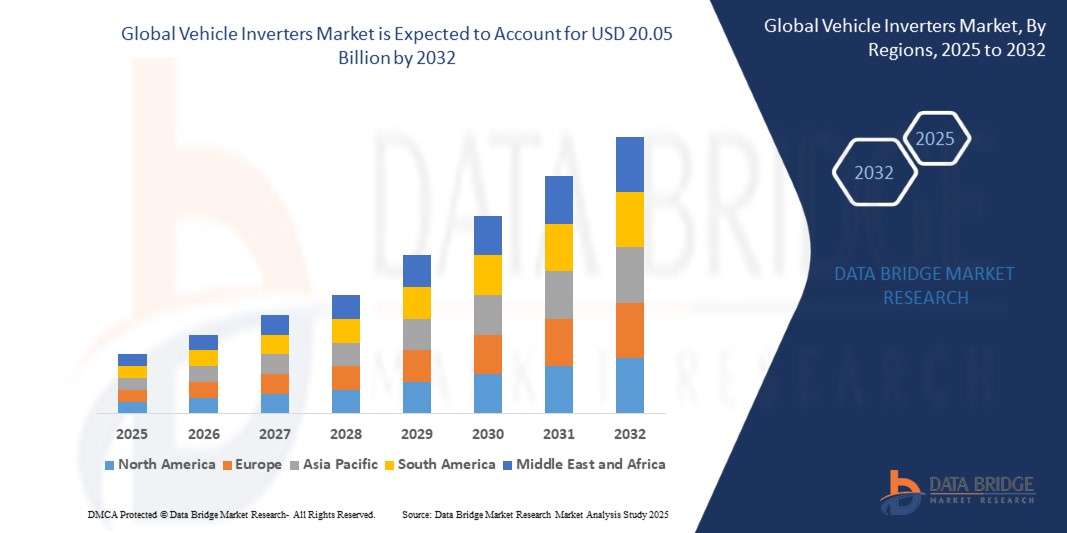
Vehicle Inverters Market Size
- The Global Vehicle Inverters Market size was valued at USD 8.55 billion in 2024 and is expected to reach USD 20.05 billion by 2032, at a CAGR of 36.3% during the forecast period
- The market expansion is primarily driven by the increasing adoption of electric vehicles (EVs) and the advancement in power electronics technologies, which are critical for efficient energy conversion in modern EV systems.
- Additionally, the growing emphasis on energy efficiency, sustainable transportation, and government incentives for EV adoption is boosting the demand for vehicle inverters, making them a crucial component in electric and hybrid vehicles. The integration of smart and high-voltage inverter systems further enhances vehicle performance and range, significantly contributing to the market's robust growth trajectory.
Vehicle Inverters Market Analysis
- Vehicle inverters, which play a crucial role in converting DC power from vehicle batteries into usable AC power, are becoming increasingly important in the automotive sector. They are essential for enhancing the performance, energy efficiency, and power management of electric and hybrid vehicles, serving both personal and commercial mobility needs.
- The rising adoption of vehicle inverters is mainly driven by the global shift towards vehicle electrification, a surge in the production and sales of electric vehicles (EVs), and ongoing innovations in advanced semiconductor technologies such as silicon carbide (SiC) and gallium nitride (GaN). These developments are accelerating the integration of high-efficiency inverters, making them a vital part of next-generation transportation systems.
- Asia-Pacific dominates the Vehicle Inverters Market with the highest revenue share of 39.6% in 2024, propelled by rapid electric vehicle (EV) adoption, supportive government policies, and a robust automotive manufacturing ecosystem.
- North America held a significant share of 31.5% in the global Vehicle Inverters Market in 2024, mainly driven by the strong EV ecosystem, especially in the United States.The region is witnessing increasing adoption of EVs across both commercial and consumer segments, supported by federal subsidies, state-level tax incentives, and emission regulations.
- The IGBT segment held the largest market revenue share in 2025 due to its high current-carrying capability and efficiency in managing power losses. IGBT-based inverters are widely used in electric vehicles (EVs) for their cost-effectiveness and robustness in high-voltage applications.
Report Scope and Vehicle Inverters Market Segmentation
|
Attributes |
Vehicle Inverters Key Market Insights |
|
Segments Covered |
|
|
Countries Covered |
North America
Europe
Asia-Pacific
Middle East and Africa
South America
|
|
Key Market Players |
|
|
Market Opportunities |
|
|
Value Added Data Infosets |
In addition to the insights on market scenarios such as market value, growth rate, segmentation, geographical coverage, and major players, the market reports curated by the Data Bridge Market Research also include in-depth expert analysis, pricing analysis, brand share analysis, consumer survey, demography analysis, supply chain analysis, value chain analysis, raw material/consumables overview, vendor selection criteria, PESTLE Analysis, Porter Analysis, and regulatory framework. |
Vehicle Inverters Market Trends
“Rising EV Adoption and Electrification of Automotive Powertrains”
- One of the primary growth drivers of the Global Vehicle Inverters Market is the rapid adoption of electric vehicles (EVs) worldwide. With increasing global awareness of environmental sustainability, governments and automakers are focusing heavily on transitioning from internal combustion engines (ICE) to electric mobility.
- Vehicle inverters are crucial for EV functionality, as they convert direct current (DC) from the battery into alternating current (AC) to power the electric motor. Without efficient inverters, energy transfer and motor control would be compromised.
- Leading automotive players like Tesla, Ford, Toyota, and General Motors are heavily investing in EV models, thereby increasing the demand for high-performance and compact inverter systems. Additionally, government incentives such as tax rebates, emission regulations, and infrastructure investments are accelerating EV sales, thus strengthening the market for vehicle inverters.
- The electrification of commercial fleets (buses, trucks, delivery vehicles) is also contributing significantly to inverter demand, especially in urban areas targeting zero-emission transportation systems.
Vehicle Inverters Market Dynamics
Driver
“Technological Advancements in Semiconductor Materials”
- Advancements in power electronics and the development of new semiconductor materials such as silicon carbide (SiC) and gallium nitride (GaN) are significantly improving the performance and efficiency of vehicle inverters.
- Compared to traditional silicon-based systems, SiC and GaN allow for higher switching frequencies, better thermal conductivity, and compact inverter designs, which are essential for modern electric vehicles that demand high power density and energy efficiency.
- Companies like Infineon Technologies, Fuji Electric, and STMicroelectronics are at the forefront of introducing inverter solutions built with wide bandgap semiconductors. These solutions not only reduce energy losses but also improve battery performance and extend EV range.
- The adoption of such advanced technologies enables automotive manufacturers to produce lighter and more energy-efficient EVs, which is a key factor influencing buyer decisions in the market.
Restraint/Challenge
“High Cost of Advanced Inverter Technologies”
- Despite significant innovations, the high cost of producing vehicle inverters—especially those using SiC and GaN semiconductors—remains a major challenge for market growth.
- These materials, while more efficient and durable than traditional silicon, are expensive to manufacture and require advanced fabrication techniques, leading to increased production costs for OEMs.
- For price-sensitive markets and low-budget EV models, the adoption of these advanced inverter systems may not be economically viable without government subsidies or cost-cutting through mass production.
- Moreover, a limited supply of raw materials, complex integration processes, and a lack of standardization across manufacturers also contribute to higher costs, delaying wider adoption and slowing market penetration in developing regions.
Vehicle Inverters Market Scope
The market is segmented on the basis of technology, propulsion type, semiconductor material, vehicle type, and output.
- By Technology
On the basis of technology, the Vehicle Inverters Market is segmented into Insulated-Gate Bipolar Transistor (IGBT) and Metal-Oxide-Semiconductor Field-Effect Transistor (MOSFET).The IGBT segment held the largest market revenue share in 2025 due to its high current-carrying capability and efficiency in managing power losses. IGBT-based inverters are widely used in electric vehicles (EVs) for their cost-effectiveness and robustness in high-voltage applications.
The MOSFET segment is expected to witness the fastest CAGR from 2025 to 2032, driven by increasing demand for compact and high-frequency switching components. Their lightweight design and efficiency in low-voltage applications make MOSFETs ideal for advanced EVs and hybrid platforms.
- By Propulsion Type
Based on propulsion type, the market is segmented into Battery Electric Vehicle (BEV), Hybrid Electric Vehicle (HEV), and Plug-In Hybrid Electric Vehicle (PHEV).The BEV segment dominated the market in 2025, driven by global trends toward decarbonization, emission-free mobility, and substantial government incentives for fully electric vehicles.
The PHEV segment is expected to grow rapidly, supported by consumer preference for extended driving range and fuel flexibility, especially in regions with developing EV charging infrastructure.
- By Unlocking Mechanism
The Vehicle Inverters Market is segmented into Gallium Nitride (GaN), Silicon (Si), and Silicon Carbide (SiC) based on semiconductor material type.The Silicon segment continues to dominate due to its established manufacturing base and affordability. It remains a common choice for traditional automotive inverters.
However, the Silicon Carbide (SiC) segment is projected to experience the highest growth rate from 2025 to 2032, attributed to its superior thermal conductivity, higher energy efficiency, and suitability for high-performance EVs.Gallium Nitride (GaN) is also gaining momentum, especially in compact inverter designs, offering high efficiency in smaller vehicles and motorcycles.
- By Vehicle Type
The market is segmented into Passenger Cars and Commercial Vehicles.The Passenger Cars segment held the largest market share in 2025, supported by surging demand for personal EVs, government subsidies, and advancements in EV charging networks.
The Commercial Vehicles segment is poised for significant growth, especially in electric buses, delivery trucks, and fleet applications, as businesses and governments push for greener logistics and public transport systems.
- By Output
Based on output power, the Vehicle Inverters Market is divided into ≤130 kW and >130 kW.
The ≤130 kW segment led the market in 2025, commonly integrated into mid-range EVs and passenger cars where moderate power output is sufficient for daily operations.The >130 kW segment is anticipated to witness strong growth due to the rise of high-performance EVs, electric SUVs, and commercial vehicles that require higher torque and acceleration performance.
Vehicle Inverters Market Regional Analysis
- Asia-Pacific dominates the Vehicle Inverters Market with the highest revenue share of 37.16% in 2024, propelled by rapid electric vehicle (EV) adoption, supportive government policies, and a robust automotive manufacturing ecosystem.
- Consumers and manufacturers in the region are increasingly focusing on sustainable mobility solutions, and vehicle inverters are essential components in electric drivetrains for EVs and hybrid vehicles.
- Countries like China, Japan, and South Korea lead the shift towards electrification with strong infrastructure, battery innovations, and large-scale production of EV components.
- The region also benefits from favorable government incentives, growing environmental awareness, and the presence of major EV OEMs, which contribute significantly to the widespread adoption of vehicle inverters.
China Vehicle Inverters Market Insight
The China Vehicle Inverters Market secured the largest revenue share in the Asia-Pacific region in 2025, driven by the country’s aggressive push for vehicle electrification under the "New Energy Vehicle" (NEV) policy.With strong support from the government and massive investments in EV production, China has become the largest producer and consumer of EVs globally.The presence of leading domestic players, coupled with advancements in inverter technology and integration with powertrain systems, has positioned China as a global hub for vehicle inverters manufacturing and innovation..
Japan Vehicle Inverters Market Insight
The Japan Vehicle Inverters Market continues to grow steadily, supported by the nation’s long-standing commitment to hybrid and electric vehicle technologies.Japan’s automotive giants are leading innovations in inverter miniaturization, energy efficiency, and silicon carbide (SiC)-based inverters.The country’s strong focus on R&D, along with rising demand for energy-efficient vehicles and smart mobility solutions, enhances market growth
North America Vehicle Inverters Market Insight
North America held a significant share of 31.5% in the global Vehicle Inverters Market in 2024, mainly driven by the strong EV ecosystem, especially in the United States.The region is witnessing increasing adoption of EVs across both commercial and consumer segments, supported by federal subsidies, state-level tax incentives, and emission regulations.The technological maturity of North American automotive players and semiconductor innovators is fostering the development of high-performance, heat-resistant inverters for advanced EV models.
U.S. Vehicle Inverters Market Insight
The U.S. Vehicle Inverters Market accounted for 83% of North America’s market share in 2025, with growth primarily driven by the expansion of EV charging infrastructure and rising investments by domestic automakers.Major U.S.-based automotive and electronics companies are investing heavily in the development of power electronics for EVs, including inverter systems.Consumer demand for eco-friendly transport and improvements in energy efficiency are accelerating the use of sophisticated inverters in electric SUVs, trucks, and sedans..
Europe Vehicle Inverters Market Insight
The European Vehicle Inverters Market is projected to grow at a notable CAGR through 2032, fueled by the European Union's zero-emission targets and strict carbon regulations.Countries like Germany, France, and the Netherlands are spearheading the electrification wave with robust charging infrastructure and subsidies for electric vehicle purchases.European consumers are increasingly embracing electric vehicles, and automakers are integrating advanced inverter systems to enhance vehicle performance and energy conversion efficiency.
Germany Vehicle Inverters Market Insight
The Germany Vehicle Inverters Market is expected to expand significantly, driven by the presence of top-tier automotive OEMs and suppliers of power electronics.The nation’s engineering excellence and commitment to green mobility make it a key contributor to the European inverter landscape.With rapid electrification of fleets and consistent investments in automotive innovation, Germany is strengthening its role in the global vehicle inverters market..
Vehicle Inverters Market Share
The Vehicle Inverters industry is primarily led by well-established companies, including:
- Siemens(Germany)
- Robert Bosch GmbH(Germany)
- Marelli Corporation(Japan)
- Continental AG (Germany)
- DENSO CORPORATION (Japan)
- HYUNDAI MOBIS(South Korea)
- LG Electronics (South Korea)
- Hitachi Automotive Systems, Ltd.(Japan)
- Valeo (France)
- BorgWarner Inc.(United States)
- Fuji Electric Co., Ltd.(Japan)
- TOYOTA INDUSTRIES CORPORATION(Japan)
- Metric Mind Corporation(United States)
- Xantrex LLC.(Canada)
- Infineon Technologies AG(Germany)
- Lear Corporation(United States)
- Aptiv (Ireland)
- TROPICOOLINDIA.COM ALL RIGHTS RESERVED.(India)
- Mobitech Industries LLP (India)
- HBJ Electronic (Distributors of SERAI)(India)
Latest Developments in Global Vehicle Inverters Market
- In April 2023, ASSA ABLOY Group, a global leader in access control solutions, launched a major strategic initiative in South Africa focused on enhancing the security infrastructure of both residential and commercial properties through its advanced vehicle inverter technologies. This move demonstrates ASSA ABLOY’s commitment to delivering tailored, innovative access control products that address the specific security challenges of the regional market. By combining its extensive global expertise with cutting-edge solutions, the company is reinforcing its leadership position within the fast-growing Global Vehicle Inverters Market.
- In March 2023, HavenLock Inc., a veteran-owned enterprise headquartered in Tennessee, introduced the Power G version of its vehicle inverter locking system, specifically designed to improve security in schools and commercial buildings. This advanced Haven Lockdown System aims to strengthen emergency response protocols by providing a dependable and effective solution to protect vulnerable environments. This launch highlights HavenLock’s dedication to developing state-of-the-art safety technologies that enhance protection and peace of mind for institutions and communities alike.
- In March 2023, Honeywell International Inc. completed the implementation of the Bengaluru Safe City Project, a key urban safety initiative leveraging its sophisticated vehicle inverter and security technologies. This project utilizes innovative solutions to build a safer and more resilient urban environment, illustrating Honeywell’s expertise in smart security systems. The initiative emphasizes the growing role of advanced technology in enhancing public safety and shaping the development of intelligent, secure cities worldwide.
- In February 2023, Sentrilock, LLC, a leading provider of electronic lockbox solutions for the real estate sector, announced a strategic partnership with the Chesapeake Bay and Rivers Association of REALTORS (CBRAR) to develop a smart electronic lockbox marketplace for REALTOR members. This collaboration aims to improve security measures and simplify property access, thereby streamlining real estate transactions. The partnership showcases Sentrilock’s focus on innovation and operational efficiency within the real estate industry.
- In January 2023, Schlage, a prominent brand under Allegion Plc specializing in access and home security, unveiled the Schlage Encode Smart Wi-Fi Lever at the NAHB International Builders’ Show (IBS) 2023. This residential vehicle inverter solution, equipped with Wi-Fi connectivity, enables homeowners to remotely manage door access via a dedicated mobile app. The Schlage Encode lever underscores the company’s ongoing commitment to integrating advanced technology into home security, providing users with greater convenience, control, and robust protection.

- Interactive Data Analysis Dashboard
- Company Analysis Dashboard for high growth potential opportunities
- Research Analyst Access for customization & queries
- Competitor Analysis with Interactive dashboard
- Latest News, Updates & Trend analysis
- Harness the Power of Benchmark Analysis for Comprehensive Competitor Tracking
Data collection and base year analysis are done using data collection modules with large sample sizes. The stage includes obtaining market information or related data through various sources and strategies. It includes examining and planning all the data acquired from the past in advance. It likewise envelops the examination of information inconsistencies seen across different information sources. The market data is analysed and estimated using market statistical and coherent models. Also, market share analysis and key trend analysis are the major success factors in the market report. To know more, please request an analyst call or drop down your inquiry.
The key research methodology used by DBMR research team is data triangulation which involves data mining, analysis of the impact of data variables on the market and primary (industry expert) validation. Data models include Vendor Positioning Grid, Market Time Line Analysis, Market Overview and Guide, Company Positioning Grid, Patent Analysis, Pricing Analysis, Company Market Share Analysis, Standards of Measurement, Global versus Regional and Vendor Share Analysis. To know more about the research methodology, drop in an inquiry to speak to our industry experts.
Data Bridge Market Research is a leader in advanced formative research. We take pride in servicing our existing and new customers with data and analysis that match and suits their goal. The report can be customized to include price trend analysis of target brands understanding the market for additional countries (ask for the list of countries), clinical trial results data, literature review, refurbished market and product base analysis. Market analysis of target competitors can be analyzed from technology-based analysis to market portfolio strategies. We can add as many competitors that you require data about in the format and data style you are looking for. Our team of analysts can also provide you data in crude raw excel files pivot tables (Fact book) or can assist you in creating presentations from the data sets available in the report.













