


What is the Transcritical CO2 Size and Growth Rate?
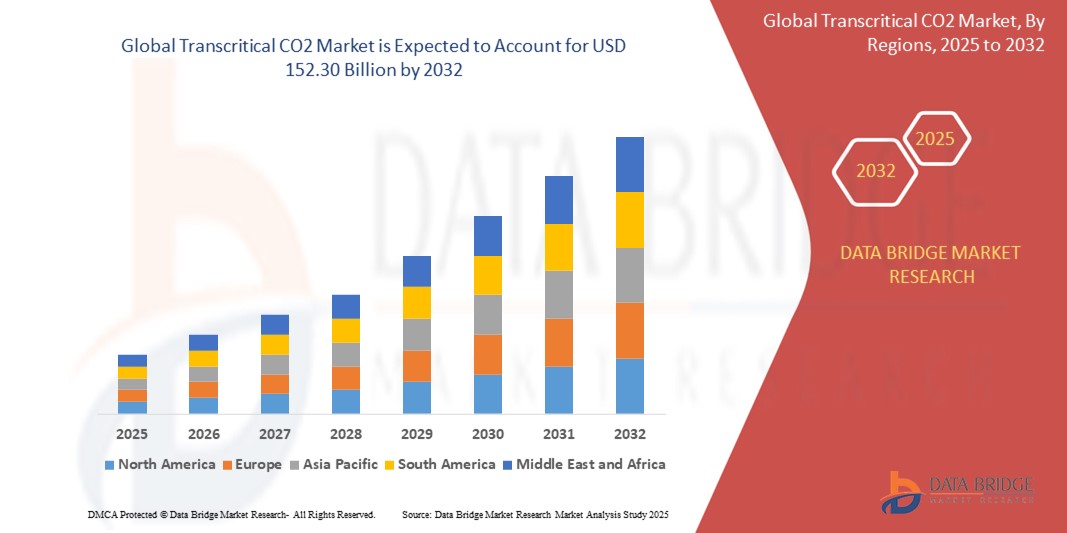
- As per Data Bridge Market Research Analysis the Global Transcritical CO2 Market was valued at USD 34.60 billion in 2024 and is expected to reach USD 152.30 billion by 2032
- During the forecast period of 2025 to 2032 the market is likely to grow at a CAGR of 17.9%, primarily driven by the surging demand for transcritical co2 in margarine production
- This growth is driven by factors such as manufacturers are increasingly investing in transcritical CO₂ for high-capacity, multi-zone cooling in margarine lines.
Market Size & Forecast
- Global Market Value (2024): USD 34.60 billion
- Expected Market Value (2032): USD 152.30 billion
- Forecast CAGR (2024–2032): 17.9%
What are the Major Takeaways of Transcritical CO2?
- Transcritical CO2 is are defined as an environmental-friendly and reliable system under which, CO2 is cooled but does not condense at the gas cooler outlet and operates above the critical point. These systems are suitable for medium to large cold storage facilities, supermarkets and light industrial processes.
- Surging demand for transcritical CO2 in margarine production, ice making and beer brewing industries are the root cause fueling up the transcritical CO2 market growth rate.
- Europe is expected to dominate the Transcritical CO2 market due to the strict governmental regulations and abolishment of usage of CFCs.
- North America is expected to be the fastest growing region in the Transcritical CO2 market during the forecast period due to the growing demand in the region for transcritical CO2 systems because of its non-toxicity and flammability nature, thus further increasing demand for Transcritical CO2 market.
- Refrigeration segment is expected to dominate the market with a market share of 90.2% due to the stringent environmental regulations phasing out high-GWP refrigerants, such as the EU's f-gas regulation.
Report Scope and Transcritical CO2 Market Segmentation
|
Attributes |
Transcritical CO2 Key Market Insights |
|
Segments Covered |
|
|
Countries Covered |
North America
Europe
Asia-Pacific
Middle East and Africa
South America
|
|
Key Market Players |
|
|
Market Opportunities |
|
|
Value Added Data Infosets |
|
What is the Key Trend in the Transcritical CO2?
“Rising Demand for Air Conditioning and Refrigeration Applications”
- With tightening global regulations on high-GWP refrigerants (like R-404A and R-134a), transcritical CO₂ systems—being natural refrigerants with a GWP of 1—are increasingly preferred, especially in commercial refrigeration.
- The expanding retail sector—particularly convenience stores and hypermarkets in urban areas—is fueling demand for sustainable refrigeration. Brands like ALDI and METRO have implemented transcritical CO₂ systems in hundreds of outlets across Europe and North America.
- Innovations like parallel compression and ejector technology have enabled CO₂ systems to perform efficiently in warmer regions.
- For instance, Woolworths in Australia has successfully installed transcritical CO₂ systems in stores located in high ambient temperatures.
- The growing need for eco-friendly, efficient, and regulatory-compliant cooling solutions is making transcritical CO₂ technology a preferred choice in both refrigeration and air conditioning—driving robust market growth globally.
Transcritical CO2 Market Dynamics
Driver
“Surging Demand for Transcritical CO2 in Margarine Production”
- Transcritical CO₂ systems offer superior energy efficiency for margarine chilling and crystallization, reducing operational costs.
- CO₂ is non-toxic and classified as a natural refrigerant (R-744), making it ideal for direct contact applications like margarine processing.
- Food companies are under pressure to reduce carbon footprints. Transcritical CO₂ systems are climate-friendly (GWP = 1), aligning with sustainability initiatives.
For instance,
- Unilever has implemented CO₂-based refrigeration in several facilities to improve process efficiency and cut emissions.
- European producers such as Upfield have adopted CO₂ systems to meet EU F-Gas Regulation compliance.
- Nestlé has incorporated CO₂-based refrigeration to meet its 2050 net-zero commitment.
- The expanding margarine industry’s shift to sustainable, efficient refrigeration reinforces transcritical CO₂ market growth globally, backed by industrial uptake, environmental policies, and cost-driven adoption.
Opportunity
“Development of Automated Flow Synthesis Systems Integrated with Machine Learning”
- Machine learning integrated with automated flow synthesis allows rapid screening of novel CO₂ blends and performance enhancers.
- ML-guided synthesis platforms can rapidly test surface coatings and nano-enhancements that improve heat transfer and reduce frost formation in CO₂ systems.
- Automated flow synthesis helps evaluate corrosion resistance and wear characteristics of metals and seals used in high-pressure transcritical CO₂ applications.
- Machine learning can dynamically optimize flow rates, temperature, and pressure in real-time during system testing, improving energy efficiency and reducing waste.
For instance,
- Researchers at MIT and ETH Zurich have used AI models to optimize refrigerant compositions for environmental efficiency and thermodynamic performance.
- AI-driven labs like Kebotix and IBM Research have pioneered similar automated workflows for materials discovery.
- The integration of automated flow synthesis with ML accelerates innovation in CO₂ system materials and refrigerant blends, driving competitive advantages in efficiency, environmental compliance, and system reliability—key factors in the expanding transcritical CO₂ market.
Restraint/Challenge
“The Presence of Few Players in the Purification of CO2 Systems”
- Few specialized players dominate the high-purity CO₂ supply chain. This concentration leads to premium pricing for purification systems, which increases capital costs for transcritical CO₂ refrigeration installations—especially in developing regions.
- With fewer competitors, innovation in purification techniques (e.g., membrane separation, adsorption) occurs more slowly. This impedes performance improvements and energy efficiency gains essential for broader adoption of transcritical CO₂ systems.
- Not all major CO₂ purification providers have global coverage. For example, European retailers may access advanced purification technologies more easily than users in Africa or Southeast Asia, restricting global market penetration for transcritical systems.
- The small number of CO₂ purification players create a strategic bottleneck—impacting affordability, innovation, and availability—which in turn slows the global expansion of transcritical CO₂ refrigeration systems despite rising demand for sustainable cooling solutions.
How is the Transcritical CO2 Segmented?
The market is segmented on the basis of function and end user.
|
Segmentation |
Sub-Segmentation |
|
By Function |
|
|
By End User |
|
In 2025, the refrigeration segment is projected to dominate the market with a largest share in function segment
The refrigeration segment is expected to dominate the market with the largest share of 90.2% in 2025 due to stringent environmental regulations phasing out high-GWP refrigerants, such as the EU's f-gas regulation. The need for energy-efficient and sustainable refrigeration solutions in sectors like food processing and retail. Technological advancements enhancing system performance and reliability.
The refrigeration segment is expected to account for the highest CAGR during the forecast period in technology market
In 2025, the refrigeration segment is expected to account for the highest CAGR due to the supermarkets and convenience stores application segment is the largest, driven by the need for energy-efficient and environmentally friendly refrigeration solutions.
Transcritical CO2 Market Regional Analysis
“Europe is the Dominant Region in the Transcritical CO2 Market”
- Europe dominates the Transcritical CO2 market, due to the strict governmental regulations and abolishment of usage of CFCs
- The France holds a significant share 26%, due to robust environmental policies aligned with the EU’s F-Gas Regulation, which aims to phase down high-GWP refrigerants like HFCs. This regulatory environment encourages the adoption of natural refrigerants such as CO₂.
- The country hosts a significant number of supermarkets and hypermarkets, which are major end-users of transcritical CO₂ systems. The widespread adoption in this sector has propelled market growth.
“North America is Projected to Register the Highest Growth Rate”
- North America region is expected to witness the highest growth rate in the Transcritical CO2 market, driven by the growing demand in the region for transcritical CO2 systems because of its non-toxicity and flammability nature
- U.S. is expected to lead the growth due to major U.S. retailers are increasingly implementing transcritical CO₂ systems in supermarkets and convenience stores to enhance energy efficiency and reduce carbon footprints.
- The U.S. Environmental Protection Agency (EPA) and initiatives like the Significant New Alternatives Policy (SNAP) promote the adoption of natural refrigerants, including CO₂, to phase out high-GWP substances.
Which are the Top Companies in Transcritical CO2?
The market competitive landscape provides details by competitor. Details included are company overview, company financials, revenue generated, market potential, investment in research and development, new market initiatives, global presence, production sites and facilities, production capacities, company strengths and weaknesses, product launch, product width and breadth, application dominance. The above data points provided are only related to the companies' focus related to market.
The Major Market Leaders Operating in the Market Are:
- Carrier (U.S.)
- SCM Frigo S.p.A (Italy)
- Emerson Electric Co. (U.S.)
- Danfoss (Denmark)
- Dorin S.p.A (Italy)
- Baltimore Aircoil Company (U.S.)
- BITZER UK LIMITED (U.K.)
- LMP Systems (Canada)
- MAYEKAWA MFG. CO., LTD. (Japan)
- Henry Group Industries (China)
- Panasonic Corporation (Japan)
- Carel Industries S.p.A (Italy)
- Parker Hannifin Corp. (U.S.)
- GEA Group Aktiengesellschaft (Germany)
- Hussmann Corporation (U.S.)
- Epta S.p.a. (Italy)
- LU-VE S.p.A (Italy)
- ALFA LAVAL (Sweden)
- YELLOW JACKET (U.S.)
- Thermal Transfer Technology Ltd. (U.K.)
What are Latest Developments in Transcritical CO2?
- In March 2023, Emerson introduced the Copeland transcritical CO₂ semi-hermetic reciprocating compressor, model 4MTLS28ME, which offers the highest displacement in its category. This unit functions both as a standard medium-temperature compressor and as a parallel compressor in transcritical CO₂ booster systems. With a capacity of 303 kBTU/hour, it provides greater design flexibility and may reduce the number of compressors required in transcritical CO₂ rack systems.
- In December 2022, Carrier Commercial Refrigeration celebrated the production of its 20,000th CO₂ transcritical refrigeration rack in Europe, a major milestone achieved through its PROFROID and Green & Cool brands.
- In October 2022, Danfoss and Beijer Ref renewed their strategic partnership, reinforcing their joint focus on sustainability.
- In October 2022, Jindal Stainless Limited (JSL), a leading stainless-steel producer in India, and Linde expanded their long-term agreement for the supply of industrial gases.
- In January 2022, German food retailer EDEKA Beckesepp implemented a transcritical CO₂ (R744) refrigeration system provided by Teko GmbH.

- Interactive Data Analysis Dashboard
- Company Analysis Dashboard for high growth potential opportunities
- Research Analyst Access for customization & queries
- Competitor Analysis with Interactive dashboard
- Latest News, Updates & Trend analysis
- Harness the Power of Benchmark Analysis for Comprehensive Competitor Tracking
Global Transcritical Co2 Market, Supply Chain Analysis and Ecosystem Framework
To support market growth and help clients navigate the impact of geopolitical shifts, DBMR has integrated in-depth supply chain analysis into its Global Transcritical Co2 Market research reports. This addition empowers clients to respond effectively to global changes affecting their industries. The supply chain analysis section includes detailed insights such as Global Transcritical Co2 Market consumption and production by country, price trend analysis, the impact of tariffs and geopolitical developments, and import and export trends by country and HSN code. It also highlights major suppliers with data on production capacity and company profiles, as well as key importers and exporters. In addition to research, DBMR offers specialized supply chain consulting services backed by over a decade of experience, providing solutions like supplier discovery, supplier risk assessment, price trend analysis, impact evaluation of inflation and trade route changes, and comprehensive market trend analysis.
Data collection and base year analysis are done using data collection modules with large sample sizes. The stage includes obtaining market information or related data through various sources and strategies. It includes examining and planning all the data acquired from the past in advance. It likewise envelops the examination of information inconsistencies seen across different information sources. The market data is analysed and estimated using market statistical and coherent models. Also, market share analysis and key trend analysis are the major success factors in the market report. To know more, please request an analyst call or drop down your inquiry.
The key research methodology used by DBMR research team is data triangulation which involves data mining, analysis of the impact of data variables on the market and primary (industry expert) validation. Data models include Vendor Positioning Grid, Market Time Line Analysis, Market Overview and Guide, Company Positioning Grid, Patent Analysis, Pricing Analysis, Company Market Share Analysis, Standards of Measurement, Global versus Regional and Vendor Share Analysis. To know more about the research methodology, drop in an inquiry to speak to our industry experts.
Data Bridge Market Research is a leader in advanced formative research. We take pride in servicing our existing and new customers with data and analysis that match and suits their goal. The report can be customized to include price trend analysis of target brands understanding the market for additional countries (ask for the list of countries), clinical trial results data, literature review, refurbished market and product base analysis. Market analysis of target competitors can be analyzed from technology-based analysis to market portfolio strategies. We can add as many competitors that you require data about in the format and data style you are looking for. Our team of analysts can also provide you data in crude raw excel files pivot tables (Fact book) or can assist you in creating presentations from the data sets available in the report.













