


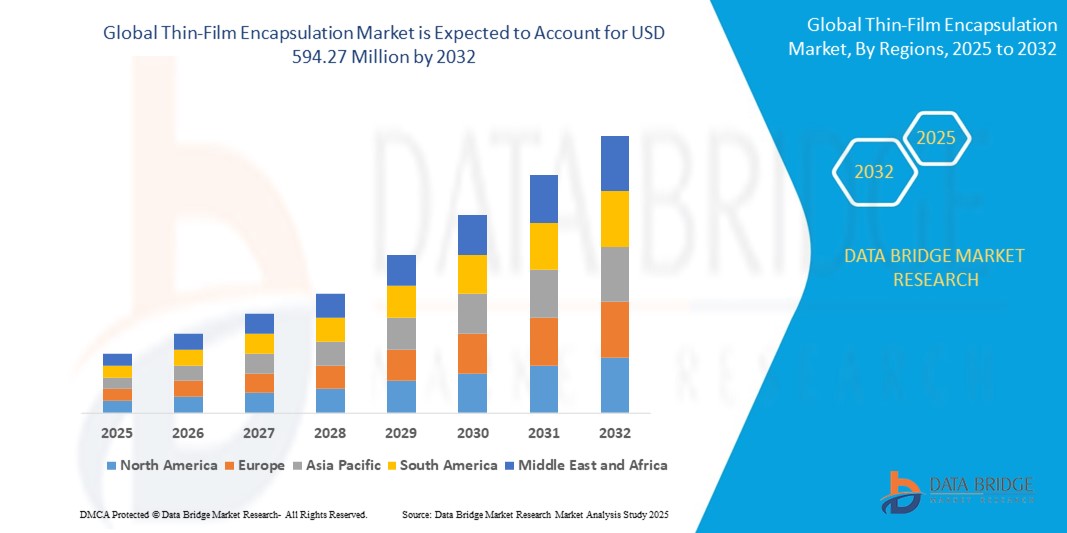
Thin-Film Encapsulation Market Size
- The Global Thin-Film Encapsulation Market size was valued at USD 132.45 Million in 2024 and is expected to reach USD 594.27 Million by 2032, at a CAGR of 20.6% during the forecast period
- This growth is driven by increase in demand for the product for various industrial applications globally is escalating the growth of thin-film encapsulation market.
Thin-Film Encapsulation Market Analysis
- Thin-film encapsulation refer to the technology which ensures the protection of flexible devices from moisture, and water, among other contaminated element. It is generally deposited through an organic layer as well as through an inorganic layer. They are integrated, which means both the organic and inorganic layers are utilized. This results in the reduction of cost and provide more flexibility with enhanced capacity.
- The increase in need for thin-film barrier in flexible and organic devices across the globe acts as one of the major factors driving the growth of thin-film encapsulation market. The surge in adoption of flexible OLED displays for smartphones and smart wearables, and rise in demand for high-efficiency, and thin-film solar cells because of the huge investment in roll-to-roll production of OLED lighting and building OLED business facilities accelerate the market growth.
- Asia-Pacific is expected to dominate the Thin-Film Encapsulation market due to the growing demand for flexible and OLED-based electronic devices, rapid industrialization, and the presence of major display panel manufacturers in countries like South Korea, China, and Japan. The region's strong manufacturing base and rising investments in next-generation display technologies significantly contribute to its leading position.
- North America is expected to be the fastest growing region in the Thin-Film Encapsulation Market during the forecast period due to increased R&D in flexible electronics, strong adoption of wearable technologies, and growing demand for high-performance encapsulation solutions in emerging sectors such as automotive displays and medical devices.
- Inorganic Layers are expected to dominate the deposition technologies segment due to their superior barrier properties against moisture and oxygen. These layers provide the necessary protection for sensitive electronic components, especially in OLED and photovoltaic applications, ensuring long-term reliability and performance.
Report Scope and Thin-Film Encapsulation Market Segmentation
|
Attributes |
Thin-Film Encapsulation Key Market Insights |
|
Segments Covered |
|
|
Countries Covered |
North America
Europe
Asia-Pacific
Middle East and Africa
South America
|
|
Key Market Players |
|
|
Market Opportunities |
|
|
Value Added Data Infosets |
In addition to the insights on market scenarios such as market value, growth rate, segmentation, geographical coverage, and major players, the market reports curated by the Data Bridge Market Research also include import export analysis, production capacity overview, production consumption analysis, price trend analysis, climate change scenario, supply chain analysis, value chain analysis, raw material/consumables overview, vendor selection criteria, PESTLE Analysis, Porter Analysis, and regulatory framework. |
Thin-Film Encapsulation Market Trends
“Surging Demand for Flexible OLED Displays Across Consumer Electronics”
- The rapid adoption of foldable and wearable smart devices has significantly accelerated the demand for flexible OLED displays, which are known for their lightweight, slim, and bendable characteristics. These advanced displays require robust protection against environmental factors such as moisture and oxygen infiltration to maintain long-term performance and durability.
- Thin-film encapsulation (TFE) has become the preferred technology for safeguarding flexible OLED panels, owing to its ability to offer superior mechanical flexibility and ultra-thin barrier layers without compromising device transparency or flexibility.
For instance,
- In March 2025, Samsung Display unveiled a strategic expansion of its OLED manufacturing plant in Asan, South Korea. The move was aimed at boosting production capacity for foldable and rollable OLED panels to meet surging global demand, particularly in the premium smartphone and smartwatch segments. This development reflects the vital role of TFE in enabling high-yield, next-gen display technologies.
Thin-Film Encapsulation Market Dynamics
Driver
“Growing Integration of Thin-Film Encapsulation in Thin-Film Photovoltaics”
- The global energy sector is undergoing a major transition toward sustainable and flexible power generation systems. Thin-film photovoltaic (PV) technologies, especially those used in off-grid, portable, and building-integrated photovoltaics (BIPV), require advanced encapsulation techniques to shield cells from environmental degradation.
- TFE solutions offer an optimal combination of lightweight protection, flexibility, and UV resistance, making them ideal for encapsulating organic and perovskite-based solar cells.
For instance,
- In January 2025, First Solar, a key player in the solar PV space, partnered with a European clean-tech startup to pilot an innovative roll-to-roll encapsulation process. The objective was to enhance the performance and scalability of flexible solar modules by leveraging inkjet-printed thin-film encapsulation—paving the way for commercial deployment of ultra-light solar solutions in urban infrastructure.
Opportunity
“Emergence of Inkjet Printing as a Scalable Solution for Thin-Film Encapsulation”
- One of the most promising opportunities in the thin-film encapsulation (TFE) market lies in the adoption of inkjet printing technology for depositing barrier layers. Unlike traditional vacuum-based methods, inkjet printing allows for precise, scalable, and cost-effective deposition of encapsulants, making it ideal for high-volume manufacturing of flexible OLED displays and lighting.
- This approach enables pattern customization, reduces material waste, and shortens production cycles—making it highly attractive to display and photovoltaic panel manufacturers seeking to scale up while maintaining quality.
For instance,
- In July 2023, Kateeva, a leading supplier of OLED inkjet printing equipment, launched its YIELDjet FLEX system designed specifically for high-throughput TFE applications in flexible OLED displays. The system was adopted by major panel manufacturers in South Korea and China, marking a significant step toward commercializing inkjet-based encapsulation.
Restraint/Challenge
“High Production Costs and Technical Barriers in Flexible Glass Encapsulation”
- While flexible glass offers remarkable optical clarity, chemical stability, and barrier properties, its widespread commercial adoption is hindered by high production costs and manufacturing complexities. Producing ultra-thin, bendable glass with uniform thickness and minimal defects requires advanced fabrication infrastructure and stringent process controls.
- Additionally, the need for intellectual property protection and specialized technical know-how makes it difficult for new market entrants to compete, limiting innovation and driving up costs.
For instance,
- In February 2025, Corning Incorporated, the developer of Willow® Glass, announced that commercialization of its ultra-thin flexible glass was facing delays due to significant challenges in mass-scale production and limited OEM integration in consumer electronics. These obstacles underscore the difficulties in transitioning from polymer-based encapsulants to glass alternatives in real-world applications.
Thin-Film Encapsulation Market Scope
The thin-film encapsulation market is segmented on the basis of deposition technologies, flexible OLED design and application.
|
Segmentation |
Sub-Segmentation |
|
By Deposition Technologies |
|
|
By Flexible OLED Design |
|
|
By Application |
|
In 2025, the flexible OLED display is projected to dominate the Thin-Film Encapsulation Market with the largest share in the application segment
The flexible OLED display segment is expected to dominate the market with the largest share of 57.27% in 2025 due to the increasing demand for OLED screens in smartphones, wearables, and flexible displays. This growth is driven by advancements in OLED technology, which offers lightweight, energy-efficient, and flexible solutions, making it ideal for a variety of applications.
In 2025, the inorganic layers segment is expected to dominate the Thin-Film Encapsulation Market with the largest share in the deposition technologies segment
The inorganic layers segment is expected to dominate the market with the largest share of 62.62% in 2025 due to their superior protection against moisture and oxygen, which enhances the performance and longevity of flexible OLED displays and thin-film photovoltaic cells. The high demand for more durable and efficient products in industries like consumer electronics and renewable energy is driving the adoption of inorganic layers.
Thin-Film Encapsulation Market Regional Analysis
“Asia-Pacific Holds the Largest Share in the Thin-Film Encapsulation Market”
- Asia-Pacific is set to maintain its dominance in the global Thin-Film Encapsulation market due to several key factors. The region’s rapid industrialization, particularly in countries such as South Korea, China, and Japan, has created a robust demand for flexible OLED-based electronic devices, which are widely used in smartphones, wearables, and next-generation display technologies. The market is primarily driven by the strong manufacturing base in these countries, which are home to major display panel manufacturers, including Samsung, LG, and TCL.
- In particular, China and South Korea are leaders in the production of OLED displays and related technologies, fostering high investments in OLED research and development. This has led to a significant increase in the adoption of Thin-Film Encapsulation technologies, which are crucial for protecting these flexible devices from environmental factors like moisture and oxygen. Additionally, the region's investments in renewable energy applications, such as thin-film photovoltaics, have further accelerated market growth.
- The integration of advanced technologies like roll-to-roll production methods, inkjet printing, and high-efficiency encapsulation technologies is expected to continue propelling the region’s dominance. Furthermore, government initiatives to promote advanced manufacturing and high-tech industries are likely to strengthen Asia-Pacific’s market position during the forecast period.
“North America is Projected to Register the Highest CAGR in the Thin-Film Encapsulation Market”
- North America is poised to experience rapid growth in the Thin-Film Encapsulation Market over the forecast period, driven by a combination of increasing research and development (R&D) in flexible electronics and the growing adoption of wearable technologies. The region’s strong focus on innovation and its well-established technology infrastructure play a significant role in advancing flexible OLED and thin-film encapsulation applications.
- In particular, the U.S. is a key driver, with major advancements in areas such as flexible electronics for medical devices, automotive displays, and the Internet of Things (IoT). The demand for flexible OLEDs and high-performance encapsulation solutions in these emerging sectors is fueling market growth. The automotive industry, for example, is adopting flexible displays for dashboards, infotainment systems, and even heads-up displays, creating new opportunities for Thin-Film Encapsulation technologies.
- Additionally, the growing popularity of wearable devices, such as fitness trackers, smartwatches, and health-monitoring gadgets, is boosting the demand for flexible and durable encapsulation solutions to protect sensitive electronics. North American companies are heavily investing in the development of new encapsulation technologies to meet the needs of these fast-growing sectors. Furthermore, the region’s strong commitment to sustainability and energy efficiency is driving the adoption of thin-film photovoltaics and other energy-efficient solutions, providing a further catalyst for the Thin-Film Encapsulation Market.
Thin-Film Encapsulation Market Share
The market competitive landscape provides details by competitor. Details included are company overview, company financials, revenue generated, market potential, investment in research and development, new market initiatives, global presence, production sites and facilities, production capacities, company strengths and weaknesses, product launch, product width and breadth, application dominance. The above data points provided are only related to the companies' focus related to market.
The Major Market Leaders Operating in the Market Are:
- BYSTRONIC GLASS(Switzerland)
- Meyer Burger Technology AG(Switzerland)
- AMS Technologies AG (Germany)
- ROLIC Technologies(Switzerland)
- SAES Getters S.p.A.(Italy)
- Picosun Oy(Finland)
- Angstrom Engineering Inc.(Canada)
- KANEKA CORPORATION(Japan)
- SNU Precision Co., Ltd. (South Korea)
- Kyoritsu Chemical & Co., Ltd.(Japan)
- SAMSUNG SDI CO., LTD.(South Korea)
- LG Chem(South Korea)
- UNIVERSAL DISPLAY(United States)
- 3M(United States)
- Applied Materials, Inc. (United States)
- Kateeva(United States)
- Areesys Corporation(United States)
- Beneq (Finland)
Latest Developments in Global Thin-Film Encapsulation Market
- In March 2025, Samsung Display announced its collaboration with multiple OLED manufacturers to advance the development of flexible OLED displays. The new partnership focuses on improving thin-film encapsulation technology to enhance the durability and performance of OLED screens for smartphones and wearables. The goal is to reduce the cost of production while increasing the lifespan of the displays, making them more viable for mass production in consumer electronics. This collaboration is expected to drive the next wave of OLED technology innovation.
- In December 2024, Applied Materials, Inc. unveiled new advancements in thin-film encapsulation technologies aimed at boosting the efficiency of OLED and photovoltaic applications. Their new solution focuses on reducing production costs while improving the quality and performance of flexible OLED displays. The company’s breakthrough in deposition technology promises to reduce the overall cost of encapsulation, which will accelerate the growth of flexible displays in the consumer electronics and automotive sectors.
- In November 2024, Picosun Oy launched a new atomic layer deposition (ALD) system designed specifically for thin-film encapsulation of flexible OLED displays. This innovative solution is expected to improve the overall efficiency of OLED production by enabling more precise, uniform, and cost-effective encapsulation. The ALD system is ideal for high-volume manufacturing of flexible OLEDs, with a particular focus on high-end consumer electronics.
- In October 2024, Meyer Burger Technology AG revealed a new thin-film encapsulation solution for photovoltaic applications. The company developed an advanced encapsulation layer using organic and inorganic materials that enhance the efficiency and longevity of thin-film solar cells. This solution is expected to make thin-film solar technology more competitive with traditional silicon-based solar panels, expanding the use of thin-film photovoltaics in renewable energy markets.

- Interactive Data Analysis Dashboard
- Company Analysis Dashboard for high growth potential opportunities
- Research Analyst Access for customization & queries
- Competitor Analysis with Interactive dashboard
- Latest News, Updates & Trend analysis
- Harness the Power of Benchmark Analysis for Comprehensive Competitor Tracking
Global Thin Film Encapsulation Market, Supply Chain Analysis and Ecosystem Framework
To support market growth and help clients navigate the impact of geopolitical shifts, DBMR has integrated in-depth supply chain analysis into its Global Thin Film Encapsulation Market research reports. This addition empowers clients to respond effectively to global changes affecting their industries. The supply chain analysis section includes detailed insights such as Global Thin Film Encapsulation Market consumption and production by country, price trend analysis, the impact of tariffs and geopolitical developments, and import and export trends by country and HSN code. It also highlights major suppliers with data on production capacity and company profiles, as well as key importers and exporters. In addition to research, DBMR offers specialized supply chain consulting services backed by over a decade of experience, providing solutions like supplier discovery, supplier risk assessment, price trend analysis, impact evaluation of inflation and trade route changes, and comprehensive market trend analysis.
Data collection and base year analysis are done using data collection modules with large sample sizes. The stage includes obtaining market information or related data through various sources and strategies. It includes examining and planning all the data acquired from the past in advance. It likewise envelops the examination of information inconsistencies seen across different information sources. The market data is analysed and estimated using market statistical and coherent models. Also, market share analysis and key trend analysis are the major success factors in the market report. To know more, please request an analyst call or drop down your inquiry.
The key research methodology used by DBMR research team is data triangulation which involves data mining, analysis of the impact of data variables on the market and primary (industry expert) validation. Data models include Vendor Positioning Grid, Market Time Line Analysis, Market Overview and Guide, Company Positioning Grid, Patent Analysis, Pricing Analysis, Company Market Share Analysis, Standards of Measurement, Global versus Regional and Vendor Share Analysis. To know more about the research methodology, drop in an inquiry to speak to our industry experts.
Data Bridge Market Research is a leader in advanced formative research. We take pride in servicing our existing and new customers with data and analysis that match and suits their goal. The report can be customized to include price trend analysis of target brands understanding the market for additional countries (ask for the list of countries), clinical trial results data, literature review, refurbished market and product base analysis. Market analysis of target competitors can be analyzed from technology-based analysis to market portfolio strategies. We can add as many competitors that you require data about in the format and data style you are looking for. Our team of analysts can also provide you data in crude raw excel files pivot tables (Fact book) or can assist you in creating presentations from the data sets available in the report.













