


What is the Thermocol Packaging Market Size and Growth Rate?
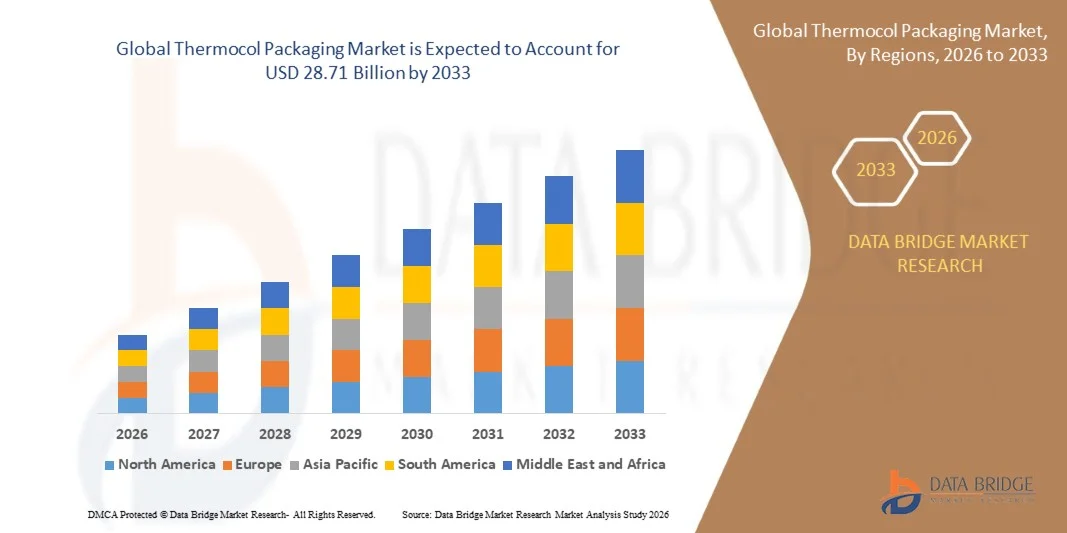
- As per Data Bridge Market Research analysis, the thermocol packaging market was valued at USD 18.70 billion in 2025 and is projected to reach USD 28.71 billion by 2033, growing at a CAGR of 5.50% from 2026 to 2033.
- The market is experiencing consistent growth driven by the increasing demand for lightweight, protective, and cost-effective packaging solutions, rising adoption of thermocol packaging across food and beverage, electronics, pharmaceutical, and consumer goods applications, growing demand for damage-resistant packaging during transportation, and the expanding use of thermocol products for insulation and temperature-sensitive goods.
- The growing demand for convenient, lightweight, and durable packaging solutions is encouraging manufacturers to expand thermocol packaging offerings. The increasing use of protective packaging for electronics, appliances, food products, and pharmaceutical products is further supporting market growth, while the development of recyclable materials, improved cushioning performance, customized designs, and lightweight packaging formats is broadening application opportunities.
Market Size & Forecast
- Global Market Value (2025): USD 18.70 Billion
- Expected Market Value (2033): USD 28.71 Billion
- Forecast CAGR (2026–2033): 5.50%
- Leading Region in 2025: North America
- Fastest Growing Region: Asia Pacific
What are the Major Takeaways of the Thermocol Packaging Market?
- North America dominated the thermocol packaging market with the largest revenue share of 40.2% in 2025, supported by strong demand for lightweight and protective packaging solutions, widespread adoption across food and beverage, electronics, pharmaceutical, and consumer goods industries, and the established presence of packaging manufacturers and distribution networks.
- Asia-Pacific is expected to be the fastest-growing region at a CAGR of 8.1% from 2026 to 2033, fueled by rapid industrialization, expanding food and beverage and electronics manufacturing, rising e-commerce activities, increasing transportation of packaged goods, and growing demand for cost-effective protective packaging solutions.
- The thermoformed trays segment led the product type category with a 46.5% share in 2025, driven by their lightweight construction, protective cushioning properties, customizable designs, and widespread use for food, electronics, pharmaceutical, and consumer product packaging.
- The protective foam segment is the fastest-growing product type, projected to register a CAGR of 8.7%, supported by increasing demand for shock-absorbing packaging, rising shipments of fragile electronics and consumer goods, and the need to minimize product damage during transportation and handling.
- The expanded polystyrene (EPS) segment dominated the material type category with a 68.4% revenue share in 2025, supported by its lightweight structure, cushioning performance, thermal insulation properties, cost-effectiveness, and widespread use across food packaging, appliances, electronics, and industrial applications.
- The recycled polystyrene segment is expected to be the fastest-growing material type category, with a CAGR of 9.2%, driven by increasing emphasis on circular packaging solutions, recycling initiatives, sustainability requirements, and growing efforts by manufacturers to reduce dependence on virgin materials.
- The food and beverage industry segment accounted for 31.8% of the market share in 2025, supported by increasing demand for lightweight protective packaging, insulated containers, trays, and boxes for the transportation and storage of food products, beverages, fresh produce, and temperature-sensitive goods.
- The electronics industry segment is expected to register the fastest growth, with a CAGR of 8.9%, driven by increasing production and shipment of electronic devices, rising e-commerce sales, growing demand for shock-absorbing protective packaging, and the need to minimize damage to fragile components during transportation.
Report Scope and Thermocol Packaging Market Segmentation
|
Attributes |
Thermocol Packaging Key Market Insights |
|
Segments Covered |
|
|
Countries Covered |
North America
Europe
Asia-Pacific
Middle East and Africa
South America
|
|
Key Market Players |
|
|
Market Opportunities |
|
|
Value Added Data Infosets |
In addition to the insights on market scenarios such as market value, growth rate, segmentation, geographical coverage, and major players, the market reports curated by the Data Bridge Market Research also include import export analysis, production capacity overview, production consumption analysis, price trend analysis, climate change scenario, supply chain analysis, value chain analysis, raw material/consumables overview, vendor selection criteria, PESTLE Analysis, Porter Analysis, and regulatory framework. |
What is the Key Trend in the Thermocol Packaging Market?
- Thermocol packaging manufacturers are increasingly focusing on lightweight, protective, and customized packaging solutions as end users seek cost-effective materials that provide cushioning, insulation, and protection during storage and transportation.
- For instance, in January 2024, Sealed Air expanded its portfolio of protective packaging solutions, highlighting the continued development of lightweight packaging formats designed to protect products throughout distribution.
- Manufacturers are increasingly developing thermocol packaging products with improved cushioning, thermal insulation, dimensional stability, and customized designs, expanding their use across food and beverage, electronics, pharmaceutical, appliance, and industrial applications.
- The market is also witnessing increased adoption of thermocol packaging for temperature-sensitive products, particularly food, beverages, pharmaceuticals, and other products requiring thermal protection during transportation.
- Product innovation is increasingly focused on lightweight construction, improved strength-to-weight ratios, customized molding, recycled content, and solutions designed to reduce material consumption while maintaining protective performance.
- For instance, in 2024, BEWI continued developing sustainable packaging and insulation solutions using EPS and other materials, supporting the industry's shift toward resource efficiency and circular material use.
- As end users increasingly prioritize product protection, transportation efficiency, customization, and material efficiency, thermocol packaging manufacturers are expanding their portfolios around lightweight designs, improved cushioning, thermal insulation, and more sustainable packaging solutions.
What are the Key Drivers of the Thermocol Packaging Market?
- The growing demand for lightweight and protective packaging is driving adoption of thermocol packaging across food and beverage, electronics, pharmaceutical, consumer goods, and industrial applications.
- For instance, in 2024, BEWI reported that its Packaging & Components business manufactured customized EPS packaging for fresh fish, pharmaceuticals, electronics, and other industries, demonstrating the broad use of EPS for protective packaging applications.
- The expansion of e-commerce and logistics activities is supporting demand for cushioning and shock-absorbing packaging solutions that can protect fragile products during transportation, handling, and last-mile delivery.
- For instance, BEWI offers Coolsafe and e-commerce EPS boxes designed to keep food and groceries fresh during delivery to customers, demonstrating the application of EPS packaging in e-commerce logistics.
- Increasing demand for temperature-controlled packaging is encouraging the use of thermocol packaging because of its thermal insulation properties, particularly for fresh food, seafood, pharmaceutical products, and other temperature-sensitive goods.
- For instance, BEWI provides EPS cooling boxes for pharmaceuticals, fish, meat, fruit, and other temperature-sensitive products, with the packaging designed to protect against heat, shocks, and moisture.
- Rising electronics and consumer appliance production is supporting demand for molded thermocol packaging designed to protect products and components from impact, vibration, and handling-related damage.
- For instance, BEWI's packaging portfolio includes shock-absorbing and insulating EPS units for white goods, while its Packaging & Components business also provides protective packaging for electronics.
- Growing emphasis on lightweight packaging is encouraging manufacturers to adopt thermocol solutions that can provide protective performance while reducing overall packaging weight and transportation-related costs.
Which Factors are Challenging the Growth of the Thermocol Packaging Market?
- Environmental concerns associated with expanded polystyrene remain a key challenge because thermocol packaging can create waste-management and recycling difficulties when collection and processing infrastructure is limited.
- For instance, in June 2024, Washington State prohibited the sale and distribution of most EPS foam foodservice containers, including cups, trays, bowls, clamshells, and coolers, citing concerns related to waste and litter.
- Increasing regulatory attention toward plastic packaging waste can restrict the use of certain thermocol packaging formats, particularly in foodservice and single-use applications where governments are promoting reusable, recyclable, or alternative packaging materials.
- For instance, Washington State's expanded polystyrene law prohibited the sale and distribution of specified EPS foodservice products beginning June 1, 2024, while EPS packing peanuts had already been restricted from June 2023.
- The availability of alternative protective packaging materials, including molded pulp, corrugated packaging, paper-based cushioning, and biodegradable materials, can increase competitive pressure on thermocol packaging manufacturers.
- For instance, Washington State's 2024 EPS restrictions noted that alternative packaging products were already widely available, encouraging businesses to transition away from certain EPS foodservice formats.
- Recycling and collection challenges can further affect the sustainability profile of thermocol packaging because lightweight EPS has a low bulk density, making transportation and collection economically challenging in regions without dedicated recycling infrastructure.
- For instance, the Washington State Department of Ecology reported in 2024 that most EPS products were not recycled because they were often not accepted through curbside recycling programs or local recycling facilities.
- Fluctuations in raw material prices can affect manufacturing costs because thermocol packaging production depends on polystyrene and other petrochemical-based inputs, creating cost pressures for manufacturers and end users.
How is the Thermocol Packaging Market Segmented?
The thermocol packaging market is segmented on the basis of product type, material type, application, end user, and distribution channel.
- By Product Type
On the basis of product type, the thermocol packaging market is segmented into thermoformed trays, protective foam, containers and boxes, and sheets and rolls. The thermoformed trays segment dominated the market with a 46.5% share in 2025, supported by widespread use of lightweight and protective packaging solutions across food and beverage, electronics, pharmaceutical, and consumer goods applications. Thermoformed trays provide cushioning, product separation, and dimensional stability, making them suitable for protecting products during storage, transportation, and handling.
The protective foam segment is projected to witness the fastest growth at a CAGR of 8.7% during the forecast period of 2026 to 2033, driven by increasing demand for shock-absorbing and impact-resistant packaging solutions. Growing e-commerce activity, electronics shipments, appliance transportation, and demand for protective packaging for fragile products are supporting the adoption of thermocol protective foam solutions.
- By Material Type
On the basis of material type, the thermocol packaging market is segmented into expanded polystyrene (EPS), extruded polystyrene (XPS), and recycled polystyrene. The expanded polystyrene (EPS) segment dominated the market with a 68.4% share in 2025, supported by its lightweight structure, thermal insulation, cushioning performance, and broad use across food, beverage, pharmaceutical, electronics, and consumer goods packaging applications. EPS packaging can provide protection against impact, temperature changes, and moisture while reducing overall packaging weight.
The recycled polystyrene segment is projected to witness the fastest growth at a CAGR of 9.2% during the forecast period of 2026 to 2033, driven by increasing emphasis on material recovery, recycling, circular packaging systems, and reduced dependence on virgin raw materials. Growing sustainability requirements are encouraging packaging manufacturers to incorporate recycled content and develop collection and recycling systems for used polystyrene packaging..
- By Application
On the basis of application, the thermocol packaging market is segmented into food and beverage packaging, electronics packaging, pharmaceutical and healthcare packaging, consumer goods packaging, and others. The food and beverage packaging segment dominated the market with a 31.8% share in 2025, supported by demand for insulated and protective packaging for fresh food, seafood, chilled products, frozen products, and temperature-sensitive goods. Thermocol packaging provides thermal insulation and cushioning properties that help protect food products during storage and transportation.
The electronics packaging segment is projected to witness the fastest growth at a CAGR of 8.9% during the forecast period of 2026 to 2033, driven by rising electronics production, increasing transportation of fragile electronic products, and growing demand for impact- and vibration-resistant packaging. Molded thermocol packaging is used to provide product-specific cushioning and protection for electronic devices, components, and appliances.
- By End User
On the basis of end user, the thermocol packaging market is segmented into food and beverage industry, electronics industry, pharmaceutical industry, consumer goods industry, and others. The food and beverage industry dominated the market in 2025, supported by extensive use of thermocol packaging for fresh, chilled, frozen, and temperature-sensitive products. The material's lightweight structure, insulation properties, and cushioning performance support its use throughout food distribution and cold-chain transportation.
The electronics industry is projected to witness the fastest growth during the forecast period of 2026 to 2033, driven by increasing production of consumer electronics, appliances, and electronic components and the need for protective packaging during transportation and handling. Growing e-commerce distribution of electronics is also supporting demand for customized protective packaging solutions.
- By Distribution Channel
On the basis of distribution channel, the thermocol packaging market is segmented into direct sales, distributors and wholesalers, retail stores, and online channels. The direct sales segment dominated the market in 2025, supported by large-volume procurement by food manufacturers, electronics companies, pharmaceutical manufacturers, consumer goods producers, and other industrial users. Direct sales enable manufacturers and end users to develop customized packaging specifications, manage bulk orders, and establish long-term supply arrangements.
The online channels segment is projected to witness the fastest growth during the forecast period of 2026 to 2033, driven by increasing digital procurement, e-commerce expansion, greater availability of packaging products through online platforms, and the convenience of comparing suppliers and product specifications. Online distribution is also providing small and medium-sized businesses with greater access to packaging suppliers and customized solutions.
Which Region Holds the Largest Share of the Thermocol Packaging Market?
- North America dominated the thermocol packaging market with the largest revenue share of 40.2% in 2025, supported by strong demand for lightweight, protective, and insulated packaging solutions across food and beverage, electronics, pharmaceutical, and consumer goods applications.
- The region also benefits from established packaging manufacturing capabilities, advanced logistics infrastructure, high e-commerce penetration, and widespread use of thermocol packaging for temperature-sensitive and fragile products. The presence of established packaging manufacturers and recycling initiatives further supports the development of the thermocol packaging market across the region.
U.S. Thermocol Packaging Market Insight
The U.S. thermocol packaging market is witnessing steady growth due to strong demand for lightweight, protective, and insulated packaging solutions across food and beverage, electronics, pharmaceutical, and consumer goods industries. The country's extensive e-commerce and logistics infrastructure is supporting the use of thermocol packaging for protecting fragile products during transportation and last-mile delivery. In addition, demand for temperature-controlled packaging for fresh food, seafood, pharmaceuticals, and other temperature-sensitive products is contributing to market expansion. The presence of established packaging manufacturers and advanced distribution networks further supports the U.S. thermocol packaging market.
Asia-Pacific Thermocol Packaging Market Insight
The Asia-Pacific thermocol packaging market is expected to witness rapid growth, supported by industrialization, expanding food and beverage production, rising electronics manufacturing, increasing e-commerce activity, and growing logistics requirements across countries such as China, India, Japan, and Australia. The region's expanding manufacturing base is increasing demand for lightweight and protective packaging solutions for electronics, appliances, food products, and consumer goods. Growing cold-chain infrastructure and demand for insulated packaging are further supporting the adoption of thermocol packaging across the region.
Japan Thermocol Packaging Market Insight
The Japan thermocol packaging market is witnessing consistent growth due to strong demand for protective and lightweight packaging across electronics, food and beverage, pharmaceutical, and consumer goods applications. The country's advanced manufacturing sector and sophisticated logistics infrastructure are supporting the use of molded thermocol packaging for protecting electronic components, appliances, and other fragile products during transportation. In addition, demand for insulated packaging for food, seafood, and temperature-sensitive products is contributing to market development.
China Thermocol Packaging Market Insight
The China thermocol packaging market is expanding steadily, supported by the country's large manufacturing base, growing electronics production, expanding food and beverage industry, and increasing e-commerce and logistics activities. Rising shipments of electronics, appliances, food products, and consumer goods are creating demand for lightweight and impact-resistant protective packaging. Furthermore, the expansion of cold-chain logistics and demand for insulated packaging solutions are supporting the adoption of thermocol packaging across food, pharmaceutical, and other temperature-sensitive applications.
U.K. Thermocol Packaging Market Insight
The U.K. thermocol packaging market is experiencing steady growth, supported by demand for protective and temperature-controlled packaging across food and beverage, pharmaceutical, electronics, and consumer goods industries. The expansion of e-commerce and last-mile delivery is increasing the need for lightweight cushioning and protective packaging solutions. In addition, demand for insulated packaging for fresh food, seafood, and pharmaceutical products is contributing to market development, while increasing regulatory and sustainability requirements are encouraging manufacturers to improve recycling and material recovery practices.
Germany Thermocol Packaging Market Insight
The Germany thermocol packaging market is expanding steadily due to strong demand for lightweight and protective packaging across food and beverage, electronics, pharmaceutical, automotive, and consumer goods industries. Germany's established manufacturing base, advanced logistics infrastructure, and strong industrial packaging sector support the use of thermocol solutions for protecting products during storage and transportation. In addition, demand for insulated packaging in food and pharmaceutical applications and growing emphasis on recycled materials are contributing to the expansion of the thermocol packaging market.
Which are the Top Companies in Thermocol Packaging Market?
The Thermocol Packaging industry is primarily led by well-established companies, including:
- Sealed Air Corporation (U.S.)
- Pactiv Evergreen Inc. (U.S.)
- Sonoco Products Company (U.S.)
- Pregis LLC (U.S.)
- BASF SE (Germany)
- Knauf Industries (France)
- JSP Corporation (Japan)
- Sekisui Plastics Co., Ltd. (Japan)
- Kaneka Corporation (Japan)
- Rengo Co., Ltd. (Japan)
- TotalEnergies (France)
- Versalis S.p.A. (Italy)
- BEWI ASA (Norway)
- Sohner Plastics, Inc. (U.S.)
- Storopack Hans Reichenecker GmbH (Germany)
- DS Smith Plc (U.K.)
- Smurfit Kappa Group (Ireland)
- Epsilyte Group (U.S.)
- ACH Foam Technologies (U.S.)
- Dart Container Corporation (U.S.)
- Foampak Pty Ltd (Australia)
- Sonoco ThermoSafe (U.S.)
- Furukawa Electric Co., Ltd. (Japan)
- Kaneka Americas Holding, Inc. (U.S.)
- BASF Polyurethanes GmbH (Germany)
What are Latest Developments in Thermocol Packaging Market?
- In June 2024, Washington State implemented restrictions on the sale and distribution of several expanded polystyrene (EPS) foodservice products, including containers, plates, bowls, clamshells, trays, and cups. The restrictions increased pressure on packaging manufacturers and foodservice businesses to adopt recyclable, reusable, or alternative packaging materials and highlighted the growing importance of sustainable packaging solutions in the thermocol packaging market.
- In 2024, BEWI expanded its focus on circularity and resource efficiency by increasing efforts to collect and recycle used EPS and developing packaging solutions containing recycled and bio-based content. The company also reported increased recycling capacity at its Norrköping facility, supporting the development of more circular EPS packaging solutions for applications across food, pharmaceutical, electronics, and other industries.
- In 2024, BEWI expanded its portfolio of EPS packaging solutions for fresh food, pharmaceuticals, electronics, and other temperature-sensitive and fragile products. The company's packaging operations included both standard and customized solutions, demonstrating the continued development of thermocol packaging for protective, insulated, and product-specific applications.
- In 2024, BEWI promoted recycled EPS solutions for thermal-chain applications, including boxes designed for vaccines, food, healthcare, and pharmaceutical products. The solutions use collected EPS that is recycled into new EPS beads, demonstrating the increasing integration of recycled materials and closed-loop approaches into thermocol packaging applications.
- In 2024, BEWI continued to develop lightweight and insulated EPS packaging solutions for food, pharmaceuticals, and medical applications, including cooling boxes and packaging for blood and diagnostic samples. These solutions provide insulation and cushioning while supporting temperature-sensitive transportation requirements, highlighting the continued role of thermocol packaging in cold-chain and healthcare logistics.

- Interactive Data Analysis Dashboard
- Company Analysis Dashboard for high growth potential opportunities
- Research Analyst Access for customization & queries
- Competitor Analysis with Interactive dashboard
- Latest News, Updates & Trend analysis
- Harness the Power of Benchmark Analysis for Comprehensive Competitor Tracking
Global Thermocol Packaging Market, Supply Chain Analysis and Ecosystem Framework
To support market growth and help clients navigate the impact of geopolitical shifts, DBMR has integrated in-depth supply chain analysis into its Global Thermocol Packaging Market research reports. This addition empowers clients to respond effectively to global changes affecting their industries. The supply chain analysis section includes detailed insights such as Global Thermocol Packaging Market consumption and production by country, price trend analysis, the impact of tariffs and geopolitical developments, and import and export trends by country and HSN code. It also highlights major suppliers with data on production capacity and company profiles, as well as key importers and exporters. In addition to research, DBMR offers specialized supply chain consulting services backed by over a decade of experience, providing solutions like supplier discovery, supplier risk assessment, price trend analysis, impact evaluation of inflation and trade route changes, and comprehensive market trend analysis.
Data collection and base year analysis are done using data collection modules with large sample sizes. The stage includes obtaining market information or related data through various sources and strategies. It includes examining and planning all the data acquired from the past in advance. It likewise envelops the examination of information inconsistencies seen across different information sources. The market data is analysed and estimated using market statistical and coherent models. Also, market share analysis and key trend analysis are the major success factors in the market report. To know more, please request an analyst call or drop down your inquiry.
The key research methodology used by DBMR research team is data triangulation which involves data mining, analysis of the impact of data variables on the market and primary (industry expert) validation. Data models include Vendor Positioning Grid, Market Time Line Analysis, Market Overview and Guide, Company Positioning Grid, Patent Analysis, Pricing Analysis, Company Market Share Analysis, Standards of Measurement, Global versus Regional and Vendor Share Analysis. To know more about the research methodology, drop in an inquiry to speak to our industry experts.
Data Bridge Market Research is a leader in advanced formative research. We take pride in servicing our existing and new customers with data and analysis that match and suits their goal. The report can be customized to include price trend analysis of target brands understanding the market for additional countries (ask for the list of countries), clinical trial results data, literature review, refurbished market and product base analysis. Market analysis of target competitors can be analyzed from technology-based analysis to market portfolio strategies. We can add as many competitors that you require data about in the format and data style you are looking for. Our team of analysts can also provide you data in crude raw excel files pivot tables (Fact book) or can assist you in creating presentations from the data sets available in the report.













