


Soil Amendments Market Overview
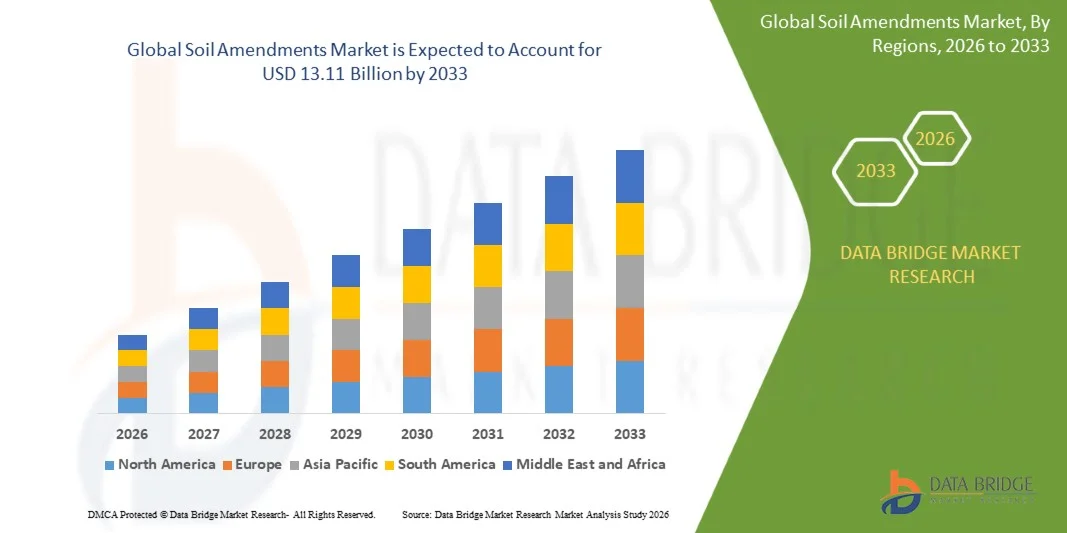
As per Data Bridge Market Research analysis The soil amendments market was valued at USD 5.90 billion in 2025 and is projected to reach USD 13.11 billion by 2033, growing at a CAGR of 10.50% from 2026 to 2033. The market is experiencing steady growth driven by increasing demand for sustainable agriculture practices, rising concerns regarding soil health and fertility, and the growing adoption of organic farming methods across developed and emerging economies.
The declining quality of arable land due to intensive farming, soil erosion, nutrient depletion, and changing climatic conditions is encouraging farmers to utilize soil amendment products to improve soil structure, water retention, and nutrient availability. Organic amendments, bio-based products, and advanced soil conditioning solutions are gaining traction as agricultural producers focus on enhancing crop productivity while minimizing environmental impact. In addition, supportive government initiatives promoting sustainable land management and the increasing need for higher agricultural yields to meet global food demand are further accelerating the adoption of soil amendments worldwide.
Key Market Trends & Insights
- North America dominated the soil amendments market with the largest revenue share of 35.12% in 2025, supported by widespread adoption of advanced agricultural practices, strong awareness of soil health management, and increasing demand for sustainable crop production.
- The Organic segment led the market with a 43.68% share in 2025, driven by rising demand for sustainable farming inputs, increasing awareness of soil health degradation, and strong adoption of eco-friendly agricultural practices.
- Asia-Pacific is expected to be the fastest-growing region at a CAGR of 7.5% from 2026 to 2033, fueled by expanding agricultural activities, increasing food demand, and rising government initiatives promoting soil fertility enhancement in China, India, and Southeast Asia.
- Inorganic are the fastest-growing source type, projected to register a CAGR of 7.2%, reflecting the surge in increasing need for rapid soil correction and immediate nutrient availability.
- The Loam segment dominated the soil type category with a 38.91% revenue share in 2025, led by its naturally balanced composition and high agricultural suitability.
- Cereals and Grains accounted for 39.84% of the market, preferred by large-scale cultivation of staple crops such as rice, wheat, and corn.
- The Fruits and Vegetables segment is the fastest-growing crop type category, with a CAGR of 7.3%, driven by the rising demand for high-value horticultural crops.
Market Size & Forecast
- Global Market Value (2025): USD 5.90 Billion
- Expected Market Value (2033): USD 13.11 Billion
- Forecast CAGR (2026–2033): 10.50%
- Leading Region in 2025: North America
- Fastest Growing Region: Asia Pacific
Report Scope and Soil Amendments Market Segmentation
|
Attributes |
Soil Amendments Key Market Insights |
|
Segments Covered |
|
|
Countries Covered |
North America · U.S. · Canada · Mexico Europe · Germany · France · U.K. · Netherlands · Switzerland · Belgium · Russia · Italy · Spain · Turkey · Rest of Europe Asia-Pacific · China · Japan · India · South Korea · Singapore · Malaysia · Australia · Thailand · Indonesia · Philippines · Rest of Asia-Pacific Middle East and Africa · Saudi Arabia · U.A.E. · South Africa · Egypt · Israel · Rest of Middle East and Africa South America · Brazil · Argentina · Rest of South America |
|
Key Market Players |
· The Scotts Company LLC (U.S.) · ICL Group Ltd (Israel) · Yara International ASA (Norway) · Nutrien Ltd. (Canada) · K+S Aktiengesellschaft (Germany) · Coromandel International Limited (India) · UPL Limited (India) · Syngenta Crop Protection AG (Switzerland) · BASF SE (Germany) · Bayer AG (Germany) · Haifa Group (Israel) · COMPO EXPERT GmbH (Germany) · Valagro S.p.A. (Italy) · Lallemand Inc. (Canada) · Premier Tech Ltd. (Canada) · BioWorks Inc. (U.S.) · EarthWorks Natural Organic Products (U.S.) · Soil Technologies Corp. (U.S.) · MustGrow Biologics Corp. (Canada) · Van Iperen International B.V. (Netherlands) |
|
Market Opportunities |
· Rising adoption of regenerative agriculture practices · Increasing demand for precision agriculture · Expansion of organic farming and residue-free food production |
|
Value Added Data Infosets |
In addition to the insights on market scenarios such as market value, growth rate, segmentation, geographical coverage, and major players, the market reports curated by the Data Bridge Market Research also include import export analysis, production capacity overview, production consumption analysis, price trend analysis, climate change scenario, supply chain analysis, value chain analysis, raw material/consumables overview, vendor selection criteria, PESTLE Analysis, Porter Analysis, and regulatory framework. |
Soil Amendments Market Trends
Trend: Rising Adoption of Regenerative and Sustainable Agriculture Practices
Farmers across both developed and emerging economies are increasingly shifting toward regenerative agriculture, where soil health restoration becomes a core farming objective rather than just yield maximization. Soil amendments such as compost, biochar, green manure, and microbial inoculants are being widely used to rebuild degraded soils, improve nutrient cycling, and increase long-term productivity. This trend is strongly supported by climate change pressures, declining arable land quality, and rising demand for residue-free food production. In addition, precision agriculture tools and soil mapping technologies are enabling farmers to apply the right amendment in the right quantity, improving efficiency and reducing waste. Government incentives and sustainability-linked subsidies are also accelerating adoption at scale.
For instance, in March 2024, the U.S. Department of Agriculture expanded funding for climate-smart agriculture programs encouraging farmers to adopt soil health restoration practices and regenerative soil management techniques across major crop-producing regions.
Soil Amendments Market Dynamics
Key Market Driver: Increasing Need to Improve Soil Health and Agricultural Productivity
One of the strongest growth drivers in the soil amendments market is the rapid deterioration of soil quality due to intensive farming, overuse of chemical fertilizers, and continuous monocropping practices. These factors have led to nutrient depletion, reduced microbial activity, and poor soil structure in many agricultural regions worldwide. Soil amendments help reverse these effects by restoring organic content, improving water retention capacity, enhancing aeration, and balancing soil pH levels. As global food demand continues to rise due to population growth, farmers are under pressure to achieve higher yields from limited arable land, making soil health management a critical priority. This has significantly increased the adoption of both organic and inorganic soil conditioning solutions in commercial farming.
For instance, in February 2024, the European Commission strengthened its Farm to Fork strategy initiatives, promoting sustainable soil management practices aimed at improving long-term agricultural productivity and reducing soil degradation across Europe.
Key Restraint/Challenge: Variability in Product Performance Across Soil and Climate Conditions
Despite strong demand, the effectiveness of soil amendments can vary significantly depending on local soil composition, climate conditions, crop type, and application practices. For instance, a product that performs well in sandy soils may deliver limited benefits in clay-rich or highly acidic soils. Similarly, microbial-based amendments require specific temperature and moisture conditions to remain active, making performance inconsistent across regions. Another key issue is the lack of standardized guidelines for application rates, which often leads to underuse or overuse, reducing cost efficiency and expected yield improvements. Limited technical knowledge among small and medium-scale farmers further restricts optimal adoption, especially in developing agricultural markets where extension services are less accessible.
For instance, in January 2024, multiple agricultural advisory bodies in Asia and Africa highlighted inconsistent field-level outcomes of bio-based soil amendments due to improper application practices and varying soil conditions.
Key Market Opportunity: Expansion of Biological and Carbon-Sequestering Soil Solutions
A major emerging opportunity in the market lies in biological soil amendments and carbon-sequestering technologies that align with global sustainability and climate goals. Products such as biochar, beneficial microbes, seaweed extracts, and humic substances are gaining traction because they not only improve soil fertility but also contribute to carbon storage in soil systems. This aligns with the growing adoption of carbon farming programs and regenerative agriculture initiatives, where farmers can potentially earn additional income through carbon credits. Furthermore, increasing investment in agri-biotech and soil microbiome research is leading to the development of highly customized, crop-specific soil enhancement solutions. These innovations are expected to play a key role in improving both productivity and environmental outcomes in the coming years.
For instance, in April 2024, several agri-tech companies expanded biochar-based soil enhancement programs aimed at improving soil carbon sequestration and boosting long-term soil fertility in large-scale commercial farms.
Soil Amendments Market Scope
The soil amendments market is segmented on the basis of source, soil type, crop type, and form.
- By Source
On the basis of source, the soil amendments market is segmented into organic and inorganic. The Organic segment dominated the market with a 43.68% share in 2025, owing to rising demand for sustainable farming inputs, increasing awareness of soil health degradation, and strong adoption of eco-friendly agricultural practices. Organic amendments such as compost, manure, biochar, and microbial inoculants are widely used to enhance soil fertility and improve long-term productivity. They also support moisture retention and microbial activity, making soils more resilient to climate variability. Government support for chemical-free farming and organic certification programs is further boosting demand. In addition, consumer preference for residue-free food products is encouraging farmers to shift toward organic solutions. Continuous innovation in bio-based soil enhancers is strengthening segment growth globally.
The Inorganic segment is expected to witness the fastest growth at a CAGR of 7.2% from 2026 to 2033, driven by increasing need for rapid soil correction and immediate nutrient availability. Inorganic amendments such as lime, gypsum, and mineral-based conditioners are widely used to address soil pH imbalance and structural issues. These products offer quick and measurable improvements in soil performance, making them suitable for large-scale commercial farming. Rising adoption in high-yield agriculture systems is further supporting demand. They are also cost-effective for large agricultural land holdings where long-term organic buildup is slower. Expanding use in precision agriculture and controlled farming environments is accelerating adoption. Improved product formulations are enhancing efficiency and application flexibility.
- By Soil Type
On the basis of soil type, the market is segmented into loam, clay, silt, and sand. The Loam segment dominated the market with a 38.91% share in 2025, due to its naturally balanced composition and high agricultural suitability. Loam soils already provide favorable conditions for crop growth, but still require amendments to maintain nutrient balance and long-term fertility. Farmers increasingly apply organic and mineral amendments to sustain productivity in intensive farming systems. The segment benefits from high cultivation of cereals, vegetables, and cash crops in loamy regions. Improved soil management practices are further enhancing amendment adoption. Rising focus on maximizing yield per hectare is strengthening demand. Continuous soil nutrient depletion due to repeated cropping is also driving usage.
The Clay soil segment is expected to witness the fastest growth at a CAGR of 7.4% from 2026 to 2033, driven by increasing efforts to improve drainage, aeration, and workability. Clay soils are highly dense and often suffer from poor water infiltration and root penetration issues, making them a key target for soil amendment applications. Organic and bio-based amendments are widely used to break soil compaction and improve structure. Growing agricultural expansion into marginal lands with clay-rich soils is boosting demand. Government-supported land improvement programs are also contributing to growth. Farmers are increasingly adopting gypsum and organic compost to enhance soil usability. Advancements in soil conditioning technologies are improving effectiveness in heavy soils.
- By Crop Type
On the basis of crop type, the market is segmented into cereals and grains, fruits and vegetables, oilseeds and pulses, and others. The Cereals and Grains segment dominated the market with a 39.84% share in 2025, driven by large-scale cultivation of staple crops such as rice, wheat, and corn. These crops require continuous soil nutrient replenishment due to intensive farming practices. Soil amendments are widely used to enhance yield stability and maintain long-term soil fertility in high-production regions. Government food security programs also support nutrient management in cereal cultivation. The segment benefits from extensive farmland coverage globally. Increasing adoption of sustainable farming practices is further strengthening demand. Continuous soil degradation from monocropping is a major contributing factor.
The Fruits and Vegetables segment is expected to witness the fastest growth at a CAGR of 7.3% from 2026 to 2033, driven by rising demand for high-value horticultural crops. These crops require nutrient-rich and well-structured soils for optimal growth and quality output. Soil amendments are increasingly used to improve flavor, size, and shelf life of produce. Growing export-oriented horticulture farming is further boosting adoption. Organic farming trends in fruits and vegetables are significantly accelerating demand for natural amendments. Controlled environment agriculture and greenhouse farming are also contributing to growth. Increasing consumer preference for fresh and residue-free produce is strengthening the segment.
- By Form
On the basis of form, the market is segmented into dry and liquid. The Dry segment dominated the market with a 58.27% share in 2025, owing to ease of handling, longer shelf life, and cost-effectiveness. Dry soil amendments such as compost, lime, gypsum, and powdered biochar are widely used in large-scale agricultural applications. They are easier to transport and store, making them highly suitable for bulk farming operations. Farmers prefer dry formulations for field applications due to their stability and lower logistical costs. The segment also benefits from widespread availability in rural agricultural markets. Continuous use in staple crop farming further strengthens dominance. Improved blending technologies are enhancing application efficiency.
The Liquid segment is expected to witness the fastest growth at a CAGR of 7.1% from 2026 to 2033, driven by increasing adoption of precision agriculture and fertigation systems. Liquid soil amendments provide faster absorption and uniform soil distribution compared to dry forms. They are increasingly used in greenhouse farming, horticulture, and high-value crop production. Rising demand for easy-to-apply and fast-acting soil conditioners is boosting adoption. Technological advancements in irrigation systems are supporting growth. Farmers are increasingly integrating liquid formulations with drip irrigation networks. Expanding use in controlled environment agriculture is further accelerating demand.
Soil Amendments Market Regional Analysis
North America dominated the soil amendments market with the largest revenue share of 35.12% in 2025, supported by widespread adoption of advanced agricultural practices, strong awareness of soil health management, and increasing demand for sustainable crop production. The region also benefits from increasing investments in sustainable agriculture technologies, favorable government programs promoting soil conservation, and high adoption of organic and bio-based soil amendment products. Growing concerns over soil degradation, nutrient depletion, and water retention efficiency are further driving demand across major agricultural regions. Increasing focus on regenerative farming practices and long-term agricultural productivity continues to strengthen North America’s leadership position in the global market.
U.S. Soil Amendments Market Insight
The U.S. soil amendments market is witnessing strong growth due to rising investments in sustainable agriculture practices, soil health improvement programs, and precision farming technologies. The country’s large commercial farming sector, along with increasing adoption of organic, bio-based, and carbon-sequestering soil solutions, is driving demand across diverse crop cultivation systems. In addition, growing emphasis on improving agricultural productivity, reducing soil degradation, and enhancing water-use efficiency is accelerating the adoption of soil amendments among farmers and agribusiness operators.
Europe Soil Amendments Market Insight
The Europe soil amendments market remains a major contributor to global revenue, driven by strong government support, sustainability-focused agricultural policies, and increasing demand for environmentally friendly farming inputs. The widespread use of soil amendments in organic farming, regenerative agriculture, and soil restoration programs is supporting market expansion across the region. Increasing investments in biological soil enhancement technologies, coupled with strict environmental regulations and growing awareness regarding soil conservation, continue to enhance the adoption of soil amendments throughout Europe.
U.K. Soil Amendments Market Insight
The U.K. soil amendments market is experiencing steady growth, supported by rising adoption of sustainable farming practices, soil restoration initiatives, and precision agriculture technologies. Increasing investments in advanced soil management solutions and growing demand for cost-effective methods to improve crop productivity are contributing to market growth. Furthermore, integration of biological products, organic amendments, and data-driven farming approaches is improving soil performance and agricultural efficiency, positioning the U.K. as a key innovation hub in the soil amendments industry.
Germany Soil Amendments Market Insight
The Germany soil amendments market is expanding steadily due to the country’s strong agricultural sector, advanced research capabilities, and increasing adoption of sustainable soil management practices. Farmers, agricultural cooperatives, and agritech organizations are increasingly utilizing soil amendments to improve fertility, optimize nutrient availability, and enhance long-term crop performance. Continuous advancements in biological soil conditioning technologies, organic farming solutions, and precision agriculture systems, along with strong government focus on environmental sustainability, are further driving market growth in Germany.
Asia-Pacific Soil Amendments Market Insight
The Asia-Pacific soil amendments market is expected to witness rapid growth, driven by increasing food demand, expanding agricultural activities, and rising investments in soil health improvement programs across countries such as China, India, and Japan. Growing awareness regarding sustainable farming, rising adoption of advanced soil enhancement products, and increasing demand for cost-effective solutions to improve crop yields are supporting regional market expansion. In addition, the growing focus on land restoration and agricultural modernization is accelerating soil amendment adoption across both commercial and smallholder farming sectors.
Japan Soil Amendments Market Insight
The Japan soil amendments market is witnessing consistent growth due to rising investments in sustainable agriculture technologies, soil fertility improvement, and environmental conservation initiatives. Agricultural producers, research institutions, and farming cooperatives are increasingly adopting advanced soil amendment products to improve crop quality, optimize nutrient management, and enhance land productivity. Moreover, increasing integration of biological soil solutions and the country’s focus on efficient and sustainable food production systems are further contributing to market growth.
China Soil Amendments Market Insight
The China soil amendments market is growing rapidly, driven by increasing agricultural modernization, expanding food production requirements, and rising government focus on soil conservation and land productivity enhancement. Growing adoption of organic, microbial, and bio-based soil amendment products across commercial farming operations is significantly boosting market demand. In addition, rising investments in agricultural technology, increasing awareness regarding soil health management, and rapid advancements in sustainable farming practices are positioning China as one of the fastest-growing markets for soil amendments globally.
Soil Amendments Market Share
The soil amendments industry is primarily led by well-established companies, including:
- The Scotts Company LLC (U.S.)
- ICL Group Ltd (Israel)
- Yara International ASA (Norway)
- Nutrien Ltd. (Canada)
- K+S Aktiengesellschaft (Germany)
- Coromandel International Limited (India)
- UPL Limited (India)
- Syngenta Crop Protection AG (Switzerland)
- BASF SE (Germany)
- Bayer AG (Germany)
- Haifa Group (Israel)
- COMPO EXPERT GmbH (Germany)
- Valagro S.p.A. (Italy)
- Lallemand Inc. (Canada)
- Premier Tech Ltd. (Canada)
- BioWorks Inc. (U.S.)
- EarthWorks Natural Organic Products (U.S.)
- Soil Technologies Corp. (U.S.)
- MustGrow Biologics Corp. (Canada)
- Van Iperen International B.V. (Netherlands)
Latest Developments in Soil Amendments Market
- In May 2025, Suntory Holdings and TOWING Co., Ltd. announced the launch of a pilot initiative utilizing high-performance biochar as a soil amendment in regenerative agriculture. The project focuses on improving soil fertility, enhancing crop productivity, and reducing dependence on chemical fertilizers through the use of biochar produced from manufacturing byproducts. The initiative also supports carbon sequestration and circular resource utilization, reflecting the increasing adoption of sustainable soil management solutions in agriculture
- In May 2025, Airex Energy, Groupe Rémabec, and SUEZ inaugurated Carbonity, Canada’s first industrial-scale biochar production facility, dedicated to producing biochar for agricultural and environmental applications. The facility is designed to supply large volumes of biochar for use as a soil amendment, improving soil structure, nutrient retention, and carbon sequestration capabilities. The project supports regenerative agriculture objectives while contributing to climate change mitigation efforts
- In January 2025, Google entered into an agreement with climate technology company Varaha to purchase carbon removal credits generated through biochar production from agricultural residues. The biochar produced under the initiative is applied as a soil amendment, helping improve soil fertility, enhance water retention, and support sustainable agricultural practices while permanently storing carbon. The partnership highlights growing investment in biochar-based solutions that deliver both agricultural and environmental benefits
- In June 2024, Skagit Soils Inc. announced the introduction of its Biochar-Enhanced Compost product developed in collaboration with Kulshan Carbon Trust. The new soil amendment combines nutrient-rich compost with biochar technology to improve soil health, increase water retention capacity, and enhance nutrient availability for crops. The product was developed to support sustainable farming practices while helping growers improve long-term soil productivity
- In April 2024, ProGro BIO Inc. launched a new portfolio of Rhizol microbial soil inoculant products designed to enhance soil biological activity and support plant growth. These microbial-based soil amendments improve nutrient uptake, stimulate root development, and promote healthier soil ecosystems for agricultural and horticultural applications. The launch expanded the company’s presence in biological soil enhancement solutions and addressed increasing demand for sustainable alternatives to conventional soil treatments

- Interactive Data Analysis Dashboard
- Company Analysis Dashboard for high growth potential opportunities
- Research Analyst Access for customization & queries
- Competitor Analysis with Interactive dashboard
- Latest News, Updates & Trend analysis
- Harness the Power of Benchmark Analysis for Comprehensive Competitor Tracking
Data collection and base year analysis are done using data collection modules with large sample sizes. The stage includes obtaining market information or related data through various sources and strategies. It includes examining and planning all the data acquired from the past in advance. It likewise envelops the examination of information inconsistencies seen across different information sources. The market data is analysed and estimated using market statistical and coherent models. Also, market share analysis and key trend analysis are the major success factors in the market report. To know more, please request an analyst call or drop down your inquiry.
The key research methodology used by DBMR research team is data triangulation which involves data mining, analysis of the impact of data variables on the market and primary (industry expert) validation. Data models include Vendor Positioning Grid, Market Time Line Analysis, Market Overview and Guide, Company Positioning Grid, Patent Analysis, Pricing Analysis, Company Market Share Analysis, Standards of Measurement, Global versus Regional and Vendor Share Analysis. To know more about the research methodology, drop in an inquiry to speak to our industry experts.
Data Bridge Market Research is a leader in advanced formative research. We take pride in servicing our existing and new customers with data and analysis that match and suits their goal. The report can be customized to include price trend analysis of target brands understanding the market for additional countries (ask for the list of countries), clinical trial results data, literature review, refurbished market and product base analysis. Market analysis of target competitors can be analyzed from technology-based analysis to market portfolio strategies. We can add as many competitors that you require data about in the format and data style you are looking for. Our team of analysts can also provide you data in crude raw excel files pivot tables (Fact book) or can assist you in creating presentations from the data sets available in the report.













