Global Smart Retail Market
Market Size in USD Billion
CAGR :
% 
 USD
54.77 Billion
USD
289.18 Billion
2025
2033
USD
54.77 Billion
USD
289.18 Billion
2025
2033
 Forecast Period Forecast Period |
2026 - 2033 |
 Market Size (Base Year) Market Size (Base Year) |
USD 54.77 Billion |
 Market Size (Forecast Year) Market Size (Forecast Year) |
USD 289.18 Billion |
 CAGR CAGR |
% |
| Major Markets Players |
|
Smart Retail Market Size
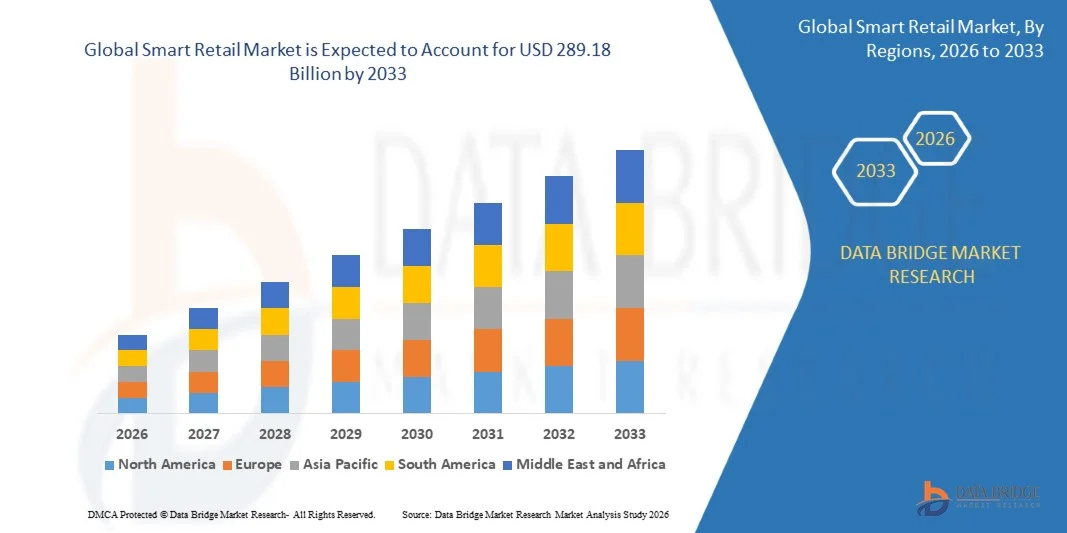
- The global smart retail market size was valued at USD 54.77 billion in 2025 and is expected to reach USD 289.18 billion by 2033, at a CAGR of 23.12% during the forecast period
- The market growth is largely fueled by the rapid adoption of digital transformation across the retail sector, supported by increasing integration of AI, IoT, cloud computing, and automation technologies in store operations and supply chain management
- Furthermore, rising consumer demand for personalized shopping experiences, seamless omnichannel engagement, and contactless payment solutions is pushing retailers to deploy intelligent retail systems that enhance efficiency and customer satisfaction, thereby accelerating smart retail adoption
Smart Retail Market Analysis
- Smart retail refers to the integration of advanced digital technologies such as artificial intelligence, visual recognition, smart sensors, robotics, and data analytics into retail environments to optimize operations, enhance customer experience, and enable real-time decision-making
- The growing expansion of smart retail solutions is primarily driven by increasing demand for automated retail operations, rising focus on data-driven customer insights, and the need for improved inventory management and efficient store performance
- North America dominated the smart retail market with a share of 34.6% in 2025, due to high adoption of advanced retail automation technologies and strong presence of organized retail chains
- Asia-Pacific is expected to be the fastest growing region in the smart retail market during the forecast period due to rapid urbanization, rising disposable incomes, and increasing penetration of digital retail platforms
- Artificial intelligence segment dominated the market with a market share of 33.75% in 2025, due to its extensive use in demand forecasting, customer behavior analysis, personalized recommendations, and dynamic pricing strategies. Retailers increasingly deploy AI-powered analytics platforms to improve operational efficiency and optimize marketing strategies across channels
Report Scope and Smart Retail Market Segmentation
|
Attributes |
Smart Retail Key Market Insights |
|
Segments Covered |
|
|
Countries Covered |
North America
Europe
Asia-Pacific
Middle East and Africa
South America
|
|
Key Market Players |
|
|
Market Opportunities |
|
|
Value Added Data Infosets |
In addition to the market insights such as market value, growth rate, market segments, geographical coverage, market players, and market scenario, the market report curated by the Data Bridge Market Research team includes in-depth expert analysis, import/export analysis, pricing analysis, production consumption analysis, and pestle analysis. |
Smart Retail Market Trends
“Increasing Adoption of AI-Powered Personalization in Retail”
- A significant trend in the smart retail market is the increasing adoption of AI-powered personalization and intelligent in-store experiences, driven by the need to enhance customer engagement, improve purchase conversion, and deliver real-time product recommendations across digital and physical retail channels. This integration is transforming traditional retail environments into data-driven ecosystems where customer behavior is continuously analyzed and utilized for optimized decision-making
- For instance, Amazon Go stores operated by Amazon.com, Inc. utilize computer vision, sensor fusion, and AI algorithms to enable cashierless checkout and personalized shopping experiences. These systems automatically track customer selections and streamline billing processes, enhancing convenience and operational efficiency
- The deployment of AI-driven recommendation engines in e-commerce and physical retail platforms is growing rapidly as retailers focus on tailoring product suggestions based on browsing history, purchase behavior, and demographic insights. This approach is improving customer retention and increasing average transaction value across retail formats
- Retailers are also integrating intelligent digital signage and smart shelving systems that dynamically adjust content and product placement based on real-time demand and customer interaction patterns. This is strengthening in-store engagement and improving inventory visibility across retail floors
- The expansion of smart mirrors and virtual fitting technologies in fashion retail is enabling customers to visualize products without physical trials, improving decision-making efficiency and reducing return rates. This trend is reshaping the apparel retail experience through immersive digital engagement
- The market is witnessing strong growth in AI-enabled customer analytics platforms that consolidate data from multiple touchpoints including mobile apps, POS systems, and loyalty programs. This increasing integration is reinforcing the shift toward fully connected, predictive, and experience-driven retail environments
Smart Retail Market Dynamics
Driver
“Growing Demand for Omnichannel Retail Experiences”
- The smart retail market is driven by the growing demand for seamless omnichannel retail experiences and real-time operational efficiency, as consumers increasingly expect consistent engagement across online platforms, mobile applications, and physical stores. Retailers are adopting integrated digital systems to unify inventory, payments, and customer data, enabling frictionless shopping journeys and improved service delivery
- For instance, Walmart Inc. has implemented advanced omnichannel retail systems that connect in-store inventory with e-commerce platforms, enabling services such as online order pickup, real-time stock visibility, and automated fulfillment. This integration enhances customer convenience and strengthens supply chain responsiveness
- The rising need for real-time inventory tracking and automated supply chain management is further accelerating adoption of smart retail solutions that reduce stockouts and optimize product availability. These systems improve operational accuracy and support data-driven procurement decisions across retail networks
- Retailers are increasingly deploying AI-based customer engagement platforms that synchronize promotions, pricing, and recommendations across multiple channels. This ensures consistent brand experience and improves customer loyalty across digital and physical touchpoints
- The continuous focus on improving operational efficiency, reducing manual intervention, and enhancing customer satisfaction is reinforcing the adoption of smart retail technologies. This sustained transformation is positioning omnichannel integration as a core growth driver for the market
Restraint/Challenge
“High Implementation Costs and Integration Complexity”
- The smart retail market faces significant challenges due to high implementation costs and complex integration with legacy retail infrastructure, as many retailers still operate traditional systems that are not fully compatible with advanced digital technologies. The transition to AI, IoT, and cloud-based platforms requires substantial investment in hardware, software, and system upgrades
- For instance, legacy retail chains transitioning to Oracle Retail cloud solutions often face integration challenges when aligning existing POS systems, inventory databases, and customer management platforms. This complexity increases deployment time and raises overall transformation costs
- The requirement for advanced hardware such as sensors, smart shelves, and automated checkout systems further increases capital expenditure, making adoption difficult for small and medium-sized retailers. These costs act as a barrier to large-scale deployment across fragmented retail markets
- Integration of multiple technologies such as AI analytics, RFID systems, and real-time data platforms often requires specialized technical expertise, which adds to operational complexity and slows down implementation cycles. Retailers face difficulties in ensuring system interoperability and data synchronization
- The continuous need for system upgrades, maintenance, and scalability adjustments further intensifies financial and operational pressure on retailers. These challenges collectively restrain rapid adoption and require long-term strategic investment planning for successful digital transformation
Smart Retail Market Scope
The market is segmented on the basis of system, application, retail offering, and technologies.
• By System
On the basis of system, the smart retail market is segmented into digital signage solutions, smart labels, smart payment system, intelligent vending machines, augmented reality solutions, virtual reality solutions, POS solutions, smart carts, robotics, and analytics. The POS solutions segment dominated the largest market revenue share in 2025, driven by its central role in enabling seamless billing, transaction processing, and unified retail operations across physical and digital stores. Retailers widely deploy advanced POS systems due to their integration with inventory databases, customer analytics, and omnichannel commerce platforms, improving operational efficiency and customer experience. The segment also benefits from rapid modernization of retail infrastructure and growing demand for cloud-based POS deployment models that support real-time data synchronization.
The robotics segment is anticipated to witness the fastest growth rate from 2026 to 2033, supported by increasing automation in retail stores and warehouses aimed at reducing operational costs and improving service efficiency. Retailers are adopting autonomous robots for shelf scanning, restocking, and customer assistance functions, enhancing productivity in high-traffic environments. The rising focus on labor optimization and contactless retail operations further accelerates deployment of robotic systems. Continuous advancements in AI-driven navigation and machine vision technologies also strengthen the adoption of robotics in smart retail ecosystems.
• By Application
On the basis of application, the smart retail market is segmented into foot traffic monitoring, inventory management, smart fitting rooms, brand protection, predictive equipment maintenance, loyalty management, and payments. The inventory management segment dominated the largest market revenue share in 2025, driven by the critical need for real-time stock visibility and efficient supply chain coordination across retail networks. Retailers prioritize automated inventory tracking systems to minimize stockouts, reduce overstocking, and improve demand forecasting accuracy. Integration of IoT sensors and AI-based analytics further enhances inventory control efficiency and operational decision-making.
The smart fitting rooms segment is anticipated to witness the fastest growth rate from 2026 to 2033, fueled by rising adoption of personalized and interactive shopping experiences in apparel retail. These systems enable customers to virtually try products, access product recommendations, and request assistance without leaving the fitting area, improving engagement and conversion rates. Retailers are increasingly deploying smart mirrors and AR-enabled interfaces to enhance in-store experience and reduce return rates. Growing investment in experiential retail strategies continues to accelerate adoption of this segment.
• By Retail Offering
On the basis of retail offering, the smart retail market is segmented into apparel and accessories, fast moving consumer goods, hardlines and leisure goods, and others. The fast moving consumer goods segment dominated the largest market revenue share in 2025, driven by high product turnover rates and consistent consumer demand across grocery, personal care, and household essentials categories. Retailers in this segment rely heavily on automated checkout systems, real-time inventory tracking, and demand forecasting tools to manage large-scale distribution efficiently. Strong penetration of organized retail and supermarket chains further supports segment dominance.
The apparel and accessories segment is anticipated to witness the fastest growth rate from 2026 to 2033, driven by increasing digitalization of fashion retail and rising demand for personalized shopping experiences. Retailers are adopting smart fitting technologies, AI-based recommendation systems, and virtual try-on solutions to enhance customer engagement. Rapid growth of e-commerce-integrated omnichannel fashion platforms further strengthens adoption of smart retail technologies in this segment. Continuous innovation in customer experience enhancement tools also contributes to strong expansion momentum.
• By Technologies
On the basis of technologies, the smart retail market is segmented into visual recognition, blockchain, artificial intelligence, and mobiles. The artificial intelligence segment dominated the largest market revenue share of 33.75% in 2025, driven by its extensive use in demand forecasting, customer behavior analysis, personalized recommendations, and dynamic pricing strategies. Retailers increasingly deploy AI-powered analytics platforms to improve operational efficiency and optimize marketing strategies across channels. Integration of AI with IoT and cloud platforms further strengthens its dominance in smart retail infrastructure.
The blockchain segment is anticipated to witness the fastest growth rate from 2026 to 2033, driven by rising demand for transparent supply chains, secure payment systems, and product authenticity verification. Retailers are adopting blockchain solutions to enhance traceability of goods and reduce counterfeit risks across global supply networks. Increasing focus on data security and decentralized transaction systems further supports adoption in high-value retail ecosystems. Growing collaboration between retailers and technology providers continues to accelerate blockchain implementation in smart retail operations.
Smart Retail Market Regional Analysis
- North America dominated the smart retail market with the largest revenue share of 34.6% in 2025, driven by high adoption of advanced retail automation technologies and strong presence of organized retail chains
- Retailers in the region increasingly deploy AI-driven analytics, smart POS systems, and robotics to enhance operational efficiency and customer experience. Consumers highly value personalized shopping experiences, contactless payments, and seamless omnichannel integration across physical and digital platforms
- This widespread adoption is further supported by high digital penetration, strong investment in retail technology, and growing demand for data-driven decision-making in retail operations
U.S. Smart Retail Market Insight
The U.S. smart retail market captured the largest revenue share within North America in 2025, fueled by rapid deployment of AI-based retail solutions and strong expansion of e-commerce-integrated brick-and-mortar stores. Retailers are increasingly focusing on automation in inventory management, smart checkout systems, and personalized marketing strategies to improve customer engagement. The growing preference for mobile-based shopping, voice-assisted commerce, and frictionless payment systems further drives market growth. In addition, strong integration of technologies such as artificial intelligence, visual recognition, and IoT platforms is significantly accelerating smart retail adoption across the country.
Europe Smart Retail Market Insight
The Europe smart retail market is projected to expand at a substantial CAGR throughout the forecast period, driven by increasing demand for efficient retail operations and enhanced customer experience solutions. Retailers across the region are adopting smart technologies such as digital signage, AI-based analytics, and automated inventory systems to optimize store performance. Growing emphasis on sustainable retail practices and regulatory compliance is also encouraging digital transformation in retail infrastructure. The region is witnessing strong adoption across supermarkets, fashion retail, and organized retail chains, supported by rising urbanization and evolving consumer expectations.
U.K. Smart Retail Market Insight
The U.K. smart retail market is anticipated to grow at a noteworthy CAGR during the forecast period, driven by rapid digital transformation in retail stores and increasing demand for contactless shopping experiences. Retailers are investing in smart payment systems, analytics platforms, and automated customer engagement tools to improve operational efficiency. Rising consumer preference for seamless omnichannel shopping and personalized retail experiences further supports market expansion. The strong presence of established retail brands and advanced e-commerce infrastructure continues to accelerate adoption of smart retail technologies across the country.
Germany Smart Retail Market Insight
The Germany smart retail market is expected to expand at a considerable CAGR during the forecast period, driven by strong emphasis on technological innovation and efficient retail operations. Retailers are increasingly implementing AI-powered analytics, smart checkout systems, and automated inventory solutions to improve productivity and reduce operational costs. Growing focus on data security and structured retail environments further supports adoption of advanced retail technologies. Germany’s well-developed retail infrastructure and strong manufacturing base also contribute to steady integration of smart retail solutions across stores.
Asia-Pacific Smart Retail Market Insight
The Asia-Pacific smart retail market is poised to grow at the fastest CAGR from 2026 to 2033, driven by rapid urbanization, rising disposable incomes, and increasing penetration of digital retail platforms. Retailers in the region are adopting smart payment systems, AI-based personalization tools, and automated inventory solutions to meet evolving consumer demand. Strong expansion of organized retail and e-commerce ecosystems further accelerates market growth. In addition, government-led digitalization initiatives and growing smart city projects are supporting large-scale deployment of smart retail technologies across the region.
Japan Smart Retail Market Insight
The Japan smart retail market is gaining momentum due to high technological adoption, advanced retail infrastructure, and strong focus on automation. Retailers are increasingly integrating robotics, smart checkout systems, and AI-based customer analytics to enhance operational efficiency and service quality. The country’s aging population is also driving demand for simplified, contactless, and highly automated retail experiences. Integration of IoT-enabled devices and smart store concepts further strengthens the adoption of smart retail technologies across urban retail environments.
China Smart Retail Market Insight
The China smart retail market accounted for the largest revenue share in Asia-Pacific in 2025, driven by rapid urbanization, strong digital ecosystem expansion, and large-scale adoption of smart retail technologies. Retailers are increasingly deploying AI-powered recommendation systems, smart payment platforms, and automated logistics solutions to enhance efficiency and customer engagement. The strong presence of domestic technology providers and large retail chains supports widespread adoption. In addition, continued expansion of smart cities and cashless payment ecosystems further strengthens market growth across both online and offline retail channels.
Smart Retail Market Share
The smart retail industry is primarily led by well-established companies, including:
- Intel Corporation (U.S.)
- IBM Corporation (U.S.)
- NVIDIA Corporation (U.S.)
- Samsung Electronics Co., Ltd. (South Korea)
- Microsoft Corporation (U.S.)
- Google LLC (U.S.)
- PTC Inc. (U.S.)
- Amazon.com, Inc. (U.S.)
- NXP Semiconductors N.V. (Netherlands)
- Cisco Systems, Inc. (U.S.)
- LG Display Co., Ltd. (South Korea)
- Huawei Investment & Holding Co., Ltd. (China)
- Par Technology Corporation (U.S.)
- Texas Instruments Incorporated (U.S.)
- Honeywell International Inc. (U.S.)
- Robert Bosch GmbH (Germany)
- SoftBank Robotics Holdings Corp. (Japan)
- Broadcom Inc. (U.S.)
- Ingenico Group (France)
- Verifone Systems, Inc. (U.S.)
Latest Developments in Global Smart Retail Market
- In May 2025, Intel Corporation, in collaboration with ASUSTeK Computer Inc., introduced an AI developer toolkit aimed at accelerating and simplifying the development of AI applications across industries. In the smart retail market. This advancement is expected to significantly reduce development cycles for AI-based retail solutions, enabling faster deployment of customer behavior analytics, intelligent recommendation engines, and optimized product placement systems. The toolkit strengthens innovation capability among developers, supporting retailers in building more responsive and data-driven shopping experiences
- In May 2025, Amazon opened its fourth robotic fulfilment centre in Virginia, expanding its automation-led logistics infrastructure. The facility is designed to significantly reduce order cycle time and improve operational efficiency, particularly during peak demand periods. In the smart retail market, this development enhances supply chain responsiveness and strengthens last-mile delivery capabilities through advanced robotics and automation technologies, supporting faster and more efficient retail fulfillment processes
- In April 2025, Axis Communications showcased IoT-enabled video analytics solutions at its Partner Summit 2025, focusing on retail applications. These solutions enhance real-time customer tracking, store traffic analysis, and loss prevention capabilities, enabling retailers to improve store layout optimization and security management. The advancement is expected to strengthen data-driven retail decision-making and improve in-store operational efficiency, particularly across organized retail networks
- In April 2025, Flagship, Vypr, and Markmi collectively raised funding to scale their visual merchandising SaaS platforms, shopper-insight tools, and AI-driven markdown solutions. This development supports smarter pricing strategies, enhanced customer behavior analysis, and improved in-store product positioning. In the smart retail market, it is expected to accelerate adoption of AI-based merchandising and analytics solutions, enabling retailers to optimize sales performance and inventory efficiency
- In January 2025, Google launched AI-driven retail solutions under its Google Agentspace platform to enhance retail operations and customer engagement. The solution enables retailers to deploy intelligent AI agents that deliver personalized shopping experiences through real-time assistance and product recommendations, while also automating critical functions such as inventory management, customer support, and loss prevention. This development is expected to improve operational efficiency, reduce manual workload, and strengthen decision-making capabilities across smart retail environments
SKU-
Get online access to the report on the World's First Market Intelligence Cloud

- Interactive Data Analysis Dashboard
- Company Analysis Dashboard for high growth potential opportunities
- Research Analyst Access for customization & queries
- Competitor Analysis with Interactive dashboard
- Latest News, Updates & Trend analysis
- Harness the Power of Benchmark Analysis for Comprehensive Competitor Tracking
Research Methodology
Data collection and base year analysis are done using data collection modules with large sample sizes. The stage includes obtaining market information or related data through various sources and strategies. It includes examining and planning all the data acquired from the past in advance. It likewise envelops the examination of information inconsistencies seen across different information sources. The market data is analysed and estimated using market statistical and coherent models. Also, market share analysis and key trend analysis are the major success factors in the market report. To know more, please request an analyst call or drop down your inquiry.
The key research methodology used by DBMR research team is data triangulation which involves data mining, analysis of the impact of data variables on the market and primary (industry expert) validation. Data models include Vendor Positioning Grid, Market Time Line Analysis, Market Overview and Guide, Company Positioning Grid, Patent Analysis, Pricing Analysis, Company Market Share Analysis, Standards of Measurement, Global versus Regional and Vendor Share Analysis. To know more about the research methodology, drop in an inquiry to speak to our industry experts.
Customization Available
Data Bridge Market Research is a leader in advanced formative research. We take pride in servicing our existing and new customers with data and analysis that match and suits their goal. The report can be customized to include price trend analysis of target brands understanding the market for additional countries (ask for the list of countries), clinical trial results data, literature review, refurbished market and product base analysis. Market analysis of target competitors can be analyzed from technology-based analysis to market portfolio strategies. We can add as many competitors that you require data about in the format and data style you are looking for. Our team of analysts can also provide you data in crude raw excel files pivot tables (Fact book) or can assist you in creating presentations from the data sets available in the report.