Global Single Cell Battery Market
Market Size in USD Billion
CAGR :
% 
 USD
109.40 Billion
USD
627.03 Billion
2025
2033
USD
109.40 Billion
USD
627.03 Billion
2025
2033
 Forecast Period Forecast Period |
2026 –2033 |
 Market Size (Base Year) Market Size (Base Year) |
USD 109.40 Billion |
 Market Size (Forecast Year) Market Size (Forecast Year) |
USD 627.03 Billion |
 CAGR CAGR |
% |
| Major Markets Players |
|
What is the Global Single Cell Battery Market Size and Growth Rate?
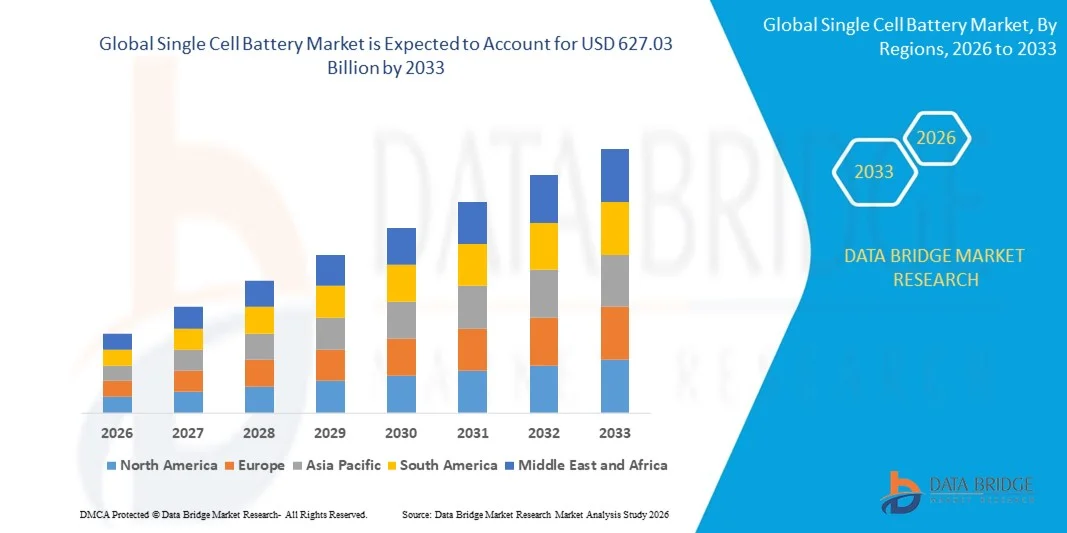
- The global single cell battery market size was valued at USD 109.40 billion in 2025 and is expected to reach USD 627.03 billion by 2033, at a CAGR of 32.40% during the forecast period
- The extended shelf life of these batteries than conventional batteries has been directly influencing the growth of single cell battery market
- Also, the miniaturization of electronic devices and rapid surge in research and development activities related to solid state batteries are also flourishing the growth of the single cell battery market
What are the Major Takeaways of Single Cell Battery Market?
- The increasing requirement of solid state batteries in electric vehicles and rising trend toward the miniaturization of consumer electronics are also positively impacting the growth of the market
- However, the high cost of batteries and intricate manufacturing process of batteries are acting as the major limitations for the growth of single cell battery in the above mentioned forecasted period, whereas the manufacturing cost-efficient single cell batteries have the potential to challenge the single cell battery market growth
- North America dominated the single cell battery market with a 35.24% revenue share in 2025, driven by strong growth in advanced battery research, electronics manufacturing, medical device production, and expanding R&D activities across the U.S. and Canada
- Asia-Pacific is projected to register the fastest CAGR of 8.85% from 2026 to 2033, driven by massive electronics production, rapid EV adoption, expanding battery manufacturing capacity, and strong demand for consumer devices across China, Japan, India, South Korea, and Southeast Asia
- The Primary Battery segment dominated the market with a 58.6% share in 2025, driven by its extensive use in low-power and long-life applications such as remote controls, medical implants, wireless sensors, smart cards, and consumer electronics
Report Scope and Single Cell Battery Market Segmentation
|
Attributes |
Single Cell Battery Key Market Insights |
|
Segments Covered |
|
|
Countries Covered |
North America
Europe
Asia-Pacific
Middle East and Africa
South America
|
|
Key Market Players |
|
|
Market Opportunities |
|
|
Value Added Data Infosets |
In addition to the insights on market scenarios such as market value, growth rate, segmentation, geographical coverage, and major players, the market reports curated by the Data Bridge Market Research also include in-depth expert analysis, pricing analysis, brand share analysis, consumer survey, demography analysis, supply chain analysis, value chain analysis, raw material/consumables overview, vendor selection criteria, PESTLE Analysis, Porter Analysis, and regulatory framework. |
What is the Key Trend in the Single Cell Battery Market?
Increasing Shift Toward High-Energy-Density, Compact, and Application-Specific Single Cell Batteries
- The single cell battery market is witnessing rising adoption of compact, lightweight, and high-energy-density battery cells designed for wearables, medical devices, IoT sensors, smart cards, and portable consumer electronics
- Manufacturers are focusing on advanced chemistries such as lithium-ion, lithium primary, and solid-state single cell batteries to improve energy density, safety, and cycle life
- Growing demand for miniaturized electronics and wireless devices is driving the use of single cell batteries that deliver stable voltage, long shelf life, and low self-discharge
- For instance, companies such as Panasonic, Energizer, Varta, and Duracell are expanding their single cell battery portfolios with improved capacity, safety features, and application-specific designs
- Increasing emphasis on compact power sources for medical implants, hearing aids, and smart IoT devices is accelerating innovation in single cell battery form factors
- As electronic devices become smaller and more power-efficient, Single Cell Batteries will remain critical for reliable, long-lasting, and compact energy storage solutions
What are the Key Drivers of Single Cell Battery Market?
- Rising demand for portable, lightweight, and long-lasting power sources across consumer electronics, healthcare devices, and industrial IoT applications
- For instance, in 2024–2025, leading battery manufacturers increased investments in lithium-based and solid-state single cell batteries to improve energy density and safety performance
- Growing adoption of wearable devices, medical monitoring equipment, smart sensors, and remote-control devices is boosting demand across the U.S., Europe, and Asia-Pacific
- Advancements in electrode materials, electrolyte formulations, and battery management technologies have enhanced reliability, lifespan, and thermal stability
- Increasing use of wireless technologies, low-power electronics, and connected devices is driving demand for compact, high-performance single cell batteries
- Supported by rising electronics production, healthcare expansion, and continuous R&D investment, the Single Cell Battery market is expected to witness steady long-term growth
Which Factor is Challenging the Growth of the Single Cell Battery Market?
- High costs associated with advanced battery chemistries, safety enhancements, and specialized manufacturing processes limit adoption in cost-sensitive applications
- For instance, during 2024–2025, fluctuations in raw material prices such as lithium, cobalt, and nickel increased production costs for several battery manufacturers
- Safety concerns related to thermal runaway, leakage, and disposal require strict compliance with regulatory standards and increase development complexity
- Limited recycling infrastructure and environmental concerns surrounding battery waste pose challenges in emerging markets
- Competition from alternative power solutions such as rechargeable multi-cell packs, energy harvesting systems, and supercapacitors creates pricing pressure
- To overcome these challenges, companies are focusing on safer chemistries, cost optimization, recycling initiatives, and improved manufacturing efficiency to expand global adoption of Single Cell Batteries
How is the Single Cell Battery Market Segmented?
The market is segmented on the basis of rechargeability, component, capacity, and application.
- By Rechargeability
On the basis of rechargeability, the single cell battery market is segmented into Primary Battery and Secondary Battery. The Primary Battery segment dominated the market with a 58.6% share in 2025, driven by its extensive use in low-power and long-life applications such as remote controls, medical implants, wireless sensors, smart cards, and consumer electronics. Primary single cell batteries offer long shelf life, stable voltage output, low self-discharge, and minimal maintenance, making them ideal for disposable and infrequently replaced devices. Their cost-effectiveness and reliability support widespread adoption across healthcare, IoT, and industrial monitoring applications.
The Secondary Battery segment is expected to grow at the fastest CAGR from 2026 to 2033, supported by rising demand for rechargeable energy storage in wearables, portable electronics, and smart devices. Advancements in lithium-ion and solid-state chemistries, combined with sustainability goals and reduced replacement costs, are accelerating adoption of rechargeable single cell batteries across global markets.
- By Component
On the basis of component, the single cell battery market is segmented into Cathode, Anode, Solid Electrolyte, and Others. The Cathode segment accounted for the largest market share of 41.2% in 2025, owing to its critical role in determining battery capacity, voltage, energy density, and overall performance. Continuous innovation in cathode materials such as lithium cobalt oxide, lithium iron phosphate, and manganese-based compounds is driving efficiency improvements and safety enhancements. High R&D investment by battery manufacturers to optimize cathode chemistry further supports segment dominance.
The Solid Electrolyte segment is projected to register the fastest CAGR from 2026 to 2033, driven by growing adoption of solid-state single cell batteries. Solid electrolytes improve safety, thermal stability, and energy density while reducing leakage risks, making them increasingly attractive for medical devices, EV electronics, and advanced consumer applications.
- By Capacity
On the basis of capacity, the single cell battery market is segmented into Below 20 mAh, Between 20 mAh and 500 mAh, and Above 500 mAh. The 20 mAh to 500 mAh segment dominated the market with a 46.9% share in 2025, as it balances compact size with sufficient energy output for consumer electronics, wireless sensors, wearables, and medical monitoring devices. These batteries are widely adopted due to their versatility, stable discharge profiles, and compatibility with modern low-power electronics.
The Above 500 mAh segment is expected to grow at the fastest CAGR from 2026 to 2033, driven by increasing demand for higher-capacity single cell batteries in electric vehicles, energy harvesting systems, and advanced industrial applications. Growing power requirements of connected devices and longer operational cycles are accelerating adoption of higher-capacity cells globally.
- By Application
On the basis of application, the single cell battery market is segmented into Consumer Electronics, Electric Vehicles, Medical Devices, Energy Harvesting, Wireless Sensors, Packaging, and Others. The Consumer Electronics segment dominated the market with a 38.4% share in 2025, supported by large-scale usage in remote controls, wearables, toys, smart home devices, and portable gadgets. High production volumes, frequent device upgrades, and continuous demand for compact power sources drive sustained market leadership.
The Electric Vehicles segment is anticipated to grow at the fastest CAGR from 2026 to 2033, propelled by rising adoption of EV electronics, battery management systems, sensors, and auxiliary power components. Increasing vehicle electrification, regulatory support, and technological advancements are accelerating the integration of single cell batteries across automotive platforms.
Which Region Holds the Largest Share of the Single Cell Battery Market?
- North America dominated the single cell battery market with a 35.24% revenue share in 2025, driven by strong growth in advanced battery research, electronics manufacturing, medical device production, and expanding R&D activities across the U.S. and Canada. High demand for compact, reliable, and high-energy-density single cell batteries in consumer electronics, medical devices, automotive electronics, and industrial applications continues to support market expansion
- Leading companies in North America are actively investing in next-generation battery chemistries, including lithium-ion and solid-state technologies, to improve energy density, safety, and lifecycle performance. Continuous innovation in wearables, IoT devices, and portable electronics strengthens the region’s technological leadership
- A strong innovation ecosystem, availability of skilled talent, and sustained investment in battery manufacturing infrastructure further reinforce North America’s dominant market position
U.S. Single Cell Battery Market Insight
The U.S. is the largest contributor in North America, supported by robust battery R&D, widespread adoption of smart devices, and strong demand from medical, defence, automotive, and consumer electronics sectors. Increasing focus on solid-state batteries, energy-efficient devices, and domestic battery manufacturing further accelerates market growth.
Canada Single Cell Battery Market Insight
Canada contributes steadily to regional growth due to rising adoption of portable electronics, medical technologies, and energy storage solutions. Government-backed innovation programs, expanding clean technology initiatives, and growing electronics manufacturing support increasing use of single cell batteries.
Asia-Pacific Single Cell Battery Market
Asia-Pacific is projected to register the fastest CAGR of 8.85% from 2026 to 2033, driven by massive electronics production, rapid EV adoption, expanding battery manufacturing capacity, and strong demand for consumer devices across China, Japan, India, South Korea, and Southeast Asia.
China Single Cell Battery Market Insight
China is the largest contributor in Asia-Pacific due to large-scale battery production, strong government support, and high demand from consumer electronics and electric mobility markets.
Japan Single Cell Battery Market Insight
Japan shows steady growth supported by advanced battery technology development, precision manufacturing, and strong focus on high-performance and safe energy storage solutions.
India Single Cell Battery Market Insight
India is emerging as a high-growth market, driven by electronics manufacturing initiatives, rising EV adoption, and increasing demand for affordable energy storage solutions.
South Korea Single Cell Battery Market Insight
South Korea contributes significantly due to strong presence of global battery manufacturers, innovation in solid-state batteries, and rising demand from consumer electronics and automotive applications.
Which are the Top Companies in Single Cell Battery Market?
The single cell battery industry is primarily led by well-established companies, including:
- QuantumScape Corporation (U.S.)
- Samsung SDI Co., Ltd. (South Korea)
- BASF SE (Germany)
- Apple Inc. (U.S.)
- BMW AG (Germany)
- Cymbet (U.S.)
- Bosch Limited (India)
- BrightVolt Solid State Batteries (U.S.)
- ProLogium Technology Co., Ltd. (Taiwan)
- STMicroelectronics (Switzerland)
- KeraCel, Inc. (U.S.)
- Ilika (U.K.)
- NGK Spark Plug Co., Ltd. (Japan)
- IDTechEx Ltd (U.K.)
- Blue Solutions (France)
- Solid Power (U.S.)
- Amprius Technologies (U.S.)
- Excellatron (U.S.)
- Dyson (U.K.)
- Altairnano (U.S.)
SKU-
Get online access to the report on the World's First Market Intelligence Cloud
- Interactive Data Analysis Dashboard
- Company Analysis Dashboard for high growth potential opportunities
- Research Analyst Access for customization & queries
- Competitor Analysis with Interactive dashboard
- Latest News, Updates & Trend analysis
- Harness the Power of Benchmark Analysis for Comprehensive Competitor Tracking
Global Single Cell Battery Market, Supply Chain Analysis and Ecosystem Framework
To support market growth and help clients navigate the impact of geopolitical shifts, DBMR has integrated in-depth supply chain analysis into its Global Single Cell Battery Market research reports. This addition empowers clients to respond effectively to global changes affecting their industries. The supply chain analysis section includes detailed insights such as Global Single Cell Battery Market consumption and production by country, price trend analysis, the impact of tariffs and geopolitical developments, and import and export trends by country and HSN code. It also highlights major suppliers with data on production capacity and company profiles, as well as key importers and exporters. In addition to research, DBMR offers specialized supply chain consulting services backed by over a decade of experience, providing solutions like supplier discovery, supplier risk assessment, price trend analysis, impact evaluation of inflation and trade route changes, and comprehensive market trend analysis.
Research Methodology
Data collection and base year analysis are done using data collection modules with large sample sizes. The stage includes obtaining market information or related data through various sources and strategies. It includes examining and planning all the data acquired from the past in advance. It likewise envelops the examination of information inconsistencies seen across different information sources. The market data is analysed and estimated using market statistical and coherent models. Also, market share analysis and key trend analysis are the major success factors in the market report. To know more, please request an analyst call or drop down your inquiry.
The key research methodology used by DBMR research team is data triangulation which involves data mining, analysis of the impact of data variables on the market and primary (industry expert) validation. Data models include Vendor Positioning Grid, Market Time Line Analysis, Market Overview and Guide, Company Positioning Grid, Patent Analysis, Pricing Analysis, Company Market Share Analysis, Standards of Measurement, Global versus Regional and Vendor Share Analysis. To know more about the research methodology, drop in an inquiry to speak to our industry experts.
Customization Available
Data Bridge Market Research is a leader in advanced formative research. We take pride in servicing our existing and new customers with data and analysis that match and suits their goal. The report can be customized to include price trend analysis of target brands understanding the market for additional countries (ask for the list of countries), clinical trial results data, literature review, refurbished market and product base analysis. Market analysis of target competitors can be analyzed from technology-based analysis to market portfolio strategies. We can add as many competitors that you require data about in the format and data style you are looking for. Our team of analysts can also provide you data in crude raw excel files pivot tables (Fact book) or can assist you in creating presentations from the data sets available in the report.