


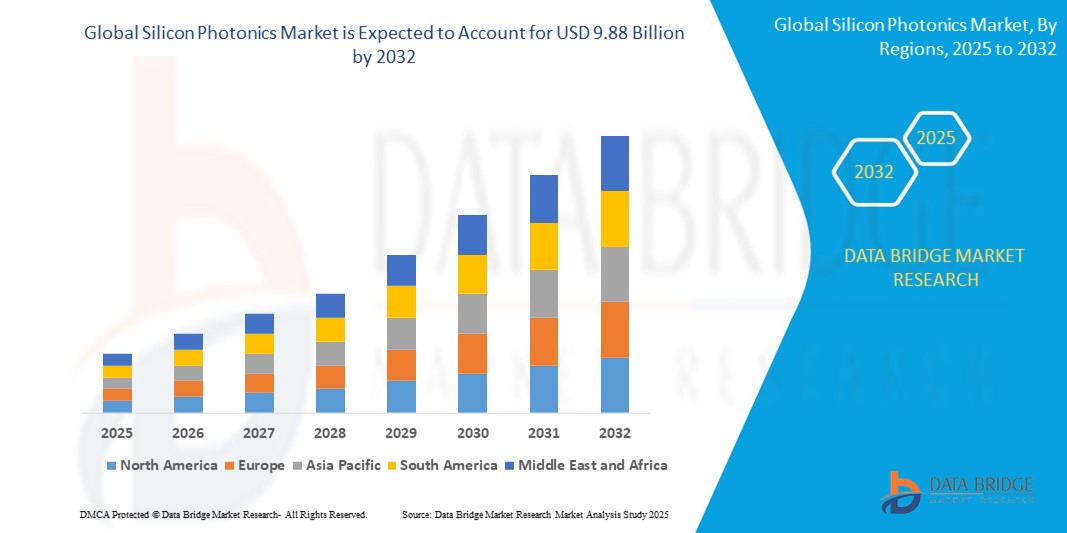
Silicon Photonics Market Size
- The global silicon photonics market size was valued at USD 1.94 billion in 2024 and is expected to reach USD 9.88 billion by 2032, at a CAGR of 22.57% during the forecast period
- This growth is driven by factors such as the increasing demand for high-speed data transfer, advancements in silicon photonics technology, and the proliferation of data-intensive applications
Silicon Photonics Market Analysis
- Silicon photonics is a technology that utilizes silicon-based components to manipulate and transmit light signals on a chip. It combines photonics with silicon fabrication techniques, enabling the integration of optical functions with traditional electronic circuits
- This approach promises high-speed data transmission, low power consumption, and compact device sizes, making it ideal for applications in telecommunications, data centers, and sensing systems
- North America is expected to dominate the silicon photonics market with 48.3% due to substantial investments in research and development, and the presence of major technology companies
- Asia-Pacific is expected to be the fastest growing region in the silicon photonics market during the forecast period due to region's strong electronics manufacturing ecosystem contributes to the scalability and affordability of silicon photonics components
- Wavelength-division multiplexing (WDM) segment is expected to dominate the market with a market share of 32.7% due to enabling the integration of multiple wavelength channels on a single silicon chip
Report Scope and Silicon Photonics Market Segmentation
|
Attributes |
Silicon Photonics Key Market Insights |
|
Segments Covered |
|
|
Countries Covered |
North America
Europe
Asia-Pacific
Middle East and Africa
South America
|
|
Key Market Players |
|
|
Market Opportunities |
|
|
Value Added Data Infosets |
In addition to the insights on market scenarios such as market value, growth rate, segmentation, geographical coverage, and major players, the market reports curated by the Data Bridge Market Research also include in-depth expert analysis, geographically represented company-wise production and capacity, network layouts of distributors and partners, detailed and updated price trend analysis and deficit analysis of supply chain and demand. |
Silicon Photonics Market Trends
“Integration of Silicon Photonics in AI and Data Centers”
- The surge in artificial intelligence (AI) applications and the expansion of data centers have significantly increased the demand for high-speed data transfer solutions. Silicon photonics technology, known for its ability to transmit data at high speeds with low latency, is becoming integral in meeting these demands
- Companies such as Marvell Technology are leading the way by developing AI accelerators and scaling silicon photonics to enhance data processing capabilities. Marvell's strategic focus on silicon photonics positions it to benefit from advancements and increased integration in optics, contributing to the growth of the $3 billion silicon photonics market
- The increasing reliance on cloud computing and the expansion of data center infrastructure are significant contributors to the demand for silicon photonics. This technology supports the high-speed, high-capacity communication required for large-scale data centers
- The rollout of 5G networks and the anticipation of 6G are accelerating the adoption of silicon photonics. The technology is essential for meeting the high-speed and low-latency requirements of next-generation wireless networks
- Beyond traditional data communication, silicon photonics is finding applications in areas such as medical diagnostics, imaging, and quantum computing. The technology’s versatility is driving research and opening new market opportunities
Silicon Photonics Market Dynamics
Driver
“Demand for High-Speed Data Transmission”
- The proliferation of Internet of Things (IoT) devices, cloud computing, and high-definition video streaming has led to an exponential increase in data generation. This surge necessitates faster data transmission solutions to handle the growing bandwidth requirements
- Silicon photonics offers a solution by enabling high-speed data transfer using light, which can transmit data at significantly higher speeds compared to traditional electronic methods. This capability is crucial for applications requiring rapid data processing and low latency.
- The telecommunications industry is experiencing a shift towards higher bandwidth requirements due to the increasing number of connected devices and the demand for faster internet speeds. Silicon photonics technology is being leveraged to meet these demands by providing efficient and scalable solutions
- Data centers, which form the backbone of cloud services, require high-speed interconnects to manage the vast amounts of data being processed. Silicon photonics provides the necessary speed and efficiency to facilitate seamless data transfer within these centers
- As global connectivity expands, especially in emerging markets, the need for high-speed data transmission becomes more critical. Silicon photonics can bridge the connectivity gap by offering cost-effective and high-performance solutions
Opportunity
“Expansion in Emerging Applications”
- Silicon photonics is being integrated into Light Detection and Ranging (LiDAR) systems, which are essential for autonomous vehicles and advanced robotics. The compact size and efficiency of silicon photonics make it an ideal choice for these applications
- In the healthcare sector, silicon photonics is enabling the development of advanced imaging systems and biosensors. These technologies enhance diagnostic capabilities and are pivotal in personalized medicine approaches
- Silicon photonics plays a crucial role in the advancement of quantum computing by facilitating the manipulation and transmission of quantum bits (qubits). This development could revolutionize computing power and data processing capabilities
- The integration of silicon photonics into consumer electronics, such as smartphones and augmented reality devices, is on the rise. This integration allows for faster data processing and improved performance in compact devices
- In industrial settings, silicon photonics is being utilized for sensor technologies that monitor and control manufacturing processes. These sensors provide real-time data, enhancing efficiency and reducing downtime
Restraint/Challenge
“High Initial Costs and Integration Complexities”
- The development and production of silicon photonics devices require advanced fabrication facilities and specialized equipment, leading to high initial costs
- Integrating photonic components with existing electronic systems presents technical difficulties, including compatibility issues and the need for specialized knowledge. This complexity can delay the adoption of silicon photonics in various industries.
- Silicon photonics devices can generate significant heat during operation, requiring effective thermal management solutions. Without proper heat dissipation, device performance can degrade, limiting their application in high-performance environments
- Silicon's inherent material properties pose challenges for certain photonic applications. For example, silicon has a low electro-optic coefficient, making it less efficient for functionalities such as active modulation and laser integration
- The silicon photonics industry relies on specialized materials and components that may face supply chain disruptions. Shortages of raw materials or disruptions in the global supply chain could affect production and pricing of photonic devices
Silicon Photonics Market Scope
The market is segmented on the basis of product, waveguides, material, component, and application.
|
Segmentation |
Sub-Segmentation |
|
By Product |
|
|
By Waveguides |
|
|
By Material |
|
|
By Component |
|
|
By Application |
|
In 2025, the wavelength-division multiplexing (WDM) is projected to dominate the market with a largest share in component segment
The wavelength-division multiplexing (WDM) segment is expected to dominate the silicon photonics market with the largest share of 32.7% in 2025 due to integration of multiple wavelength channels on a single silicon chip. Silicon photonics leverages the compatibility of silicon with both electronic and photonic components, allowing for the integration of WDM filters alongside other photonic and electronic functionalities.
The photonic IC is expected to account for the largest share during the forecast period in material market
In 2025, the photonic IC segment is expected to dominate the market with the largest market share of 27.8% due to allowing multiple wavelengths to be transmitted over a single optical fiber. The trends in this product type include higher channel counts, compact designs, lower insertion losses, and compatibility with different wavelength bands.
Silicon Photonics Market Regional Analysis
“North America Holds the Largest Share in the Silicon Photonics Market”
- North America holds a significant share of the global silicon photonics market, driven by substantial investments in research and development, and the presence of major technology companies
- The region boasts advanced telecommunications and IT infrastructure, facilitating the adoption of cutting-edge technologies such as silicon photonics
- Companies such as Intel Corporation, Cisco Systems, and Acacia Communications are pivotal in advancing silicon photonics technologies in North America
- Supportive government policies and funding for high-tech initiatives bolster the region's leadership in silicon photonics
- The technology is extensively utilized in data centers, telecommunications, and high-performance computing systems across the region
“Asia-Pacific is Projected to Register the Highest CAGR in the Silicon Photonics Market”
- Asia-Pacific is experiencing significant growth in the silicon photonics market
- Countries such as China, Japan, and South Korea are heavily investing in 5G infrastructure and data center development, driving the demand for silicon photonics
- The region's strong electronics manufacturing ecosystem contributes to the scalability and affordability of silicon photonics components
- Government-driven initiatives and research collaborations foster innovation and adoption of silicon photonics technologies
- Silicon photonics is being integrated into various sectors, including telecommunications, consumer electronics, and automotive industries in the region
Silicon Photonics Market Share
The market competitive landscape provides details by competitor. Details included are company overview, company financials, revenue generated, market potential, investment in research and development, new market initiatives, global presence, production sites and facilities, production capacities, company strengths and weaknesses, product launch, product width and breadth, application dominance. The above data points provided are only related to the companies' focus related to market.
The Major Market Leaders Operating in the Market Are:
- Intel Corporation (U.S.)
- Cisco Systems, Inc. (U.S.)
- Skorpios Technologies Inc (U.S.)
- Ciena Corporation (U.S.)
- Lumentum Operations LLC (U.S.)
- NVIDIA Corporation (U.S.)
- GlobalFoundries U.S. Inc. (U.S.)
- Hamamatsu Photonics K.K. (Japan)
- IBM Corp. (U.S.)
- Juniper Networks (U.S.)
- Rockley Photonics (U.K.)
- STMicroelectronics (Switzerland)
- Broadcom (U.S.)
- Smiths Interconnect Group Limited (U.K.)
- RANVOUS Inc. (Canada)
- SICOYA GMBH (Germany)
- Molex (U.S.)
Latest Developments in Global Silicon Photonics Market
- In December 2024, IBM (U.S.) unveiled a new process for CPO that enhances data center connectivity by integrating optical waveguides with silicon photonics. This technology is designed to replace traditional electrical interconnects, potentially speeding up data center training for generative Al models by up to 5 times. The use of polymer optical waveguides (PWGs) allows for a higher density of optical fibers-up to six times more at the chip edge-improving bandwidth significantly and extending cable lengths from one meter to hundreds of meters
- In October 2024, Lumentum (U.S.) participated in the European Conference on Optical Communication (ECOC) 2024, highlighting its enhanced 800G ZR+ coherent pluggable transceivers. These transceivers are optimized for extended reach and higher optical power applications, addressing the growing demands of Al infrastructure and long-reach data center interconnects. The transceivers leverage Lumentum's proprietary indium phosphide technology for superior performance
- In November 2024, Celestial Al (U.S.) acquired Rockley Photonics' (U.S.) silicon photonics intellectual property (IP) portfolio for USD 20 million. This acquisition includes worldwide issued and pending patents related to optoelectronic systems-in-package, electro-absorption modulators (EAMs), and optical switch technology. The integration of Rockley's IP enhances Celestial Al's Photonic Fabric technology platform, which targets Al data center infrastructure applications
- In October 2024, Cisco Investments (U.S.) participated in a Series A funding round for Xscape Photonics, which raised USD 44 million to develop its ChromX platform. This platform aims to enhance scalability and performance in Al data centers by utilizing multi-color, programmable photonics technology
- In March 2024, MACOM (U.S.) launched MACOM PURE DRIVE 200 Gbps per lane Liner Drive to enable the development of 1.6 TB linear pluggable optical ("LPO") modules

- Interactive Data Analysis Dashboard
- Company Analysis Dashboard for high growth potential opportunities
- Research Analyst Access for customization & queries
- Competitor Analysis with Interactive dashboard
- Latest News, Updates & Trend analysis
- Harness the Power of Benchmark Analysis for Comprehensive Competitor Tracking
Global Silicon Photonics Market, Supply Chain Analysis and Ecosystem Framework
To support market growth and help clients navigate the impact of geopolitical shifts, DBMR has integrated in-depth supply chain analysis into its Global Silicon Photonics Market research reports. This addition empowers clients to respond effectively to global changes affecting their industries. The supply chain analysis section includes detailed insights such as Global Silicon Photonics Market consumption and production by country, price trend analysis, the impact of tariffs and geopolitical developments, and import and export trends by country and HSN code. It also highlights major suppliers with data on production capacity and company profiles, as well as key importers and exporters. In addition to research, DBMR offers specialized supply chain consulting services backed by over a decade of experience, providing solutions like supplier discovery, supplier risk assessment, price trend analysis, impact evaluation of inflation and trade route changes, and comprehensive market trend analysis.
Data collection and base year analysis are done using data collection modules with large sample sizes. The stage includes obtaining market information or related data through various sources and strategies. It includes examining and planning all the data acquired from the past in advance. It likewise envelops the examination of information inconsistencies seen across different information sources. The market data is analysed and estimated using market statistical and coherent models. Also, market share analysis and key trend analysis are the major success factors in the market report. To know more, please request an analyst call or drop down your inquiry.
The key research methodology used by DBMR research team is data triangulation which involves data mining, analysis of the impact of data variables on the market and primary (industry expert) validation. Data models include Vendor Positioning Grid, Market Time Line Analysis, Market Overview and Guide, Company Positioning Grid, Patent Analysis, Pricing Analysis, Company Market Share Analysis, Standards of Measurement, Global versus Regional and Vendor Share Analysis. To know more about the research methodology, drop in an inquiry to speak to our industry experts.
Data Bridge Market Research is a leader in advanced formative research. We take pride in servicing our existing and new customers with data and analysis that match and suits their goal. The report can be customized to include price trend analysis of target brands understanding the market for additional countries (ask for the list of countries), clinical trial results data, literature review, refurbished market and product base analysis. Market analysis of target competitors can be analyzed from technology-based analysis to market portfolio strategies. We can add as many competitors that you require data about in the format and data style you are looking for. Our team of analysts can also provide you data in crude raw excel files pivot tables (Fact book) or can assist you in creating presentations from the data sets available in the report.













