Global Seedless Watermelon Seed Market
Market Size in USD Million
CAGR :
% 
 USD
533.46 Million
USD
831.20 Million
2025
2033
USD
533.46 Million
USD
831.20 Million
2025
2033
 Forecast Period Forecast Period |
2026 –2033 |
 Market Size (Base Year) Market Size (Base Year) |
USD 533.46 Million |
 Market Size (Forecast Year) Market Size (Forecast Year) |
USD 831.20 Million |
 CAGR CAGR |
% |
| Major Markets Players |
|
Seedless Watermelon Seed Market Size
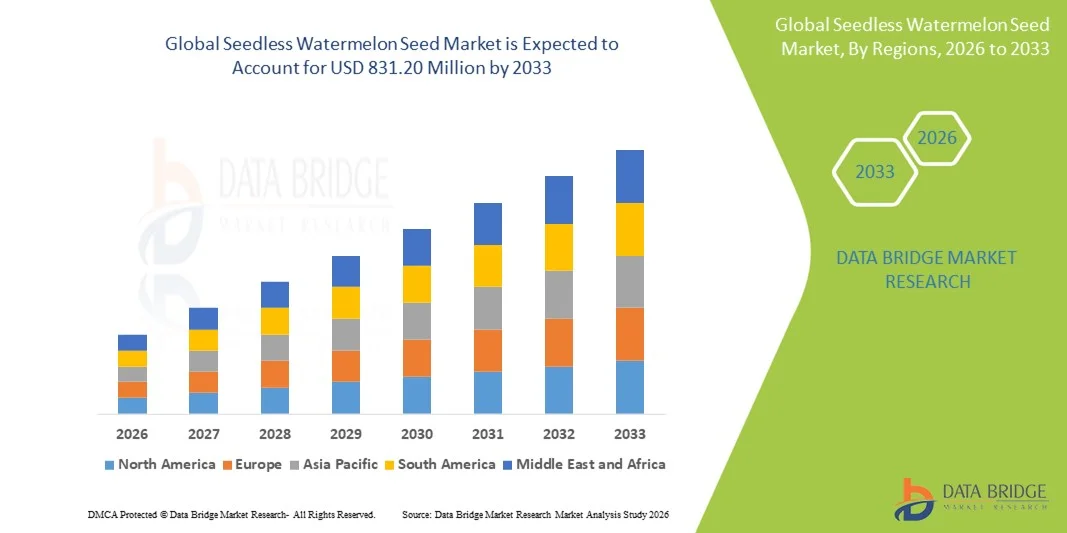
- The global seedless watermelon seed market size was valued at USD 533.46 million in 2025 and is expected to reach USD 831.20 million by 2033, at a CAGR of 5.70% during the forecast period
- The market growth is largely fueled by rising consumer preference for seedless fruit varieties and continuous advancements in hybrid seed breeding technologies, leading to improved yield performance and fruit quality across commercial farming operations
- Furthermore, increasing demand from modern retail, food service, and export markets for uniform, convenient, and high-quality watermelons is establishing seedless varieties as the preferred choice for growers. These converging factors are accelerating the adoption of seedless watermelon seeds, thereby significantly boosting overall market growth
Seedless Watermelon Seed Market Analysis
- Seedless watermelon seeds, developed through advanced hybridization techniques, are becoming essential inputs in commercial horticulture due to their ability to deliver consistent fruit size, superior taste, and higher market value across large-scale and controlled cultivation systems
- The escalating demand for seedless watermelon seeds is primarily driven by growing health awareness, increasing consumption of fresh fruits, and farmers’ focus on maximizing profitability through high-yield, premium-quality crop production
- North America dominated the seedless watermelon seed market with a share of 38.5% in 2025, due to high consumption of fresh fruits, strong preference for seedless varieties, and advanced agricultural practices
- Asia-Pacific is expected to be the fastest growing region in the seedless watermelon seed market during the forecast period due to rising population, increasing disposable incomes, and expanding commercial farming activities
- Pattern watermelon segment dominated the market with a market share of 46.8% in 2025, due to its strong acceptance among commercial growers due to higher visual appeal and consumer preference for traditional striped watermelon varieties. Farmers often favor patterned types because of their proven yield performance, uniform fruit shape, and better market pricing in wholesale channels. These varieties are widely cultivated for open-field farming, supporting consistent demand across major producing regions
Report Scope and Seedless Watermelon Seed Market Segmentation
|
Attributes |
Seedless Watermelon Seed Key Market Insights |
|
Segments Covered |
|
|
Countries Covered |
North America
Europe
Asia-Pacific
Middle East and Africa
South America
|
|
Key Market Players |
|
|
Market Opportunities |
|
|
Value Added Data Infosets |
In addition to the insights on market scenarios such as market value, growth rate, segmentation, geographical coverage, and major players, the market reports curated by the Data Bridge Market Research also include import export analysis, production capacity overview, production consumption analysis, price trend analysis, climate change scenario, supply chain analysis, value chain analysis, raw material/consumables overview, vendor selection criteria, PESTLE Analysis, Porter Analysis, and regulatory framework. |
Seedless Watermelon Seed Market Trends
Rising Adoption of Hybrid and High-Yield Seedless Watermelon Varieties
- A major trend in the seedless watermelon seed market is the increasing adoption of hybrid and high-yield seed varieties, driven by growers’ focus on improving productivity, fruit uniformity, and overall farm profitability. Hybrid seedless watermelon varieties are gaining strong traction as they offer superior yield stability, enhanced sweetness, and better resistance to pests and diseases across diverse growing conditions
- For instance, companies such as Syngenta and Bayer AG (Seminis) have expanded their portfolios of triploid seedless watermelon hybrids designed to deliver consistent fruit quality and higher commercial returns. These seed offerings are widely adopted by large-scale growers supplying modern retail and export markets, reinforcing the shift toward premium hybrid seeds
- The trend is further supported by the growing preference for visually uniform and size-consistent watermelons that align with retail grading standards. Hybrid seed varieties enable farmers to meet these strict quality requirements more reliably, strengthening their presence in organized supply chains
- Advancements in breeding technologies are also improving germination rates and plant vigor, making hybrid seedless watermelon cultivation more predictable. This is encouraging adoption among professional growers who seek reduced crop risk and stable output
- The rising penetration of greenhouse and controlled-environment farming is amplifying demand for hybrid seed varieties optimized for such conditions. These cultivation systems rely heavily on high-performance seeds to maximize yield efficiency
- Overall, the sustained shift toward hybrid and high-yield seedless watermelon varieties is reinforcing market growth by aligning seed innovation with evolving commercial farming and retail requirements
Seedless Watermelon Seed Market Dynamics
Driver
Increasing Consumer Demand for Convenient and Premium Seedless Fruits
- The growing consumer preference for convenient and premium fruit options is a key driver supporting the expansion of the seedless watermelon seed market. Seedless watermelons are increasingly favored due to ease of consumption, improved eating experience, and suitability for ready-to-eat and fresh-cut fruit segments
- For instance, seed producers such as VILMORIN & CIE and Limagrain are actively developing seedless watermelon varieties tailored to meet retail demand for sweetness, texture, and visual appeal. These varieties support growers supplying supermarkets and food service operators that prioritize premium fruit offerings
- Rising health awareness and increased fruit consumption across urban populations are further accelerating demand for seedless watermelon varieties. Consumers associate seedless fruits with convenience and higher quality, driving retailers to source consistent seedless produce
- The growth of organized retail and e-commerce grocery platforms is also strengthening this driver, as these channels emphasize standardized, premium fruits with minimal preparation requirements. Seedless watermelons align well with these distribution models
- Collectively, rising consumer expectations for premium, convenient fruits are directly influencing growers’ seed choices and reinforcing long-term demand for seedless watermelon seeds
Restraint/Challenge
High Cost of Hybrid Seed Production and Cultivation Complexity
- The seedless watermelon seed market faces notable challenges related to the high cost of hybrid seed production and the complexity involved in cultivation. Producing triploid seedless watermelon seeds requires advanced breeding processes, specialized pollination techniques, and strict quality control, which significantly increase seed costs
- For instance, companies such as Hazera and Sakata Seed America invest heavily in research, breeding infrastructure, and controlled seed production systems to ensure genetic stability and performance. These investments raise production expenses, which are reflected in higher seed prices for farmers
- Seedless watermelon cultivation also requires careful management of pollinator varieties and precise planting ratios, increasing operational complexity for growers. This can limit adoption among small-scale or resource-constrained farmers
- The requirement for skilled labor and advanced agronomic knowledge further adds to cultivation challenges, particularly in developing agricultural regions. These factors can reduce accessibility and slow market penetration
- As a result, balancing high-performance seed development with cost efficiency remains a critical challenge for both seed producers and growers, influencing adoption rates and overall market dynamics
Seedless Watermelon Seed Market Scope
The market is segmented on the basis of product type, size, and application.
- By Product Type
On the basis of product type, the seedless watermelon seed market is segmented into patterned watermelon and pure color watermelon. The patterned watermelon segment dominated the market with the largest revenue share of 46.8% in 2025, driven by its strong acceptance among commercial growers due to higher visual appeal and consumer preference for traditional striped watermelon varieties. Farmers often favor patterned types because of their proven yield performance, uniform fruit shape, and better market pricing in wholesale channels. These varieties are widely cultivated for open-field farming, supporting consistent demand across major producing regions.
The pure color watermelon segment is anticipated to witness the fastest growth rate from 2026 to 2033, fueled by rising demand for premium and specialty watermelons in urban and export markets. Pure color varieties are increasingly adopted for their distinctive appearance, sweeter taste profile, and suitability for branding in modern retail formats. Advancements in hybrid seed technology further support their growing adoption among progressive farmers.
- By Size
On the basis of size, the seedless watermelon seed market is segmented into small size (below 5 kg) and medium-large size (above 5 kg). The medium-large size segment accounted for the dominant market share in 2025, driven by higher yield per hectare and strong demand from traditional markets and food service operators. Growers prefer medium-large varieties due to their cost efficiency, better shelf presence, and suitability for bulk sales. These watermelons are widely used in food processing and large-scale distribution channels, reinforcing segment dominance.
The small size segment is expected to register the fastest CAGR during the forecast period, supported by increasing consumer preference for portion-controlled fruits and convenience-oriented consumption. Smaller watermelons are gaining popularity in urban households due to easier handling, reduced wastage, and compatibility with modern retail packaging. Rising demand from premium grocery stores and export markets further accelerates segment growth.
- By Application
Based on application, the seedless watermelon seed market is segmented into farmland, greenhouse, and others. The farmland segment dominated the market revenue share in 2025, driven by large-scale cultivation practices and favorable climatic conditions in major producing regions. Open-field farming remains the preferred application due to lower production costs and the ability to achieve high-volume output. Most commercial seedless watermelon production continues to rely on farmland cultivation, ensuring stable demand for hybrid seeds.
The greenhouse segment is projected to be the fastest growing from 2026 to 2033, fueled by increasing adoption of controlled environment agriculture. Greenhouse cultivation enables year-round production, better pest control, and improved fruit quality, making it attractive for high-value markets. Growing investment in protected farming techniques supports the rapid expansion of this segment.
Seedless Watermelon Seed Market Regional Analysis
- North America dominated the seedless watermelon seed market with the largest revenue share of 38.5% in 2025, driven by high consumption of fresh fruits, strong preference for seedless varieties, and advanced agricultural practices
- Growers in the region value the higher yield consistency, uniform fruit quality, and strong retail demand associated with seedless watermelon cultivation
- This widespread adoption is further supported by well-established distribution networks, increasing demand from supermarkets and food service channels, and the presence of advanced seed breeding and farming technologies
U.S. Seedless Watermelon Seed Market Insight
The U.S. seedless watermelon seed market captured the largest revenue share within North America in 2025, fueled by strong consumer preference for convenience-focused fruit options and high per capita watermelon consumption. Farmers increasingly favor seedless varieties to meet retail and export demand, supported by large-scale commercial farming operations. The presence of advanced hybrid seed developers and widespread adoption of precision farming practices further contribute to market growth. In addition, the dominance of organized retail and strong summer seasonal demand continue to reinforce market expansion.
Europe Seedless Watermelon Seed Market Insight
The Europe seedless watermelon seed market is projected to expand at a steady CAGR during the forecast period, driven by rising health awareness and growing demand for high-quality fresh produce. Increasing adoption of hybrid seeds and sustainable farming practices is supporting market growth across the region. European growers are focusing on improved yield efficiency and consistent fruit size to cater to retail chains. The expansion of greenhouse cultivation in certain countries further supports seedless watermelon production.
U.K. Seedless Watermelon Seed Market Insight
The U.K. seedless watermelon seed market is anticipated to grow at a notable CAGR, supported by increasing consumption of imported and domestically grown seedless fruits. Rising consumer preference for convenient, ready-to-eat fruit options is encouraging demand for seedless watermelon varieties. The growth of modern retail formats and emphasis on premium-quality produce further stimulate market expansion. Controlled environment farming practices are also gaining traction in the country.
Germany Seedless Watermelon Seed Market Insight
The Germany seedless watermelon seed market is expected to expand at a considerable CAGR, driven by strong demand for high-quality, sustainably produced fruits. German consumers place high importance on food quality and safety, supporting the adoption of improved hybrid seed varieties. The presence of advanced agricultural infrastructure and focus on yield optimization promote steady market growth. Increasing imports and localized greenhouse cultivation also contribute to demand.
Asia-Pacific Seedless Watermelon Seed Market Insight
The Asia-Pacific seedless watermelon seed market is poised to grow at the fastest CAGR during the forecast period, driven by rising population, increasing disposable incomes, and expanding commercial farming activities. Growing awareness of hybrid seeds and improved farming techniques is accelerating adoption across the region. Rapid urbanization and rising demand for premium fruits further support market growth. The region’s strong agricultural base and favorable climatic conditions enhance large-scale cultivation.
Japan Seedless Watermelon Seed Market Insight
The Japan seedless watermelon seed market is gaining momentum due to strong consumer preference for premium-quality fruits and visually appealing produce. The market benefits from advanced farming practices and a focus on consistent size and sweetness. Increasing use of greenhouse cultivation supports year-round production. Japan’s emphasis on quality-driven agriculture continues to drive demand for high-performance seed varieties.
China Seedless Watermelon Seed Market Insight
The China seedless watermelon seed market accounted for the largest revenue share in Asia Pacific in 2025, attributed to large-scale cultivation, high domestic consumption, and rapid adoption of hybrid seed technologies. China remains one of the largest producers and consumers of watermelon globally, supporting strong demand for seedless varieties. Expanding commercial farming operations and improving agricultural productivity further propel market growth. The availability of cost-effective hybrid seeds and strong local breeding programs strengthens China’s market position.
Seedless Watermelon Seed Market Share
The seedless watermelon seed industry is primarily led by well-established companies, including:
- Bayer AG (Germany)
- VILMORIN & CIE (France)
- Syngenta (Switzerland)
- ORIGENE SEEDS (India)
- RIZWAN SEED COMPANY (Pakistan)
- Tokita Seed India Pvt. Ltd. (India)
- Emerald Seed Company (U.S.)
- Hazera (Israel)
- BASF SE (Germany)
- Sakata Seed America, Inc. (U.S.)
- Limagrain (France)
- American Takii, Inc. (U.S.)
- Fengle Seed Co., Ltd. (China)
- VoloAgri (Israel)
- Namdhari Seeds Pvt. Ltd. (India)
- Liaoning Dongya Agricultural Development Co., Ltd. (China)
- Harris Seeds (U.S.)
- Johnny's Selected Seeds (U.S.)
- Highmark Seed Company (U.S.)
Latest Developments in Global Seedless Watermelon Seed Market
- In March 2025, Bayer AG launched new seedless watermelon varieties, including export-oriented hybrids and enhanced pollinator lines, strengthening its competitive position in high-performance watermelon genetics. This development supports improved yield stability and fruit quality, enabling growers to achieve better productivity and meet premium market requirements, thereby accelerating adoption of advanced seed technologies
- In February 2025, Ferry-Morse introduced its Triple Crown Hybrid Organic seedless watermelon seeds, expanding its organic seed portfolio and addressing rising demand for organically grown seedless fruits. This product launch enhances market penetration in the organic farming segment and supports growers seeking certified, high-yield seed solutions
- In June 2024, Syngenta Vegetable Seeds entered an exclusive global licensing agreement with Apricus Seeds, gaining access to advanced watermelon breeding germplasm. This partnership significantly strengthens Syngenta’s innovation pipeline, improves hybrid seed development capabilities, and intensifies competition in the global seedless watermelon seed market
- In April 2024, Origene Seeds partnered with Emerald Seed Company to expand the global distribution of premium watermelon seed varieties. This collaboration improves market accessibility across key agricultural regions and supports faster commercialization of high-quality seedless watermelon hybrids
- In January 2024, Vilmorin & Cie inaugurated a dedicated research and development facility in Spain focused on watermelon seed improvement. This investment enhances breeding efficiency, supports the development of climate-resilient and high-yield seedless varieties, and reinforces long-term innovation in the global seedless watermelon seed market
SKU-
Get online access to the report on the World's First Market Intelligence Cloud
- Interactive Data Analysis Dashboard
- Company Analysis Dashboard for high growth potential opportunities
- Research Analyst Access for customization & queries
- Competitor Analysis with Interactive dashboard
- Latest News, Updates & Trend analysis
- Harness the Power of Benchmark Analysis for Comprehensive Competitor Tracking
Research Methodology
Data collection and base year analysis are done using data collection modules with large sample sizes. The stage includes obtaining market information or related data through various sources and strategies. It includes examining and planning all the data acquired from the past in advance. It likewise envelops the examination of information inconsistencies seen across different information sources. The market data is analysed and estimated using market statistical and coherent models. Also, market share analysis and key trend analysis are the major success factors in the market report. To know more, please request an analyst call or drop down your inquiry.
The key research methodology used by DBMR research team is data triangulation which involves data mining, analysis of the impact of data variables on the market and primary (industry expert) validation. Data models include Vendor Positioning Grid, Market Time Line Analysis, Market Overview and Guide, Company Positioning Grid, Patent Analysis, Pricing Analysis, Company Market Share Analysis, Standards of Measurement, Global versus Regional and Vendor Share Analysis. To know more about the research methodology, drop in an inquiry to speak to our industry experts.
Customization Available
Data Bridge Market Research is a leader in advanced formative research. We take pride in servicing our existing and new customers with data and analysis that match and suits their goal. The report can be customized to include price trend analysis of target brands understanding the market for additional countries (ask for the list of countries), clinical trial results data, literature review, refurbished market and product base analysis. Market analysis of target competitors can be analyzed from technology-based analysis to market portfolio strategies. We can add as many competitors that you require data about in the format and data style you are looking for. Our team of analysts can also provide you data in crude raw excel files pivot tables (Fact book) or can assist you in creating presentations from the data sets available in the report.