


What is the Rubber Moulding Market Size and Growth Rate?
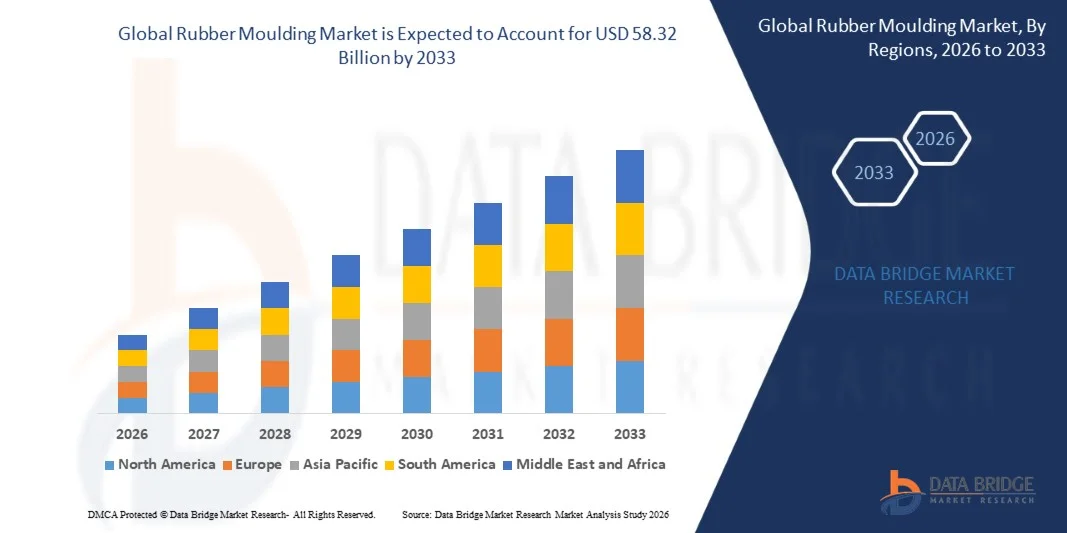
- As per Data Bridge Market Research analysis, the rubber moulding market was valued at USD 40.39 billion in 2025 and is projected to reach USD 58.32 billion by 2033, growing at a CAGR of 4.70% from 2026 to 2033.
- The market is experiencing consistent growth driven by rising demand for lightweight, durable rubber components in automotive manufacturing, rapid advancements in molding technologies, and expanding applications across passenger vehicles, commercial fleets, and electric vehicle platforms.
- The increasing production of electric and hybrid vehicles, combined with stricter government regulations on vehicle emissions and noise, vibration, and harshness (NVH) performance, is compelling automotive OEMs and Tier-1 suppliers to adopt precision-molded rubber components. Injection molding and liquid injection molding are replacing traditional compression molding in many markets, offering higher throughput, dimensional precision, and reduced material waste.
Market Size & Forecast
- Global Market Value (2025): USD 40.39 Billion
- Expected Market Value (2033): USD 58.32 Billion
- Forecast CAGR (2026–2033): 4.70%
- Leading Region in 2025: Asia-Pacific
- Fastest Growing Region: North America
What are the Major Takeaways of the Rubber Moulding Market?
- Asia-Pacific dominated the global rubber moulding market with the largest revenue share of 36.72% in 2025, supported by an expansive automotive manufacturing base, cost-effective labor, and a strong presence of component suppliers across China, India, and Japan.
- North America is expected to be the fastest-growing region at a CAGR of 5.4% from 2026 to 2033, fueled by rising electric vehicle production, reshoring of component manufacturing, and growing investment in advanced molding infrastructure across the U.S. and Mexico.
- The seals segment led the market with a 28.94% share in 2025, driven by widespread use in engine, transmission, and chassis assemblies for leak prevention and NVH reduction.
- The ethylene propylene diene monomer segment is the leading material category with a 38.62% share in 2025, owing to its superior heat, ozone, and weathering resistance, and it is projected to remain central to automotive sealing applications.
- The passenger vehicles segment dominated the vehicle type category with a 44.30% revenue share in 2025, led by automotive OEMs adopting molded rubber components for lightweighting and NVH reduction.
- The injection molding segment is the fastest-growing molding type, projected to register a CAGR of 6.0%, reflecting rising demand for high-precision, high-volume production compatible with automation.
Report Scope and Rubber Moulding Market Segmentation
|
Attributes |
Rubber Moulding Key Market Insights |
|
Segments Covered |
|
|
Countries Covered |
North America
Europe
Asia-Pacific
Middle East and Africa
South America
|
|
Key Market Players |
|
|
Market Opportunities |
|
|
Value Added Data Infosets |
In addition to insights on market value, growth rate, segmentation, geographic coverage, and major players, reports curated by Data Bridge Market Research also include in-depth expert analysis, geographically represented company-wise production and capacity, distributor and partner network layouts, detailed and updated price trend analysis, and deficit analysis of supply and demand. |
What is the Key Trend in the Rubber Moulding Market?
- Automotive manufacturers are increasingly adopting liquid silicone rubber (LSR) and multi-component injection molding to integrate sealing and damping functions into single components, reducing assembly steps and overall vehicle weight.
- Real-time process monitoring enables manufacturers to analyze cure time, mold temperature, and material flow with high precision, improving consistency and reducing scrap rates.
- For instance, in April 2026, Freudenberg Sealing Technologies introduced its new “FACT” surface technology, establishing a cost-efficient, sustainable manufacturing process for elastomer and rubber-to-metal bonding that eliminates the use of wet chemicals.
- As automakers continue to prioritize sustainability, precision, and weight reduction, the integration of digital process monitoring and automation is expected to accelerate, reinforcing molded rubber components as a core enabling technology for next-generation vehicle platforms.
What are the Key Drivers of the Rubber Moulding Market?
- The rapid growth of electric vehicle production has significantly increased demand for high-performance molded rubber components, including battery seals, thermal management gaskets, and cable grommets capable of withstanding extreme temperature and chemical exposure.
- For instance, in June 2026, Trelleborg Sealing Solutions launched a new line of EPDM elastomers for O-rings and engineered molded parts, delivering up to a 55% reduction in product carbon footprint without compromising mechanical performance.
- Automotive OEMs and Tier-1 suppliers are integrating advanced molding processes into their production lines to reduce costs, improve NVH performance, and meet tightening emission and safety regulations.
- For instance, Sumitomo Riko has been expanding its automotive hose and antivibration component production capacity through new plant investments in Vietnam and Japan to meet rising regional demand.
- With the automotive industry increasingly relying on precision-molded rubber for sealing, vibration control, and fluid management, rubber moulding will remain indispensable for both internal combustion and electric vehicle platforms.
Which Factors are Challenging the Growth of the Rubber Moulding Market?
- Rubber moulding operations require significant upfront investment due to the cost of precision tooling, energy-intensive vulcanization and curing systems, and automation infrastructure.
- Volatility in raw material prices, particularly for natural rubber and synthetic elastomers, along with energy-intensive production processes, continues to raise manufacturing costs across the industry.
- For instance, in November 2023, Desma invested in expanding its mold-making operations in Kentucky, U.S., with the division accounting for around 15% of the company's sales, demonstrating the substantial capital investment required to scale advanced molding tooling capacity.
- The high capital investment and recurring operational costs associated with advanced molding systems continue to restrict adoption, particularly among small and medium-sized molders. This cost barrier slows market penetration in price-sensitive and emerging regions, limiting the widespread deployment of advanced molding technologies despite growing demand.
How is the Rubber Moulding Market Segmented?
The rubber moulding market is segmented on the basis of component, vehicle type, molding type, end user, material, application, manufacturing mode, integration & connectivity, deployment and support & services.
- By Component
On the basis of component, the rubber moulding market is segmented into hoses, gaskets, diaphragms, bellows, seals, and weather-strips. The seals segment dominated the market with a 28.94% share in 2025, owing to extensive use across engine, transmission, and chassis assemblies where leak prevention and NVH reduction are critical performance requirements. These components deliver reliable sealing performance across a wide range of operating temperatures, making them the preferred choice for OEMs and Tier-1 suppliers.
The bellows and diaphragms segment is projected to register the fastest growth at a CAGR of 5.9% from 2026 to 2033, driven by rising demand for flexible, durable components in turbocharger, suspension, and electric vehicle thermal management systems.
- By Vehicle Type
On the basis of vehicle type, the rubber moulding market is segmented into passenger vehicles, commercial vehicles, two-wheelers, and off-highway vehicles. The passenger vehicles segment led the market with a 44.30% share in 2025, supported by extensive use of molded rubber seals, gaskets, and mounts across global OEM production lines for lightweighting and NVH reduction.
The two-wheelers segment is expected to experience the fastest growth at a CAGR of 5.6% from 2026 to 2033, driven by rising electric two-wheeler adoption and increasing demand for compact, durable molded components in emerging markets such as India and China.
- By Molding Type
On the basis of molding type, the rubber moulding market is segmented into injection molding, compression molding, transfer molding, and liquid injection molding. The injection molding segment dominated the market with a share of 40.85% in 2025 due to its widespread adoption by automotive OEMs and component manufacturers, increasing demand for high-volume, high-precision production, and growing integration with automated manufacturing lines. additionally, rising focus on production efficiency, dimensional accuracy, and material waste reduction further supports the strong adoption of injection molding solutions.
The liquid injection molding segment is anticipated to witness the fastest CAGR of 6.0% from 2026 to 2033, driven by this growth is fueled by the increasing reliance on liquid silicone rubber for high-precision, contamination-sensitive components used in electric vehicle sealing and connector applications. automotive manufacturers, tier-1 suppliers, and electronics producers are adopting liquid injection molding to conduct cost-effective, repeatable, and high-throughput production. additionally, the integration of automated dosing and real-time process monitoring is enhancing the accuracy and efficiency of liquid injection molding processes, further driving segment growth.
- By End User
On the basis of end user, the rubber moulding market is segmented into automotive OEMs, Tier-1 & Tier-2 suppliers, aftermarket service providers, and industrial & electronics manufacturers. The automotive OEMs segment dominated the market with a share of 46.15% in 2025 due to its critical role in vehicle design, assembly, and validation of sealing, vibration control, and fluid management systems. the widespread adoption of high-precision molding, automated production lines, and stringent quality control for safety-critical components is driving strong demand for molded rubber solutions. additionally, increasing focus on emission compliance, weight reduction, and cost efficiency is reinforcing the dominance of this segment across global markets.
The Tier-1 & Tier-2 suppliers segment is expected to witness the fastest CAGR of 5.3% from 2026 to 2033, driven by the rising need for outsourced, specialized molding capabilities as OEMs increasingly rely on component suppliers for integrated sealing and damping assemblies. additionally, the growing emphasis on just-in-time delivery, regional manufacturing footprints, and cost optimization is further accelerating the adoption of molding capacity among supplier networks.
- By Material
On the basis of material, the rubber moulding market is segmented into ethylene propylene diene monomer (EPDM), natural rubber (NR), styrene-butadiene rubber (SBR), silicone rubber, and others. The EPDM segment dominated the market with a share of 38.62% in 2025 due to its critical role in providing heat, ozone, and weathering resistance for automotive sealing applications. high adoption is driven by the increasing need for durable, long-life components, integration with under-the-hood and exterior sealing systems, and enhanced manufacturing consistency. additionally, growing investment by automotive OEMs, Tier-1 suppliers, and research organizations to improve component durability, thermal stability, and cost efficiency is reinforcing the leading position of this segment in the market.
The silicone rubber segment is expected to witness the fastest CAGR of 6.1% from 2026 to 2033, this growth is driven by increasing demand for high-purity, temperature-resistant materials used in electric vehicle battery sealing and thermal management. advanced material formulations, including flame-retardant and thermally conductive silicone compounds, are improving performance and reliability. additionally, the adoption of these materials in EV powertrains, connectors, and sensor housings is further accelerating market expansion.
- By Application
On the basis of application, the rubber moulding market is segmented into interior, exterior, under-the-hood, and powertrain & chassis. The under-the-hood segment dominated the market with a share of 33.75% in 2025 due to its widespread use in engine, cooling system, and fluid management components that must withstand high temperatures, chemical exposure, and continuous vibration. rising adoption of heat-resistant compounds, integration with turbocharged and hybrid powertrains, and increasing demand for durable sealing solutions is enabling manufacturers to enhance component reliability. additionally, increasing investment by automotive OEMs and Tier-1 suppliers is accelerating adoption and reinforcing this segment's leading position in the market.
The powertrain & chassis segment is expected to witness the fastest CAGR of 5.7% from 2026 to 2033, driven by this growth is driven by the increasing adoption of molded rubber mounts, bushings, and vibration-damping components in electric and hybrid vehicle platforms. these components enhance ride comfort, reduce structural noise, and allow precise vibration control, making molded rubber solutions more efficient and valuable for next-generation vehicle architectures.
- By Manufacturing Mode
On the basis of manufacturing mode, the rubber moulding market is segmented into manual molding, semi-automated molding, and fully automated molding. the fully automated molding segment dominated the market with a share of 47.28% in 2025 due to its widespread adoption in high-volume automotive component production, which requires consistent, repeatable output for precision-critical sealing and vibration-control parts. high adoption is supported by OEMs, Tier-1 suppliers, and contract manufacturers that rely on automated systems to ensure consistency, throughput, and measurable quality outcomes. additionally, increasing integration with robotics, sensor-based inspection, and data analytics enhances process reliability and reinforces the dominance of the fully automated molding segment.
the semi-automated molding segment is expected to witness the fastest CAGR of 6.2% from 2026 to 2033, driven by the growth is primarily driven by the increasing transition of small and mid-sized molders from manual operations toward semi-automated systems that improve consistency without the full capital outlay of fully automated lines. by offering scalable, cost-effective production upgrades, this mode enhances output quality, operational efficiency, and competitiveness, making it highly attractive for regional and contract manufacturers.
- By Integration & Connectivity
On the basis of integration & connectivity, the rubber moulding market is segmented into smart sensor integration, IoT-enabled process monitoring, and Industry 4.0 connectivity. The IoT-enabled process monitoring segment dominated the market with a share of 35.18% in 2025 due to its critical role in enabling real-time tracking of cure time, mold temperature, and material flow, which is essential for automotive OEMs, Tier-1 suppliers, and contract manufacturers. additionally, established partnerships with automation vendors, software providers, and equipment manufacturers are expanding reach, improving accessibility, and reinforcing the adoption of connected molding solutions across the global market.
The smart sensor integration segment is expected to witness the fastest CAGR of 6.4% from 2026 to 2033, driven by this growth is primarily driven by the increasing demand for embedded sensors that enable predictive maintenance and in-process quality verification. manufacturers are leveraging sensor-enabled tooling to enhance yield, reduce scrap, and support advanced driver-assistance and electric vehicle component validation, thereby accelerating adoption across production facilities.
- By Deployment
On the basis of deployment, the rubber moulding market is segmented into in-house manufacturing and outsourced/contract manufacturing. The in-house manufacturing segment dominated the market with a share of 61.47% in 2025 due to its preference among automotive OEMs and large Tier-1 suppliers that require high control over quality, intellectual property, and production scheduling for safety-critical components. additionally, established in-house tooling capabilities, regional plants, and integrated supply chains are facilitating faster production cycles and reinforcing this segment's leading market position.
The outsourced/contract manufacturing segment is expected to witness the fastest CAGR of 5.8% from 2026 to 2033, driven by this growth is primarily driven by the increasing adoption of contract molding to manage capacity fluctuations, reduce capital expenditure, and access specialized tooling expertise. outsourced molding offers scalable, cost-effective production for OEMs and suppliers, while providing advanced quality certification, flexible capacity, and regional manufacturing footprints, enhancing overall supply chain flexibility.
- By Support & Services
On the basis of support & services, the rubber moulding market is segmented into maintenance & retooling, installation & commissioning, quality testing & certification, and consulting services. The maintenance & retooling segment dominated the market with a share of 33.02% in 2025 due to its critical role in ensuring continuous, high-precision operation of molding equipment across automotive OEMs, Tier-1 suppliers, and contract manufacturers. the widespread presence of regional service partners and tooling specialists facilitates faster service delivery and timely mold refurbishment. additionally, collaborations with equipment manufacturers and material suppliers are enhancing accessibility, reliability, and trust, further reinforcing the leading position of this segment.
The quality testing & certification segment is expected to witness the fastest CAGR of 5.9% from 2026 to 2033, driven by this growth is primarily driven by the increasing need for compliance with automotive safety and emission standards. as OEMs and suppliers adopt advanced molded components, ongoing testing and certification become essential for validating material performance, extending component lifespan, and supporting integration with electric vehicle and ADAS systems.
Which Region Holds the Largest Share of the Rubber Moulding Market?
- Asia-Pacific dominated the rubber moulding market and accounted for the largest revenue share of 36.72% in 2025, supported by an extensive automotive manufacturing base, cost-effective labor availability, and the presence of established component suppliers across China, India, and Japan.
- The region also benefits from expanding electric vehicle production, growing Tier-1 and Tier-2 supplier networks, and increasing government support for domestic automotive manufacturing. Rising investment in automation and precision molding technologies continues to strengthen Asia-Pacific's leadership position in the global market.
China Rubber Moulding Market Insight
The China rubber moulding market is experiencing steady growth, supported by the country's large automotive production base, expanding electric vehicle manufacturing, and increasing adoption of precision molding technologies. Rising investments in automated production lines and growing demand for cost-effective, high-volume component manufacturing are contributing to market growth. Furthermore, integration of smart sensors and digital process monitoring is improving production efficiency, positioning China as a key manufacturing hub in the rubber moulding industry.
India Rubber Moulding Market Insight
The India rubber moulding market is expanding steadily due to the country's growing automotive manufacturing sector, rising two-wheeler and passenger vehicle production, and increasing adoption of next-generation molding technologies. Component manufacturers and Tier-1 suppliers are increasingly investing in automated molding capacity to meet rising domestic and export demand. Continuous advancements in material formulations and growing government focus on domestic manufacturing are further driving market growth in India.
North America Rubber Moulding Market Insight
The North America rubber moulding market is expected to witness the fastest growth globally, driven by rising electric vehicle production, reshoring of component manufacturing, and increasing investment in automated molding infrastructure across the U.S., Canada, and Mexico. Growing awareness regarding sustainable material sourcing, rising adoption of advanced molding technologies, and increasing demand for scalable, cost-effective production solutions are supporting regional market expansion. Additionally, the growing presence of automotive R&D centers and Tier-1 supplier facilities is accelerating molding capacity investment across the region.
U.S. Rubber Moulding Market Insight
The U.S. rubber moulding market is witnessing consistent growth due to rising investments in advanced molding technologies, expanding electric vehicle manufacturing, and reshoring initiatives across the automotive supply chain. Automotive OEMs, Tier-1 suppliers, and specialized molders are increasingly adopting high-precision molding equipment for component production, testing, and validation. Moreover, increasing integration of automation and the country's focus on efficient, resilient supply chains are further contributing to market growth.
Mexico Rubber Moulding Market Insight
The Mexico rubber moulding market is growing rapidly, driven by expanding automotive assembly operations, rising nearshoring of component manufacturing, and increasing government focus on industrial development. Growing adoption of automated molding platforms across OEM-adjacent supplier parks is significantly boosting market demand. In addition, rising investments from global Tier-1 suppliers and increasing integration into North American automotive supply chains are positioning Mexico as one of the fastest-growing markets for rubber moulding globally.
Which are the Top Companies in the Rubber Moulding Market?
The rubber moulding industry is primarily led by well-established companies, including:
- Trelleborg AB (Sweden)
- Hutchinson SA (France)
- Continental AG / ContiTech (Germany)
- Cooper Standard Holdings Inc. (U.S.)
- Sumitomo Riko Company Limited (Japan)
- NOK Corporation (Japan)
- Toyoda Gosei Co., Ltd. (Japan)
- Tenneco Inc. (U.S.)
- Freudenberg Sealing Technologies (Germany)
- Dana Incorporated (U.S.)
- SKF (Sweden)
- Parker Hannifin Corporation (U.S.)
- ElringKlinger AG (Germany)
- Datwyler Holding AG (Switzerland)
- Minnesota Rubber and Plastics (U.S.)
- Mason Rubber Company, Inc. (U.S.)
- Federal-Mogul / FST (U.S.)
- Pierce-Roberts Rubber Co. (U.S.)
- RD Rubber Technology Corporation (U.S.)
- National Rubber (Singapore)
- Steele Rubber Products (U.S.)
- REDCO (U.S.)
- Bohra Rubber Pvt. Ltd. (India)
- Accurate Products (U.S.)
- Britech Industries (U.S.)
- The Yokohama Rubber Co., Ltd. (Japan)
- Nishikawa Rubber Co., Ltd. (Japan)
- Hebei Shida Seal Group Co., Ltd. (China)
- ALP Group (China)
What are Latest Developments in the Rubber Moulding Market?
- In June 2026, Trelleborg Sealing Solutions launched a new line of EPDM elastomers for O-rings and engineered molded parts. The compounds deliver up to a 55% reduction in product carbon footprint without compromising mechanical performance, reflecting Trelleborg's continued investment in sustainable sealing materials for demanding automotive applications.
- In April 2026, Freudenberg Sealing Technologies introduced its new “FACT” surface technology, establishing a cost-efficient, sustainable manufacturing process for elastomer and rubber-to-metal bonding that eliminates the use of wet chemicals. This development strengthens Freudenberg's position in the automotive sealing segment by improving process sustainability while maintaining bonding performance.
- In April 2025, Trelleborg Group acquired Aero-Plastics Inc., a U.S.-based high-performance plastics and aerospace interior solutions provider that generated approximately SEK 150 million in sales in 2024. This acquisition broadens Trelleborg's engineered polymer portfolio and reinforces its strategy of expanding into adjacent, high-precision molding applications.
- Sumitomo Riko has continued to expand its automotive component production capacity, including a new antivibration systems facility in Japan and an automotive hose plant in Vietnam, strengthening its regional manufacturing footprint to meet rising demand from automotive OEMs.
- In November 2023, Desma invested in the expansion of its mold-making operations in Kentucky, U.S. Desma USA's mold-making division accounted for around 15% of the company's sales, demonstrating consistent growth in demand for advanced rubber molding tooling within North America.

- Interactive Data Analysis Dashboard
- Company Analysis Dashboard for high growth potential opportunities
- Research Analyst Access for customization & queries
- Competitor Analysis with Interactive dashboard
- Latest News, Updates & Trend analysis
- Harness the Power of Benchmark Analysis for Comprehensive Competitor Tracking
Data collection and base year analysis are done using data collection modules with large sample sizes. The stage includes obtaining market information or related data through various sources and strategies. It includes examining and planning all the data acquired from the past in advance. It likewise envelops the examination of information inconsistencies seen across different information sources. The market data is analysed and estimated using market statistical and coherent models. Also, market share analysis and key trend analysis are the major success factors in the market report. To know more, please request an analyst call or drop down your inquiry.
The key research methodology used by DBMR research team is data triangulation which involves data mining, analysis of the impact of data variables on the market and primary (industry expert) validation. Data models include Vendor Positioning Grid, Market Time Line Analysis, Market Overview and Guide, Company Positioning Grid, Patent Analysis, Pricing Analysis, Company Market Share Analysis, Standards of Measurement, Global versus Regional and Vendor Share Analysis. To know more about the research methodology, drop in an inquiry to speak to our industry experts.
Data Bridge Market Research is a leader in advanced formative research. We take pride in servicing our existing and new customers with data and analysis that match and suits their goal. The report can be customized to include price trend analysis of target brands understanding the market for additional countries (ask for the list of countries), clinical trial results data, literature review, refurbished market and product base analysis. Market analysis of target competitors can be analyzed from technology-based analysis to market portfolio strategies. We can add as many competitors that you require data about in the format and data style you are looking for. Our team of analysts can also provide you data in crude raw excel files pivot tables (Fact book) or can assist you in creating presentations from the data sets available in the report.













