


What is the Restaurant Point of Sale (POS) Software Market Size and Growth Rate?
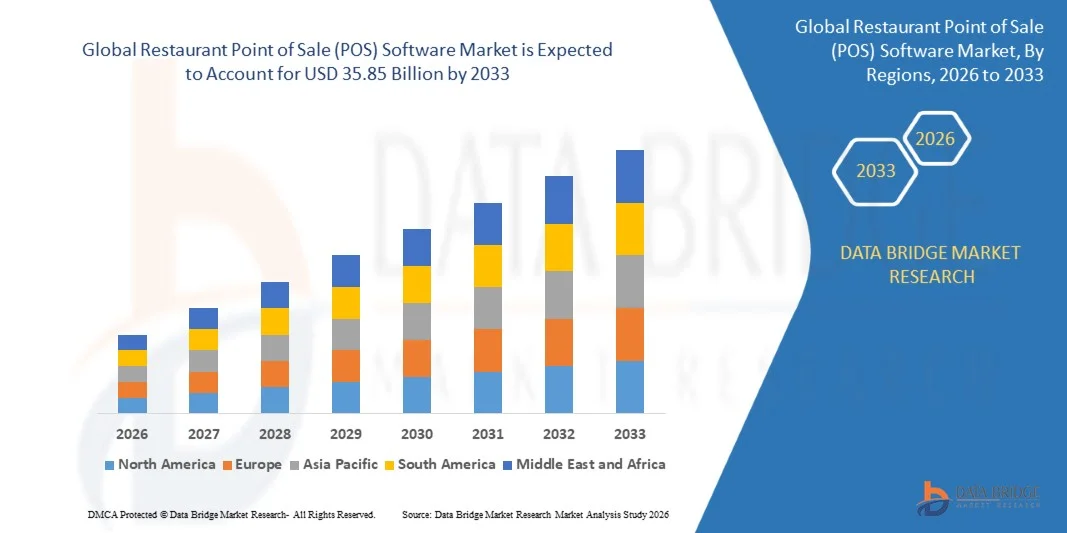
- As per Data Bridge Market Research Analysis the global restaurant point of sale (POS) software market size was valued at USD 20.26 billion in 2025 and is expected to reach USD 35.85 billion by 2033, at a CAGR of 7.40% during the forecast period
- The market growth is largely fuelled by the increasing digital transformation of foodservice operations, rising adoption of cloud-based restaurant management solutions, and growing demand for streamlined billing, inventory management, and customer engagement systems
- Expanding quick-service restaurants, full-service dining chains, and food delivery ecosystems are significantly accelerating demand for advanced POS software that enhances operational efficiency, order accuracy, and omnichannel service integration
Market Size & Forecast
- Global Market Value (2025): USD 20.26 billion
- Expected Market Value (2033): USD 35.85 billion
- Forecast CAGR (2026–2033): 7.40%
What are the Major Takeaways of Restaurant Point of Sale (POS) Software Market ?
- Restaurant POS software is becoming increasingly essential for modern foodservice businesses due to its ability to optimize transaction processing, improve inventory visibility, support customer loyalty programs, and enhance overall operational productivity across dine-in, takeaway, and delivery channels
- Growing investments in AI-powered analytics, cloud infrastructure, integrated payment ecosystems, and digital customer experience platforms are encouraging widespread deployment of advanced restaurant POS systems, supporting long-term innovation, scalability, and competitive differentiation across the global foodservice industry
- North America dominated the restaurant point of sale (POS) software market with the largest revenue share in 2025, driven by the widespread adoption of digital payment solutions, increasing demand for operational efficiency, and the growing presence of advanced restaurant chains across the region
- Asia-Pacific region is expected to witness the highest growth rate in the global restaurant point of sale (POS) software market, driven by rapid urbanization, rising disposable incomes, expanding food delivery ecosystems, increasing adoption of digital payment technologies, and the growing number of restaurants embracing automation and cloud-based operational systems
- The software segment held the largest market revenue share in 2025 driven by the increasing demand for advanced digital solutions that streamline restaurant operations, including billing, order management, customer relationship management, and analytics. Software platforms are essential for improving operational efficiency, enhancing customer experience, and integrating multiple restaurant functions into a centralized system. The growing adoption of AI-powered analytics, loyalty program management, and cloud-based software platforms has further strengthened software dominance. Restaurants increasingly rely on software solutions to manage both front-end customer interactions and back-end operational workflows efficiently
Report Scope and Restaurant Point of Sale (POS) Software Market Segmentation
Attributes |
Restaurant Point of Sale (POS) Software Key Market Insights |
|
Segments Covered |
|
|
Countries Covered |
North America
Europe
Asia-Pacific
Middle East and Africa
South America
|
|
Key Market Players |
|
|
Market Opportunities |
|
|
Value Added Data Infosets |
In addition to the market insights such as market value, growth rate, market segments, geographical coverage, market players, and market scenario, the market report curated by the Data Bridge Market Research team includes in-depth expert analysis, import/export analysis, pricing analysis, production consumption analysis, and pestle analysis. |
What is the Key Trend in the Restaurant Point of Sale (POS) Software Market ?
“Rising Demand for Digitalized Restaurant Operations and Omnichannel Customer Experience”
• The growing focus on operational efficiency, digital transformation, and seamless customer service is significantly shaping the restaurant point of sale (POS) software market, as restaurants increasingly seek advanced software solutions that streamline transactions, inventory management, workforce scheduling, and customer engagement. POS software is gaining traction due to its ability to centralize restaurant operations, improve order accuracy, and enhance business intelligence without compromising service quality. This trend is accelerating adoption across quick-service restaurants, full-service establishments, cafes, and hospitality chains
• Increasing consumer demand for contactless payments, online ordering, self-service kiosks, and integrated loyalty programs has accelerated the adoption of restaurant POS software across global foodservice ecosystems. Restaurant operators are actively prioritizing cloud-based and mobile-enabled POS platforms to support evolving consumer preferences, improve convenience, and optimize omnichannel operations
• Digital transformation and data-driven management trends are influencing purchasing decisions, with restaurant operators emphasizing real-time analytics, flexible deployment, third-party delivery integration, and scalable software ecosystems. These factors are helping POS providers differentiate products in a highly competitive market while also driving strategic collaborations between software developers, payment processors, and foodservice operators
• For instance, in 2024, Toast in the U.S. and Lightspeed in Canada expanded their restaurant POS software portfolios by introducing AI-powered analytics, enhanced delivery integrations, and advanced customer relationship management capabilities. These launches were introduced in response to rising demand for streamlined digital restaurant management, broader payment flexibility, and improved customer retention strategies, strengthening recurring subscription revenues and customer loyalty
• While demand for restaurant POS software is growing, sustained market expansion depends on continuous software innovation, cybersecurity enhancements, cost optimization, and integration flexibility. Providers are also focusing on improving mobile accessibility, automation capabilities, and international scalability to support broader market penetration
Restaurant Point of Sale (POS) Software Market Dynamics
Driver
“Growing Adoption of Cloud-Based Restaurant Management and Digital Payment Solutions”
• Rising digitalization across the foodservice industry is a major driver for the restaurant POS software market. Restaurant operators are increasingly replacing traditional cash registers and fragmented management tools with integrated POS systems to improve operational visibility, payment processing, inventory management, and customer experience
• Expanding applications in quick-service restaurants, fine dining, food trucks, ghost kitchens, and franchise operations are significantly influencing market growth. POS software helps businesses optimize workflows, reduce manual errors, and support omnichannel service models while maintaining operational efficiency and customer satisfaction
• POS software providers and restaurant operators are actively promoting digital transformation through cloud innovation, AI-powered analytics, mobile payment integration, and customer loyalty platforms. These efforts are supported by growing consumer preference for convenience, speed, and personalized service experiences
• For instance, in 2023, Square in the U.S. and Oracle MICROS in the U.S. reported expanded deployment of cloud-based restaurant POS platforms across hospitality and foodservice businesses. This growth followed increasing demand for flexible management tools, integrated payment systems, and enhanced operational intelligence, strengthening competitive differentiation and recurring software revenues
• Although digital transformation trends support growth, broader adoption depends on affordability, user training, reliable connectivity, and integration with evolving restaurant technologies. Investment in cybersecurity, software flexibility, and operational support will be critical for sustaining competitive advantage
Restraint/Challenge
“High Implementation Costs and Integration Complexity for Independent Operators”
• The relatively high upfront investment associated with advanced POS software deployment remains a key challenge, particularly for small and independent restaurant operators. Subscription fees, hardware upgrades, integration requirements, and employee training can create financial barriers to adoption
• Restaurant owner awareness and technological readiness remain uneven, particularly in emerging markets where digital transformation is still developing. Limited understanding of advanced software benefits may restrict adoption among traditional foodservice businesses and smaller establishments
• Integration complexity with third-party delivery services, payment gateways, inventory systems, and customer relationship management platforms also impacts market growth. Restaurants require seamless interoperability, secure data handling, and reliable performance to maximize software value
• For instance, in 2024, independent restaurant operators across Southeast Asia and Latin America reported slower adoption of premium restaurant POS software due to cost concerns, technical complexity, and limited digital infrastructure. Subscription pricing pressures and implementation challenges were additional barriers affecting widespread deployment
• Overcoming these challenges will require cost-efficient pricing models, simplified implementation processes, expanded educational initiatives, and stronger technical support frameworks. Collaboration between software providers, payment companies, and restaurant operators can help unlock the long-term growth potential of the global restaurant POS software market while ensuring scalability, accessibility, and operational efficiency
How is the Restaurant Point of Sale (POS) Software Market Segmented ?
The market is segmented on the basis of component, type, operating system, usage, application, enterprise size, deployment mode, and restaurant type
• By Component
On the basis of component, the global restaurant point of sale (POS) software market is segmented into Software, Hardware, and Services. The software segment held the largest market revenue share in 2025 driven by the increasing demand for advanced digital solutions that streamline restaurant operations, including billing, order management, customer relationship management, and analytics. Software platforms are essential for improving operational efficiency, enhancing customer experience, and integrating multiple restaurant functions into a centralized system. The growing adoption of AI-powered analytics, loyalty program management, and cloud-based software platforms has further strengthened software dominance. Restaurants increasingly rely on software solutions to manage both front-end customer interactions and back-end operational workflows efficiently.
The services segment is expected to witness the fastest growth rate from 2026 to 2033, driven by the growing need for implementation, customization, technical support, and maintenance services as restaurants increasingly adopt sophisticated POS solutions. Service providers play a crucial role in ensuring seamless deployment, regular updates, and optimal system performance for restaurant businesses. Rising demand for employee training, software upgrades, and cybersecurity services is also contributing to segment expansion. As restaurant businesses seek tailored POS ecosystems, service offerings are becoming increasingly valuable
• By Type
On the basis of type, the global restaurant point of sale (POS) software market is segmented into Terminal POS System, Tablet POS System, Mobile POS System, Online POS System, Self-Service Kiosk POS System, and Others. The terminal POS system segment held the largest market revenue share in 2025 driven by its widespread use in established restaurants due to its reliability, comprehensive features, and ability to handle high transaction volumes. These systems are commonly preferred by large and full-service restaurants for robust operational management. Their advanced integrations with kitchen displays, payment gateways, and inventory systems contribute significantly to operational stability. Traditional terminal systems remain a preferred choice where consistent performance and durability are critical.
The mobile POS system segment is expected to witness the fastest growth rate from 2026 to 2033, driven by increasing demand for flexibility, tableside ordering, and portable payment processing. Mobile POS systems enhance customer service speed and operational convenience, particularly in quick service and small restaurant environments. The rise of smartphone and tablet adoption, along with wireless payment technologies, is accelerating mobile POS demand. Their affordability and scalability make them highly attractive for modern restaurants seeking agile solutions
• By Operating System
On the basis of operating system, the global restaurant point of sale (POS) software market is segmented into Android, MAC, DOS System, Windows System, and Linux System. The Windows system segment held the largest market revenue share in 2025 driven by its long-standing presence, extensive software compatibility, and widespread adoption across traditional restaurant POS infrastructures. Windows-based systems are valued for their robust performance and broad support capabilities. Many enterprise-grade restaurant POS providers continue to prioritize Windows platforms due to established infrastructure and security frameworks. This segment also benefits from familiarity among restaurant operators and IT teams.
The Android segment is expected to witness the fastest growth rate from 2026 to 2033, driven by the rising popularity of cost-effective, user-friendly, and highly customizable Android-based POS devices. Android systems offer flexibility and affordability, making them increasingly attractive to small and medium-sized restaurant operators. Their compatibility with a broad range of devices and applications supports innovation and customization. Increasing availability of Android-based self-service kiosks and handheld devices further boosts market growth
• By Usage
On the basis of usage, the global restaurant point of sale (POS) software market is segmented into Online and Offline. The online segment held the largest market revenue share in 2025 driven by increasing cloud adoption, real-time data synchronization, remote management capabilities, and seamless integration with online ordering and delivery platforms. Online POS systems provide restaurants with greater scalability and operational visibility. These systems enable business owners to access sales reports, monitor performance, and manage multiple locations remotely. Growing consumer preference for digital ordering and omnichannel experiences has reinforced online segment leadership.
The online segment is also expected to witness the fastest growth rate from 2026 to 2033, driven by continuous digital transformation, growing internet penetration, and increasing consumer preference for connected dining experiences. The expansion of food delivery ecosystems and digital payment infrastructure further accelerates adoption. Restaurants are increasingly investing in online systems to remain competitive in an evolving digital marketplace
• By Application
On the basis of application, the global restaurant point of sale (POS) software market is segmented into Inventory Management, Employee Clocking, Tablet Compatibility, Receipt Printing, Menu Building, Accounting Integration, Credit/Debit Card Processing, and Others. The credit/debit card processing segment held the largest market revenue share in 2025 driven by the increasing shift toward cashless transactions, secure payment systems, and consumer demand for fast, convenient payment options. Payment processing remains a core functionality of restaurant POS systems. Integration with contactless payment, digital wallets, and fraud prevention tools has further strengthened this segment. Restaurants increasingly prioritize secure and seamless payment experiences to improve customer satisfaction.
The inventory management segment is expected to witness the fastest growth rate from 2026 to 2033, driven by restaurants’ growing focus on cost control, waste reduction, and supply chain optimization through automated inventory tracking solutions. Real-time stock visibility and predictive purchasing capabilities are improving operational efficiency. This segment is benefiting from increasing awareness regarding food cost management and profitability enhancement
• By Enterprise Size
On the basis of enterprise size, the global restaurant point of sale (POS) software market is segmented into Large Enterprises and SME’s. The large enterprises segment held the largest market revenue share in 2025 driven by higher technology budgets, complex operational requirements, and widespread deployment across multiple restaurant locations. Large restaurant chains prioritize advanced POS systems to ensure consistency and scalability. Their need for centralized management, customer data analytics, and enterprise-wide operational efficiency supports strong segment dominance. Large enterprises are also more likely to invest in premium integrated POS ecosystems.
The SME’s segment is expected to witness the fastest growth rate from 2026 to 2033, driven by increasing digitalization among independent restaurants and small chains seeking affordable, cloud-based POS solutions to enhance efficiency and competitiveness. Lower subscription costs and flexible deployment models are improving accessibility for SMEs. Government support for small business digital transformation in various markets is also supporting growth
• By Deployment Mode
On the basis of deployment mode, the global restaurant point of sale (POS) software market is segmented into Cloud and On-Premise. The cloud segment held the largest market revenue share in 2025 driven by its scalability, lower upfront costs, remote accessibility, and ease of software updates. Cloud-based deployment has become increasingly popular among restaurants seeking operational flexibility. Restaurants benefit from automatic updates, reduced IT maintenance, and seamless integration with digital platforms. The subscription-based model also improves affordability and business continuity.
The cloud segment is also expected to witness the fastest growth rate from 2026 to 2033, driven by ongoing advancements in cloud security, integration capabilities, and increasing demand for subscription-based software models. Enhanced data backup, disaster recovery, and multi-location management features are contributing to stronger adoption. The shift toward digital-first restaurant ecosystems is expected to sustain long-term cloud growth
• By Restaurant Type
On the basis of restaurant type, the global restaurant point of sale (POS) software market is segmented into Full-Service Restaurants (FSR) and Quick Service Restaurants (QSR). The quick service restaurants (QSR) segment held the largest market revenue share in 2025 driven by high transaction volumes, rapid service requirements, and the widespread need for efficient order management systems. POS solutions are essential in QSR environments to maintain speed and customer satisfaction. Integration with drive-thru, self-service kiosks, and delivery applications further supports QSR segment leadership. The global expansion of fast-food chains continues to drive POS investments in this category.
The full-service restaurants (FSR) segment is expected to witness the fastest growth rate from 2026 to 2033, driven by increasing adoption of advanced POS features such as tableside ordering, reservation integration, and enhanced customer engagement tools. FSR operators are increasingly focusing on personalized dining experiences and operational sophistication. The demand for premium service quality and customer retention strategies is accelerating advanced POS adoption in this segment.
Which Region Holds the Restaurant Point of Sale (POS) Software Market ?
• North America dominated the restaurant point of sale (POS) software market with the largest revenue share in 2025, driven by the widespread adoption of digital payment solutions, increasing demand for operational efficiency, and the growing presence of advanced restaurant chains across the region
• Restaurants in the region highly value the convenience, real-time analytics, inventory management, and seamless integration offered by POS software with online ordering platforms, customer loyalty programs, and third-party delivery services
• This widespread adoption is further supported by strong technological infrastructure, high consumer preference for cashless transactions, and increasing investment in cloud-based solutions, establishing restaurant POS software as an essential operational tool for both quick service and full-service establishments
U.S. Restaurant Point of Sale (POS) Software Market Insight
The U.S. restaurant point of sale (POS) software market captured the largest revenue share in 2025 within North America, fueled by the rapid expansion of digital dining technologies and the increasing focus on improving customer experiences. Restaurant operators are increasingly prioritizing advanced POS systems to streamline order processing, payment management, and customer engagement. The strong presence of major POS software providers, rising adoption of mobile and self-service technologies, and growing integration with delivery platforms significantly contribute to market growth. Moreover, increasing demand for data-driven decision-making and operational automation is accelerating POS software deployment across the country.
Europe Restaurant Point of Sale (POS) Software Market Insight
The Europe restaurant point of sale (POS) software market is expected to witness the fastest growth rate from 2026 to 2033, primarily driven by increasing digital transformation across the hospitality industry and the growing demand for efficient restaurant management solutions. The region’s emphasis on regulatory compliance, secure payment systems, and customer service excellence is fostering market expansion. European restaurants are increasingly adopting cloud-based and mobile POS platforms to improve operational flexibility. In addition, the growth of online food delivery and reservation systems is further strengthening POS software adoption across multiple restaurant formats.
U.K. Restaurant Point of Sale (POS) Software Market Insight
The U.K. restaurant point of sale (POS) software market is expected to witness the fastest growth rate from 2026 to 2033, driven by the growing trend of restaurant digitalization, rising consumer preference for contactless payments, and increasing operational demands for efficiency. Restaurant operators are investing heavily in modern POS technologies to improve customer convenience and streamline front- and back-end operations. The country’s advanced retail and e-commerce infrastructure, combined with strong adoption of cloud technologies, is expected to continue stimulating market growth.
Germany Restaurant Point of Sale (POS) Software Market Insight
The Germany restaurant point of sale (POS) software market is expected to witness the fastest growth rate from 2026 to 2033, fueled by increasing awareness of digital business management solutions and rising demand for secure, high-performance POS systems. Germany’s strong hospitality sector, advanced technological ecosystem, and focus on operational precision are driving software adoption. Restaurants are increasingly integrating POS solutions with accounting, inventory, and customer relationship systems. The demand for efficiency, compliance, and data security strongly aligns with Germany’s business environment.
Asia-Pacific Restaurant Point of Sale (POS) Software Market Insight
The Asia-Pacific restaurant point of sale (POS) software market is expected to witness the fastest growth rate from 2026 to 2033, driven by rapid urbanization, increasing disposable incomes, and expanding foodservice industries across countries such as China, Japan, and India. The region’s growing adoption of digital payment systems, cloud technologies, and online food delivery services is accelerating POS software demand. Government-led digitalization initiatives and the rising number of quick service restaurants are further strengthening market growth. In addition, increasing affordability of software solutions is expanding adoption among small and medium-sized restaurants.
Japan Restaurant Point of Sale (POS) Software Market Insight
The Japan restaurant point of sale (POS) software market is expected to witness the fastest growth rate from 2026 to 2033 due to the country’s strong technological advancement, growing demand for automation, and emphasis on operational precision. Japanese restaurants are increasingly adopting advanced POS platforms to enhance customer service, improve inventory management, and streamline payment processing. The integration of AI, robotics, and self-service kiosks within restaurant environments is fueling software demand. Moreover, Japan’s focus on convenience and efficiency continues to support widespread adoption across both quick service and full-service sectors.
China Restaurant Point of Sale (POS) Software Market Insight
The China restaurant point of sale (POS) software market accounted for the largest market revenue share in Asia Pacific in 2025, attributed to the country’s rapidly growing foodservice industry, widespread digital payment adoption, and expanding urban consumer base. China represents one of the largest restaurant technology markets globally, with strong demand for integrated POS solutions across chain restaurants, independent eateries, and delivery-focused businesses. The rise of smart city initiatives, domestic software innovation, and highly competitive restaurant markets are major factors propelling POS software adoption throughout the country.
Which are the Top Companies in Restaurant Point of Sale (POS) Software Market ?
The Restaurant Point of Sale (POS) Software industry is primarily led by well-established companies, including:
- Oracle (U.S.)
- Infor. (U.S.)
- Toshiba Tec Corporation (Japan)
- NCR Corporation (U.S.)
- Toast, Inc. (U.S.)
- SpotOn Transact, LLC (U.S.)
- Clover Network, Inc. (U.S.)
- Epos Now (U.K.)
- eZee BurrP! (India)
- Future POS. (U.S.)
- Global Retail Technology Limited. (U.K.)
- Guest Innovations, Inc. (U.S.)
- Kitchen CUT Limited (U.K.)
- LAVU, Inc. (U.S.)
- Lightspeed Management Company, L.L.C. (U.S.)
- LimeTray. (India)
- Loyverse (U.S.)
- Mad Mobile. (U.S.)
- PAR Tech (U.S.)
- POSitouch (U.S.)

- Interactive Data Analysis Dashboard
- Company Analysis Dashboard for high growth potential opportunities
- Research Analyst Access for customization & queries
- Competitor Analysis with Interactive dashboard
- Latest News, Updates & Trend analysis
- Harness the Power of Benchmark Analysis for Comprehensive Competitor Tracking
Data collection and base year analysis are done using data collection modules with large sample sizes. The stage includes obtaining market information or related data through various sources and strategies. It includes examining and planning all the data acquired from the past in advance. It likewise envelops the examination of information inconsistencies seen across different information sources. The market data is analysed and estimated using market statistical and coherent models. Also, market share analysis and key trend analysis are the major success factors in the market report. To know more, please request an analyst call or drop down your inquiry.
The key research methodology used by DBMR research team is data triangulation which involves data mining, analysis of the impact of data variables on the market and primary (industry expert) validation. Data models include Vendor Positioning Grid, Market Time Line Analysis, Market Overview and Guide, Company Positioning Grid, Patent Analysis, Pricing Analysis, Company Market Share Analysis, Standards of Measurement, Global versus Regional and Vendor Share Analysis. To know more about the research methodology, drop in an inquiry to speak to our industry experts.
Data Bridge Market Research is a leader in advanced formative research. We take pride in servicing our existing and new customers with data and analysis that match and suits their goal. The report can be customized to include price trend analysis of target brands understanding the market for additional countries (ask for the list of countries), clinical trial results data, literature review, refurbished market and product base analysis. Market analysis of target competitors can be analyzed from technology-based analysis to market portfolio strategies. We can add as many competitors that you require data about in the format and data style you are looking for. Our team of analysts can also provide you data in crude raw excel files pivot tables (Fact book) or can assist you in creating presentations from the data sets available in the report.













