Global Primary Cells Market
Market Size in USD Billion
CAGR :
% 
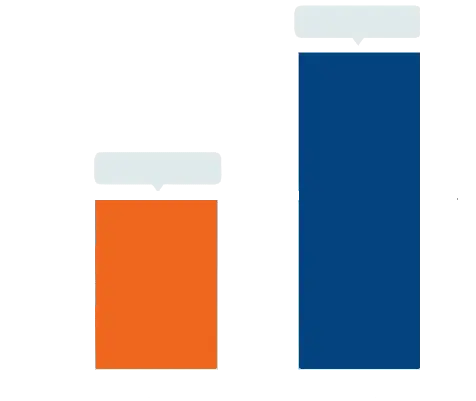 USD
1.90 Billion
USD
4.47 Billion
2025
2033
USD
1.90 Billion
USD
4.47 Billion
2025
2033
 Forecast Period Forecast Period |
2026 –2033 |
 Market Size (Base Year) Market Size (Base Year) |
USD 1.90 Billion |
 Market Size (Forecast Year) Market Size (Forecast Year) |
USD 4.47 Billion |
 CAGR CAGR |
% |
| Major Markets Players |
|
Primary Cells Market Size
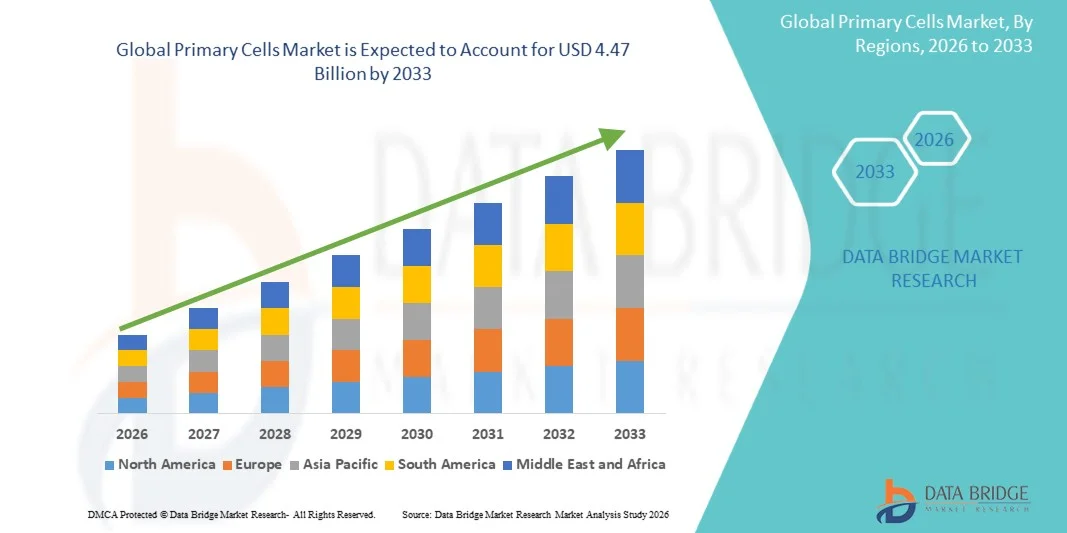
- The global primary cells market size was valued at USD 1.90 billion in 2025 and is expected to reach USD 4.47 billion by 2033, at a CAGR of 11.30% during the forecast period
- The market growth is primarily driven by the expanding demand for portable electronic devices, including remote controls, medical devices, and wearable technology, which rely heavily on reliable and long-lasting primary cells
- In addition, increasing adoption of energy-efficient and low-maintenance power sources across various industrial and consumer applications is fueling the demand for primary cells. These combined factors are promoting widespread usage and technological advancements, thereby propelling the market’s growth
Primary Cells Market Analysis
- Primary cells, providing non-rechargeable power for a wide range of devices, are increasingly essential in modern consumer electronics, medical devices, and industrial applications due to their reliability, long shelf life, and low maintenance requirements
- The growing demand for primary cells is largely driven by the proliferation of portable electronic devices, rising need for backup and emergency power solutions, and the preference for compact, high-energy-density power sources in remote or off-grid applications
- North America dominated the primary cells market with the largest revenue share of 40.2% in 2025, characterized by early adoption of advanced electronics, high consumption of medical and industrial devices, and a strong presence of key industry players, with the U.S. leading in both production and adoption of primary cells across consumer, medical, and industrial sectors
- Asia-Pacific is expected to be the fastest-growing region in the primary cells market during the forecast period due to increasing urbanization, rising disposable incomes, and expanding consumer electronics and industrial sectors
- Human primary cells segment dominated the market with a share of 46.5% in 2025, driven by their widespread use in life science research, drug discovery, and regenerative medicine applications
Report Scope and Primary Cells Market Segmentation
|
Attributes |
Primary Cells Key Market Insights |
|
Segments Covered |
|
|
Countries Covered |
North America
Europe
Asia-Pacific
Middle East and Africa
South America
|
|
Key Market Players |
|
|
Market Opportunities |
|
|
Value Added Data Infosets |
In addition to the insights on market scenarios such as market value, growth rate, segmentation, geographical coverage, and major players, the market reports curated by the Data Bridge Market Research also include in-depth expert analysis, patient epidemiology, pipeline analysis, pricing analysis, and regulatory framework |
Primary Cells Market Trends
“Increasing Focus on Human Primary Cells for Advanced Research”
- A notable trend in the global primary cells market is the growing emphasis on human primary cells for applications in regenerative medicine, drug discovery, and personalized therapies, driven by their ability to closely mimic in vivo conditions
- For instance, human liver and hematopoietic cells are increasingly being used in preclinical studies to assess drug toxicity and efficacy, offering more accurate insights than traditional cell lines
- Advancements in cell isolation and preservation technologies are enabling longer shelf life and higher viability of primary cells, supporting complex experimental designs and repeated testing
- The integration of primary cells with 3D culture systems, organ-on-a-chip platforms, and high-throughput screening methods is enhancing their utility in life sciences research, allowing more predictive and physiologically relevant results
- This trend towards more sophisticated and application-specific use of primary cells is shaping research methodologies, prompting companies such as Lonza and Thermo Fisher Scientific to expand their human primary cell portfolios
- The growing demand for high-quality, authenticated human primary cells is rising rapidly across pharmaceutical, biotech, and academic research sectors as scientists seek more reliable and translational models
- Growing interest in genetically modified primary cells for targeted research and therapeutic applications is driving innovation and specialized product development in the market
Primary Cells Market Dynamics
Driver
“Rising Demand from Life Science Research and Pharmaceutical Applications”
- The expanding use of primary cells in drug discovery, toxicity testing, and regenerative medicine is a key driver fueling market growth
- For instance, in March 2025, Thermo Fisher Scientific launched an expanded portfolio of human primary cells optimized for 3D culture and organoid models, aimed at accelerating research productivity
- Primary cells provide physiologically relevant models that improve experimental accuracy and reduce reliance on animal testing, appealing to research institutes and pharmaceutical companies alike
- Furthermore, increasing investment in biomedical research and the development of personalized medicine are making primary cells indispensable in modern laboratories
- The ability to use human and animal primary cells in diverse applications, from stem cell research to disease modeling, is significantly boosting adoption across life science research companies and academic institutions
- Rising collaborations between primary cell suppliers and pharmaceutical companies to provide customized solutions for drug testing are accelerating market growth
- Technological advancements enabling high-throughput primary cell screening are further driving adoption and expanding market opportunities
Restraint/Challenge
“High Cost and Limited Shelf Life Constraints”
- The relatively high cost of sourcing, processing, and maintaining primary cells, coupled with their limited viability outside controlled conditions, presents a significant challenge to broader market adoption
- For instance, human hepatocytes and hematopoietic cells often require cryopreservation and specialized handling, increasing operational expenses for laboratories and research facilities
- Sensitivity to environmental conditions, batch-to-batch variability, and strict regulatory standards for sourcing human and animal cells can hinder large-scale deployment in research and commercial applications
- In addition, logistical challenges associated with shipping and storing live primary cells safely can limit accessibility for smaller institutions or emerging markets
- Overcoming these constraints through improved preservation techniques, standardized quality control, and cost-effective solutions is crucial for expanding market penetration and supporting the growing global demand for primary cells
- Ethical and regulatory complexities surrounding the use of human primary cells may slow approvals and limit supply for research purposes
- Dependence on skilled personnel for proper handling and experimentation adds operational challenges, particularly for smaller laboratories with limited expertise
Primary Cells Market Scope
The market is segmented on the basis of type, origin, and end user.
- By Type
On the basis of type, the global primary cells market is segmented into human primary cells, animal primary cells, and others. The human primary cells segment dominated the market with the largest revenue share of 46.5% in 2025, driven by their extensive use in regenerative medicine, drug discovery, and disease modeling. Human primary cells are preferred by researchers for their physiological relevance, closely mimicking in vivo conditions, which enhances the accuracy of experimental results. The segment also benefits from technological advancements in isolation, cryopreservation, and high-viability culture methods, which ensure consistency across batches. Pharmaceutical and biotech companies increasingly rely on human primary cells for preclinical testing, accelerating market demand. In addition, rising investment in personalized medicine and organ-on-chip technologies further boosts the adoption of human primary cells. Research institutions also prefer these cells due to the breadth of applications in studying organ-specific functions, toxicity assays, and therapeutic developments.
The animal primary cells segment is anticipated to witness the fastest growth from 2026 to 2033, fueled by the expanding use of animal models for preclinical research and translational studies. Animal primary cells offer cost-effective alternatives for initial screening, toxicity studies, and mechanistic research before human cell validation. Their use in veterinary research and comparative biology studies is also contributing to demand growth. Improvements in culture techniques, cryopreservation, and co-culture systems are enhancing the utility of animal primary cells for complex experiments. Companies providing ready-to-use animal primary cells with standardized protocols are witnessing strong adoption among research institutes and pharmaceutical labs. The segment’s growth is further accelerated by collaborations between suppliers and life science companies focused on drug development and disease modeling.
- By Origin
On the basis of origin, the market is segmented into hematopoietic cells, skin cells, gastrointestinal cells, liver cells, lung cells, renal cells, heart cells, skeletal and muscle cells, dermatocytes, and other primary cells. The hematopoietic cells segment dominated the market in 2025 due to their critical role in stem cell research, immunology studies, and regenerative medicine applications. Hematopoietic cells are widely used in developing therapies for blood-related disorders, transplantation studies, and immunotherapy development. The segment benefits from advancements in cell isolation, expansion, and cryopreservation techniques, ensuring high viability and functionality. Pharmaceutical companies extensively use hematopoietic cells for drug screening, gene therapy research, and development of hematological treatments. Research institutions also prioritize hematopoietic cells for studying hematopoiesis, immune response, and disease mechanisms. The rising prevalence of blood disorders and demand for innovative therapeutic solutions further support the segment’s dominance.
The skin cells segment is expected to register the fastest growth from 2026 to 2033, driven by increasing applications in dermatology, cosmetic testing, wound healing studies, and 3D skin modeling. Skin cells are essential for evaluating topical drug efficacy, toxicity, and regenerative therapies. Advances in organ-on-chip and tissue engineering technologies are expanding the scope of skin cell research. Companies offering pre-validated, high-quality skin cells with standardized culture protocols are witnessing strong uptake among life science research companies and academic labs. The growing interest in personalized skin models and ethical alternatives to animal testing also contributes to market growth. The segment benefits from collaborations between cell suppliers and research institutions focusing on cosmetic and therapeutic product development.
- By End User
On the basis of end user, the market is segmented into life science research companies and research institutes. The life science research companies segment dominated the market in 2025, driven by the increasing demand for primary cells in drug discovery, preclinical testing, and regenerative medicine applications. These companies rely on high-quality human and animal primary cells to develop novel therapeutics, optimize drug formulations, and conduct mechanistic studies. Life science research companies often enter partnerships with primary cell suppliers to obtain customized solutions for specific applications, accelerating adoption. The segment also benefits from increasing investment in biopharmaceutical research, personalized medicine, and translational studies. Technological advancements, such as 3D culture systems, co-culture models, and organ-on-chip platforms, further drive the demand for primary cells. In addition, life science companies prioritize human primary cells for their physiological relevance and translational potential, supporting market dominance.
The research institutes segment is expected to witness the fastest growth from 2026 to 2033 due to the expanding focus on academic research, stem cell studies, and disease modeling. Research institutes often require a wide variety of primary cells, including human, animal, and organ-specific cells, to conduct exploratory and translational studies. The adoption of advanced culture systems, high-throughput screening, and organoid models in academic labs is fueling demand. Increased funding for biomedical research, collaborations with pharmaceutical companies, and emphasis on ethical alternatives to animal testing are contributing to market growth. Ready-to-use, high-quality primary cells with consistent performance are particularly attractive to research institutes aiming to accelerate scientific discoveries.
Primary Cells Market Regional Analysis
- North America dominated the primary cells market with the largest revenue share of 40.2% in 2025, characterized by early adoption of advanced electronics, high consumption of medical and industrial devices, and a strong presence of key industry players
- Researchers and companies in the region increasingly rely on high-quality human and animal primary cells for drug discovery, preclinical testing, regenerative medicine, and disease modeling applications
- This widespread adoption is further supported by advanced laboratory infrastructure, robust funding for biomedical research, and a strong focus on personalized medicine and translational studies, establishing primary cells as a critical resource for both academic and commercial research
U.S. Primary Cells Market Insight
The U.S. primary cells market captured the largest revenue share of 81% in 2025 within North America, driven by the presence of leading pharmaceutical, biotechnology, and life science research companies. Researchers are increasingly prioritizing high-quality human and animal primary cells for drug discovery, preclinical testing, and regenerative medicine applications. The growing focus on personalized medicine and organ-on-chip technologies further propels market demand. Moreover, the U.S. has well-established laboratory infrastructure and robust funding for biomedical research, facilitating widespread adoption. Collaborations between primary cell suppliers and life science companies are also significantly contributing to market expansion.
Europe Primary Cells Market Insight
The Europe primary cells market is projected to expand at a substantial CAGR throughout the forecast period, primarily driven by increasing investment in biomedical research and stringent regulatory standards for quality and ethical sourcing of cells. The rising demand for human and animal primary cells in drug development, disease modeling, and stem cell research is fostering adoption across the region. European research institutions and pharmaceutical companies are leveraging primary cells for translational and regenerative medicine studies. Moreover, growing urbanization and technological advancements in laboratory equipment are enhancing research efficiency. The integration of primary cells into advanced culture systems, organoid models, and high-throughput screening is further supporting market growth.
U.K. Primary Cells Market Insight
The U.K. primary cells market is anticipated to grow at a noteworthy CAGR during the forecast period, driven by the rising trend of biomedical research and the focus on regenerative medicine. Concerns about disease modeling accuracy and the need for physiologically relevant models are encouraging research institutes and life science companies to adopt human and animal primary cells. The U.K.’s strong academic and pharmaceutical ecosystem, combined with collaborative research initiatives, is expected to continue to stimulate market growth. In addition, advanced laboratory infrastructure and government support for innovation are promoting wider adoption of primary cells for drug discovery and translational studies.
Germany Primary Cells Market Insight
The Germany primary cells market is expected to expand at a considerable CAGR during the forecast period, fueled by the country’s emphasis on technological innovation and high-quality biomedical research. Germany’s well-developed infrastructure, skilled workforce, and focus on sustainable and ethical sourcing support the adoption of primary cells across research applications. Pharmaceutical and academic research sectors are increasingly using primary cells for disease modeling, stem cell studies, and preclinical testing. Furthermore, integration with advanced research platforms such as 3D cultures, co-culture systems, and organ-on-chip technologies is becoming more prevalent. There is also strong demand for human primary cells in translational medicine and personalized therapy research.
Asia-Pacific Primary Cells Market Insight
The Asia-Pacific primary cells market is poised to grow at the fastest CAGR of 24% during the forecast period of 2026 to 2033, driven by increasing biomedical research activities, urbanization, and technological advancements in countries such as China, Japan, and India. The region is witnessing rapid expansion of life science research companies and research institutes investing in primary cells for drug discovery, stem cell research, and disease modeling. Government initiatives promoting biotechnology and innovation are accelerating market adoption. In addition, the growing availability of cost-effective primary cells and domestic suppliers is enhancing accessibility across research institutions. Collaboration between global suppliers and local research centers is further driving growth in APAC.
Japan Primary Cells Market Insight
The Japan primary cells market is gaining momentum due to the country’s high focus on advanced biomedical research, technological innovation, and demand for physiologically relevant cellular models. The adoption of human and animal primary cells is driven by drug discovery, regenerative medicine, and organ-on-chip applications. Integration with advanced research platforms and high-throughput screening systems is fueling growth. Moreover, Japan’s aging population is likely to increase research demand for therapies targeting age-related diseases, boosting the use of primary cells. The presence of established life science companies and research collaborations supports market expansion in both academic and commercial sectors.
India Primary Cells Market Insight
The India primary cells market accounted for the largest market revenue share in Asia-Pacific in 2025, attributed to the country’s expanding biotechnology and life sciences research ecosystem, growing investment in biomedical research, and rapid technological adoption. India is emerging as a hub for pharmaceutical and regenerative medicine research, increasing demand for high-quality human and animal primary cells. The government’s focus on biotechnology, smart laboratories, and collaborations with global suppliers are key factors propelling the market. In addition, the availability of cost-effective primary cell solutions and strong domestic manufacturing support widespread adoption in academic, commercial, and clinical research applications.
Primary Cells Market Share
The Primary Cells industry is primarily led by well-established companies, including:
- Thermo Fisher Scientific Inc. (U.S.)
- Lonza (Switzerland)
- STEMCELL Technologies Inc. (Canada)
- PromoCell GmbH (Germany)
- Cell Biologics Inc. (U.S.)
- American Type Culture Collection (U.S.)
- Axol Bioscience Ltd (U.K.)
- ZenBio Inc. (U.S.)
- AllCells LLC (U.S.)
- BioIVT (U.S.)
- ScienCell Research Laboratories Inc. (U.S.)
- Creative Bioarray (U.S.)
- BPS Bioscience Inc. (U.S.)
- HemaCare Corporation (U.S.)
- Cell Applications Inc. (U.S.)
- Applied Biological Materials Inc. (Canada)
- Amsbio Ltd (U.K.)
- CellSystems GmbH (Germany)
- Epithelix Sarl (Switzerland)
- ReachBio LLC (U.S.)
What are the Recent Developments in Global Primary Cells Market?
- In November 2025, Tebubio partnered with Apricell to expand access to advanced 3D cell culture and organoid research solutions across Europe, enabling more physiologically relevant in‑vitro models for drug screening and disease studies
- In June 2025, Cellular Origins announced a strategic collaboration with Thermo Fisher Scientific to combine its robotic cell‑and‑gene‑therapy manufacturing platform with Thermo Fisher’s cell processing technologies to support industrial‑scale primary cell use and advanced therapy production
- In April 2025, RoosterBio, Inc. revealed a collaboration with Thermo Fisher Scientific to accelerate manufacturing of mesenchymal stem/stromal cells (hMSCs) and related exosome therapies, enhancing GMP‑grade primary cell supply for clinical trials and regenerative applications
- In April 2024, Merck committed to investing €300+ million in a new Life Science Advanced Research Center in Darmstadt, Germany, to strengthen research and manufacturing infrastructure supporting cell‑based research tools and primary cell applications
- In June 2023, iXCells Biotechnologies and Tebubio entered a strategic distribution partnership to expand availability of primary human cell products across Europe and the UK, broadening research access for labs and biotech firms
SKU-
Get online access to the report on the World's First Market Intelligence Cloud
- Interactive Data Analysis Dashboard
- Company Analysis Dashboard for high growth potential opportunities
- Research Analyst Access for customization & queries
- Competitor Analysis with Interactive dashboard
- Latest News, Updates & Trend analysis
- Harness the Power of Benchmark Analysis for Comprehensive Competitor Tracking
Research Methodology
Data collection and base year analysis are done using data collection modules with large sample sizes. The stage includes obtaining market information or related data through various sources and strategies. It includes examining and planning all the data acquired from the past in advance. It likewise envelops the examination of information inconsistencies seen across different information sources. The market data is analysed and estimated using market statistical and coherent models. Also, market share analysis and key trend analysis are the major success factors in the market report. To know more, please request an analyst call or drop down your inquiry.
The key research methodology used by DBMR research team is data triangulation which involves data mining, analysis of the impact of data variables on the market and primary (industry expert) validation. Data models include Vendor Positioning Grid, Market Time Line Analysis, Market Overview and Guide, Company Positioning Grid, Patent Analysis, Pricing Analysis, Company Market Share Analysis, Standards of Measurement, Global versus Regional and Vendor Share Analysis. To know more about the research methodology, drop in an inquiry to speak to our industry experts.
Customization Available
Data Bridge Market Research is a leader in advanced formative research. We take pride in servicing our existing and new customers with data and analysis that match and suits their goal. The report can be customized to include price trend analysis of target brands understanding the market for additional countries (ask for the list of countries), clinical trial results data, literature review, refurbished market and product base analysis. Market analysis of target competitors can be analyzed from technology-based analysis to market portfolio strategies. We can add as many competitors that you require data about in the format and data style you are looking for. Our team of analysts can also provide you data in crude raw excel files pivot tables (Fact book) or can assist you in creating presentations from the data sets available in the report.