Global Piezoelectric Biosensors Market
Market Size in USD Billion
CAGR :
% 
 USD
8.00 Billion
USD
13.38 Billion
2025
2033
USD
8.00 Billion
USD
13.38 Billion
2025
2033
 Forecast Period Forecast Period |
2026 –2033 |
 Market Size (Base Year) Market Size (Base Year) |
USD 8.00 Billion |
 Market Size (Forecast Year) Market Size (Forecast Year) |
USD 13.38 Billion |
 CAGR CAGR |
% |
| Major Markets Players |
|
Piezoelectric Biosensors Market Size
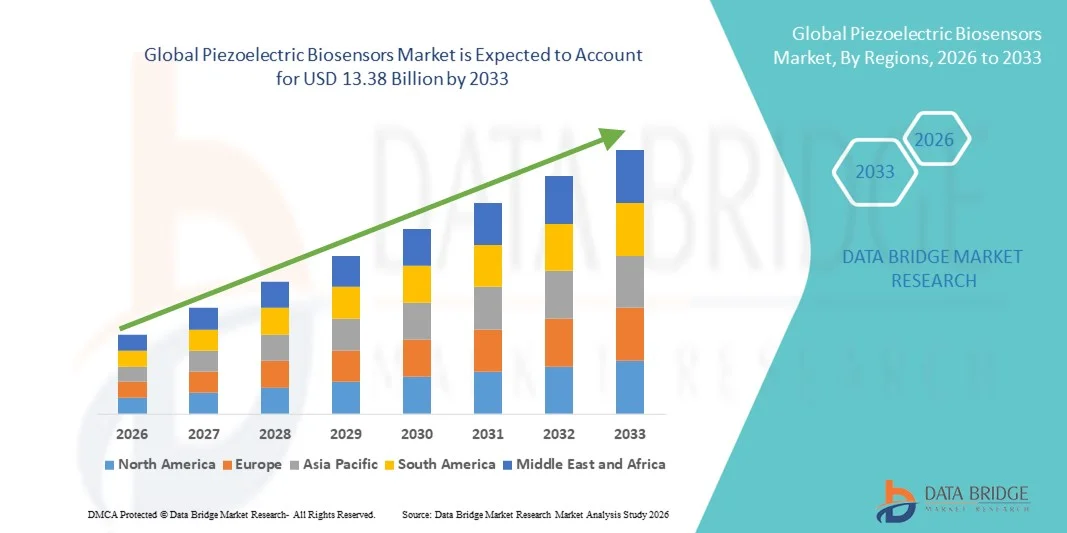
- The global piezoelectric biosensors market size was valued at USD 8.00 billion in 2025 and is expected to reach USD 13.38 billion by 2033, at a CAGR of 6.65% during the forecast period
- The market growth is largely driven by the increasing adoption of advanced biosensing technologies and continuous progress in medical diagnostics, point-of-care testing, and life-science research, enabling highly sensitive and real-time detection of biological signals
- Furthermore, rising demand for accurate, rapid, and minimally invasive diagnostic solutions across healthcare, biotechnology, and environmental monitoring is positioning piezoelectric biosensors as a preferred analytical platform. These converging factors are accelerating the adoption of piezoelectric biosensor solutions, thereby significantly boosting overall market growth
Piezoelectric Biosensors Market Analysis
- Piezoelectric biosensors, which convert biological interactions into measurable electrical signals, are increasingly critical components in modern analytical and diagnostic systems across healthcare, biotechnology, food safety, and environmental monitoring due to their high sensitivity, real-time detection capabilities, and label-free operation
- The rising demand for piezoelectric biosensors is primarily driven by the growing need for rapid and accurate diagnostics, expanding applications in point-of-care testing, and increasing investments in life sciences and biomedical research worldwide
- North America dominated the piezoelectric biosensors market with the largest revenue share of 38.4% in 2025, supported by advanced healthcare infrastructure, strong R&D activities, and the presence of leading biosensor manufacturers and biotechnology firms, with the U.S. witnessing significant adoption in clinical diagnostics and pharmaceutical research, driven by continuous innovation in microelectronics and sensor miniaturization
- Asia-Pacific is expected to be the fastest-growing region in the piezoelectric biosensors market during the forecast period due to rising healthcare expenditure, expanding biotechnology industries, and increasing focus on early disease detection in emerging economies
- Medical segment dominated the piezoelectric biosensors market with a market share of 44.7% in 2025, driven by its extensive use in disease detection, biomolecular interaction analysis, and real-time monitoring applications requiring high precision and reliability
Report Scope and Piezoelectric Biosensors Market Segmentation
|
Attributes |
Piezoelectric Biosensors Key Market Insights |
|
Segments Covered |
|
|
Countries Covered |
North America
Europe
Asia-Pacific
Middle East and Africa
South America
|
|
Key Market Players |
|
|
Market Opportunities |
|
|
Value Added Data Infosets |
In addition to the insights on market scenarios such as market value, growth rate, segmentation, geographical coverage, and major players, the market reports curated by the Data Bridge Market Research also include in-depth expert analysis, patient epidemiology, pipeline analysis, pricing analysis, and regulatory framework |
Piezoelectric Biosensors Market Trends
Rising Adoption of Real-Time and Label-Free Detection Technologies
- A significant and accelerating trend in the global piezoelectric biosensors market is the increasing adoption of real-time, label-free detection technologies across healthcare, biotechnology, and analytical laboratories, driven by the need for faster and more precise biomolecular analysis
- For instance, quartz crystal microbalance (QCM)-based piezoelectric biosensors are increasingly used in drug discovery and protein interaction studies, enabling direct mass-change detection without complex sample preparation
- Technological advancements in microfabrication and nanomaterials are enabling piezoelectric biosensors to achieve higher sensitivity, improved stability, and miniaturized form factors suitable for portable and point-of-care applications
- The integration of piezoelectric biosensors with microfluidics and digital data acquisition platforms is facilitating automated workflows and centralized monitoring across diagnostic, research, and industrial testing environments
- The convergence of piezoelectric biosensors with wearable and IoT-enabled devices is emerging as a trend, enabling continuous health monitoring and remote patient diagnostics in real-time
- This trend toward more precise, compact, and multifunctional biosensing systems is reshaping expectations for analytical performance, prompting companies and research institutes to develop next-generation piezoelectric biosensors for clinical and industrial use
- The demand for piezoelectric biosensors offering rapid response, real-time monitoring, and high analytical accuracy is growing steadily across medical diagnostics, pharmaceutical research, and environmental testing sectors
Piezoelectric Biosensors Market Dynamics
Driver
Growing Demand for Rapid and Accurate Diagnostics
- The increasing need for rapid, sensitive, and accurate diagnostic solutions across healthcare and life-science research is a major driver accelerating the demand for piezoelectric biosensors globally
- For instance, in recent years, piezoelectric biosensors have been increasingly adopted in clinical diagnostics and pharmaceutical R&D for real-time monitoring of biomolecular interactions and disease biomarkers
- As healthcare providers and researchers seek early disease detection and precise therapeutic monitoring, piezoelectric biosensors offer high sensitivity, label-free detection, and real-time analytical capabilities compared to conventional methods
- Furthermore, the expansion of point-of-care testing and personalized medicine is strengthening the role of piezoelectric biosensors as essential components in advanced diagnostic platforms
- The growing focus on preventive healthcare, coupled with rising investments in biotechnology and medical research, is further propelling the adoption of piezoelectric biosensors across both clinical and research settings
- Increasing integration of AI and data analytics with piezoelectric biosensors is enabling enhanced interpretation of complex biological data, improving diagnostic accuracy and decision-making
- Rising awareness of environmental monitoring and food safety is opening new applications for piezoelectric biosensors, driving adoption beyond healthcare into industrial and regulatory sectors
Restraint/Challenge
High Development Costs and Regulatory Complexity
- Challenges associated with high development costs, complex fabrication processes, and stringent regulatory requirements pose significant barriers to the widespread commercialization of piezoelectric biosensors
- For instance, compliance with regulatory standards for clinical diagnostics can increase development timelines and costs, particularly for biosensors intended for medical and in-vitro diagnostic applications
- Addressing these challenges requires substantial investment in R&D, validation studies, and manufacturing optimization, which can limit market entry for small and emerging players despite strong technological potential
- While ongoing technological advancements are gradually reducing production costs, the perceived complexity and regulatory burden can still hinder adoption, especially in cost-sensitive and emerging markets
- Overcoming these restraints through standardized manufacturing processes, supportive regulatory frameworks, and increased collaboration between industry and research institutions will be critical for sustained market growth
- Limited awareness and understanding of piezoelectric biosensor capabilities among end-users can slow adoption, necessitating educational initiatives and demonstrations of value across applications
- Challenges in ensuring long-term stability and reproducibility of piezoelectric biosensors under varied environmental and biological conditions remain a concern for large-scale deployment across industries
Piezoelectric Biosensors Market Scope
The market is segmented on the basis of product and application.
- By Product
On the basis of product, the piezoelectric biosensors market is segmented into piezoelectric ceramics, single crystal materials, and others. The piezoelectric ceramics segment dominated the market with the largest revenue share in 2025, driven by its established reliability, cost-effectiveness, and widespread availability. Ceramics such as lead zirconate titanate (PZT) offer strong piezoelectric properties, making them ideal for high-sensitivity biosensing applications in medical diagnostics and industrial monitoring. Their compatibility with standard fabrication techniques and robust performance under varied environmental conditions enhances their adoption across laboratories and healthcare facilities. In addition, the ability to mass-produce ceramic-based sensors at lower costs compared to single crystals supports large-scale deployment. This segment also benefits from extensive research and development aimed at improving sensitivity, stability, and miniaturization. The wide range of applications, including pathogen detection, biomolecule monitoring, and chemical sensing, further reinforces its market dominance.
The single crystal materials segment is expected to witness the fastest growth during the forecast period, driven by superior piezoelectric coefficients, higher sensitivity, and lower signal noise compared to ceramics. Single crystal sensors are particularly suitable for precision applications in advanced medical diagnostics, environmental monitoring, and pharmaceutical research where accuracy is critical. Their ability to deliver consistent, reproducible results in detecting small biomolecular changes is attracting adoption in point-of-care and laboratory-based diagnostic systems. Furthermore, ongoing innovations in crystal growth techniques are gradually reducing costs, making these sensors more accessible. Increasing investment in high-performance biosensor technologies for early disease detection and drug discovery is further propelling growth in this segment. The combination of advanced performance and expanding applications positions single crystal materials as a rapidly growing segment in the global market.
- By Application
On the basis of application, the piezoelectric biosensors market is segmented into medical, automotive, tools, electronics, and others. The medical application segment dominated the market with the largest revenue share of 44.7% in 2025, driven by the critical need for rapid, accurate, and real-time diagnostics. Piezoelectric biosensors are widely used in disease biomarker detection, drug discovery, and point-of-care testing, offering high sensitivity and label-free operation. Hospitals, diagnostic laboratories, and pharmaceutical companies are increasingly adopting these sensors to enhance clinical outcomes and streamline research processes. The segment also benefits from government initiatives promoting advanced diagnostic technologies and preventive healthcare measures. The integration of piezoelectric biosensors with microfluidic and wearable devices is further expanding their utility in continuous patient monitoring and personalized medicine. With growing awareness of the benefits of real-time and minimally invasive diagnostics, the medical segment remains the largest revenue contributor in the market.
The automotive application segment is expected to witness the fastest growth during the forecast period, driven by increasing demand for advanced driver-assistance systems (ADAS), vehicle safety monitoring, and environmental sensing. Piezoelectric biosensors are used in automotive systems to detect gases, monitor air quality, and ensure compliance with emission standards. The rising adoption of electric and connected vehicles is further creating opportunities for high-sensitivity sensors capable of real-time monitoring in compact, embedded systems. Manufacturers are investing in integrating biosensors for enhanced in-cabin air quality and safety monitoring, boosting market growth. Moreover, growing regulatory requirements and the emphasis on eco-friendly technologies in the automotive sector support rapid adoption. The combination of technological innovation and increasing automotive applications positions this segment as the fastest-growing in the market.
Piezoelectric Biosensors Market Regional Analysis
- North America dominated the piezoelectric biosensors market with the largest revenue share of 38.4% in 2025, supported by advanced healthcare infrastructure, strong R&D activities, and the presence of leading biosensor manufacturers and biotechnology firms
- Consumers and research institutions in the region highly value the accuracy, real-time monitoring, and label-free detection offered by piezoelectric biosensors, which are widely used in medical diagnostics, pharmaceutical research, and environmental monitoring
- This widespread adoption is further supported by significant government funding, presence of leading biosensor manufacturers, and a growing focus on personalized medicine and preventive healthcare, establishing piezoelectric biosensors as a preferred analytical and diagnostic solution in both clinical and research settings
U.S. Piezoelectric Biosensors Market Insight
The U.S. piezoelectric biosensors market captured the largest revenue share of 82% in North America in 2025, driven by the strong presence of leading biosensor manufacturers and high adoption of advanced diagnostic technologies. Healthcare providers and research institutions increasingly rely on piezoelectric biosensors for real-time biomarker detection, drug discovery, and point-of-care testing. The growing focus on personalized medicine and preventive healthcare further accelerates market adoption. In addition, integration with microfluidics, wearable devices, and AI-enabled platforms is enhancing analytical capabilities. Robust government funding for biotechnology and medical research also supports rapid innovation and deployment. These factors collectively establish the U.S. as a dominant market for piezoelectric biosensors.
Europe Piezoelectric Biosensors Market Insight
The Europe piezoelectric biosensors market is projected to expand at a significant CAGR throughout the forecast period, primarily driven by increasing investments in healthcare diagnostics and life-science research. Stringent regulatory standards for healthcare and environmental monitoring encourage the adoption of highly accurate biosensing technologies. Urbanization and the rise of smart laboratories in countries such as Germany, France, and Italy are fostering demand. European institutions value precision, reproducibility, and rapid results, which piezoelectric biosensors deliver. Furthermore, the integration of biosensors in industrial applications such as food safety and environmental monitoring is fueling growth. The region is witnessing significant uptake across both clinical and research applications.
U.K. Piezoelectric Biosensors Market Insight
The U.K. piezoelectric biosensors market is expected to grow at a noteworthy CAGR during the forecast period, driven by the increasing focus on innovative healthcare solutions and early disease diagnostics. Growing adoption of point-of-care testing and laboratory automation is expanding the market. The presence of prominent biotech and pharmaceutical companies, along with supportive government policies, enhances research and commercialization opportunities. Moreover, U.K. consumers and healthcare providers are seeking high-precision, rapid, and user-friendly diagnostic tools, which boosts the deployment of piezoelectric biosensors. Integration with IoT-enabled and wearable devices is also accelerating adoption. These factors collectively stimulate market expansion across clinical, research, and industrial applications.
Germany Piezoelectric Biosensors Market Insight
The Germany piezoelectric biosensors market is expected to expand at a considerable CAGR during the forecast period, fueled by strong R&D activities, advanced healthcare infrastructure, and a focus on precision diagnostics. High awareness of technological innovations and increasing demand for real-time monitoring solutions drive adoption in medical and research sectors. Germany’s emphasis on sustainability and industrial efficiency promotes the use of biosensors in environmental and food safety applications. Integration with automated laboratory systems enhances workflow efficiency and analytical accuracy. In addition, collaborations between academic institutions and biotech companies foster innovation and market penetration. These factors collectively strengthen Germany’s position as a key market in Europe.
Asia-Pacific Piezoelectric Biosensors Market Insight
The Asia-Pacific piezoelectric biosensors market is poised to grow at the fastest CAGR during the forecast period, driven by rising healthcare expenditure, expanding biotechnology industries, and increasing adoption of advanced diagnostic tools in countries such as China, Japan, and India. Government initiatives promoting healthcare innovation, digitalization, and smart laboratories are boosting adoption. The region’s growing population and rising prevalence of chronic diseases increase demand for rapid and accurate diagnostic solutions. In addition, APAC is emerging as a manufacturing hub for biosensor components, improving affordability and accessibility. Expansion in both clinical diagnostics and industrial applications supports sustained market growth.
Japan Piezoelectric Biosensors Market Insight
The Japan piezoelectric biosensors market is gaining momentum due to the country’s high-tech ecosystem, emphasis on precision healthcare, and adoption of smart laboratory technologies. Increasing investments in point-of-care diagnostics, wearable health monitoring, and personalized medicine drive market growth. Integration with IoT and AI-enabled platforms enhances real-time biomarker analysis and workflow efficiency. Japan’s aging population is fueling demand for user-friendly, accurate diagnostic solutions in both clinical and research applications. Furthermore, strong collaborations between universities, healthcare institutions, and biotech firms foster innovation. These factors collectively support steady expansion of the piezoelectric biosensors market in Japan.
India Piezoelectric Biosensors Market Insight
The India piezoelectric biosensors market accounted for the largest revenue share in Asia-Pacific in 2025, attributed to rapid urbanization, expanding healthcare infrastructure, and high adoption of digital health technologies. Increasing demand for cost-effective, point-of-care diagnostic tools is driving adoption across hospitals, clinics, and research centers. Government initiatives supporting biotechnology and healthcare innovation further boost market growth. In addition, domestic manufacturing of biosensor components is improving affordability and accessibility. Rising awareness about preventive healthcare and growing investment in life sciences research contribute to expanding market opportunities. These factors establish India as a key growth market in APAC.
Piezoelectric Biosensors Market Share
The Piezoelectric Biosensors industry is primarily led by well-established companies, including:
- AWSensors (Spain)
- PCB Piezotronics, Inc. (U.S.)
- Biolin Scientific AB (Sweden)
- QuartzPro AB (Sweden)
- INFICON GmbH (Switzerland)
- MicroVacuum Ltd. (Hungary)
- 3T Analytik GmbH (Germany)
- Gamry Instruments, Inc. (U.S.)
- Texas Instruments Incorporated (U.S.)
- Honeywell International Inc. (U.S.)
- Siemens AG (Germany)
- STMicroelectronics N.V. (Switzerland)
- TE Connectivity Ltd. (Switzerland)
- Bosch Sensortec GmbH (Germany)
- NXP Semiconductors N.V. (Netherlands)
- Murata Manufacturing Co., Ltd. (Japan)
- Analog Devices, Inc. (U.S.)
- Biosensors International Group, Ltd. (Singapore)
- Kistler Group (Switzerland)
- Channel Technologies Group (U.S.)
What are the Recent Developments in Global Piezoelectric Biosensors Market?
- In February 2025, researchers published a study demonstrating a machine‑learning optimized design of a THz piezoelectric perovskite‑based biosensor capable of detecting formalin in aqueous environments, signaling a significant advancement in combining artificial intelligence with piezoelectric biosensor design to enhance sensitivity and specificity for chemical and biomolecule detection, which could broaden applications in environmental monitoring and biomedical diagnostics
- In September 2024, a flexible piezoelectric biosensor integrating BaTiO₃ within a PDMS matrix was presented, aimed at real‑time posture monitoring and correction, showing enhanced output performance and demonstrating piezoelectric biosensor applications beyond traditional health diagnostics into wearable functional sensing
- In June 2024, researchers developed a breakthrough nanoporous piezoelectric material exhibiting a giant piezoelectric response, enabling more eco‑friendly, highly efficient sensors and transducers that could be applied to future high‑sensitivity piezoelectric biosensing systems a significant advance toward sustainable, high‑performance biosensor materials
- In October 2023, academic research highlighted the rapid development of flexible and wearable piezoelectric biosensors, combining machine learning‑assisted signal processing with sensitive piezoelectric detection for continuous physiological monitoring, marking a shift toward integrated smart health monitoring solutions
- In January 2021, researchers at Penn State and QorTek developed a new piezoelectric material capable of remaining effective at high temperatures, expanding the potential use of piezoelectric sensing in harsh environments and suggesting future incorporation into robust biosensing and diagnostic devices where stability under extreme conditions is critical
SKU-
Get online access to the report on the World's First Market Intelligence Cloud
- Interactive Data Analysis Dashboard
- Company Analysis Dashboard for high growth potential opportunities
- Research Analyst Access for customization & queries
- Competitor Analysis with Interactive dashboard
- Latest News, Updates & Trend analysis
- Harness the Power of Benchmark Analysis for Comprehensive Competitor Tracking
Research Methodology
Data collection and base year analysis are done using data collection modules with large sample sizes. The stage includes obtaining market information or related data through various sources and strategies. It includes examining and planning all the data acquired from the past in advance. It likewise envelops the examination of information inconsistencies seen across different information sources. The market data is analysed and estimated using market statistical and coherent models. Also, market share analysis and key trend analysis are the major success factors in the market report. To know more, please request an analyst call or drop down your inquiry.
The key research methodology used by DBMR research team is data triangulation which involves data mining, analysis of the impact of data variables on the market and primary (industry expert) validation. Data models include Vendor Positioning Grid, Market Time Line Analysis, Market Overview and Guide, Company Positioning Grid, Patent Analysis, Pricing Analysis, Company Market Share Analysis, Standards of Measurement, Global versus Regional and Vendor Share Analysis. To know more about the research methodology, drop in an inquiry to speak to our industry experts.
Customization Available
Data Bridge Market Research is a leader in advanced formative research. We take pride in servicing our existing and new customers with data and analysis that match and suits their goal. The report can be customized to include price trend analysis of target brands understanding the market for additional countries (ask for the list of countries), clinical trial results data, literature review, refurbished market and product base analysis. Market analysis of target competitors can be analyzed from technology-based analysis to market portfolio strategies. We can add as many competitors that you require data about in the format and data style you are looking for. Our team of analysts can also provide you data in crude raw excel files pivot tables (Fact book) or can assist you in creating presentations from the data sets available in the report.