


Pet Cancer Therapeutics Market Size
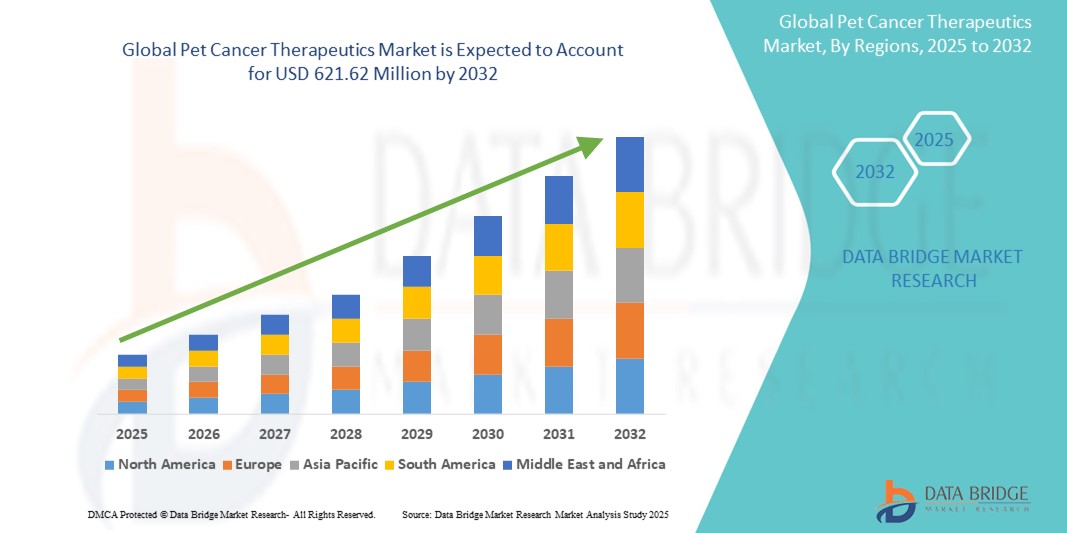
- The global pet cancer therapeutics market size was valued at USD 309.69 Million in 2024 and is expected to reach USD 621.62 Million by 2032, at a CAGR of 9.10% during the forecast period
- The market growth is largely fueled by the growing adoption and technological progress in veterinary oncology, leading to the development of more advanced, targeted therapies for treating cancer in pets. This includes innovations such as monoclonal antibodies, targeted small molecules, and immunotherapy, which are transforming the landscape of animal cancer care
- Furthermore, rising pet ownership, increasing awareness among pet owners about early cancer diagnosis, and a growing willingness to spend on specialized treatments are significantly boosting demand for effective and safe pet cancer therapeutics solutions. These converging factors are accelerating the uptake of veterinary oncology drugs and personalized treatments, thereby significantly boosting the industry's growth
Pet Cancer Therapeutics Market Analysis
- Pet cancer therapeutics, including chemotherapy, targeted therapy, immunotherapy, and others, are becoming essential in veterinary oncology due to the rising incidence of cancer in companion animals and growing awareness among pet owners regarding advanced treatment options
- The increasing demand for pet cancer therapeutics is largely driven by the growing pet population, rising healthcare spending on pets, and technological advancements in veterinary diagnostics and treatments
- North America dominated the pet cancer therapeutics market with the largest revenue share of 41.6% in 2024, fueled by early adoption of advanced veterinary care, high pet ownership rates, and robust healthcare infrastructure for companion animals. The U.S. contributes significantly to this growth through extensive investments in animal health research and the presence of major market players focused on oncology solutions
- Asia-Pacific is projected to be the fastest-growing region in the pet cancer therapeutics market during the forecast period, with a CAGR of 11.3% from 2025 to 2032, driven by rapid urbanization, increasing disposable incomes, and growing awareness about veterinary oncology care in countries such as China, India, and Japan
- The chemotherapy segment dominated the pet cancer therapeutics market with the largest revenue share of 38.4% in 2024, owing to its widespread use in treating a variety of pet cancers
Report Scope and Pet Cancer Therapeutics Market Segmentation
|
Attributes |
Pet Cancer Therapeutics Key Market Insights |
|
Segments Covered |
|
|
Countries Covered |
North America
Europe
Asia-Pacific
Middle East and Africa
South America
|
|
Key Market Players |
|
|
Market Opportunities |
|
|
Value Added Data Infosets |
In addition to the insights on market scenarios such as market value, growth rate, segmentation, geographical coverage, and major players, the market reports curated by the Data Bridge Market Research also include in-depth expert analysis, pricing analysis, brand share analysis, consumer survey, demography analysis, supply chain analysis, value chain analysis, raw material/consumables overview, vendor selection criteria, PESTLE Analysis, Porter Analysis, and regulatory framework. |
Pet Cancer Therapeutics Market Trends
“Advancing Veterinary Oncology Through Targeted and Personalized Therapies”
- A significant and accelerating trend in the global pet cancer therapeutics market is the rising focus on targeted therapies and personalized medicine for treating cancer in companion animals. This approach is reshaping veterinary oncology by offering more effective, less invasive treatment options tailored to specific cancer types and the genetic profiles of pets
- For instance, targeted therapies such as tyrosine kinase inhibitors (TKIs) are gaining traction in treating mast cell tumors in dogs, with products such as Palladia (toceranib phosphate) approved by the U.S. FDA for veterinary use. These therapies work by interfering with specific molecular targets involved in cancer progression, minimizing damage to healthy tissues and improving treatment outcomes
- The increasing availability of veterinary diagnostic tools, such as genetic testing and biomarker analysis, is enabling veterinarians to select more appropriate and effective treatment regimens for individual pets. This trend is contributing to the growth of companion diagnostics in the animal healthcare sector, supporting earlier detection and improved monitoring of cancer progression
- Moreover, immunotherapy is emerging as a promising area, particularly in canine melanoma and lymphoma treatment. Veterinary oncologists are now exploring the use of cancer vaccines and monoclonal antibodies that stimulate the pet’s immune system to recognize and destroy cancer cells
- With pet owners becoming more emotionally and financially invested in the health of their animals, there is increasing willingness to pursue advanced oncology care, including chemotherapy, radiation therapy, and surgery. This has led to the expansion of specialty veterinary cancer centers across major markets such as the U.S., Canada, and parts of Europe
- Leading pharmaceutical companies and biotech firms are investing significantly in R&D for novel veterinary oncology drugs, supported by favorable regulatory environments that facilitate accelerated approvals for animal health products
- This shift towards precision oncology and evidence-based treatment is expected to continue driving innovation and revenue growth in the pet cancer therapeutics market, ultimately improving survival rates and quality of life for pets undergoing cancer treatment
Pet Cancer Therapeutics Market Dynamics
Driver
“Growing Demand Driven by Increasing Pet Ownership and Rising Cancer Incidence”
- The increasing number of companion animals globally, along with heightened awareness among pet owners regarding animal health, is a significant driver for the growing demand for pet cancer therapeutics. As pets are increasingly considered family members, there is a stronger willingness among owners to pursue advanced treatments, including cancer therapies
- For instance, in May 2024, Zoetis Services LLC announced the expansion of its oncology pipeline with a focus on targeted biologics and immunotherapies for canine and feline cancers. Such initiatives by key companies are expected to significantly drive the growth of the Pet Cancer Therapeutics market in the coming years
- Moreover, the growing incidence of cancers such as lymphoma, mast cell tumors, and melanoma in cats and dogs is prompting a shift toward early diagnosis and intervention. With more veterinary practices adopting advanced imaging and biopsy techniques, the demand for effective cancer therapies is increasing rapidly
- The availability of specialized cancer treatments, including chemotherapy, immunotherapy, and targeted therapy, along with improved veterinary infrastructure, is helping increase adoption in both urban and semi-urban markets
- In addition, the emergence of telemedicine and online pet pharmacies is improving accessibility to cancer therapeutics, especially in remote regions. This trend, coupled with growing veterinary awareness and training, is expected to further boost the adoption of pet oncology solutions
Restraint/Challenge
“High Treatment Costs and Limited Availability of Approved Therapies”
- One of the primary challenges in the pet cancer therapeutics market is the high cost of treatment. Many advanced therapies, such as targeted drugs and radiation therapy, remain expensive and may not be financially viable for all pet owners, especially in developing regions
- Moreover, the limited number of approved oncology drugs for animals, compared to the human pharmaceutical industry, restricts treatment options. Regulatory challenges and lengthy approval timelines further slow down the introduction of novel drugs into the market
- For instance, while companies such as Elanco and AB Science have made strides in veterinary oncology, the process of bringing innovative therapies to market remains time-consuming and resource-intensive
- In addition, there is a lack of insurance coverage or reimbursement policies for pet treatments in many countries, making advanced cancer care unaffordable for a large section of pet owners
- Overcoming these challenges will require increased R&D investment, collaboration with veterinary institutions, and policy support to enhance access, reduce treatment costs, and drive sustainable growth in the Pet Cancer Therapeutics market
Pet Cancer Therapeutics Market Scope
The market is segmented on the basis of therapy, medicine type, route of administration, cancer type, species type, and end user.
• By Therapy
On the basis of therapy, the pet cancer therapeutics market is segmented into chemotherapy, radiation therapy, immunotherapy, targeted therapy, combination therapy, and others. The chemotherapy segment dominated the market with the largest revenue share of 38.4% in 2024, owing to its widespread use in treating a variety of pet cancers.
The immunotherapy segment is expected to register the fastest CAGR of 10.8% from 2025 to 2032, driven by increased focus on novel cancer vaccines and monoclonal antibodies.
• By Medicine Type
On the basis of medicine type, the pet cancer therapeutics market is segmented into chemotherapy drugs and vaccines. The chemotherapy drugs segment held the largest share of 66.1% in 2024, due to the extensive availability of conventional cytotoxic drugs.
The vaccines segment is anticipated to grow at a CAGR of 11.5% from 2025 to 2032, as demand rises for preventive therapies in pet oncology.
• By Route of Administration
On the basis of route of administration, the pet cancer therapeutics market is segmented into parenteral, oral, and others. The parenteral segment accounted for the largest revenue share of 57.9% in 2024, reflecting its dominance in veterinary clinics for rapid drug action.
The oral segment is projected to grow at the fastest CAGR of 9.7% from 2025 to 2032, supported by pet owners' preference for home-based care.
• By Cancer Type
On the basis of cancer type, the pet cancer therapeutics market is segmented into melanoma, mast cell cancer, lymphoma, mammary and squamous cell cancer, and others. The lymphoma segment led the market with a share of 29.6% in 2024, due to its high incidence and responsiveness to treatment.
The melanoma segment is projected to witness the fastest CAGR of 10.2% from 2025 to 2032, driven by advances in therapeutic vaccines and diagnostics.
• By Species Type
On the basis of species type, the pet cancer therapeutics market is segmented into cat, dog, and others. The dog segment held the largest share of 71.3% in 2024, owing to a higher cancer prevalence in dogs and availability of more treatment options.
The cat segment is expected to grow at a fastest CAGR of 8.6% from 2025 to 2032, with increasing access to specialized feline therapies.
• By End User
On the basis of end user, the pet cancer therapeutics market is segmented into veterinary hospitals and clinical pharmacies, retail pharmacies, online pharmacies, and others. The veterinary hospitals and clinical pharmacies segment dominated the market with a share of 54.8% in 2024, benefiting from comprehensive oncology services and patient care.
The online pharmacies segment is expected to grow at the fastest CAGR of 12.3% from 2025 to 2032, driven by rising digital pet care adoption and e-commerce expansion.
Pet Cancer Therapeutics Market Regional Analysis
- North America dominated the pet cancer therapeutics market with the largest revenue share of 41.6% in 2024, driven by the increasing prevalence of cancer in pets, high awareness among pet owners, and strong veterinary healthcare infrastructure
- There is a growing demand for advanced therapies, including chemotherapy, immunotherapy, and targeted drug delivery, supported by pet insurance coverage and increasing pet healthcare spending in the region
- The presence of major players and ongoing research and development in veterinary oncology further fuel market growth
U.S. Pet Cancer Therapeutics Market Insight
The U.S. pet cancer therapeutics market accounted for 85.1% of the North America market share in 2024, supported by a robust network of veterinary oncology centers, early access to newly approved therapies, and strong adoption of personalized cancer treatments for pets. Rising cases of lymphoma, mast cell tumors, and melanoma in dogs and cats are contributing to the demand for novel therapeutics. The U.S. also benefits from the presence of advanced diagnostics and favorable regulatory pathways from the FDA Center for Veterinary Medicine (CVM).
Europe Pet Cancer Therapeutics Market Insight
The Europe pet cancer therapeutics market is expected to witness a significant CAGR during the forecast period, due to increasing pet adoption rates and growing awareness of pet health. Stricter regulations around animal welfare and increased funding for veterinary research are supporting the expansion of treatment options. Several European countries, including Germany, France, and the U.K., are focusing on integrating oncology services into general veterinary practice.
U.K. Pet Cancer Therapeutics Market Insight
The U.K. pet cancer therapeutics market is projected to grow at a noteworthy CAGR during the forecast period, driven by a rising number of pet owners seeking advanced treatments and diagnostics. The country’s veterinary practices are increasingly adopting specialized cancer therapies, and the presence of universities and institutions conducting research on veterinary oncology is supporting growth.
Germany Pet Cancer Therapeutics Market Insight
The Germany pet cancer therapeutics market is expected to expand at a significant CAGR during the forecast period, with strong demand for advanced veterinary diagnostics and treatment protocols. The German market benefits from high pet ownership rates, growing expenditure on pet care, and an emphasis on improving the quality of life of companion animals with chronic conditions, including cancer.
Asia-Pacific Pet Cancer Therapeutics Market Insight
The Asia-Pacific pet cancer therapeutics market is projected to grow at the fastest CAGR of 11.3% from 2025 to 2032, attributed to growing awareness of pet health, increasing disposable incomes, and expanding veterinary services in countries such as China, Japan, and India. Urbanization and the humanization of pets are increasing the demand for specialty services, including cancer diagnostics and treatment. Supportive government policies and international collaborations are encouraging veterinary advancements in the region.
Japan Pet Cancer Therapeutics Market Insight
The Japan pet cancer therapeutics market is seeing rising demand for cancer treatment in pets, driven by its aging pet population and high standards of veterinary care. The market is benefitting from technological innovations in diagnostics and a cultural emphasis on preventive healthcare for animals, leading to early detection and treatment of various cancers.
China Pet Cancer Therapeutics Market Insight
The China pet cancer therapeutics market held the largest share of the Asia-Pacific market in 2024, supported by rapid urbanization, a growing middle class, and increasing spending on pet healthcare. The expanding pet insurance sector and strong presence of domestic veterinary pharmaceutical companies are supporting wider access to cancer therapies. China is also witnessing a growing number of veterinary specialty clinics that offer targeted cancer treatments such as chemotherapy and immunotherapy.
Pet Cancer Therapeutics Market Share
The pet cancer therapeutics industry is primarily led by well-established companies, including:
- AB Science (France)
- Elanco (U.S.)
- Candel Therapeutics (Canada)
- NIPPON ZENYAKU KOGYO CO., LTD. (Japan)
- Rhizen Pharmaceuticals AG (Switzerland)
- Virbac (France)
- Pfizer Inc. (U.S.)
- VetDC (U.S.)
- Boehringer Ingelheim International GmbH (Germany)
- Karyopharm (U.S.)
- VETCO (U.S.)
- ELIAS Animal Health (U.S.)
- Vivesto AB (Sweden)
- Torigen Pharmaceuticals Inc. (U.S.)
- Zoetis Services LLC (U.S.)
Latest Developments in Global Pet Cancer Therapeutics Market
- In October 2024, Calviri (a biotech specialized in canine cancer vaccines) initiated a clinical trial for its immunotherapy vaccine targeting early-stage hemangiosarcoma in dogs. This SOCH study evaluates whether combining the vaccine with surgery and chemotherapy can significantly extend survival compared to standard care
- In March 2025, ELIAS Animal Health received full USDA approval for its ELIAS Cancer Immunotherapy (ECI)—the first licensed autologous cell therapy for treating canine osteosarcoma—opening access via apheresis treatment centers across the U.S.
- In August 2024, FidoCure (One Health Company) secured a U.S. patent for its AI-enhanced targeted therapy and biomarker platform for canine bladder cancer, representing a major step forward in personalized veterinary oncology
- In January 2025, Vetigenics, a biotech focused on canine monoclonal antibodies, closed a USD 6 million seed round. They achieved positive results from a clinical trial of an anti-CTLA4 therapy for canine oral melanoma and are nearing completion of an anti-PD1 study for urothelial carcinoma

- Interactive Data Analysis Dashboard
- Company Analysis Dashboard for high growth potential opportunities
- Research Analyst Access for customization & queries
- Competitor Analysis with Interactive dashboard
- Latest News, Updates & Trend analysis
- Harness the Power of Benchmark Analysis for Comprehensive Competitor Tracking
Table of Content
1 INTRODUCTION
1.1 OBJECTIVES OF THE STUDY
1.2 MARKET DEFINITION
1.3 OVERVIEW OF GLOBAL PET CANCER THERAPEUTICS MARKET
1.4 CURRENCY AND PRICING
1.5 LIMITATION
1.6 MARKETS COVERED
2 MARKET SEGMENTATION
2.1 KEY TAKEAWAYS
2.2 ARRIVING AT THE GLOBAL PET CANCER THERAPEUTICS MARKET SIZE
2.2.1 VENDOR POSITIONING GRID
2.2.2 PIPELINE CURVE
2.2.3 MARKET GUIDE
2.2.4 COMPANY POSITIONING GRID
2.2.5 COMPANY MARKET SHARE ANALYSIS
2.2.6 MULTIVARIATE MODELLING
2.2.7 TOP TO BOTTOM ANALYSIS
2.2.8 STANDARDS OF MEASUREMENT
2.2.9 VENDOR SHARE ANALYSIS
2.2.10 EPIDEMIOLOGY MODELLING
2.2.11 DATA POINTS FROM KEY PRIMARY INTERVIEWS
2.2.12 DATA POINTS FROM KEY SECONDARY DATABASES
2.3 GLOBAL PET CANCER THERAPEUTICS MARKET: RESEARCH SNAPSHOT
2.4 ASSUMPTIONS
3 MARKET OVERVIEW
3.1 DRIVERS
3.2 RESTRAINTS
3.3 OPPORTUNITIES
3.4 CHALLENGES
4 EXECUTIVE SUMMARY
5 PREMIUM INSIGHTS
5.1 PESTEL ANALYSIS
5.2 PORTER’S FIVE FORCES MODEL
6 INDUSTRY INSIGHTS
6.1 MICRO AND MACRO ECONOMIC FACTORS
6.2 PENETRATION AND GROWTH PROSPECT MAPPING
6.3 KEY PRICING STRATEGIES
6.4 INTERVIEWS WITH SPECIALIST
6.5 ANALYIS AND RECOMMENDATION
7 INTELLECTUAL PROPERTY (IP) PORTFOLIO
7.1 PATENT QUALITY AND STRENGTH
7.2 PATENT FAMILIES
7.3 LICENSING AND COLLABORATIONS
7.4 COMPETITIVE LANDSCAPE
7.5 IP STRATEGY AND MANAGEMENT
7.6 OTHER
8 COST ANALYSIS BREAKDOWN
9 TECHNONLOGY ROADMAP
10 INNOVATION TRACKER AND STRATEGIC ANALYSIS
10.1 MAJOR DEALS AND STRATEGIC ALLIANCES ANALYSIS
10.1.1 JOINT VENTURES
10.1.2 MERGERS AND ACQUISITIONS
10.1.3 LICENSING AND PARTNERSHIP
10.1.4 TECHNOLOGY COLLABORATIONS
10.1.5 STRATEGIC DIVESTMENTS
10.2 NUMBER OF PRODUCTS IN DEVELOPMENT
10.3 STAGE OF DEVELOPMENT
10.4 TIMELINES AND MILESTONES
10.5 INNOVATION STRATEGIES AND METHODOLOGIES
10.6 RISK ASSESSMENT AND MITIGATION
10.7 MERGERS AND ACQUISITIONS
10.8 FUTURE OUTLOOK
11 EPIDEMIOLOGY
11.1 INCIDENCE OF ALL BY GENDER
11.2 TREATMENT RATE
11.3 MORTALITY RATE
11.4 DRUG ADHERENCE AND THERAPY SWITCH MODEL
11.5 PATIENT TREATMENT SUCCESS RATES
12 REGULATORY COMPLIANCE
12.1 REGULATORY AUTHORITIES
12.2 REGULATORY CLASSIFICATIONS
12.2.1 CLASS I
12.2.2 CLASS II
12.2.3 CLASS III
12.3 REGULATORY SUBMISSIONS
12.4 INTERNATIONAL HARMONIZATION
12.5 COMPLIANCE AND QUALITY MANAGEMENT SYSTEMS
12.6 REGULATORY CHALLENGES AND STRATEGIES
13 PIPELINE ANALYSIS
13.1 CLINICAL TRIALS AND PHASE ANALYSIS
13.2 DRUG THERAPY PIPELINE
13.3 PHASE III CANDIDATES
13.4 PHASE II CANDIDATES
13.5 PHASE I CANDIDATES
13.6 OTHERS (PRE-CLINICAL AND RESEARCH)
TABLE 1 GLOBAL CLINICAL TRIAL MARKET FOR PET CANCER THERAPEUTICS MARKET
Company Name Product Name
XX XX
XX XX
XX XX
XX XX
XX XX
XX XX
XX XX
Sources: Press Releases, Annual Reports, SEC Filings, Investor Presentations, Other Government Sources, Analysis Based on Inputs from Secondary, Expert Interviews
TABLE 2 DISTRIBUTION OF PRODUCTS AND PROJECTS BY PHASE FOR PET CANCER THERAPEUTICS MARKET
Phase Number of Projects
Preclinical/Research Projects XX
Clinical Development XX
Phase I XX
Phase II XX
Phase III XX
U.S. Filed/Approved but Not Yet Marketed XX
Total XX
Sources: Press Releases, Annual Reports, SEC Filings, Investor Presentations, Other Government Sources, Analysis Based on Inputs from Secondary, Expert Interviews
TABLE 3 DISTRIBUTION OF PROJECTS BY THERAPEUTIC AREA AND PHASE FOR PET CANCER THERAPEUTICS MARKET
Therapeutic Area Preclinical/ Research Project
XX XX
XX XX
XX XX
XX XX
XX XX
Total Projects XX
Sources: Press Releases, Annual Reports, SEC Filings, Investor Presentations, Other Government Sources, Analysis Based on Inputs from Secondary, Expert Interviews
TABLE 4 DISTRIBUTION OF PROJECTS BY SCIENTIFIC APPROACH AND PHASE FOR PET CANCER THERAPEUTICS MARKET
Technology Preclinical/ Research Project
XX XX
XX XX
XX XX
XX XX
XX XX
Total Projects XX
FIGURE 1 TOP ENTITIES BASED ON R&D GLANCE FOR PET CANCER THERAPEUTICS MARKET
Sources: Press Releases, Annual Reports, SEC Filings, Investor Presentations, Other Government Sources, Analysis Based on Inputs from Secondary, Expert Interviews
14 REIMBURSEMENT FRAMEWORK
15 OPPUTUNITY MAP ANALYSIS
16 VALUE CHAIN ANALYSIS
17 HEALTHCARE ECONOMY
17.1 HEALTHCARE EXPENDITURE
17.2 CAPITAL EXPENDITURE
17.3 CAPEX TRENDS
17.4 CAPEX ALLOCATION
17.5 FUNDING SOURCES
17.6 INDUSTRY BENCHMARKS
17.7 GDP RATION IN OVERALL GDP
17.8 HEALTHCARE SYSTEM STRUCTURE
17.9 GOVERNMENT POLICIES
17.1 ECONOMIC DEVELOPMENT
18 GLOBAL PET CANCER THERAPEUTICS MARKET, BY TYPE
18.1 OVERVIEW
18.2 CHEMOTHERAPY
18.3 IMMUNOTHERAPY
18.4 TARGETED THERAPY
18.5 COMBINATION THERAPY
18.6 RADIATION THERAPY
18.6.1 STEREOTACTIC RADIATION
18.6.2 CONVENTIONAL RADIATION THERAPY
18.7 RADIOACTIVE IODINE I-131 THERAPY
18.8 OTHERS
19 GLOBAL PET CANCER THERAPEUTICS MARKET, BY PRODUCT TYPE
19.1 OVERVIEW
19.2 MEDICINE/DRUGS
19.2.1 BY DRUGS
19.2.1.1. MARKETED
19.2.1.1.1. CISPLATIN
19.2.1.1.2. TOCERANIB
19.2.1.1.3. PREDNISONE
19.2.1.1.4. CYCLOPHOSPHAMIDE
19.2.1.1.5. CHLORAMBUCIL
19.2.1.1.6. LOMUSTINE
19.2.1.1.7. METHOTREXATE
19.2.1.1.8. OTHERS
19.2.1.2. EMERGING
19.2.1.2.1. AURANOFIN
19.2.1.2.2. DESMOPRESSIN
19.2.1.2.3. DOXYCYCLINE
19.2.1.2.4. LOSARTAN
19.2.1.2.5. OTHERS
19.2.2 BY FORM
19.2.2.1. TABLET
19.2.2.2. CAPSULES
19.2.2.3. OTHERS
19.2.3 BY DRUG TYPE
19.2.3.1. BRANDED
19.2.3.2. GENERICS
19.2.4 BY THERAPY TYPE
19.2.4.1. MONO THERAPY
19.2.4.2. COMBINATION THERAPY
19.2.5 OTHERS
19.3 INJECTABLE/VACCINES
19.3.1 BY TYPE
19.3.1.1. INJECTIONS
19.3.1.1.1. RABACFOSADINE
19.3.1.1.2. DACTINOMYCIN
19.3.1.1.3. MELPHALAN
19.3.1.1.4. L-ASPARAGINASE
19.3.1.1.5. OTHERS
19.3.1.2. INTRAVENOUS (IV) INFUSIONS
19.3.1.2.1. DOXORUBICIN
19.3.1.2.2. CARBOPLATIN
19.3.1.2.3. EPIRUBICIN
19.3.1.2.4. MITOXANTRONE
19.3.1.2.5. VINBLASTINE
19.3.1.2.6. VINCRISTINE
19.3.1.2.7. VINORELBINE
19.3.1.2.8. CYTOSINE ARABINOSIDE
19.3.1.2.9. OTHERS
19.3.2 BY DRUG TYPE
19.3.2.1. BRANDED
19.3.2.2. GENERICS
19.3.3 BY THERAPY
19.3.3.1. MONO THERAPY
19.3.3.2. COMBINATION THERAPY
19.3.4 OTHERS
20 GLOBAL PET CANCER THERAPEUTICS MARKET, BY DRUG TYPE
20.1 OVERVIEW
20.2 BRANDED
20.3 GENERICS
21 GLOBAL PET CANCER THERAPEUTICS MARKET, BY ANIMAL TYPE
21.1 OVERVIEW
21.2 CAT
21.3 DOG
21.4 OTHERS
22 GLOBAL PET CANCER THERAPEUTICS MARKET, BY ROUTE OF ADMINISTRATION
22.1 OVERVIEW
22.2 ORAL
22.2.1 TABLET
22.2.2 CAPSULES
22.2.3 OTHERS
22.3 PARENTERAL
22.3.1 INTRAVENEOUS
22.3.2 SUBCUTANEOUS
22.3.3 OTHERS
22.4 OTHERS
23 GLOBAL PET CANCER THERAPEUTICS MARKET, BY APPLICATION
23.1 OVERVIEW
23.2 LYMPHOMA
23.3 MELANOMA
23.4 MAST CELL CANCER
23.5 MAMMARY AND SQUAMOUS CELL CANCER
23.6 OTHERS
24 GLOBAL PET CANCER THERAPEUTICS MARKET, BY END USER
24.1 OVERVIEW
24.2 VETERINARY HOSPITALS
24.2.1 PUBLIC
24.2.2 PRIVATE
24.3 HOME HEALTHCARE
24.4 VETERINARY CARE CENTRES
24.5 ANIMAL AND VETERINARY FARMS
24.6 VETERINARY RESEARCH CENTRES
24.7 OTHERS
25 GLOBAL PET CANCER THERAPEUTICS MARKET, BY DISTRIBUTION CHANNEL
25.1 OVERVIEW
25.2 DIRECT TENDER
25.3 RETAIL SALES
25.3.1 ONLINE SALES
25.3.2 OFFLINE SALES
25.4 OTHERS
26 GLOBAL PET CANCER THERAPEUTICS MARKET, BY GEOGRAPHY
GLOBAL PET CANCER THERAPEUTICS MARKET, (ALL SEGMENTATION PROVIDED ABOVE IS REPRESENTED IN THIS CHAPTER BY COUNTRY)
26.1 NORTH AMERICA
26.1.1 U.S.
26.1.2 CANADA
26.1.3 MEXICO
26.2 EUROPE
26.2.1 GERMANY
26.2.2 FRANCE
26.2.3 U.K.
26.2.4 HUNGARY
26.2.5 LITHUANIA
26.2.6 AUSTRIA
26.2.7 IRELAND
26.2.8 NORWAY
26.2.9 POLAND
26.2.10 ITALY
26.2.11 SPAIN
26.2.12 RUSSIA
26.2.13 TURKEY
26.2.14 BELGIUM
26.2.15 NETHERLANDS
26.2.16 SWITZERLAND
26.2.17 REST OF EUROPE
26.3 ASIA-PACIFIC
26.3.1 JAPAN
26.3.2 CHINA
26.3.3 SOUTH KOREA
26.3.4 INDIA
26.3.5 AUSTRALIA
26.3.6 SINGAPORE
26.3.7 THAILAND
26.3.8 MALAYSIA
26.3.9 INDONESIA
26.3.10 PHILIPPINES
26.3.11 VIETNAM
26.3.12 REST OF ASIA-PACIFIC
26.4 SOUTH AMERICA
26.4.1 BRAZIL
26.4.2 ARGENTINA
26.4.3 PERU
26.4.4 REST OF SOUTH AMERICA
26.5 MIDDLE EAST AND AFRICA
26.5.1 SOUTH AFRICA
26.5.2 SAUDI ARABIA
26.5.3 UAE
26.5.4 EGYPT
26.5.5 KUWAIT
26.5.6 ISRAEL
26.5.7 REST OF MIDDLE EAST AND AFRICA
27 GLOBAL PET CANCER THERAPEUTICS MARKET, COMPANY LANDSCAPE
27.1 COMPANY SHARE ANALYSIS: GLOBAL
27.2 COMPANY SHARE ANALYSIS: NORTH AMERICA
27.3 COMPANY SHARE ANALYSIS: EUROPE
27.4 COMPANY SHARE ANALYSIS: ASIA-PACIFIC
27.5 MERGERS & ACQUISITIONS
27.6 NEW PRODUCT DEVELOPMENT & APPROVALS
27.7 EXPANSIONS
27.8 REGULATORY CHANGES
27.9 PARTNERSHIP AND OTHER STRATEGIC DEVELOPMENTS
28 GLOBAL PET CANCER THERAPEUTICS MARKET, SWOT AND DBMR ANALYSIS
29 GLOBAL PET CANCER THERAPEUTICS MARKET, COMPANY PROFILE
29.1 ELANCO OR ITS AFFILIATES.
29.1.1 COMPANY OVERVIEW
29.1.2 REVENUE ANALYSIS
29.1.3 GEOGRAPHIC PRESENCE
29.1.4 PRODUCT PORTFOLIO
29.1.5 RECENT DEVELOPMENTS
29.2 ZOETIS SERVICES LLC.
29.2.1 COMPANY OVERVIEW
29.2.2 REVENUE ANALYSIS
29.2.3 GEOGRAPHIC PRESENCE
29.2.4 PRODUCT PORTFOLIO
29.2.5 RECENT DEVELOPMENTS
29.3 AB SCIENCE
29.3.1 COMPANY OVERVIEW
29.3.2 REVENUE ANALYSIS
29.3.3 GEOGRAPHIC PRESENCE
29.3.4 PRODUCT PORTFOLIO
29.3.5 RECENT DEVELOPMENTS
29.4 BOEHRINGER INGELHEIM INTERNATIONAL GMBH
29.4.1 COMPANY OVERVIEW
29.4.2 REVENUE ANALYSIS
29.4.3 GEOGRAPHIC PRESENCE
29.4.4 PRODUCT PORTFOLIO
29.4.5 RECENT DEVELOPMENTS
29.5 PFIZER INC.
29.5.1 COMPANY OVERVIEW
29.5.2 REVENUE ANALYSIS
29.5.3 GEOGRAPHIC PRESENCE
29.5.4 PRODUCT PORTFOLIO
29.5.5 RECENT DEVELOPMENTS
29.6 TORIGEN PHARMACEUTICALS INC.
29.6.1 COMPANY OVERVIEW
29.6.2 REVENUE ANALYSIS
29.6.3 GEOGRAPHIC PRESENCE
29.6.4 PRODUCT PORTFOLIO
29.6.5 RECENT DEVELOPMENTS
29.7 ELIAS ANIMAL HEALTH
29.7.1 COMPANY OVERVIEW
29.7.2 REVENUE ANALYSIS
29.7.3 GEOGRAPHIC PRESENCE
29.7.4 PRODUCT PORTFOLIO
29.7.5 RECENT DEVELOPMENTS
29.8 RHIZEN PHARMACEUTICALS AG
29.8.1 COMPANY OVERVIEW
29.8.2 REVENUE ANALYSIS
29.8.3 GEOGRAPHIC PRESENCE
29.8.4 PRODUCT PORTFOLIO
29.8.5 RECENT DEVELOPMENTS
29.9 VIRBAC
29.9.1 COMPANY OVERVIEW
29.9.2 REVENUE ANALYSIS
29.9.3 GEOGRAPHIC PRESENCE
29.9.4 PRODUCT PORTFOLIO
29.9.5 RECENT DEVELOPMENTS
29.1 KARYOPHARM
29.10.1 COMPANY OVERVIEW
29.10.2 REVENUE ANALYSIS
29.10.3 GEOGRAPHIC PRESENCE
29.10.4 PRODUCT PORTFOLIO
29.10.5 RECENT DEVELOPMENTS
29.11 VETCO PHARMACEUTICAL INC.
29.11.1 COMPANY OVERVIEW
29.11.2 REVENUE ANALYSIS
29.11.3 GEOGRAPHIC PRESENCE
29.11.4 PRODUCT PORTFOLIO
29.11.5 RECENT DEVELOPMENTS
29.12 VIVESTO AB
29.12.1 COMPANY OVERVIEW
29.12.2 REVENUE ANALYSIS
29.12.3 GEOGRAPHIC PRESENCE
29.12.4 PRODUCT PORTFOLIO
29.12.5 RECENT DEVELOPMENTS
29.13 CURELAB ONCOLOGY
29.13.1 COMPANY OVERVIEW
29.13.2 REVENUE ANALYSIS
29.13.3 GEOGRAPHIC PRESENCE
29.13.4 PRODUCT PORTFOLIO
29.13.5 RECENT DEVELOPMENTS
29.14 DECHRA
29.14.1 COMPANY OVERVIEW
29.14.2 REVENUE ANALYSIS
29.14.3 GEOGRAPHIC PRESENCE
29.14.4 PRODUCT PORTFOLIO
29.14.5 RECENT DEVELOPMENTS
29.15 QBIOTICS GROUP
29.15.1 COMPANY OVERVIEW
29.15.2 REVENUE ANALYSIS
29.15.3 GEOGRAPHIC PRESENCE
29.15.4 PRODUCT PORTFOLIO
29.15.5 RECENT DEVELOPMENTS
29.16 NOVAVIVE INC.
29.16.1 COMPANY OVERVIEW
29.16.2 REVENUE ANALYSIS
29.16.3 GEOGRAPHIC PRESENCE
29.16.4 PRODUCT PORTFOLIO
29.16.5 RECENT DEVELOPMENTS
29.17 NIPPON ZENYAKU KOGYO CO., LTD.
29.17.1 COMPANY OVERVIEW
29.17.2 REVENUE ANALYSIS
29.17.3 GEOGRAPHIC PRESENCE
29.17.4 PRODUCT PORTFOLIO
29.17.5 RECENT DEVELOPMENTS
29.18 VETDC
29.18.1 COMPANY OVERVIEW
29.18.2 REVENUE ANALYSIS
29.18.3 GEOGRAPHIC PRESENCE
29.18.4 PRODUCT PORTFOLIO
29.18.5 RECENT DEVELOPMENTS
29.19 ANIVIVE
29.19.1 COMPANY OVERVIEW
29.19.2 REVENUE ANALYSIS
29.19.3 GEOGRAPHIC PRESENCE
29.19.4 PRODUCT PORTFOLIO
29.19.5 RECENT DEVELOPMENTS
29.2 VETOQUINOL
29.20.1 COMPANY OVERVIEW
29.20.2 REVENUE ANALYSIS
29.20.3 GEOGRAPHIC PRESENCE
29.20.4 PRODUCT PORTFOLIO
29.20.5 RECENT DEVELOPMENTS
NOTE: THE COMPANIES PROFILED IS NOT EXHAUSTIVE LIST AND IS AS PER OUR PREVIOUS CLIENT REQUIREMENT. WE PROFILE MORE THAN 100 COMPANIES IN OUR STUDY AND HENCE THE LIST OF COMPANIES CAN BE MODIFIED OR REPLACED ON REQUEST
30 RELATED REPORTS
31 CONCLUSION
32 QUESTIONNAIRE
33 ABOUT DATA BRIDGE MARKET RESEARCH

Data collection and base year analysis are done using data collection modules with large sample sizes. The stage includes obtaining market information or related data through various sources and strategies. It includes examining and planning all the data acquired from the past in advance. It likewise envelops the examination of information inconsistencies seen across different information sources. The market data is analysed and estimated using market statistical and coherent models. Also, market share analysis and key trend analysis are the major success factors in the market report. To know more, please request an analyst call or drop down your inquiry.
The key research methodology used by DBMR research team is data triangulation which involves data mining, analysis of the impact of data variables on the market and primary (industry expert) validation. Data models include Vendor Positioning Grid, Market Time Line Analysis, Market Overview and Guide, Company Positioning Grid, Patent Analysis, Pricing Analysis, Company Market Share Analysis, Standards of Measurement, Global versus Regional and Vendor Share Analysis. To know more about the research methodology, drop in an inquiry to speak to our industry experts.
Data Bridge Market Research is a leader in advanced formative research. We take pride in servicing our existing and new customers with data and analysis that match and suits their goal. The report can be customized to include price trend analysis of target brands understanding the market for additional countries (ask for the list of countries), clinical trial results data, literature review, refurbished market and product base analysis. Market analysis of target competitors can be analyzed from technology-based analysis to market portfolio strategies. We can add as many competitors that you require data about in the format and data style you are looking for. Our team of analysts can also provide you data in crude raw excel files pivot tables (Fact book) or can assist you in creating presentations from the data sets available in the report.













