Global Peak Flow Meters Anesthesia And Respiratory Devices
Market Size in USD Million
CAGR :
% 
 USD
567.83 Million
USD
1,076.20 Million
2025
2033
USD
567.83 Million
USD
1,076.20 Million
2025
2033
 Forecast Period Forecast Period |
2026 –2033 |
 Market Size (Base Year) Market Size (Base Year) |
USD 567.83 Million |
 Market Size (Forecast Year) Market Size (Forecast Year) |
USD 1,076.20 Million |
 CAGR CAGR |
% |
| Major Markets Players |
|
Peak Flow Meters (Anesthesia and Respiratory Devices) Market Size
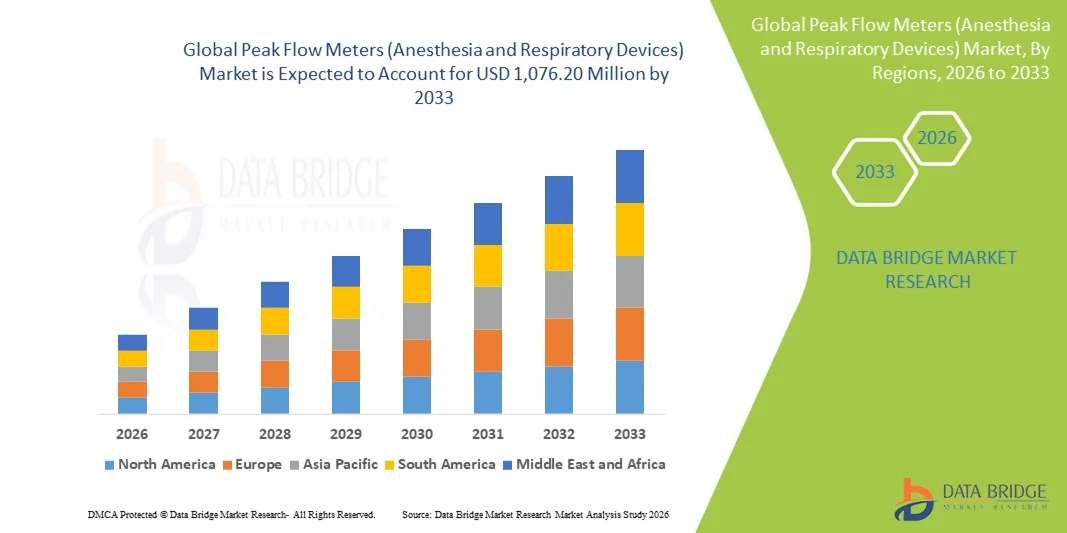
- The global peak flow meters (anesthesia and respiratory devices) market size was valued at USD 567.83 million in 2025 and is expected to reach USD 1,076.20 million by 2033, at a CAGR of 8.32% during the forecast period
- The market growth is largely fueled by the rising prevalence of respiratory disorders such as asthma and chronic obstructive pulmonary disease (COPD), increasing awareness of respiratory health, and continual innovations in portable and digital respiratory monitoring devices that enhance early detection and patient self‑management
- Furthermore, growing consumer demand for user‑friendly, accurate, and connected respiratory measurement solutions including digital and smartphone‑integrated peak flow meters combined with expanded home healthcare adoption and supportive healthcare investments, is positioning peak flow meters as essential tools in respiratory care. These converging factors are accelerating the uptake of advanced respiratory monitoring technologies, thereby significantly boosting the industry’s growth
Peak Flow Meters (Anesthesia and Respiratory Devices) Market Analysis
- Peak flow meters (anesthesia and respiratory devices), providing portable and easy-to-use respiratory monitoring for measuring lung function, are increasingly essential devices in managing respiratory disorders such as asthma and chronic obstructive pulmonary disease (COPD), both in home care and clinical settings, due to their accuracy, real-time feedback, and integration with digital health tracking tools
- The rising demand for peak flow meters (anesthesia and respiratory devices) is primarily driven by growing awareness of respiratory health, increasing prevalence of asthma and COPD, and the shift toward home-based monitoring solutions, as well as technological innovations in digital and smartphone-connected meters that improve usability and patient compliance
- North America dominated the peak flow meters (anesthesia and respiratory devices) market with the largest revenue share of 38.5% in 2025, attributed to high asthma prevalence, strong healthcare infrastructure, rising adoption of home monitoring devices, and the presence of leading device manufacturers driving innovation and distribution
- Asia-Pacific is expected to be the fastest-growing region in the peak flow meters (anesthesia and respiratory devices) market during the forecast period due to increasing respiratory disorder incidence, rising healthcare awareness, expanding healthcare infrastructure, and higher adoption of affordable digital and smartphone-integrated monitoring solutions
- Respiratory Devices segment dominated the peak flow meters (anesthesia and respiratory devices) market in 2025 with a share of 62.7%, due to their essential role in ongoing respiratory monitoring and increasing use in homecare and clinical applications
Report Scope and Peak Flow Meters (Anesthesia and Respiratory Devices) Market Segmentation
|
Attributes |
Peak Flow Meters (Anesthesia and Respiratory Devices) Key Market Insights |
|
Segments Covered |
|
|
Countries Covered |
North America
Europe
Asia-Pacific
Middle East and Africa
South America
|
|
Key Market Players |
|
|
Market Opportunities |
|
|
Value Added Data Infosets |
In addition to the insights on market scenarios such as market value, growth rate, segmentation, geographical coverage, and major players, the market reports curated by the Data Bridge Market Research also include in-depth expert analysis, patient epidemiology, pipeline analysis, pricing analysis, and regulatory framework |
Peak Flow Meters (Anesthesia and Respiratory Devices) Market Trends
Integration of Digital and Smartphone-Connected Monitoring
- A significant and accelerating trend in the global peak flow meters (anesthesia and respiratory devices) market is the growing integration of devices with digital apps and smartphone platforms, enabling real-time monitoring, data logging, and remote sharing of respiratory metrics with healthcare providers
- For instance, the Propeller Health Smart Peak Flow Meter connects with mobile applications to track daily readings, send reminders, and provide personalized insights for asthma management, while devices such as the RespiTrack enable synchronization with cloud-based patient portals for physician monitoring
- Digital integration allows features such as trend analysis, automatic alerts for abnormal readings, and gamified feedback to encourage patient adherence. For instance, some Peak Flow Meters now provide visual notifications and warnings if lung function drops below personalized thresholds, enabling timely intervention
- The ability to seamlessly integrate peak flow monitoring with broader digital health ecosystems, including telehealth platforms and wearable devices, supports centralized management of chronic respiratory conditions and promotes proactive care planning
- This trend toward connected, data-driven, and patient-centric respiratory monitoring is transforming user expectations for home and clinical respiratory care. Consequently, companies such as Omron and Philips are developing smart peak flow meters with automated data upload, app-based tracking, and alert notifications for both patients and clinicians
- The demand for peak flow meters (anesthesia and respiratory devices) that provide digital integration and remote monitoring is increasing rapidly across homecare, hospital, and clinic settings as healthcare providers and patients prioritize convenience, adherence, and continuous respiratory health monitoring
- Innovations in AI-driven analytics within peak flow devices allow predictive insights for asthma attacks and COPD exacerbations, improving proactive care and reducing hospitalizations
Peak Flow Meters (Anesthesia and Respiratory Devices) Market Dynamics
Driver
Rising Prevalence of Respiratory Disorders and Home Monitoring
- The increasing incidence of asthma, COPD, and other respiratory conditions, combined with the shift toward proactive home-based monitoring, is a key driver for the adoption of peak flow meters (anesthesia and respiratory devices)
- For instance, in March 2025, Omron Healthcare launched an advanced digital peak flow meter with smartphone integration to improve patient self-management and remote monitoring capabilities
- As patients and healthcare providers seek tools for early detection of lung function decline, peak flow meters provide real-time feedback, long-term tracking, and personalized alerts, making them an essential component of respiratory care
- Furthermore, increasing awareness of respiratory health, telemedicine adoption, and mobile health technologies is encouraging the integration of peak flow meters into daily patient routines, enhancing adherence and outcomes
- The convenience of portable, easy-to-use, and connected devices allows patients to track their lung function at home or on the go, while clinicians can remotely monitor progress and intervene early when necessary, driving adoption in both residential and clinical settings
- Government initiatives promoting remote patient monitoring and chronic disease management programs are creating additional growth avenues for peak flow meters
- Rising investments by healthcare providers and insurers in preventive care solutions are driving adoption of connected respiratory monitoring devices for cost-effective long-term disease management
Restraint/Challenge
Device Accuracy Concerns and User Compliance Barriers
- Concerns regarding measurement accuracy, calibration needs, and proper usage techniques pose significant challenges to widespread adoption of peak flow meters (anesthesia and respiratory devices)
- For instance, improper technique or inconsistent usage by patients can lead to unreliable readings, reducing the effectiveness of monitoring and adherence to treatment plans
- Addressing these issues through improved sensor technology, built-in calibration checks, and guided instructions within apps is crucial for enhancing reliability and user trust. In addition, the relatively higher cost of advanced digital or connected devices compared to basic mechanical meters can limit adoption, particularly in low-income regions
- While simpler peak flow meters are affordable, premium devices with app connectivity, automated alerts, and cloud-based tracking come at a higher price, which may deter price-sensitive consumers
- Overcoming these challenges through patient education, affordable device options, and robust accuracy validation will be essential for sustained growth in the peak flow meters (anesthesia and respiratory devices) market
- Limited digital literacy among elderly or rural patients can reduce effective utilization of smartphone-connected devices, slowing market penetration in certain demographics
- Inconsistent regulatory standards across regions for digital health devices create hurdles in market expansion, requiring manufacturers to adapt products for compliance in multiple countries
Peak Flow Meters (Anesthesia and Respiratory Devices) Market Scope
The market is segmented on the basis of product and end user.
- By Product
On the basis of product, the peak flow meters (anesthesia and respiratory devices) market is segmented into anesthesia devices and respiratory devices. The Respiratory Devices segment dominated the market with the largest revenue share of 62.7% in 2025, driven by the widespread use of peak flow meters for routine monitoring and management of chronic respiratory conditions such as asthma and chronic obstructive pulmonary disease (COPD). Respiratory peak flow meters are extensively used in hospitals, clinics, and homecare settings due to their simplicity, portability, and role in early detection of airflow limitation. The growing emphasis on preventive healthcare and self-monitoring has further strengthened demand for respiratory devices. In addition, the increasing adoption of digital and smartphone-connected respiratory peak flow meters has enhanced patient compliance and long-term disease management, reinforcing the dominance of this segment.
The Anesthesia Devices segment is expected to witness the fastest growth from 2026 to 2033, fueled by rising volumes of surgical procedures and increasing focus on perioperative respiratory assessment. Peak flow meters integrated within anesthesia-related respiratory monitoring are gaining traction for evaluating pulmonary function before and after anesthesia administration. The growing number of elective surgeries, especially among aging populations, is supporting demand for anesthesia-related respiratory monitoring tools. Furthermore, advancements in anesthesia delivery systems and rising awareness of anesthesia-associated respiratory risks are driving adoption. Hospitals are increasingly incorporating peak flow assessments into preoperative and postoperative protocols, contributing to accelerated growth of this segment.
- By End User
On the basis of end user, the peak flow meters (anesthesia and respiratory devices) market is segmented into hospitals, ambulatory service centers, homecare, and clinics. The Hospitals segment accounted for the largest revenue share of 46% in 2025, driven by high patient volumes, advanced diagnostic infrastructure, and widespread use of peak flow meters in inpatient and outpatient respiratory care. Hospitals routinely use peak flow meters for asthma management, COPD monitoring, preoperative respiratory evaluation, and postoperative recovery assessment. The presence of trained healthcare professionals ensures accurate usage and interpretation of results, supporting consistent demand. In addition, hospitals often adopt advanced digital peak flow meters integrated with electronic health records, reinforcing their dominant market position.
The Homecare segment is projected to be the fastest-growing end user from 2026 to 2033, supported by the increasing shift toward home-based disease management and remote patient monitoring. Rising awareness of self-monitoring for asthma and chronic respiratory conditions is encouraging patients to use peak flow meters at home for daily lung function assessment. The growing availability of user-friendly, portable, and app-connected peak flow meters has significantly enhanced adoption in homecare settings. Moreover, healthcare providers are increasingly recommending home monitoring to reduce hospital visits and manage chronic conditions more cost-effectively. The expansion of telehealth services and remote consultation models is further accelerating growth in the homecare segment.
Peak Flow Meters (Anesthesia and Respiratory Devices) Market Regional Analysis
- North America dominated the peak flow meters (anesthesia and respiratory devices) market with the largest revenue share of 38.5% in 2025, attributed to high asthma prevalence, strong healthcare infrastructure, rising adoption of home monitoring devices, and the presence of leading device manufacturers driving innovation and distribution
- Healthcare providers and patients in the region place strong emphasis on early diagnosis, continuous monitoring, and effective management of asthma and chronic obstructive pulmonary disease (COPD), leading to increased utilization of peak flow meters across hospitals, clinics, and homecare settings
- This widespread adoption is further supported by high healthcare spending, strong awareness of respiratory health, favorable reimbursement policies, and rapid integration of digital and remote monitoring solutions, establishing peak flow meters as essential tools in both clinical and home-based respiratory care settings
U.S. Peak Flow Meters (Anesthesia and Respiratory Devices) Market Insight
The U.S. peak flow meters (anesthesia and respiratory devices) market captured the largest revenue share of 79% in 2025 within North America, driven by the high prevalence of asthma and chronic obstructive pulmonary disease (COPD) and strong awareness of respiratory health management. Healthcare providers and patients increasingly prioritize early diagnosis and continuous monitoring of lung function, supporting sustained demand for peak flow meters. The growing adoption of home-based monitoring devices, combined with widespread use of digital and smartphone-connected respiratory tools, further propels market growth. Moreover, strong healthcare infrastructure, favorable reimbursement policies, and the integration of peak flow meters into telehealth and remote patient monitoring programs are significantly contributing to market expansion in the U.S.
Europe Peak Flow Meters (Anesthesia and Respiratory Devices) Market Insight
The Europe peak flow meters (anesthesia and respiratory devices) market is projected to expand at a substantial CAGR during the forecast period, primarily driven by rising respiratory disease burden and strong emphasis on preventive healthcare. Increasing awareness of asthma management and chronic respiratory monitoring across hospitals and primary care settings is fostering adoption. European healthcare systems focus on early intervention and cost-effective disease management, encouraging the use of peak flow meters in both clinical and homecare environments. The region is witnessing growing demand across hospitals, clinics, and homecare settings, with peak flow meters increasingly incorporated into routine respiratory assessment protocols.
U.K. Peak Flow Meters (Anesthesia and Respiratory Devices) Market Insight
The U.K. peak flow meters (anesthesia and respiratory devices) market is anticipated to grow at a noteworthy CAGR during the forecast period, driven by the rising incidence of asthma and increasing focus on self-monitoring and preventive care. National healthcare initiatives promoting early detection and management of respiratory conditions are supporting adoption. In addition, the growing use of homecare monitoring devices and the integration of peak flow meters into primary care practices are stimulating market growth. The U.K.’s strong emphasis on digital health and remote monitoring solutions further enhances demand for connected respiratory monitoring devices.
Germany Peak Flow Meters (Anesthesia and Respiratory Devices) Market Insight
The Germany peak flow meters (anesthesia and respiratory devices) market is expected to expand at a considerable CAGR during the forecast period, fueled by strong healthcare infrastructure and high awareness of respiratory disease management. Germany’s focus on clinical accuracy, quality medical devices, and preventive healthcare supports steady demand for peak flow meters in hospitals and clinics. The increasing adoption of respiratory monitoring tools for preoperative and postoperative assessment is also contributing to growth. Furthermore, the preference for technologically advanced and reliable medical devices aligns with the increasing uptake of digital peak flow meters in the country.
Asia-Pacific Peak Flow Meters (Anesthesia and Respiratory Devices) Market Insight
The Asia-Pacific peak flow meters (anesthesia and respiratory devices) market is poised to grow at the fastest CAGR during the forecast period of 2026 to 2033, driven by rising air pollution levels, increasing prevalence of respiratory diseases, and expanding healthcare access. Rapid urbanization, growing healthcare awareness, and improving diagnostic infrastructure in countries such as China, Japan, and India are supporting market growth. Government initiatives aimed at strengthening primary healthcare and chronic disease management are further encouraging adoption. In addition, the availability of affordable and portable peak flow meters is expanding access across a broader patient population.
Japan Peak Flow Meters (Anesthesia and Respiratory Devices) Market Insight
The Japan peak flow meters (anesthesia and respiratory devices) market is gaining momentum due to the country’s advanced healthcare system, aging population, and strong emphasis on preventive care. Respiratory monitoring is increasingly prioritized for elderly patients who are more susceptible to chronic respiratory conditions. The integration of peak flow meters into routine clinical assessments and homecare programs is driving adoption. Moreover, Japan’s focus on precision healthcare and digital health solutions is supporting the uptake of connected and easy-to-use respiratory monitoring devices.
India Peak Flow Meters (Anesthesia and Respiratory Devices) Market Insight
The India peak flow meters (anesthesia and respiratory devices) market accounted for the largest revenue share in Asia Pacific in 2025, attributed to rising air pollution, increasing asthma prevalence, and expanding healthcare awareness. India’s growing middle class and improving access to healthcare services are supporting demand for affordable respiratory monitoring tools. The increasing adoption of homecare devices and government initiatives aimed at strengthening respiratory disease management are further driving market growth. In addition, the presence of domestic manufacturers offering cost-effective peak flow meters is enhancing accessibility across urban and semi-urban regions.
Peak Flow Meters (Anesthesia and Respiratory Devices) Market Share
The Peak Flow Meters (Anesthesia and Respiratory Devices) industry is primarily led by well-established companies, including:
- Omron Healthcare Co., Ltd (Japan)
- Vyaire Medical, Inc (U.S.)
- Microlife Corporation (Switzerland)
- Vitalograph Ltd (U.K.)
- Clement Clarke International Ltd (U.K.)
- Rossmax International Ltd (Taiwan)
- PARI GmbH (Germany)
- Trudell Medical International (Canada)
- DeVilbiss Healthcare LLC (U.S.)
- Medline Industries, Inc (U.S.)
- NDD Medical Technologies, Inc (Switzerland)
- ResMed Inc (U.S.)
- BD (U.S.)
- SHL Telemedicine Ltd (Israel)
- GaleMed Corporation (China)
- Spengler SAS (France)
- Piston Medical Pvt Ltd (India)
- IndoSurgicals Private Limited (India)
- MicroDirect, Inc (U.S.)
What are the Recent Developments in Global Peak Flow Meters (Anesthesia and Respiratory Devices) Market?
- In March 2025, MGC Diagnostics introduced a new Bluetooth-enabled electronic peak flow meter with cloud-based analytics to enhance remote lung function monitoring for asthma and COPD patients, enabling clinicians to access patient data in real time for improved disease management
- In August 2024, Sonmol Electronic launched its electronic peak flow meter optimized for integration into remote patient monitoring systems, enabling seamless transmission of lung function data to healthcare providers for improved COPD and asthma management across telehealth platforms
- In August 2023, Accuhealth introduced the world’s first cellular-connected peak flow meter designed to aid patients with chronic obstructive pulmonary disease (COPD) in at-home respiratory monitoring by transmitting daily PEF and FEV1 readings directly into electronic health records, enabling improved chronic care management
- In April 2023, Tenovi, a remote patient monitoring solutions leader, launched its cellular-enabled remote Peak Expiratory Flow Meter (PFM) that allows asthma patients to transmit peak expiratory flow rate (PEF) and one-second forced expiratory volume (FEV1) readings instantly to clinicians, advancing connected lung monitoring and telehealth care
- In January 2022, Smart Respiratory showcased the world’s first integrated ‘smart’ peak flow meter at Arab Health 2022, featuring smartphone connectivity and AI-assisted lung function prediction to support asthma self-management and reduce hospital readmissions
SKU-
Get online access to the report on the World's First Market Intelligence Cloud
- Interactive Data Analysis Dashboard
- Company Analysis Dashboard for high growth potential opportunities
- Research Analyst Access for customization & queries
- Competitor Analysis with Interactive dashboard
- Latest News, Updates & Trend analysis
- Harness the Power of Benchmark Analysis for Comprehensive Competitor Tracking
Research Methodology
Data collection and base year analysis are done using data collection modules with large sample sizes. The stage includes obtaining market information or related data through various sources and strategies. It includes examining and planning all the data acquired from the past in advance. It likewise envelops the examination of information inconsistencies seen across different information sources. The market data is analysed and estimated using market statistical and coherent models. Also, market share analysis and key trend analysis are the major success factors in the market report. To know more, please request an analyst call or drop down your inquiry.
The key research methodology used by DBMR research team is data triangulation which involves data mining, analysis of the impact of data variables on the market and primary (industry expert) validation. Data models include Vendor Positioning Grid, Market Time Line Analysis, Market Overview and Guide, Company Positioning Grid, Patent Analysis, Pricing Analysis, Company Market Share Analysis, Standards of Measurement, Global versus Regional and Vendor Share Analysis. To know more about the research methodology, drop in an inquiry to speak to our industry experts.
Customization Available
Data Bridge Market Research is a leader in advanced formative research. We take pride in servicing our existing and new customers with data and analysis that match and suits their goal. The report can be customized to include price trend analysis of target brands understanding the market for additional countries (ask for the list of countries), clinical trial results data, literature review, refurbished market and product base analysis. Market analysis of target competitors can be analyzed from technology-based analysis to market portfolio strategies. We can add as many competitors that you require data about in the format and data style you are looking for. Our team of analysts can also provide you data in crude raw excel files pivot tables (Fact book) or can assist you in creating presentations from the data sets available in the report.