


Patient Handling Equipment Market Size
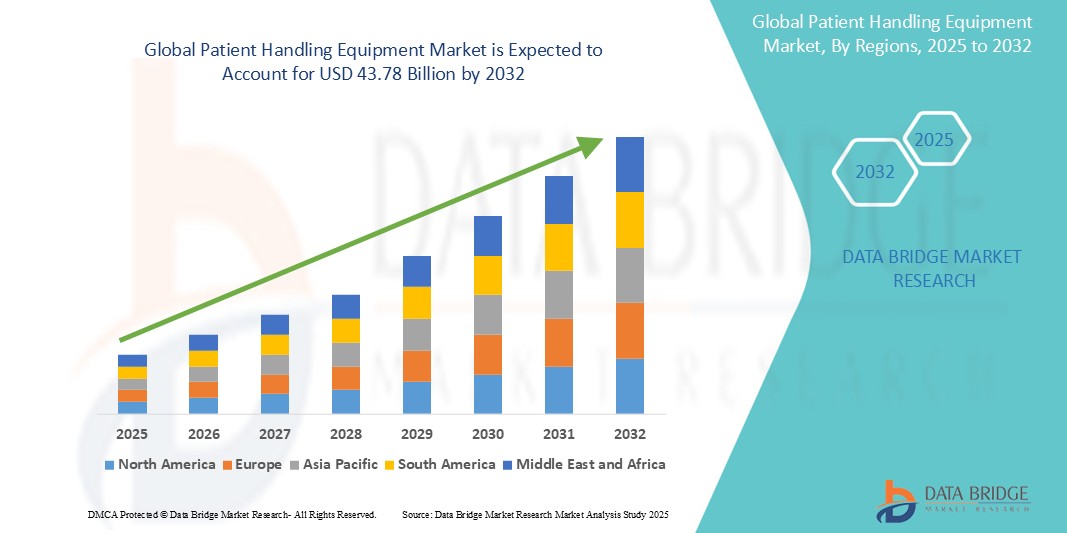
- The global patient handling equipment market size was valued at USD 17.49 billion in 2024 and is expected to reach USD 43.78 billion by 2032, at a CAGR of 12.15% during the forecast period
- The market growth is largely fueled by the increasing aging and obese populations worldwide, which necessitate more assistance with mobility and daily tasks. Furthermore, the rising incidence of chronic diseases and disabilities significantly contributes to the demand for specialized equipment to ensure patient safety and improve their quality of life
- Rising awareness regarding the high risk of injuries to caregivers during manual patient handling is establishing patient handling equipment as an essential solution for safer and more efficient patient transfers. These converging factors, alongside technological advancements in devices and increasing investments in healthcare infrastructure, are accelerating the uptake of patient handling solutions, thereby significantly boosting the industry's growth
Patient Handling Equipment Market Analysis
- Patient handling equipment, encompassing devices such as lifts, slings, stretchers, and specialized beds, are increasingly crucial components of modern healthcare, ensuring the safe and efficient transfer, repositioning, and mobility of patients with limited movement. This equipment is vital in various settings, including hospitals, long-term care facilities, and home care
- The escalating demand for patient handling equipment is primarily fueled by the globally increasing geriatric and obese populations, who often require assistance with daily tasks and mobility. Furthermore, growing concerns about the high risk of injuries to caregivers during manual patient handling and the implementation of regulations and guidelines promoting patient and caregiver safety are significant drivers
- North America dominates the patient handling equipment market with the largest revenue share of 37.5% in 2024, characterized by its advanced healthcare infrastructure, high healthcare expenditure, and a substantial aging population. The U.S. is a major contributor to this dominance, driven by technological advancements and strong emphasis on patient and staff safety
- Asia-Pacific is expected to be the fastest growing region in the patient handling equipment market during the forecast period with a CAGR of 12.6%, due to increasing healthcare expenditure, expanding geriatric populations, rising awareness about patient handling equipment, and the rapid development of healthcare infrastructure in countries
- Acute and critical care segment dominates the patient handling equipment market with a market share of 28.5% in 2024, driven by the increasing preference for in-home care, particularly among the elderly and those with chronic conditions, and the cost-effectiveness of home healthcare compared to institutional care
Report Scope and Patient Handling Equipment Market Segmentation
|
Attributes |
Patient Handling Equipment Key Market Insights |
|
Segments Covered |
|
|
Countries Covered |
North America
Europe
Asia-Pacific
Middle East and Africa
South America
|
|
Key Market Players |
|
|
Market Opportunities |
|
|
Value Added Data Infosets |
In addition to the insights on market scenarios such as market value, growth rate, segmentation, geographical coverage, and major players, the market reports curated by the Data Bridge Market Research also include in-depth expert analysis, pricing analysis, brand share analysis, consumer survey, demography analysis, supply chain analysis, value chain analysis, raw material/consumables overview, vendor selection criteria, PESTLE Analysis, Porter Analysis, and regulatory framework. |
Patient Handling Equipment Market Trends
“Technological Advancements and Smart Integration for Enhanced Care”
- A significant and accelerating trend in the global patient handling equipment market is the increasing integration of advanced technologies, including artificial intelligence (AI), the Internet of Things (IoT), and smart sensors. This fusion of technologies is fundamentally transforming patient care by enhancing safety, efficiency, and real-time monitoring capabilities
- For instance, manufacturers are developing AI-powered patient lifts that can learn patient movement patterns and adjust automatically, optimizing transfers and reducing the risk of injury for both patients and caregivers. Stryker's ProCuity hospital bed, for example, is a fully wireless, intelligent bed designed to help reduce in-hospital patient falls and improve nurse workflow efficiency
- AI integration in patient handling equipment enables features such as predictive maintenance for devices, ensuring optimal performance and minimizing downtime. This can also lead to more intelligent alerts based on patient activity or unusual equipment operation. For instance, some advanced lift systems can detect an uneven load distribution and alert caregivers to adjust, preventing potential accident
- Furthermore, voice control capabilities are emerging, offering users the ease of hands-free operation, allowing caregivers to control equipment remotely using simple verbal commands, thus improving workflow and reducing direct contact in certain situations. This enhances overall operational efficiency within healthcare facilities
- This trend towards more intelligent, intuitive, and interconnected patient handling solutions is fundamentally reshaping expectations for patient care and caregiver safety. Consequently, companies such as Arjo and Hill-Rom developing technologically advanced and ergonomically sound devices with features such as automated positioning and smart sensors to meet the evolving needs across hospitals, long-term care facilities, and home care settings
Patient Handling Equipment Market Dynamics
Driver
“Growing Need Due to Rising Geriatric and Obese Populations & Caregiver Safety Concerns"
- The increasing global prevalence of geriatric and obese populations, coupled with a heightened focus on ensuring caregiver safety, is a significant driver for the accelerated demand for patient handling equipment. As the world's population ages, a larger segment requires assistance with mobility due to age-related conditions and chronic diseases. Similarly, the growing prevalence of obesity necessitates specialized equipment capable of safely handling heavier individuals
- For instance, the United Nations projects that the proportion of the global population aged 65 and above will rise from 10% in 2022 to 16% by 2050, directly correlating with an increased need for mobility assistance. Simultaneously, the rising incidence of chronic diseases such as arthritis and cardiovascular conditions further contributes to the demand for equipment that facilitates safe movement
- As healthcare facilities and home care providers become more aware of the significant risk of musculoskeletal injuries to caregivers during manual patient handling, the adoption of mechanical and assistive devices is rapidly increasing. Occupational Safety and Health Administration (OSHA) recommendations for using mechanical lifting equipment are driving this shift, as organizations seek to reduce worker's compensation claims and improve staff well-being
- Furthermore, the growing emphasis on patient safety and comfort is propelling the adoption of advanced patient handling solutions. These devices not only protect caregivers from injury but also provide a more dignified and comfortable experience for patients during transfers and repositioning.
- The convenience offered by modern patient handling equipment, such as electric patient lifts, adjustable beds, and specialized slings, is a key factor. These solutions offer ease of use, reduce physical strain, and can often be operated by fewer personnel, leading to increased efficiency in healthcare settings. The trend towards home healthcare settings also significantly contributes to market growth, as families and caregivers seek reliable solutions for managing patient mobility in a non-institutional environment
Restraint/Challenge
“High Initial Costs, Maintenance Burdens, and Lack of Skilled Training"
- Concerns surrounding the high initial capital investment required for advanced patient handling equipment, coupled with the ongoing costs of maintenance and the challenges of ensuring adequate staff training, pose significant restraints to broader market penetration. While these devices are crucial for patient and caregiver safety, their considerable price tag can be a substantial barrier, particularly for healthcare facilities with limited budgets or in developing regions
- For instance, a single advanced patient lift can cost several thousands of dollars, and specialized beds or transfer systems can be even more expensive. This initial outlay is often compounded by the need for regular maintenance, repairs, and calibration to ensure the equipment remains safe and functional. These costs can strain the financial resources of smaller hospitals, nursing homes, and home care providers
- Addressing these cost concerns requires manufacturers to focus on developing more affordable yet effective solutions, alongside flexible financing options. Companies such as Invacare Corporation and Handicare are continuously working on optimizing their product lines to offer various price points. In addition, the perceived premium for advanced technology can still hinder widespread adoption, especially for those who do not immediately recognize the long-term benefits in terms of injury prevention and improved efficiency.
- Overcoming these challenges through enhanced affordability, comprehensive training programs, and consumer education on the long-term benefits and cost savings associated with reduced injuries and improved patient outcomes will be vital for sustained market growth. This includes developing user-friendly interfaces and clear operational guidelines to minimize the learning curve for staff
Patient Handling Equipment Market Scope
The market is segmented on the basis of mode, product type, type of care, accessories, application, and end user
- By Mode
On the basis of mode, the patient handling equipment market is segmented into mechanical equipment and non-mechanical equipment. The mechanical equipment segment dominated the largest market revenue share, driven by its ability to significantly reduce physical strain on caregivers and enhance patient safety during transfers. Innovations in electric and hydraulic systems, coupled with increasing automation in healthcare, contribute to its strong adoption
The non-mechanical equipment segment is anticipated to witness steady growth, fueled by its cost-effectiveness and versatility, particularly in home care settings and situations where basic, manual assistance is sufficient. These devices remain vital for patient mobility and support without requiring power sources
- By Product Type
On the basis of product type, the patient handling equipment market is segmented into medical beds, patient repositioning equipment, mobility aids, bathroom safety, and ambulatory aids. The medical beds segment is expected to hold the largest market revenue share, primarily due to their indispensable role in all healthcare settings and continuous technological advancements in features such as pressure redistribution, automated positioning, and integrated monitoring
The patient repositioning equipment segment is anticipated to witness the fastest growth rate, fueled by the increasing emphasis on preventing pressure ulcers, reducing caregiver injuries, and the rising demand for safe and efficient lateral transfers in acute and long-term care environments
- By Type of Care
On the basis of type of care, the patient handling equipment market is segmented into long-term care, bariatric care, acute and critical care, wound care, fall prevention, and others. The acute & critical care segment is expected to dominated the patient handling equipment market with a share of 28.5%, driven by the severe nature of the patient's ailments, acute and critical care units, including emergency departments and intensive care units (ICUs), need specialist patient handling equipment. These units frequently treat patients in severe conditions who have been hurt or require emergency care.
The long-term care segment is expected to witness fastest CAGR of 7.9%, driven by the rapidly growing geriatric population and the increasing prevalence of chronic conditions requiring ongoing assistance with mobility and daily living activities in nursing homes, assisted living facilities, and home care
- By Accessories
On the basis of accessories, the patient handling equipment market is segmented into hospital bed accessories, medical bed accessories, lifting accessories, transfer accessories, stretcher accessories, and others. The lifting accessories segment (primarily slings) is expected to hold the largest market revenue share, driven by their critical role as consumable components essential for the safe and effective operation of patient lifts across all care environments
The hospital bed accessories segment is expected to witness significant growth, fueled by the continuous upgrades and customization needs for hospital beds, including specialized mattresses for pressure injury prevention and various attachments that enhance patient comfort and care efficiency
- By Application
On the basis of application, the patient handling equipment market is segmented into acute and critical care, long-term care, mobility assistance, fall prevention, and others. The long-term care application is expected to hold the largest market revenue share, aligning with the dominant type of care and reflecting the extensive need for patient handling solutions in chronic care and elder care settings
The fall prevention application is anticipated to witness the fastest CAGR, driven by the increasing global awareness of patient safety, the high costs associated with falls, and the growing adoption of equipment such as low-height beds and alarms designed to mitigate fall risks across all healthcare environments
- By End User
On the basis of end-user, the patient handling equipment market is segmented into hospitals, home care settings, elderly care facilities, and others. The hospitals segment is expected to account for the largest market revenue share, driven by the high volume of patients, diverse medical procedures, and stringent safety protocols necessitating a wide array of patient handling equipment
The home care settings segment is anticipated to witness the fastest CAGR, fueled by the increasing patient preference for receiving care at home, the aging-in-place trend, and the growing availability of user-friendly and cost-effective patient handling solutions designed for residential use
Patient Handling Equipment Market Regional Analysis
- North America dominates the patient handling equipment market with the largest revenue share of 37.5% in 2024, driven by its advanced healthcare infrastructure, high healthcare expenditure, and a substantial aging population
- Consumers and healthcare providers in North America highly value the efficiency, safety, and advanced features offered by modern patient handling equipment, such as automated patient lifts and intelligent hospital beds
- This widespread adoption is further supported by significant investments in medical technology research and development, aiming to enhance patient comfort, reduce caregiver injuries, and improve overall operational efficiency in various care settings, from hospitals to home care
U.S. Patient Handling Equipment Market Insight
The U.S. patient handling equipment market captures a substantial revenue share within North America, primarily fueled by its highly developed healthcare infrastructure, significant healthcare spending, and robust government support for patient safety. Consumers and healthcare providers in the U.S. are increasingly prioritizing advanced, technologically integrated patient handling solutions due to the rising geriatric population, increased prevalence of chronic diseases, and stringent safety regulations from bodies such as OSHA. This robust demand ensures the U.S. remains a leading market for innovative patient handling systems
Europe Patient Handling Equipment Market Insight
The European patient handling equipment market is poised for considerable growth throughout the forecast period, primarily driven by stringent patient safety regulations, well-established healthcare infrastructure, and the region's aging population. European countries are actively implementing "no-lift" policies and investing in advanced equipment to reduce caregiver injuries and enhance patient dignity. The increasing prevalence of lifestyle diseases and a focus on improving patient recovery outcomes also contribute to the consistent demand for modern patient handling solutions across hospitals and long-term care facilities
U.K. Patient Handling Equipment Market Insight
The U.K. patient handling equipment market is anticipated to grow at a noteworthy CAGR, driven by the increasing emphasis on patient and caregiver safety, coupled with the aging demographic and rising prevalence of chronic conditions. The National Health Service (NHS) initiatives promoting safe patient handling practices and investments in upgrading healthcare infrastructure are key drivers. The U.K.'s focus on reducing musculoskeletal injuries among healthcare staff and improving the quality of care for immobile patients further stimulates the adoption of advanced lifting and transfer devices
Germany Patient Handling Equipment Market Insight
The German patient handling equipment market is expected to expand at a considerable CAGR, fueled by high healthcare expenditure, a strong focus on medical technology innovation, and a rapidly aging population. Germany's advanced healthcare system places a premium on ergonomic and efficient patient handling solutions to ensure optimal patient comfort and minimize occupational hazards for caregivers. The country's robust regulatory framework and continuous investment in modernizing healthcare facilities also significantly propel market growth across hospitals and elderly care settings
Asia-Pacific Patient Handling Equipment Market Insight
The Asia-Pacific patient handling equipment market is poised to grow at the fastest CAGR of 12.6%, driven by increasing urbanization, rising disposable incomes, and significant investments in healthcare infrastructure across countries such as China, Japan, and India. The region's rapidly expanding geriatric population, coupled with a growing awareness of patient and caregiver safety, is boosting the demand for advanced patient handling solutions. Furthermore, the increasing adoption of Western healthcare standards and the local manufacturing capabilities are making patient handling equipment more accessible and affordable to a wider consumer base
Japan Patient Handling Equipment Market Insight
The Japan patient handling equipment market is gaining significant momentum due to the country’s rapidly aging population (one of the highest globally), advanced healthcare infrastructure, and strong demand for innovative and user-friendly medical devices. The Japanese government's prioritization of aged care services and increased investments in nursing homes and long-term care facilities directly contribute to the market's expansion. There is a strong emphasis on ergonomic solutions that enhance patient comfort and dignity while reducing the burden on caregivers
India Patient Handling Equipment Market Insight
The India patient handling equipment market is experiencing substantial growth, primarily attributed to the country's expanding middle class, rapid urbanization, and increasing healthcare awareness. The growing demand for improved patient safety, coupled with the rising prevalence of chronic diseases and disabilities, is driving the adoption of patient handling equipment in both institutional and home care settings. Government initiatives to upgrade healthcare facilities and the increasing availability of affordable, locally manufactured patient handling solutions are key factors propelling the market in India
Patient Handling Equipment Market Share
The patient handling equipment industry is primarily led by well-established companies, including:
- Arjo (Sweden)
- Baxter (U.S.)
- Stryker (U.S.)
- Invacare Holdings Corporation (U.S.)
- Etac AB (Sweden)
- V. Guldmann A/S (Denmark)
- Joerns Healthcare (U.S.)
- Medline Industries, Inc. (U.S.)
- Savaria (Canada)
- LINET (Czech Republic)
- Stiegelmeyer GmbH & Co. KG (Germany)
- Handicare Group (Sweden)
- Medical Depot, Inc. (U.S.)
- GF Health Products, Inc. (U.S.)
- Prism Medical UK (U.K.)
- PARAMOUNT BED CO., LTD. (Japan)
- Sunrise Medical (U.S.)
- Getinge AB (Sweden)
- Malvestio S.p.A. (Italy)
Latest Developments in Global Patient Handling Equipment Market
- In April 2025 Apollo Hospitals announced a Rs 6,000 crore investment over five years to add 3,500 beds across India, including plans for expansion in Mumbai and Lucknow. This significant investment is expected to drive substantial demand for patient handling equipment in the region
- In June 2024, Etac Group acquired Klaxon Mobility GmbH, an Austrian developer of mobility solutions for wheelchair users. This strategic acquisition aims to expand Etac Group's product portfolio with innovative power assist solutions, enhancing mobility options and fostering collaboration for future advancements in assistive technologies
- In August 2024, Libpet, a Hong Kong-based health tech start-up, unveiled its innovative smart robot wheelchairs. These devices are designed for universal use, aiming to enhance mobility and productivity with minimal physical effort through innovative, inclusive technology
- In September 2024, Sunrise Medical announced the launch of the Empulse R90, a Red Dot award-winning push assist device for manual wheelchairs. This sleek and smart device provides powered assistance for longer distances and easier ramp navigation, aiming to reduce shoulder strain and preserve energy for manual wheelchair users
- In February 2024, Stryker Corporation expanded its prototype and testing facility in India. This move marks significant growth of its R& D footprint in the country, with the advanced 55,600-square-foot facility dedicated to rigorous life-cycle testing of medical devices, including plastic 3D printing and metal machining capabilities transactions. The initiative underscores Sentrilock's commitment to driving innovation and improving operational effectiveness within the real estate sector
- In March 2023, Golden Technologies LLC introduced new lightweight foldable power wheelchairs: the GP301 Stride aluminum folding power wheelchair and the GP302 Cricket carbon fiber folding power wheelchair. These models are designed for adaptability and convenience, offering ease of transport and storage for individuals needing mobility assistance

- Interactive Data Analysis Dashboard
- Company Analysis Dashboard for high growth potential opportunities
- Research Analyst Access for customization & queries
- Competitor Analysis with Interactive dashboard
- Latest News, Updates & Trend analysis
- Harness the Power of Benchmark Analysis for Comprehensive Competitor Tracking
Data collection and base year analysis are done using data collection modules with large sample sizes. The stage includes obtaining market information or related data through various sources and strategies. It includes examining and planning all the data acquired from the past in advance. It likewise envelops the examination of information inconsistencies seen across different information sources. The market data is analysed and estimated using market statistical and coherent models. Also, market share analysis and key trend analysis are the major success factors in the market report. To know more, please request an analyst call or drop down your inquiry.
The key research methodology used by DBMR research team is data triangulation which involves data mining, analysis of the impact of data variables on the market and primary (industry expert) validation. Data models include Vendor Positioning Grid, Market Time Line Analysis, Market Overview and Guide, Company Positioning Grid, Patent Analysis, Pricing Analysis, Company Market Share Analysis, Standards of Measurement, Global versus Regional and Vendor Share Analysis. To know more about the research methodology, drop in an inquiry to speak to our industry experts.
Data Bridge Market Research is a leader in advanced formative research. We take pride in servicing our existing and new customers with data and analysis that match and suits their goal. The report can be customized to include price trend analysis of target brands understanding the market for additional countries (ask for the list of countries), clinical trial results data, literature review, refurbished market and product base analysis. Market analysis of target competitors can be analyzed from technology-based analysis to market portfolio strategies. We can add as many competitors that you require data about in the format and data style you are looking for. Our team of analysts can also provide you data in crude raw excel files pivot tables (Fact book) or can assist you in creating presentations from the data sets available in the report.













