


What is Parental Control Software Market Size & Growth Rate?
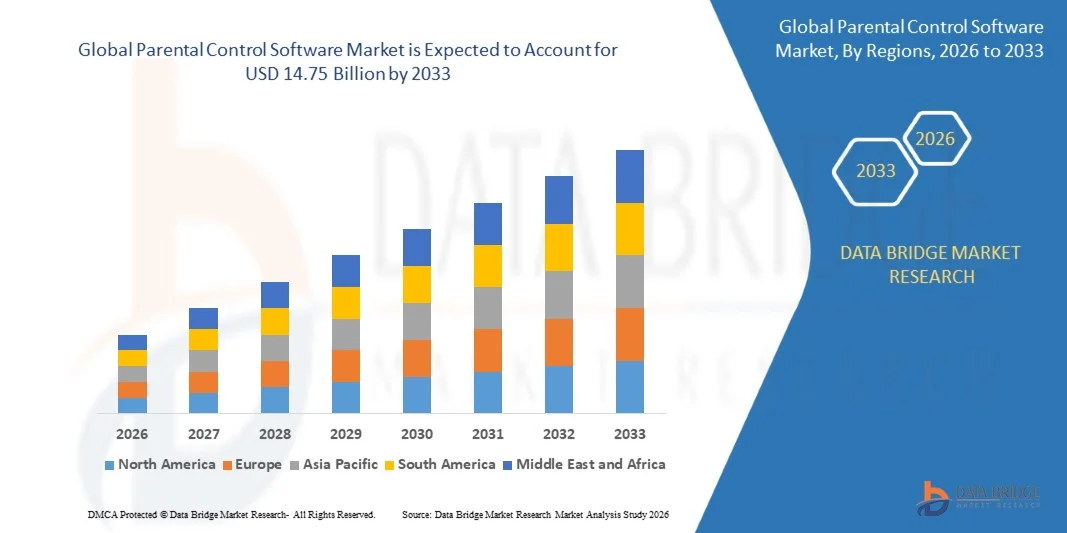
- As per Data Bridge Market Research Analysis the global Parental control software market size was valued at USD 4.11 billion in 2025 and is expected to reach USD 14.75 billion by 2033, at a CAGR of 17.30% during the forecast period
- The market growth is largely fuelled by the increasing concerns regarding children’s online safety and rising exposure to digital content
- Growing adoption of smartphones, tablets, and internet-enabled devices among children is further accelerating demand for parental control solutions
Market Size and Forecast:
- Global Market Value (2025): USD 4.11 billion
- Expected Market Value (2033): USD 14.75 billion
- Forecast CAGR (2026–2033):17.30%
How Parental Control Software Market Analysed?
- The market is witnessing rapid growth due to the increasing need for monitoring tools that ensure safe internet usage and digital well-being among children
- Advancements in AI-based monitoring, real-time tracking, and content filtering technologies are further strengthening the development and adoption of parental control software
- North America dominated the parental control software market with the largest revenue share in 2025, driven by rising concerns over children’s online safety and increasing adoption of digital devices
- Asia-Pacific region is expected to witness the highest growth rate in the global parental control software market, driven by rising digital education adoption, growing youth internet usage, and increasing demand for affordable cybersecurity and monitoring solutions
- The smart phones segment held the largest market revenue share in 2025 driven by the widespread usage of smartphones among children and teenagers and the increasing need for monitoring mobile-based activities. Smartphone-based solutions offer real-time tracking, app monitoring, and internet usage control, making them highly preferred by parents. The integration of advanced features such as GPS tracking and social media monitoring further strengthens segment growth. Increasing internet penetration and mobile-first digital behavior are also contributing to rising adoption
How Parental Control Software Market Segmented?
|
Attributes |
Parental Control Software Key Market Insights |
|
Segments Covered |
|
|
Countries Covered |
North America
Europe
Asia-Pacific
Middle East and Africa
South America
|
|
Key Market Players |
• Avast Software s.r.o. (Czech Republic) |
|
Market Opportunities |
• Increasing Demand For AI-Based Monitoring Solutions |
|
Value Added Data Infosets |
In addition to the market insights such as market value, growth rate, market segments, geographical coverage, market players, and market scenario, the market report curated by the Data Bridge Market Research team includes in-depth expert analysis, import/export analysis, pricing analysis, production consumption analysis, and pestle analysis. |
What are Parental Control Software Market Trends?
“Rising Demand for Digital Safety and Screen Time Management”
• The growing concern regarding children’s online safety and exposure to inappropriate content is significantly shaping the parental control software market, as parents increasingly seek tools to monitor and manage digital activities. These solutions are gaining traction due to their ability to provide real-time tracking, content filtering, and usage control across multiple devices. This trend is encouraging software providers to enhance features and improve user experience to meet evolving consumer expectations
• Increasing adoption of smartphones, tablets, and internet-enabled devices among children has accelerated the demand for parental control software across households globally. Parents are actively looking for solutions that can ensure safe browsing, restrict harmful content, and manage screen time effectively. This has led to the integration of advanced features such as app blocking, location tracking, and usage analytics
• Growing awareness around mental health, digital well-being, and balanced screen usage is influencing purchasing decisions, with parents prioritizing solutions that offer comprehensive monitoring and reporting capabilities. Companies are focusing on developing intuitive interfaces and customizable settings to improve accessibility and convenience. These factors are supporting strong market growth and product innovation
• For instance, in 2024, companies such as Qustodio and Net Nanny expanded their software capabilities by introducing AI-based monitoring, enhanced content filtering, and improved cross-platform compatibility. These updates were launched to address growing concerns around online safety and to strengthen their market presence
• While demand for parental control software is increasing, sustained market expansion depends on continuous technological advancements, data privacy compliance, and user-friendly design. Providers are also focusing on improving accuracy, reducing false alerts, and enhancing integration with multiple operating systems
What are Parental Control Software Market Dynamics?
Driver
“Increasing Concerns Over Children’s Online Safety”
• Rising concerns regarding cyber threats, online predators, and exposure to inappropriate content are major drivers for the parental control software market. Parents are increasingly adopting monitoring tools to ensure safe internet usage and protect children from digital risks. This trend is significantly boosting the demand for advanced parental control solutions
• Expanding use of digital learning platforms and online education tools is influencing market growth. As children spend more time online for academic purposes, the need for supervision and content control becomes more critical. Parental control software helps maintain a safe and productive digital environment for learning
• Technology companies are actively investing in innovation, integrating artificial intelligence and machine learning to enhance monitoring accuracy and provide real-time alerts. These advancements are improving product efficiency and encouraging wider adoption among tech-savvy consumers. Partnerships between software developers and educational platforms are also supporting market growth
• For instance, in 2023, Microsoft and Google enhanced their parental control features within operating systems and applications, offering improved screen time management, content restrictions, and activity reporting. These developments contributed to increased adoption of built-in parental control tools
• Although demand is growing, long-term market growth depends on maintaining data privacy, ensuring cybersecurity, and addressing ethical concerns related to monitoring. Continuous innovation and compliance with regulations will be essential for sustaining market expansion
Restraint/Challenge
“Privacy Concerns and Limited Awareness in Emerging Markets”
• Privacy concerns related to data collection and monitoring remain a key challenge, as users may be hesitant to adopt solutions that track personal activities. Ensuring transparency and compliance with data protection regulations is critical for building consumer trust. Companies must invest in secure systems and clear privacy policies
• Limited awareness and understanding of parental control tools in developing regions can restrict market growth. Many parents are unaware of available solutions or lack the technical knowledge to implement them effectively. This creates a gap in adoption despite increasing internet penetration
• Compatibility issues across devices and platforms can also impact user experience, as not all software solutions offer seamless integration. This may lead to reduced efficiency and user dissatisfaction. Developers need to focus on cross-platform functionality and ease of use to address these challenges
• For instance, in 2024, users in emerging markets utilizing solutions from Kaspersky and NortonLifeLock reported concerns regarding data privacy and complexity of setup, which affected adoption rates. These challenges highlight the need for simplified solutions and stronger consumer education
• Overcoming these challenges will require improved awareness campaigns, user-friendly interfaces, and strong data protection measures. Collaboration between technology providers, educational institutions, and regulatory bodies will help unlock the long-term potential of the parental control software market
What is Parental Control Software Market Scope?
The market is segmented on the basis of device type, deployment, pricing, and function.
• By Device Type
On the basis of device type, the parental control software market is segmented into smart phones, computers and video games, tablets, digital television, and others. The smart phones segment held the largest market revenue share in 2025 driven by the widespread usage of smartphones among children and teenagers and the increasing need for monitoring mobile-based activities. Smartphone-based solutions offer real-time tracking, app monitoring, and internet usage control, making them highly preferred by parents. The integration of advanced features such as GPS tracking and social media monitoring further strengthens segment growth. Increasing internet penetration and mobile-first digital behavior are also contributing to rising adoption.
The tablets segment is expected to witness the fastest growth rate from 2026 to 2033, driven by the rising use of tablets for online education, gaming, and entertainment among children. Tablets are widely adopted in e-learning environments, increasing the demand for monitoring and control solutions. These devices are often shared among family members, further necessitating parental supervision tools. Growing investments in digital education infrastructure are also supporting segment expansion. In addition, increasing screen time among children is accelerating demand for effective control solutions.
• By Deployment
On the basis of deployment, the parental control software market is segmented into on-premise and cloud. The cloud segment held the largest market revenue share in 2025 driven by its ease of access, scalability, and ability to provide real-time updates and remote monitoring capabilities. Cloud-based solutions allow centralized management across multiple devices and locations. They also support automatic updates and integration with various platforms. Increasing preference for subscription-based models is further boosting adoption. The flexibility and cost efficiency of cloud deployment are key factors supporting segment dominance.
The on-premise segment is expected to witness the fastest growth rate from 2026 to 2033, driven by increasing concerns over data privacy and the need for secure, locally managed solutions. On-premise deployment offers greater control over sensitive data and minimizes risks related to cloud storage. It is particularly preferred by users with strict privacy requirements. Advancements in local device processing and security features are enhancing its appeal. The segment is also benefiting from growing awareness regarding data protection regulations.
• By Pricing
On the basis of pricing, the parental control software market is segmented into free, basic, premium, and others. The free segment held the largest market revenue share in 2025 driven by the availability of no-cost solutions that offer essential features such as content filtering and screen time management. These solutions are widely adopted by price-sensitive users and new adopters exploring parental control tools. Free versions often serve as entry points for users before upgrading to paid plans. The widespread availability of freemium models is also supporting segment growth.
The premium segment is expected to witness the fastest growth rate from 2026 to 2033, driven by increasing demand for advanced features such as AI-based monitoring, detailed analytics, and multi-device compatibility. Premium solutions provide enhanced customization, deeper insights into user behavior, and stronger security features. They are particularly preferred by users seeking comprehensive digital safety solutions. Growing willingness to pay for child safety and digital well-being is further supporting segment expansion. Continuous innovation in premium offerings is also driving adoption.
• By Function
On the basis of function, the parental control software market is segmented into time management, gaming, app management, web access, program-specific controls, cyber security, and others. The web access segment held the largest market revenue share in 2025 driven by the growing need to filter and restrict harmful online content and ensure safe browsing for children. These tools help block inappropriate websites, monitor browsing activity, and enforce safe search settings. Increasing exposure to online content is further driving demand for web filtering solutions. The segment is also supported by regulatory focus on child online safety.
The cyber security segment is expected to witness the fastest growth rate from 2026 to 2033, driven by rising concerns regarding cyber threats, online fraud, and data breaches. Cyber security features in parental control software provide protection against malware, phishing attacks, and harmful applications. These tools enhance overall digital safety and reduce risks associated with internet usage. Growing awareness of cybersecurity risks among parents is accelerating adoption. Integration of AI and real-time threat detection is further strengthening segment growth.
Which Region Holds the Largest Share of the Parental Control Software Market?
• North America dominated the parental control software market with the largest revenue share in 2025, driven by rising concerns over children’s online safety and increasing adoption of digital devices
• Consumers in the region highly value advanced monitoring features, real-time alerts, and content filtering capabilities offered by parental control software across multiple platforms
• This widespread adoption is further supported by high internet penetration, strong technological infrastructure, and growing awareness regarding digital well-being, establishing parental control solutions as essential tools for households
U.S. Parental Control Software Market Insight
The U.S. parental control software market captured the largest revenue share in 2025 within North America, fueled by the rapid adoption of smartphones, tablets, and online learning platforms among children. Parents are increasingly focusing on monitoring screen time and ensuring safe internet usage through advanced software solutions. The demand for AI-based monitoring, real-time tracking, and app management tools is significantly driving the market. Moreover, the presence of leading technology companies and continuous innovation in digital safety solutions are contributing to strong market growth.
Europe Parental Control Software Market Insight
The Europe parental control software market is expected to witness the fastest growth rate from 2026 to 2033, primarily driven by increasing awareness of online safety and strict data protection regulations. The growing use of digital devices among children and the expansion of online education are supporting market growth. European consumers are also emphasizing privacy and secure monitoring solutions. The region is witnessing rising adoption across households and educational institutions, further boosting demand.
U.K. Parental Control Software Market Insight
The U.K. parental control software market is expected to witness the fastest growth rate from 2026 to 2033, driven by increasing concerns regarding cyber threats and children’s exposure to harmful online content. Parents are actively adopting monitoring tools to manage screen time and ensure safe browsing. The country’s strong digital infrastructure and widespread use of connected devices are supporting market expansion. In addition, the availability of subscription-based services is further encouraging adoption.
Germany Parental Control Software Market Insight
The Germany parental control software market is expected to witness the fastest growth rate from 2026 to 2033, fueled by growing emphasis on data privacy and digital security. Germany’s strong regulatory framework and awareness regarding cybersecurity are encouraging the use of parental control solutions. Increasing adoption of digital learning tools and connected devices is further driving demand. The market is also benefiting from technological advancements and innovation in monitoring solutions.
Asia-Pacific Parental Control Software Market Insight
The Asia-Pacific parental control software market is expected to witness the fastest growth rate from 2026 to 2033, driven by increasing smartphone penetration, rising internet usage, and growing awareness of online safety. The region’s expanding digital ecosystem and growing adoption of e-learning platforms are boosting demand for monitoring solutions. Countries such as China, India, and Japan are witnessing significant growth due to increasing digital engagement among children. Government initiatives promoting digital literacy are also supporting market expansion.
Japan Parental Control Software Market Insight
The Japan parental control software market is expected to witness the fastest growth rate from 2026 to 2033 due to the country’s advanced technological environment and high digital adoption. Parents are increasingly focusing on ensuring safe online experiences for children through advanced monitoring tools. The integration of parental control features with smart devices and applications is further driving growth. Moreover, the demand for secure and user-friendly solutions is supporting market expansion.
China Parental Control Software Market Insight
The China parental control software market accounted for the largest market revenue share in Asia Pacific in 2025, attributed to the country’s large population of internet users and increasing use of smartphones among children. The rapid expansion of digital platforms and online education is driving the demand for parental control solutions. China represents a significant market due to strong technological adoption and growing awareness of digital safety. The availability of cost-effective solutions and domestic software providers is further propelling market growth.
What is Parental Control Software Market Share?
The parental control software industry is primarily led by well-established companies, including:
• Avast Software s.r.o. (Czech Republic)
• Google (U.S.)
• Mobile Fence (South Korea)
• Eturi Corp. (U.S.)
• Bark (U.S.)
• Canopy (U.S.)
• Microsoft (U.S.)
• SafeDNS, Inc. (U.S.)
• NortonLifeLock Inc. (U.S.)
• SentryPC (U.S.)
• REVE Antivirus (Singapore)
• FamilyTime (U.S.)
• Verizon (U.S.)
• Cisco Systems, Inc. (U.S.)
• Bitdefender (Romania)
• SecureTeen (U.S.)
• RAM Antivirus (India)
• CYBERWISE (U.S.)
• mSpy (U.K.)
• AT&T (U.S.)
• Clean Router (U.S.)
• REFOG (U.S.)
What are Latest Developments in Global Parental Control Software Market?
- In January 2024, Snapchat, product enhancement, introduced updated parental control features for its MyAI chatbot, enabling parents to monitor and manage children’s usage along with privacy settings through the Family Center, improving digital safety, strengthening parental oversight, and enhancing trust in AI-driven social platforms
- In August 2023, Xsolla, product integration, launched enhanced parental control capabilities for game developers by integrating authentication tools that allow parents to manage access and permissions, improving child safety in gaming environments, strengthening developer compliance tools, and enhancing responsible gaming experiences
- In May 2023, Kaspersky, product upgrade, released an updated version of its Safe Kids application with a redesigned interface and advanced monitoring features, enabling better screen time control and digital safety guidance for parents, improving usability, strengthening child protection capabilities, and expanding adoption across mobile platforms
- In April 2023, Internet Matters and Amazon Kids, collaboration, partnered to launch educational resources through the Family Digital Well-Being Hub, helping parents guide children’s online behavior, improving awareness of digital safety, strengthening family engagement with connected devices, and supporting safer internet usage among children
- In February 2023, Bark Technologies and Vilo Living, partnership, collaborated to integrate parental control solutions into mesh Wi-Fi systems, enabling in-home monitoring without additional cost, improving household digital safety, expanding accessibility of parental control tools, and strengthening cybersecurity protection for families in the U.S.
- In January 2023, Linewise (Family Zone), product launch, introduced Qustodio for school administrators and parents to monitor school-issued devices, improving visibility and reporting of student device usage, enhancing digital safety in educational environments, and strengthening collaboration between schools and families for responsible device usage

- Interactive Data Analysis Dashboard
- Company Analysis Dashboard for high growth potential opportunities
- Research Analyst Access for customization & queries
- Competitor Analysis with Interactive dashboard
- Latest News, Updates & Trend analysis
- Harness the Power of Benchmark Analysis for Comprehensive Competitor Tracking
Data collection and base year analysis are done using data collection modules with large sample sizes. The stage includes obtaining market information or related data through various sources and strategies. It includes examining and planning all the data acquired from the past in advance. It likewise envelops the examination of information inconsistencies seen across different information sources. The market data is analysed and estimated using market statistical and coherent models. Also, market share analysis and key trend analysis are the major success factors in the market report. To know more, please request an analyst call or drop down your inquiry.
The key research methodology used by DBMR research team is data triangulation which involves data mining, analysis of the impact of data variables on the market and primary (industry expert) validation. Data models include Vendor Positioning Grid, Market Time Line Analysis, Market Overview and Guide, Company Positioning Grid, Patent Analysis, Pricing Analysis, Company Market Share Analysis, Standards of Measurement, Global versus Regional and Vendor Share Analysis. To know more about the research methodology, drop in an inquiry to speak to our industry experts.
Data Bridge Market Research is a leader in advanced formative research. We take pride in servicing our existing and new customers with data and analysis that match and suits their goal. The report can be customized to include price trend analysis of target brands understanding the market for additional countries (ask for the list of countries), clinical trial results data, literature review, refurbished market and product base analysis. Market analysis of target competitors can be analyzed from technology-based analysis to market portfolio strategies. We can add as many competitors that you require data about in the format and data style you are looking for. Our team of analysts can also provide you data in crude raw excel files pivot tables (Fact book) or can assist you in creating presentations from the data sets available in the report.













