

Global Os Level Server Virtualization Market
Market Size in USD Billion

 USD
20.91 Billion
USD
36.20 Billion
2025
2033
USD
20.91 Billion
USD
36.20 Billion
2025
2033
Forecast Period |
2026 - 2033 |
Market Size (Base Year) |
USD 20.91 Billion |
Market Size (Forecast Year) |
USD 36.20 Billion |
CAGR |
% |
Major Markets Players |
|
 Forecast Period
 Market Size (Base Year)
 Market Size (Forecast Year)
 CAGR
CAGR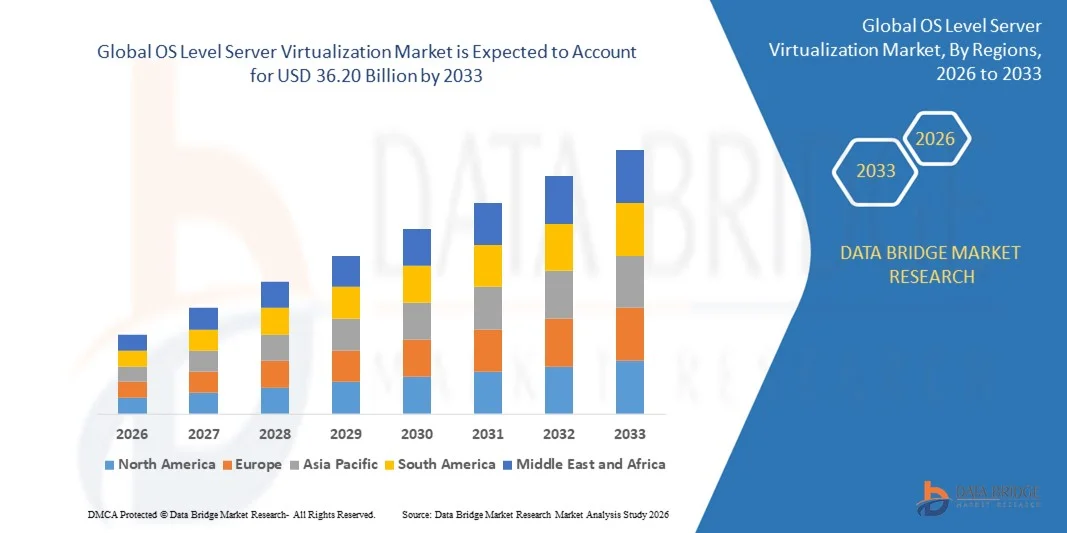
OS Level Server Virtualization Market Size
- The global OS level server virtualization market size was valued at USD 20.91 billion in 2025 and is expected to reach USD 36.20 billion by 2033, at a CAGR of 7.10% during the forecast period
- The market growth is largely fueled by the increasing adoption of cloud computing, data center modernization, and enterprise IT infrastructure optimization, leading to higher demand for OS level server virtualization solutions across multiple industries
- Furthermore, the rising need for cost-efficient, scalable, and flexible server management solutions is driving enterprises to adopt OS level virtualization for improved workload consolidation, resource utilization, and simplified IT operations. These factors are accelerating the deployment of virtualization platforms, thereby significantly boosting market growth
OS Level Server Virtualization Market Analysis
- OS level server virtualization enables multiple virtual machines to run on a single physical server, allowing for optimized resource utilization, reduced hardware costs, and simplified management of IT workloads. These solutions support hybrid and multi-cloud environments, enhancing operational flexibility and disaster recovery capabilities for enterprises
- The escalating demand for OS level server virtualization is primarily driven by enterprise digital transformation initiatives, the need for efficient server management, rising adoption of cloud services, and increasing focus on high availability and business continuity across IT infrastructure
- North America dominated the OS level server virtualization market with a share of 42.09% in 2025, due to the early and widespread adoption of virtualization technologies, strong cloud infrastructure, and heavy investment in digital transformation across enterprise IT environments
- Asia-Pacific is expected to be the fastest growing region in the OS level server virtualization market during the forecast period due to rapid digitalization, increasing cloud adoption, and expanding IT infrastructure in countries such as China, Japan, and India
- Software segment dominated the market with a market share of around 40% in 2025, due to its key role in enabling virtualization and efficient resource utilization across servers. Organizations prefer software for its ability to partition physical servers into multiple isolated environments while supporting workload balancing and security controls. Vendor ecosystems offering management tools and cloud integration further strengthen software demand. Customers view software as high-value due to continuous enhancements and compatibility with hybrid environments
Report Scope and OS Level Server Virtualization Market Segmentation
|
Attributes |
OS Level Server Virtualization Key Market Insights |
|
Segments Covered |
|
|
Countries Covered |
North America
Europe
Asia-Pacific
Middle East and Africa
South America
|
|
Key Market Players |
|
|
Market Opportunities |
|
|
Value Added Data Infosets |
In addition to the market insights such as market value, growth rate, market segments, geographical coverage, market players, and market scenario, the market report curated by the Data Bridge Market Research team includes in-depth expert analysis, import/export analysis, pricing analysis, production consumption analysis, and pestle analysis. |
OS Level Server Virtualization Market Trends
Rising Adoption of Hybrid and Multi-Cloud Virtualization Solutions
- A significant trend in the OS level server virtualization market is the increasing adoption of hybrid and multi-cloud environments, driven by the growing need for flexible, scalable, and cost-efficient IT infrastructure across enterprises. This trend is enabling organizations to run workloads seamlessly across on-premises servers, public clouds, and private cloud setups, enhancing operational efficiency and disaster recovery capabilities
- For instance, VMware’s vSphere and Tanzu platforms allow enterprises to manage VMs and containerized applications across hybrid cloud environments, providing unified management and automated orchestration. These solutions reduce complexity and improve resource utilization across distributed IT landscapes
- The trend is further strengthened by the expansion of cloud services from providers such as Amazon Web Services and Microsoft Azure, which integrate OS level virtualization tools with cloud-native management, enabling businesses to scale workloads on demand and optimize server utilization
- Enterprises in sectors such as banking, healthcare, and e-commerce are increasingly leveraging hybrid virtualization solutions to maintain high availability, improve workload mobility, and enhance security for critical applications. This is positioning OS level virtualization as a core component of modern IT strategies
- The adoption of hybrid and multi-cloud virtualization is also accelerating innovation in virtualization management tools, as vendors focus on automating deployment, monitoring, and orchestration across complex environments
- The market is witnessing steady growth as organizations aim to reduce hardware costs, improve energy efficiency, and consolidate server workloads, establishing OS level virtualization as a standard approach for enterprise IT modernization
OS Level Server Virtualization Market Dynamics
Driver
Increasing Demand for Cost-Efficient and Scalable IT Infrastructure
- The OS level server virtualization market is driven by the rising demand for cost-effective, scalable, and high-performing IT infrastructure that allows enterprises to consolidate servers and optimize resource utilization. Organizations are seeking solutions that reduce operational expenses while improving business continuity and performance
- For instance, Red Hat OpenShift Virtualization enables enterprises to run VM workloads alongside containerized applications on a single platform, lowering hardware costs and simplifying IT management. Such solutions help organizations scale workloads dynamically and respond quickly to changing business requirements
- The growing focus on digital transformation, cloud migration, and modernization of data centers is further boosting the adoption of OS level virtualization, as enterprises seek flexible deployment models and faster provisioning of resources
- Major IT service providers, including IBM and Dell Technologies, are offering integrated virtualization solutions that combine hypervisors, storage, and management tools to provide a complete, cost-efficient infrastructure package for businesses
- The increasing pressure on enterprises to improve operational efficiency, reduce energy consumption, and achieve higher server utilization continues to drive the uptake of OS level virtualization technologies
Restraint/Challenge
Complexity in Managing Diverse Virtualization Environments
- The OS level server virtualization market faces challenges due to the complexity involved in managing multiple virtualization platforms, hypervisors, and hybrid cloud setups. Enterprises often struggle to ensure seamless integration, consistent security policies, and efficient monitoring across heterogeneous environments
- For instance, organizations using a mix of VMware, Hyper-V, and Red Hat Virtualization need specialized skills and advanced orchestration tools to manage workloads effectively. This adds operational overhead and increases reliance on trained IT personnel
- Ensuring compatibility, performance optimization, and high availability across diverse virtualization environments requires advanced management solutions and automated orchestration, which may increase costs and slow adoption in some organizations
- The challenge is further amplified in large-scale enterprise deployments where multiple teams, legacy systems, and cloud-native applications must coexist within a unified virtualization strategy
- These complexities continue to constrain market growth by raising implementation barriers and creating a need for streamlined, integrated solutions that simplify management while maintaining security and performance standards
OS Level Server Virtualization Market Scope
The market is segmented on the basis of component, deployment type, organization size, and end-user.
- By Component
On the basis of component, the OS level server virtualization market is segmented into hardware, software, and services. The software segment dominated the largest market revenue share of around 40% in 2025, driven by its key role in enabling virtualization and efficient resource utilization across servers. Organizations prefer software for its ability to partition physical servers into multiple isolated environments while supporting workload balancing and security controls. Vendor ecosystems offering management tools and cloud integration further strengthen software demand. Customers view software as high-value due to continuous enhancements and compatibility with hybrid environments.
The services segment is anticipated to witness the fastest growth rate from 2026 to 2033, fueled by rising demand for consulting, integration, and management services that help enterprises implement virtualization successfully. Services such as deployment support, training, and managed operations are critical for performance and security optimization. Enterprises increasingly rely on experts to manage hybrid and multi-cloud environments, driving strong CAGR for services.
- By Deployment Type
On the basis of deployment type, the market is segmented into cloud and on‑premises. The on‑premises segment held the largest market revenue share in 2025, driven by enterprises’ preference for control over critical workloads and data in regulated industries. On-premises adoption is supported by existing data center infrastructure, direct performance management, and compatibility with legacy applications. IT teams’ expertise in local platform management further strengthens revenue dominance.
The cloud segment is expected to witness the fastest CAGR from 2026 to 2033, propelled by growing adoption of hybrid and cloud-native architectures. Cloud virtualization offers scalability, flexible pricing, and integration with analytics and DevOps tools. SMBs and large enterprises adopt cloud deployment to improve agility, cost efficiency, and workload portability.
- By Organization Size
On the basis of organization size, the market is segmented into large enterprises and SMEs. The large enterprises segment dominated the largest market revenue share in 2025, driven by high IT budgets, extensive server estates, and the need for automation and disaster recovery. Large organizations prioritize virtualization to optimize server utilization and support global operations.
The SMEs segment is anticipated to witness the fastest growth rate from 2026 to 2033, as affordable and easy-to-deploy virtualization enables smaller businesses to consolidate servers and improve efficiency. Simplified licensing, bundled support, and cloud-friendly options accelerate adoption among SMEs pursuing digital transformation.
- By End User
On the basis of end user, the market is segmented into BFSI, telecommunications and IT, healthcare, transportation and logistics, and others. The telecommunications and IT segment dominated the largest market revenue share in 2025, driven by network infrastructure demands, virtualization for service platforms, and software-defined networks. Virtualization supports scalable workloads, high uptime, and rapid provisioning essential for telecom and IT services.
The healthcare segment is expected to witness the fastest CAGR from 2026 to 2033, fueled by digitization of patient records, telehealth platforms, and need for secure, scalable infrastructure. Virtualization helps healthcare providers consolidate servers, ensure compliance, and optimize system performance, driving strong adoption growth.
OS Level Server Virtualization Market Regional Analysis
- North America dominated the OS level server virtualization market with the largest revenue share of 42.09% in 2025, driven by the early and widespread adoption of virtualization technologies, strong cloud infrastructure, and heavy investment in digital transformation across enterprise IT environments
- The presence of major technology vendors and advanced data center ecosystems further reinforces the region’s leadership position. U.S. enterprises prioritize virtualization for cost‑efficient resource management, security, and scalability, pushing demand higher year over year
- The robust regulatory focus on secure, compliant IT operations also fuels adoption across BFSI, healthcare, IT & telecom, and government sectors. Overall, mature IT markets and innovation hubs sustain North America’s dominant share globally
U.S. OS Level Server Virtualization Market Insight
The U.S. OS level server virtualization market captured the largest revenue share in 2025 within North America, fueled by rapid digital transformation initiatives and cloud adoption among enterprises. Organizations are increasingly focusing on server consolidation and high availability solutions to optimize operational efficiency. The growing trend of hybrid cloud deployment, alongside demand for containerization and virtualized workloads, is accelerating market growth. In addition, integration of virtualization platforms with management and orchestration tools such as VMware vSphere and Microsoft System Center is significantly contributing to market expansion.
Europe OS Level Server Virtualization Market Insight
The Europe OS level server virtualization market is projected to grow at a significant CAGR during the forecast period, driven by the increasing demand for energy-efficient data centers and compliance with strict IT regulations. Enterprises are adopting virtualization to reduce hardware costs and improve scalability of their IT infrastructure. The presence of key players such as IBM and Red Hat, coupled with increasing adoption across financial, healthcare, and government sectors, is fostering market growth. The market is also supported by European initiatives for green IT and sustainable technology practices.
U.K. OS Level Server Virtualization Market Insight
The U.K. OS level server virtualization market is anticipated to expand at a notable CAGR during the forecast period, fueled by the increasing trend of cloud migration and digital infrastructure upgrades. Concerns regarding operational efficiency and IT agility are encouraging enterprises to adopt virtualization solutions. The country’s well-established IT services ecosystem, along with strong government support for cloud-first policies, is expected to continue driving market growth. Major IT service providers such as VMware, Microsoft, and Canonical are strengthening their presence to capture the growing demand.
Germany OS Level Server Virtualization Market Insight
The Germany OS level server virtualization market is expected to grow at a considerable CAGR during the forecast period, supported by increasing enterprise investments in digital transformation and smart manufacturing initiatives. Germany’s focus on Industry 4.0 and advanced data management is fostering virtualization adoption in manufacturing and IT sectors. The integration of OS level virtualization with cloud and container platforms, such as Red Hat OpenShift, is becoming more prevalent. Furthermore, enterprises are prioritizing solutions that ensure security, compliance, and energy efficiency.
Asia-Pacific OS Level Server Virtualization Market Insight
The Asia-Pacific OS level server virtualization market is poised to grow at the fastest CAGR during the forecast period of 2026 to 2033, driven by rapid digitalization, increasing cloud adoption, and expanding IT infrastructure in countries such as China, Japan, and India. The region’s growing enterprise sector, supported by government initiatives promoting smart data centers and cloud services, is accelerating virtualization adoption. Furthermore, as APAC becomes a hub for IT services and software development, the availability of cost-effective solutions is widening access for SMEs and large organizations alike.
Japan OS Level Server Virtualization Market Insight
The Japan OS level server virtualization market is gaining momentum due to the country’s focus on digital transformation, IT efficiency, and automation in enterprise operations. The adoption is driven by the need for server consolidation, workload optimization, and improved disaster recovery solutions. Integration with cloud platforms and containerized environments, such as VMware Tanzu and Red Hat OpenShift, is fueling growth. Moreover, Japan’s emphasis on innovation, energy efficiency, and automation in both commercial and industrial sectors is boosting demand for advanced virtualization solutions.
China OS Level Server Virtualization Market Insight
The China OS level server virtualization market accounted for the largest revenue share in Asia-Pacific in 2025, attributed to the country’s rapidly expanding enterprise IT sector, high cloud adoption, and government support for digital infrastructure. Virtualization is increasingly deployed across banking, telecom, and e-commerce sectors to enhance resource utilization and operational agility. The presence of strong domestic providers, such as Huawei and Alibaba Cloud, offering virtualization and cloud-integrated solutions, is a key factor driving market growth. Furthermore, China’s push towards smart cities and next-generation data centers is creating sustained demand for OS level virtualization solutions.
OS Level Server Virtualization Market Share
The OS level server virtualization industry is primarily led by well-established companies, including:
- IBM (U.S.)
- Microsoft (U.S.)
- Amazon Web Services, Inc. (U.S.)
- Oracle (U.S.)
- Dell (U.S.)
- Cisco Systems, Inc. (U.S.)
- Google LLC (U.S.)
- VMware, Inc. (U.S.)
- Huawei Technologies Co., Ltd. (China)
- Embotics Corporation (Canada)
- Zerto Ltd. (U.K.)
- Citrix Systems, Inc. (U.S.)
- Red Hat, Inc. (U.S.)
- Odin, Inc. (U.S.)
- i2k2 Networks (India)
- PCS Technology Ltd. (India)
- Proxmox Server Solutions GmbH (Germany)
- Broadcom (U.S.)
- Accenture (Ireland)
- Capgemini (France)
Latest Developments in Global OS Level Server Virtualization Market
- In October 2025, NetApp and Red Hat expanded their collaboration to deepen joint development around Red Hat OpenShift Virtualization, enabling enterprises to modernize and migrate workloads more efficiently. This strengthened alliance allows customers to run both VMs and container workloads with unified tools across on‑premises and cloud environments, reducing migration complexity and enhancing hybrid cloud flexibility for businesses scaling virtualization operations
- In September 2025, Shadow‑Soft was named a Red Hat Specialized Partner for virtualization, giving it validated expertise to accelerate enterprise migrations to Red Hat OpenShift Virtualization. This expands service capabilities for organizations moving away from legacy virtualization, helping them reduce costs and operational risks while increasing adoption of modern, container‑enabled virtualization architectures
- In May 2025, Pure Storage and Red Hat collaborated to introduce Portworx for KubeVirt with Red Hat OpenShift Virtualization Engine, delivering optimized storage and management for VM workloads on Kubernetes. This integration helps enterprises cut total cost of ownership and simplifies management of mixed VM and container environments, driving broader OS‑level virtualization adoption by reducing infrastructure complexity
- In November 2025, Red Hat released OpenShift Virtualization 4.20, a major version focused on improved VM management, live migrations, and expanded hybrid cloud support. This update makes it easier for organizations to run, scale, and extend VM workloads across public clouds and on‑prem environments, helping virtualization vendors and users align with hybrid multicloud strategies
- In February 2025, Veeam introduced enhanced disaster recovery orchestration for Microsoft Hyper‑V in its Data Platform Premium, enabling enterprises to automate recovery planning and simplify migration between hypervisors. This development increases resilience for OS‑level virtualization environments and supports diversified hypervisor strategies, making virtualization operations more robust and flexible for IT teams
SKU-

- Interactive Data Analysis Dashboard
- Company Analysis Dashboard for high growth potential opportunities
- Research Analyst Access for customization & queries
- Competitor Analysis with Interactive dashboard
- Latest News, Updates & Trend analysis
- Harness the Power of Benchmark Analysis for Comprehensive Competitor Tracking
Data collection and base year analysis are done using data collection modules with large sample sizes. The stage includes obtaining market information or related data through various sources and strategies. It includes examining and planning all the data acquired from the past in advance. It likewise envelops the examination of information inconsistencies seen across different information sources. The market data is analysed and estimated using market statistical and coherent models. Also, market share analysis and key trend analysis are the major success factors in the market report. To know more, please request an analyst call or drop down your inquiry.
The key research methodology used by DBMR research team is data triangulation which involves data mining, analysis of the impact of data variables on the market and primary (industry expert) validation. Data models include Vendor Positioning Grid, Market Time Line Analysis, Market Overview and Guide, Company Positioning Grid, Patent Analysis, Pricing Analysis, Company Market Share Analysis, Standards of Measurement, Global versus Regional and Vendor Share Analysis. To know more about the research methodology, drop in an inquiry to speak to our industry experts.
Data Bridge Market Research is a leader in advanced formative research. We take pride in servicing our existing and new customers with data and analysis that match and suits their goal. The report can be customized to include price trend analysis of target brands understanding the market for additional countries (ask for the list of countries), clinical trial results data, literature review, refurbished market and product base analysis. Market analysis of target competitors can be analyzed from technology-based analysis to market portfolio strategies. We can add as many competitors that you require data about in the format and data style you are looking for. Our team of analysts can also provide you data in crude raw excel files pivot tables (Fact book) or can assist you in creating presentations from the data sets available in the report.