


Optogenetics Actuators and Sensors Market Size
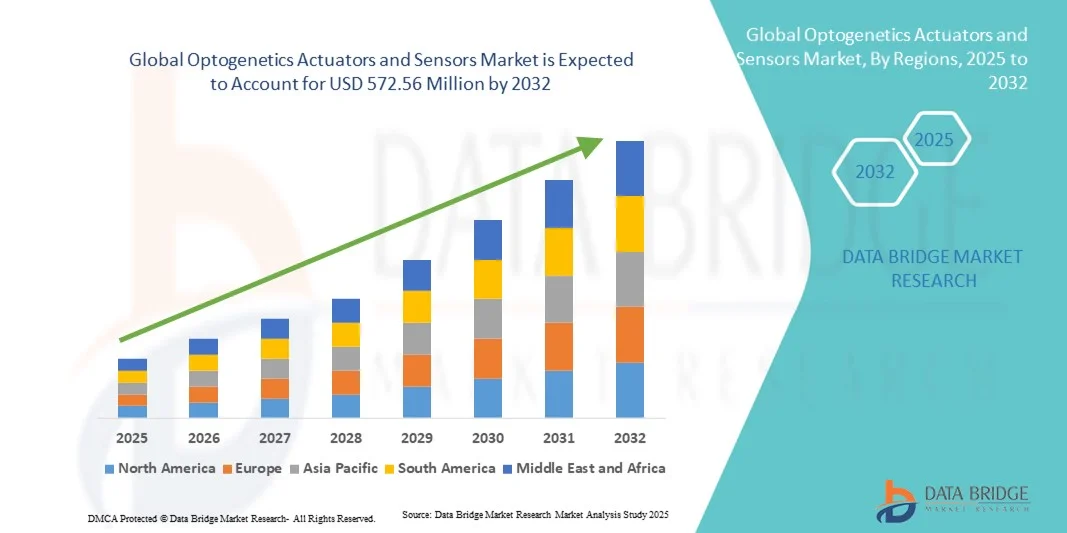
- The global optogenetics actuators and sensors market size was valued at USD 469.20 Million in 2024 and is expected to reach USD 572.56 Million by 2032, at a CAGR of 2.52% during the forecast period
- The market growth is largely fueled by the growing adoption and technological advancements in optogenetics, leading to increased utilization of actuators and sensors in both research and clinical applications
- Furthermore, rising demand for precise, efficient, and minimally invasive neural modulation tools is driving the adoption of optogenetics actuators and sensors, thereby significantly boosting the industry's growth
Optogenetics Actuators and Sensors Market Analysis
- The optogenetics actuators and sensors market growth is largely fueled by the growing adoption and technological advancements in optogenetics, leading to increased utilization of actuators and sensors in both research and clinical applications
- Furthermore, rising demand for precise, efficient, and minimally invasive neural modulation tools is driving the adoption of optogenetics actuators and sensors, thereby significantly boosting the industry's growth
- North America dominated the optogenetics actuators and sensors market with the largest revenue share of 43.5% in 2024, characterized by advanced research infrastructure, high investment in neuroscience and biotech, and a strong presence of key industry players, with the U.S. experiencing substantial growth in installations, driven by innovations from both established tech companies and startups focusing on high-precision actuators and sensors
- Asia-Pacific is expected to be the fastest-growing region in the optogenetics actuators and sensors market during the forecast period due to increasing research initiatives, rising healthcare and biotech investments, and growing adoption of advanced neural modulation technologies
- The Sensors segment dominated the largest market revenue share of 46.3% in 2024, owing to its crucial role in accurately detecting and monitoring physiological signals in real time for neurological and retinal applications
Report Scope and Optogenetics Actuators and Sensors Market Segmentation
|
Attributes |
Optogenetics Actuators and Sensors Key Market Insights |
|
Segments Covered |
|
|
Countries Covered |
North America
Europe
Asia-Pacific
Middle East and Africa
South America
|
|
Key Market Players |
|
|
Market Opportunities |
|
|
Value Added Data Infosets |
In addition to the insights on market scenarios such as market value, growth rate, segmentation, geographical coverage, and major players, the market reports curated by the Data Bridge Market Research also include in-depth expert analysis, patient epidemiology, pipeline analysis, pricing analysis, and regulatory framework. |
Optogenetics Actuators and Sensors Market Trends
Advancements in High-Precision and Miniaturized Optogenetics Devices
- A prominent trend in the global optogenetics actuators and sensors market is the development of high-precision and miniaturized devices, which allow researchers to perform more complex and less invasive studies on neuronal circuits.
- These miniaturized actuators and sensors enable real-time monitoring and modulation of cellular activity in freely moving animal models, increasing experimental flexibility and accuracy
- For instance, in September 2023, Doric Lenses launched a compact optogenetic probe system designed for high-resolution in vivo studies, allowing for precise stimulation and recording in small animal models
- Another trend is the integration of multifunctional capabilities, such as combining optical stimulation with electrophysiological recording, to provide comprehensive datasets from a single experiment. These integrated platforms help reduce experimental time and improve reproducibility
- Furthermore, there is a growing focus on scalable, customizable systems that allow researchers to adapt devices for various types of experiments and species, addressing the diverse needs of neuroscience and biomedical research communities
- This trend toward miniaturization, multifunctionality, and scalability is expected to continue, driven by rising investments in neuroscience research, expanding applications in disease modeling, and increasing demand for efficient and precise experimental tools worldwide
Optogenetics Actuators and Sensors Market Dynamics
Driver
Growing Demand Due to Expanding Research Activities and Neuroscience Applications
- The increasing prevalence of neuroscience research, along with rising investments in academic and commercial laboratories, is a significant driver for the growing demand for optogenetics actuators and sensors
- For instance, in April 2024, announced advancements in precision sensor integration for laboratory automation. Such strategies by key companies are expected to drive growth in the Optogenetics Actuators and Sensors market in the forecast period
- Researchers are increasingly using optogenetic actuators and sensors to study neuronal circuits, enabling precise control and monitoring of cellular activity. These tools provide critical insights into neurological disorders, including Parkinson’s disease, Alzheimer’s disease, and epilepsy
- Furthermore, the rising adoption of optogenetics in preclinical studies and the growing demand for high-throughput, automated experimentation systems are positioning these devices as essential components in modern neuroscience laboratories
- The ability to perform real-time modulation and recording of neuronal activity, coupled with the availability of customizable and scalable optogenetics solutions, is a key factor propelling market adoption in both academic and commercial research sectors
- The trend towards advanced experimental setups and the increasing availability of user-friendly optogenetics actuators and sensors options further contribute to market growth
Restraint/Challenge
“High Costs and Technical Complexity Limiting Wider Adoption”
- The high cost associated with optogenetics actuators and sensors, including specialized equipment and consumables, poses a significant challenge to wider market penetration, particularly for smaller research institutions
- Technical complexity is another limiting factor, as successful implementation requires expertise in molecular biology, neuroscience, and optical engineering. Researchers without proper training may face difficulties in integrating these devices into experimental workflows
- Addressing these challenges through the development of cost-effective, modular systems, user-friendly interfaces, and training programs is crucial for expanding market adoption. Companies such as Thorlabs, Doric Lenses, and NeuroLux are increasingly investing in product simplification and educational resources to help laboratories maximize experimental efficiency
- Moreover, regulatory considerations and the need for high-precision calibration further add to the cost and complexity of implementing optogenetics solutions in research settings
- While prices for basic optogenetics components are gradually decreasing, advanced devices with high spatial and temporal resolution capabilities continue to carry a premium, limiting adoption among budget-conscious researchers
- Overcoming these challenges through affordable solutions, streamlined workflows, and technical support will be vital for sustained growth in the Optogenetics Actuators and Sensors market
Optogenetics Actuators and Sensors Market Scope
The market is segmented on the basis of product type, disease type, application, and distribution channel.
- By Product Type
On the basis of product type, the Optogenetics Actuators and Sensors market is segmented into Light Instruments, Actuators, and Sensors. The Sensors segment dominated the largest market revenue share of 46.3% in 2024, owing to its crucial role in accurately detecting and monitoring physiological signals in real time for neurological and retinal applications. Sensors are widely utilized in neuroscience research, optogenetic therapies, and behavioral tracking, providing precise feedback and enhancing the efficacy of interventions. Their growing integration with AI and cloud-based platforms allows for advanced data analytics and remote monitoring, which further strengthens their market position. The segment also benefits from continuous technological innovations improving sensitivity, miniaturization, and biocompatibility, making sensors highly suitable for both research and clinical applications. Rising investments by academic and commercial laboratories, coupled with increasing demand in retinal disease treatment, reinforce the dominance of this segment.
The Actuators segment is expected to witness the fastest CAGR of 10.2% from 2025 to 2032, driven by their expanding applications in precision stimulation of neural circuits and optogenetic therapy. Actuators provide controlled delivery of light or electrical signals to target cells, enabling researchers and clinicians to modulate biological responses with high accuracy. Continuous advancements in flexible, miniaturized actuators suitable for long-term implantation are enhancing adoption across neuroscience and therapeutic applications. In addition, the rising prevalence of neurodegenerative disorders and behavioral conditions, along with the push for minimally invasive treatment technologies, is further fueling growth in this segment. Increasing collaborations between tech companies and research institutions are also accelerating actuator deployment in experimental and clinical setups.
- By Disease Type
On the basis of disease type, the Optogenetics Actuators and Sensors market is segmented into Retinal Disorders, Parkinson’s Disease, Anxiety and Depression, Autism, Schizophrenia, and Others.
The Retinal Disorders segment held the largest market revenue share of 39.5% in 2024, due to the rising prevalence of vision impairment and retinal degenerative conditions worldwide. Optogenetic devices, including light-sensitive actuators and sensors, are increasingly employed in restoring visual functions in patients with conditions such as retinitis pigmentosa. The segment benefits from ongoing clinical trials and approvals for retinal prosthetics, which improve patient quality of life. Its dominance is further reinforced by government and private funding for research on ocular disorders, combined with increasing awareness among ophthalmologists and patients regarding novel treatment options. The established efficacy and safety profile of optogenetic interventions in retinal applications continue to drive this segment’s growth.
The Parkinson’s Disease segment is expected to witness the fastest CAGR of 11.4% from 2025 to 2032, attributed to the increasing adoption of optogenetic actuators and sensors in neuromodulation therapies. These devices allow precise stimulation of dopaminergic neurons, offering improved symptom management and reduced side effects compared to conventional therapies. Growing prevalence of Parkinson’s disease, advancements in implantable actuator technologies, and integration with AI-driven behavioral monitoring systems are accelerating the segment’s growth. In addition, rising clinical research initiatives focusing on neurodegenerative disorders are boosting market demand.
- By Application
On the basis of application, the Optogenetics Actuators and Sensors market is segmented into Neuroscience, Retinal Diseases Treatment, Hearing Problem Treatment, Behavioral Tracking, Cardiovascular Alignment, and Pacing. The Neuroscience segment accounted for the largest market revenue share of 42.7% in 2024, owing to the high demand for optogenetic tools in studying brain functions, mapping neural circuits, and developing therapeutic interventions. Neuroscience applications leverage sensors and actuators to modulate and monitor neuronal activity with high spatial and temporal precision. The segment benefits from extensive research funding, increasing academic and pharmaceutical collaborations, and the growing prevalence of neurological disorders requiring advanced intervention methods. The integration of optogenetic devices with AI-based data analytics further enhances experimental accuracy, strengthening the segment’s leadership in market share.
The Behavioral Tracking segment is projected to witness the fastest CAGR of 10.8% from 2025 to 2032, driven by the growing utilization of sensors and actuators to monitor and analyze animal and human behavioral patterns in research and therapeutic settings. This application is increasingly employed in neuropsychiatric studies, autism research, and cognitive behavior experiments, enabling real-time, non-invasive monitoring. Technological advancements in wearable and miniaturized devices, coupled with AI-enabled behavioral analysis platforms, are accelerating adoption. Rising demand from research institutions, pharmaceutical companies, and clinical trials is also fueling segment growth.
- By Distribution Channel
On the basis of distribution channel, the Optogenetics Actuators and Sensors market is segmented into Hospital Pharmacies, Retail Pharmacies, and Others. The Hospital Pharmacies segment dominated the largest market revenue share of 50.2% in 2024, as hospitals are primary adopters of optogenetic devices for clinical research, therapy, and treatment of retinal and neurological disorders. Hospital pharmacies facilitate direct procurement for patient-specific applications, supported by specialized handling, storage, and administration protocols. The presence of trained staff, established supply chains, and integration with hospital-based research centers further reinforces market dominance. Moreover, hospitals often participate in clinical trials and pilot studies, promoting the adoption of advanced actuators and sensors in routine medical practice.
The Retail Pharmacies segment is expected to witness the fastest CAGR of 9.6% from 2025 to 2032, due to the increasing availability of optogenetic-related therapeutic devices and adjunct products for home-based applications. Growth is supported by rising patient awareness, demand for convenience, and expanding pharmacy networks offering specialized neurological and retinal treatment support. Technological innovations enabling user-friendly devices suitable for non-clinical settings are also accelerating segment adoption. The segment benefits from partnerships between device manufacturers and retail pharmacy chains, promoting wider market penetration.
Optogenetics Actuators and Sensors Market Regional Analysis
- North America dominated the optogenetics actuators and sensors market with the largest revenue share of 43.5% in 2024
- Characterized by advanced research infrastructure, high investment in neuroscience and biotech, and a strong presence of key industry players
- The region also sees increasing integration of actuators and sensors with AI-driven platforms for improved experimental outcomes, making it a focal point for global market growth
U.S. Optogenetics Actuators and Sensors Market Insight
The U.S. optogenetics actuators and sensors market captured the largest revenue share within North America, driven by substantial growth in installations and innovations from both established tech companies and startups focusing on high-precision actuators and sensors. Increased adoption in neuroscience research, retinal therapies, and behavioral studies is fueling market expansion. Strong collaborations between academic institutions, hospitals, and biotech firms accelerate the deployment of advanced devices. The focus on minimally invasive neural interventions and high-accuracy therapies continues to drive demand. In addition, growing funding and research initiatives in neural modulation enhance market growth.
Europe Optogenetics Actuators and Sensors Market Insight
The Europe optogenetics actuators and sensors market is projected to expand at a substantial CAGR throughout the forecast period, driven by strong research initiatives, healthcare investment, and the adoption of advanced neural modulation technologies. Germany, France, and the U.K. are the key contributors, supported by well-developed research infrastructure and a strong focus on precision neuroscience and retinal therapies. Collaborative projects between universities, hospitals, and biotech firms further enhance adoption. Regulatory support for innovative technologies ensures safe and effective deployment.
U.K. Optogenetics Actuators and Sensors Market Insight
The U.K. optogenetics actuators and sensors market is anticipated to grow at a noteworthy CAGR during the forecast period, fueled by increasing neuroscience research, biotech investments, and adoption of advanced actuators and sensors in both clinical and research applications. The presence of academic and research institutions promotes innovation and technology deployment.
Germany Optogenetics Actuators and Sensors Market Insight
The Germany optogenetics actuators and sensors market is expected to expand at a considerable CAGR during the forecast period, driven by strong infrastructure, investment in neuroscience research, and demand for advanced, high-precision actuators and sensors. Collaborative efforts between hospitals, research centers, and biotech companies accelerate adoption.
Asia-Pacific Optogenetics Actuators and Sensors Market Insight
The Asia-Pacific optogenetics actuators and sensors market is expected to grow at the fastest CAGR during the forecast period, driven by increasing research initiatives, rising healthcare and biotech investments, and growing adoption of advanced neural modulation technologies. China, Japan, and India are leading contributors, supported by expanding infrastructure, high-tech adoption, and government-backed research programs.
Japan Optogenetics Actuators and Sensors Market Insight
The Japan optogenetics actuators and sensors market is gaining momentum due to rapid urbanization, high-tech adoption, and increased research in neural modulation and retinal therapies. Expansion of research institutions and biotech collaborations supports the deployment of high-precision actuators and sensors.
China Optogenetics Actuators and Sensors Market Insight
The China optogenetics actuators and sensors market accounted for the largest revenue share in Asia-Pacific in 2024, attributed to rapid urbanization, a growing middle class, and high investment in neuroscience and biotech research. Government-supported initiatives and domestic manufacturing capabilities further drive market growth in neural modulation technologies.
Optogenetics Actuators and Sensors Market Share
The Optogenetics Actuators and Sensors industry is primarily led by well-established companies, including:
• Bruker (U.S.)
• GenSight Biologics (France)
• Prizmatix. (Israel)
• Merck KGaA (Germany)
• Elliot Scientific Ltd. (U.K.)
• Coherent Corp. (U.S.)
• The Jackson Laboratory (U.S.)
• Judges Scientific plc (U.K.)
• Addgene, Inc. (U.S.)
• Shanghai Laser & Optics Century Co., Ltd. (SLOC) (China)
• Noldus Information Technology (Netherlands)
• Thorlabs, Inc. (U.S.)
• Danaher Corporation (U.S.)
Latest Developments in Global Optogenetics Actuators and Sensors Market
- In May 2025, researchers at the University of California, Berkeley, unveiled a wireless, implantable optoelectrochemical probe designed for simultaneous optogenetic stimulation and dopamine detection. This advancement aims to enhance the precision of neuromodulation therapies for neurological disorders, marking a significant step forward in the integration of optogenetics with real-time biochemical sensing
- In August 2024, a collaborative team from Harvard University and Massachusetts General Hospital introduced a miniaturized optogenetic system tailored for in vivo applications. This system is designed to facilitate high-resolution neural circuit manipulation in freely moving animal models, thereby advancing the study of complex brain functions and behaviors
- In October 2023, a partnership between a leading pharmaceutical company and an optogenetics technology developer was announced, focusing on the development of a novel therapeutic approach for depression. This collaboration underscores the growing interest in leveraging optogenetic tools for psychiatric research and potential treatments
- In February 2022, the U.S. Food and Drug Administration (FDA) approved a new optogenetic sensor intended for monitoring retinal activity. This approval represents a significant milestone in the application of optogenetic technologies for retinal disease management, offering new avenues for patient care
- In November 2021, a groundbreaking preclinical trial demonstrated the effectiveness of a novel optogenetic actuator in treating Parkinson's disease symptoms in animal models. This trial paves the way for future clinical applications of optogenetics in neurodegenerative disease therapies

- Interactive Data Analysis Dashboard
- Company Analysis Dashboard for high growth potential opportunities
- Research Analyst Access for customization & queries
- Competitor Analysis with Interactive dashboard
- Latest News, Updates & Trend analysis
- Harness the Power of Benchmark Analysis for Comprehensive Competitor Tracking
Data collection and base year analysis are done using data collection modules with large sample sizes. The stage includes obtaining market information or related data through various sources and strategies. It includes examining and planning all the data acquired from the past in advance. It likewise envelops the examination of information inconsistencies seen across different information sources. The market data is analysed and estimated using market statistical and coherent models. Also, market share analysis and key trend analysis are the major success factors in the market report. To know more, please request an analyst call or drop down your inquiry.
The key research methodology used by DBMR research team is data triangulation which involves data mining, analysis of the impact of data variables on the market and primary (industry expert) validation. Data models include Vendor Positioning Grid, Market Time Line Analysis, Market Overview and Guide, Company Positioning Grid, Patent Analysis, Pricing Analysis, Company Market Share Analysis, Standards of Measurement, Global versus Regional and Vendor Share Analysis. To know more about the research methodology, drop in an inquiry to speak to our industry experts.
Data Bridge Market Research is a leader in advanced formative research. We take pride in servicing our existing and new customers with data and analysis that match and suits their goal. The report can be customized to include price trend analysis of target brands understanding the market for additional countries (ask for the list of countries), clinical trial results data, literature review, refurbished market and product base analysis. Market analysis of target competitors can be analyzed from technology-based analysis to market portfolio strategies. We can add as many competitors that you require data about in the format and data style you are looking for. Our team of analysts can also provide you data in crude raw excel files pivot tables (Fact book) or can assist you in creating presentations from the data sets available in the report.













