


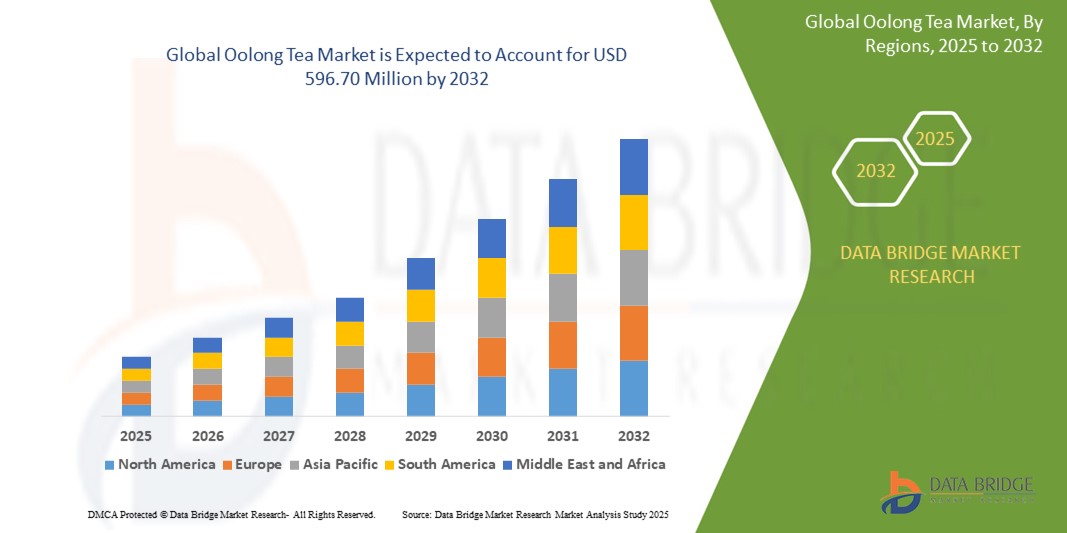
What is the Global Oolong Tea Market Size and Growth Rate?
- The global oolong tea market size was valued at USD 453.14 million in 2024 and is expected to reach USD 596.70 million by 2032, at a CAGR of 3.50% during the forecast period
- The oolong tea market encompasses the production, distribution, and consumption of oolong tea, a partially fermented tea that bridges the flavor profiles of green and black teas. Known for its complex taste, ranging from floral and fruity to woody and toasty, oolong tea is valued for its unique characteristics and potential health benefits, such as antioxidant properties and metabolic support
What are the Major Takeaways of Oolong Tea Market?
- The market includes a diverse range of oolong tea products, from high-quality loose leaf varieties to convenient tea bags, catering to both traditional tea drinkers and modern consumers seeking premium, health-conscious options. As interest in specialty teas grows globally, driven by increasing consumer awareness of health benefits and the demand for unique flavors, the oolong tea market is expanding
- This growth is supported by rising consumer preference for natural and premium beverages, along with innovations in product offerings and packaging. The market is influenced by factors such as regional production, quality standards, and consumer trends towards healthier and more diverse tea options
- Asia-Pacific dominated the oolong tea market with the largest revenue share of 38.7% in 2024, driven by a long-standing tea-drinking culture, rising health consciousness, and a rapidly growing demand for premium and specialty tea products
- North America is projected to grow at the fastest CAGR of 12.3% during the forecast period from 2025 to 2032, driven by growing awareness of the health benefits associated with oolong tea, especially among millennials and health-conscious consumers
- The Tea Bag segment dominated the oolong tea market with the largest market revenue share of 41.3% in 2024, attributed to its ease of use, portability, and longer shelf life, making it a convenient choice for consumers with busy lifestyles
Report Scope and Oolong Tea Market Segmentation
|
Attributes |
Oolong Tea Key Market Insights |
|
Segments Covered |
|
|
Countries Covered |
North America
Europe
Asia-Pacific
Middle East and Africa
South America
|
|
Key Market Players |
|
|
Market Opportunities |
|
|
Value Added Data Infosets |
In addition to the insights on market scenarios such as market value, growth rate, segmentation, geographical coverage, and major players, the market reports curated by the Data Bridge Market Research also include in-depth expert analysis, pricing analysis, brand share analysis, consumer survey, demography analysis, supply chain analysis, value chain analysis, raw material/consumables overview, vendor selection criteria, PESTLE Analysis, Porter Analysis, and regulatory framework. |
What is the Key Trend in the Oolong Tea Market?
“Premiumization and Health-Focused Offerings”
- A significant and accelerating trend in the global oolong tea market is the rising demand for premium and functional blends, driven by increasing consumer awareness of health and wellness. oolong tea, known for its metabolism-boosting and antioxidant properties, is being positioned as both a luxury beverage and a daily health supplement
- Companies are launching organic, single-origin, and specialty Oolong teas to cater to consumers who are willing to pay more for authenticity, sustainability, and wellness benefits. For instance, Tata Consumer Products and Dilmah have expanded their wellness tea lines to include oolong variants infused with herbs such as ginseng and turmeric
- In addition, the market is witnessing a surge in ready-to-drink (RTD) oolong tea products and functional beverages aimed at urban, health-conscious consumers looking for convenience without compromising on quality or benefits
- The trend is also being supported by clean-label and eco-friendly packaging solutions, with brands using biodegradable tea bags and recyclable containers to appeal to environmentally aware customers
- As consumers increasingly seek premium, health-enhancing alternatives to sugary or carbonated drinks, oolong tea is emerging as a preferred choice in both retail and foodservice channels, reshaping the global tea landscape
What are the Key Drivers of Oolong Tea Market?
- Rising consumer interest in natural, healthy beverages is a major driver of the oolong tea market, especially due to its association with weight management, heart health, and digestion improvement
- The growth of specialty tea cafes, premium wellness brands, and e-commerce platforms has significantly increased the visibility and availability of high-quality oolong tea products worldwide
- For instance, in 2023, Bigelow Tea (U.S.) launched an organic oolong tea blend emphasizing its antioxidant and calming properties catering to wellness-focused millennials and Gen Z consumers
- The increasing adoption of Asian tea traditions in Western markets, driven by globalization and cultural exchange, is also fueling oolong tea consumption
- In addition, the shift towards low-caffeine and naturally flavored beverages is pushing health-conscious consumers to choose oolong tea as a more balanced alternative to green or black tea
Which Factor is challenging the Growth of the Oolong Tea Market?
- One of the major challenges facing the oolong tea market is limited consumer awareness outside of Asia, particularly regarding its unique taste profile, brewing requirements, and health benefits compared to green or black tea
- For instance, while Oolong tea is widely consumed in China and Taiwan, it still remains a niche product in parts of Europe and North America due to lack of familiarity and availability.
- Another hurdle is the higher production cost and price point of premium Oolong teas, which may deter price-sensitive consumers or mass-market buyers
- Furthermore, climate change and shifting agricultural patterns are affecting the quality and yield of traditional oolong tea plantations, especially in regions such as Fujian and Taiwan, putting pressure on supply chains
- Overcoming these challenges will require consumer education, innovation in product formats (e.g., RTD teas, sachets), and expanded retail access. Brands that can successfully combine tradition, wellness, and convenience are best positioned to lead future market growth
How is the Oolong Tea Market Segmented?
The market is segmented on the basis of type, communication protocol, unlocking mechanism, and application.
• By Form
On the basis of form, the oolong tea market is segmented into Loose Leaf, Powder, Tea Bag, and Others. The Tea Bag segment dominated the Oolong Tea market with the largest market revenue share of 41.3% in 2024, attributed to its ease of use, portability, and longer shelf life, making it a convenient choice for consumers with busy lifestyles. Tea bags also align well with foodservice operations, offices, and travel packs, driving their popularity across both developed and emerging regions.
The Loose Leaf segment is anticipated to witness the fastest CAGR of 20.2% from 2025 to 2032, propelled by growing consumer interest in premium, artisanal, and whole-leaf teas. Loose leaf Oolong is often perceived as more authentic and higher in quality, making it especially appealing to tea connoisseurs and health-conscious buyers seeking richer flavor and higher antioxidant content.
• By Flavor
On the basis of flavor, the oolong tea market is segmented into Flavored and Plain. The Plain segment held the largest market revenue share in 2024, driven by strong demand for traditional and authentic Oolong tea profiles, especially in Asian markets such as China and Taiwan. These unflavored variants are often preferred for their natural aroma, balanced oxidation, and health benefits such as metabolism boosting and antioxidant properties.
The Flavored segment is expected to register the fastest CAGR during the forecast period, supported by the rising popularity of fruit-infused, floral, and herbal Oolong blends among younger consumers. Flavored teas appeal to experimental tea drinkers and are widely featured in ready-to-drink formats and wellness-focused offerings.
• By Distribution Channel
On the basis of distribution channel, the oolong tea market is segmented into Direct Sales, Online Retail, Supermarkets/Hypermarkets, and Specialty Stores. The Supermarkets/Hypermarkets segment captured the largest market revenue share in 2024, accounting for 37.5%, due to its widespread accessibility and trust factor among consumers. These outlets offer a wide variety of tea products across brands and price ranges, making them the most common retail channel for packaged Oolong tea.
The Online Retail segment is projected to grow at the fastest CAGR of 22.9% from 2025 to 2032, driven by the global e-commerce boom, growing preference for direct-to-consumer models, and the ease of comparing product offerings. Online platforms also support niche and premium tea brands that may not be readily available in traditional retail outlets, thus broadening the consumer base.
Which Region Holds the Largest Share of the Oolong Tea Market?
- Asia-Pacific dominated the oolong tea market with the largest revenue share of 38.7% in 2024, driven by a long-standing tea-drinking culture, rising health consciousness, and a rapidly growing demand for premium and specialty tea products
- Countries such as China, Japan, and India are witnessing increased consumption of oolong tea due to its perceived health benefits, such as aiding in digestion, weight management, and boosting metabolism
- The region also benefits from strong domestic production, government support for organic farming, and growing export opportunities, solidifying Asia-Pacific's leadership in the global oolong tea landscape
China Oolong Tea Market Insight
The China oolong tea market accounted for the largest share in the Asia-Pacific region in 2024, driven by its role as a key producer and consumer of oolong tea. The domestic demand is supported by cultural preferences, government backing for traditional Chinese medicine, and a robust e-commerce infrastructure that promotes tea sales across platforms. Premium and organic Oolong variants are especially in demand among urban consumers and health-focused demographics.
Japan Oolong Tea Market Insight
The Japan oolong tea market is expanding steadily, fueled by a preference for clean-label, health-enhancing beverages and a well-established tea culture. The market benefits from a surge in ready-to-drink oolong tea products, increasing demand for sugar-free and functional drinks, and a growing elderly population focused on wellness. In addition, the country’s technological integration supports innovative packaging and convenience in consumption, boosting market appeal.
Which Region is the Fastest Growing Region in the Oolong Tea Market?
North America is projected to grow at the fastest CAGR of 12.3% during the forecast period from 2025 to 2032, driven by growing awareness of the health benefits associated with oolong tea, especially among millennials and health-conscious consumers. Increasing preference for natural and antioxidant-rich beverages, combined with innovative flavor introductions and premium product launches, is stimulating demand across the U.S. and Canada. E-commerce platforms, specialty tea shops, and the café culture are accelerating the adoption of Oolong Tea in the region, positioning North America as a lucrative emerging market.
U.S. Oolong Tea Market Insight
The U.S. oolong tea market captured dominated North America in 2024, driven by a surge in functional beverage consumption, the rise of wellness-driven diets, and a growing interest in traditional Eastern teas. Health claims linked to oolong tea, including its metabolism-boosting and cholesterol-lowering properties, have made it a favored choice among fitness enthusiasts. The availability of organic and flavored variants through health food stores and online platforms is further supporting the market’s growth trajectory.
Europe Oolong Tea Market Insight
The Europe oolong tea market is experiencing robust growth, fueled by increasing demand for sustainable and organic beverages, especially in countries such as the U.K., Germany, and France. Consumers are gravitating toward premium and exotic tea blends, with Oolong positioned as a sophisticated, mid-point between green and black teas. The region's growing café culture, coupled with clean-label preferences and wellness trends, is driving sales through specialty stores and high-end retail chains.
U.K. Oolong Tea Market Insight
The U.K. oolong tea market is projected to grow steadily, supported by a mature tea-drinking population and rising demand for premium, loose-leaf varieties. Increasing awareness of the tea’s digestive and weight management benefits, combined with a shift toward non-caffeinated and low-calorie drinks, is helping oolong gain traction. The country’s strong retail and e-commerce ecosystems enable easy access to imported and specialty Oolong products.
Germany Oolong Tea Market Insight
The Germany oolong tea market is gaining momentum as consumers increasingly prioritize organic, herbal, and functional teas. With its emphasis on sustainability, eco-conscious packaging, and low-sugar beverage alternatives, Oolong Tea aligns well with German consumer values. Tea festivals, wellness expos, and growing retail shelf space are also contributing to rising visibility and consumer interest in oolong tea across the country.
Which are the Top Companies in Oolong Tea Market?
The oolong tea industry is primarily led by well-established companies, including:
- Bigelow Tea (U.S.)
- R. Twining and Company Limited (U.K.)
- Teas and Thes (China) Ltd. (China)
- Ceylon Organic Spices (Sri Lanka)
- Unilever (U.K.)
- Arbor Teas (U.S.)
- The Republic of Tea (U.S.)
- Dilmah Ceylon Tea Company PLC. (Sri Lanka)
- Harney & Sons Fine Teas (U.S.)
- Mighty Leaf Tea (U.S.)
- Tata Consumer Products Limited (India)
- ITO EN (North America) INC. (U.S.)
- COFCO (China)
- International Coffee & Tea, LLC (U.S.)
- Harada Seicha (Japan)
- Generation Tea (U.S.)
- East West Tea Company, LLC (U.S.)
- Starbucks Coffee Company (U.S.)
- TETLEY (U.K.)
What are the Recent Developments in Global Oolong Tea Market?
- In July 2024, Nestlé China expanded its functional beverage range by introducing a no-sugar Oolong tea enriched with white mulberry leaf extract, an ingredient clinically proven to reduce post-meal blood sugar spikes. This launch reinforces Nestlé’s commitment to offering health-focused, functional drinks tailored to the wellness-conscious Chinese consumer
- In February 2024, HOJO released two highly exclusive teas under the Phoenix Dancong Lao Cong line: Yu Jin Xiang Single Tree 2022 and Ba Xian Wang 2022, both celebrated for their exceptional rarity and age. This unveiling solidifies HOJO’s positioning in the ultra-premium Oolong tea segment targeting connoisseurs and collectors
- In August 2023, PT Perkebunan Nusantara (PTPN) Group, in collaboration with PT Suntory Garuda Beverage, completed its first Oolong tea shipment to Vietnam for Suntory Pepsico Vietnam Beverage, marking the beginning of a major regional supply partnership. This milestone underscores the companies’ shared strategy to support the growing demand for premium RTD Oolong beverages across Asia

- Interactive Data Analysis Dashboard
- Company Analysis Dashboard for high growth potential opportunities
- Research Analyst Access for customization & queries
- Competitor Analysis with Interactive dashboard
- Latest News, Updates & Trend analysis
- Harness the Power of Benchmark Analysis for Comprehensive Competitor Tracking
Global Oolong Tea Market, Supply Chain Analysis and Ecosystem Framework
To support market growth and help clients navigate the impact of geopolitical shifts, DBMR has integrated in-depth supply chain analysis into its Global Oolong Tea Market research reports. This addition empowers clients to respond effectively to global changes affecting their industries. The supply chain analysis section includes detailed insights such as Global Oolong Tea Market consumption and production by country, price trend analysis, the impact of tariffs and geopolitical developments, and import and export trends by country and HSN code. It also highlights major suppliers with data on production capacity and company profiles, as well as key importers and exporters. In addition to research, DBMR offers specialized supply chain consulting services backed by over a decade of experience, providing solutions like supplier discovery, supplier risk assessment, price trend analysis, impact evaluation of inflation and trade route changes, and comprehensive market trend analysis.
Data collection and base year analysis are done using data collection modules with large sample sizes. The stage includes obtaining market information or related data through various sources and strategies. It includes examining and planning all the data acquired from the past in advance. It likewise envelops the examination of information inconsistencies seen across different information sources. The market data is analysed and estimated using market statistical and coherent models. Also, market share analysis and key trend analysis are the major success factors in the market report. To know more, please request an analyst call or drop down your inquiry.
The key research methodology used by DBMR research team is data triangulation which involves data mining, analysis of the impact of data variables on the market and primary (industry expert) validation. Data models include Vendor Positioning Grid, Market Time Line Analysis, Market Overview and Guide, Company Positioning Grid, Patent Analysis, Pricing Analysis, Company Market Share Analysis, Standards of Measurement, Global versus Regional and Vendor Share Analysis. To know more about the research methodology, drop in an inquiry to speak to our industry experts.
Data Bridge Market Research is a leader in advanced formative research. We take pride in servicing our existing and new customers with data and analysis that match and suits their goal. The report can be customized to include price trend analysis of target brands understanding the market for additional countries (ask for the list of countries), clinical trial results data, literature review, refurbished market and product base analysis. Market analysis of target competitors can be analyzed from technology-based analysis to market portfolio strategies. We can add as many competitors that you require data about in the format and data style you are looking for. Our team of analysts can also provide you data in crude raw excel files pivot tables (Fact book) or can assist you in creating presentations from the data sets available in the report.













