


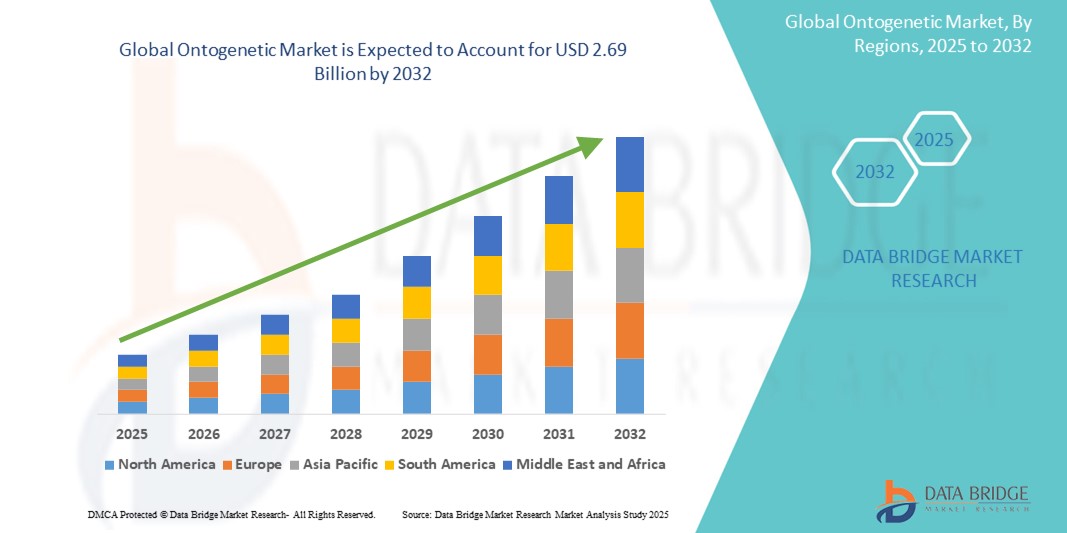
Ontogenetic Market Size
- The global ontogenetic market size was valued at USD 1.91 billion in 2024 and is expected to reach USD 2.69 billion by 2032, at a CAGR of 4.32% during the forecast period
- The market growth is primarily driven by rising investments in developmental biology research, regenerative medicine, and precision healthcare, enabling deeper insights into cellular and tissue-level development across the human lifespan
- In addition, increasing applications of ontogenetic insights in oncology, neurodevelopmental disorders, and personalized treatment approaches are establishing this domain as a vital contributor to next-generation medical innovations. These driving forces are rapidly advancing the global ontogenetic market, propelling its significant expansion across academic, clinical, and biopharmaceutical landscapes
Ontogenetic Market Analysis
- Ontogenetics, the study of individual organism development from embryo to maturity, is becoming increasingly central to biomedical research, personalized medicine, and therapeutic innovation due to its ability to provide critical insights into gene expression, cellular differentiation, and developmental pathways
- The surging demand for ontogenetic applications is primarily driven by advancements in genomics, stem cell research, and regenerative medicine, along with growing interest in understanding developmental disorders and age-related diseases
- North America led the ontogenetic market with the largest revenue share of 40.3% in 2024, attributed to robust funding in life sciences research, a strong presence of academic and biopharmaceutical institutions, and the rapid integration of AI-driven bioinformatics in developmental studies, particularly across the U.S. where precision medicine initiatives are accelerating adoption
- Asia-Pacific is expected to witness the fastest growth in the ontogenetic market during the forecast period due to increasing investments in biotechnology infrastructure, expanding research capabilities, and rising collaborations between academia and industry
- The developmental biology segment dominated the ontogenetic market with a market share of 42.1% in 2024, driven by its foundational role in exploring genetic regulation and embryonic development, thereby supporting drug discovery and targeted treatment innovations
Report Scope and Ontogenetic Market Segmentation
|
Attributes |
Ontogenetic Key Market Insights |
|
Segments Covered |
|
|
Countries Covered |
North America
Europe
Asia-Pacific
Middle East and Africa
South America
|
|
Key Market Players |
|
|
Market Opportunities |
|
|
Value Added Data Infosets |
In addition to the insights on market scenarios such as market value, growth rate, segmentation, geographical coverage, and major players, the market reports curated by the Data Bridge Market Research also include in-depth expert analysis, pricing analysis, brand share analysis, consumer survey, demography analysis, supply chain analysis, value chain analysis, raw material/consumables overview, vendor selection criteria, PESTLE Analysis, Porter Analysis, and regulatory framework. |
Ontogenetic Market Trends
“Expansion of AI-Driven Developmental Modeling and Single-Cell Analysis”
- A significant and rapidly evolving trend in the global ontogenetic market is the integration of artificial intelligence (AI) with advanced single-cell sequencing and developmental modeling technologies. This combination is accelerating our understanding of gene regulation and cell differentiation across various developmental stages, thereby reshaping biomedical and therapeutic research
- For instance, AI-powered platforms such as DeepCell and Cellarium are enabling researchers to model complex ontogenetic pathways by analyzing millions of cellular states and trajectories. These models help uncover patterns in tissue regeneration, organ formation, and disease progression with unprecedented precision
- Furthermore, developmental ontogenetics is benefitting from the application of machine learning algorithms that predict developmental abnormalities and simulate gene expression profiles. Platforms such as CellRank are using probabilistic AI to forecast future cell states, aiding in regenerative therapy development and cancer treatment strategies
- The integration of AI with ontogenetic tools is also driving automation in developmental biology research workflows, enabling real-time data interpretation and accelerating discovery timelines. These platforms assist in the classification of cellular lineages and mapping of organ-specific development in both healthy and pathological conditions
- This convergence of AI and ontogenetics is streamlining drug discovery pipelines, particularly in developmental disorders and pediatric oncology, by pinpointing early-stage molecular targets. As a result, biopharma companies and academic institutions are increasing their investments in AI-augmented ontogenetic technologies
- The growing demand for precision medicine, combined with AI’s capacity to handle vast biological data, is fostering a new era in developmental science, transforming how researchers understand, model, and manipulate human development
Ontogenetic Market Dynamics
Driver
“Rising Demand for Precision Medicine and Developmental Disorder Research”
- The increasing demand for precision medicine solutions, coupled with a growing focus on understanding developmental origins of diseases, is a major driver for the global ontogenetic market. As healthcare shifts towards early intervention and individualized therapies, ontogenetics provides vital insights into embryogenesis, neurodevelopment, and stem cell differentiation
- For instance, in March 2024, Genentech initiated a strategic partnership with academic institutions to map neural development at the single-cell level, aiming to accelerate drug discovery in autism and rare neurodevelopmental syndromes. Such initiatives underscore the expanding importance of ontogenetics in translational research
- Ontogenetic analyses also support regenerative medicine by revealing mechanisms of tissue repair and organogenesis, enhancing the development of targeted stem cell therapies. Moreover, these tools help decipher congenital defects and predict disease susceptibility at early stages
- The increasing incidence of developmental disorders, along with a surge in funding for developmental biology research, is pushing hospitals, research centers, and biotech firms to invest in ontogenetic technologies. This shift is particularly pronounced in pediatric and prenatal medicine, where early diagnostic tools are critical
- In addition, the widespread application of ontogenetic data in drug screening, biomarker identification, and functional genomics is contributing to the market’s growth, especially in oncology and rare genetic conditions
Restraint/Challenge
“Ethical Concerns and High Complexity of Data Interpretation”
- Ethical concerns regarding embryonic studies, fetal tissue usage, and genetic manipulation remain key barriers to the broader expansion of the ontogenetic market. Stringent regulations in several countries regarding stem cell research and developmental interventions can delay or restrict scientific progress
- Moreover, the complexity of ontogenetic data — especially in multi-omics and single-cell platforms — poses significant challenges in terms of data integration, standardization, and interpretation. Researchers must navigate vast datasets with intricate signaling interactions and stochastic gene expression, requiring advanced bioinformatics infrastructure and expertise
- For instance, inconsistencies in developmental data from different model organisms and human samples can lead to reproducibility issues, limiting clinical translation. To address this, institutions are investing in standardized ontogenetic databases and interoperable AI tools
- In addition, the high cost of advanced sequencing platforms, imaging systems, and computational resources needed for ontogenetic studies may restrict access for smaller research labs or institutions in developing regions
- Overcoming these hurdles will require harmonization of ethical frameworks, public education on the benefits of developmental research, and expanded funding for accessible ontogenetic technologies and AI-powered analysis platforms
Ontogenetic Market Scope
The market is segmented on the basis of devices, application, and end user.
- By Devices
On the basis of devices, the ontogenetic market is segmented into Electroencephalography (EEG), Magnetoencephalography (MEG), and others. The Electroencephalography (EEG) segment dominated the market with the largest market revenue share in 2024, attributed to its widespread use in developmental cognitive neuroscience and psychobiology research. EEG devices offer high temporal resolution, are non-invasive, and are widely utilized for studying early brain development, sleep patterns, and neural response in infants and children. Their affordability and accessibility make them a cornerstone in developmental studies, especially in academic and pediatric research settings.
The Magnetoencephalography (MEG) segment is projected to experience the fastest growth from 2025 to 2032, owing to its advanced spatial resolution and growing relevance in mapping neural activity during critical stages of cognitive development. MEG’s ability to localize brain function in real time makes it increasingly valuable in developmental disorder research, particularly for autism spectrum and epilepsy diagnostics.
- By Application
On the basis of application, the market is segmented into developmental biology, developmental psychology, developmental cognitive neuroscience, developmental psychobiology, and others. The Developmental Biology segment held the largest market share of 42.1% in 2024, driven by expanding research into embryogenesis, tissue regeneration, and genetic regulation during organismal growth. The increasing use of stem cell technologies and gene-editing tools such as CRISPR in developmental biology is fueling demand for ontogenetic tools and devices. This application forms the scientific basis for many therapeutic innovations and regenerative medicine strategies.
The Developmental Cognitive Neuroscience segment is expected to grow at the fastest rate during the forecast period, supported by rising interest in understanding brain development, cognitive functions, and neurodevelopmental disorders. The integration of neuroimaging, EEG/MEG technologies, and AI analytics in this field is creating new opportunities for early diagnosis and intervention strategies in pediatric care and mental health.
- By End User
On the basis of end user, the market is segmented into research laboratories, academic institutes, and others. Research Laboratories dominated the market in 2024, with the largest revenue contribution, owing to the growing number of funded developmental biology and neuroscience projects. These laboratories often drive innovation in ontogenetic modeling, neurodevelopmental diagnostics, and pharmacological testing. Their high adoption of advanced imaging, molecular biology tools, and high-throughput platforms supports the continuous evolution of the market.
Academic Institutes are anticipated to witness the highest CAGR from 2025 to 2032, propelled by the growing inclusion of ontogenetics in life sciences curricula and the expansion of developmental biology programs. Collaborations between academia and biotech companies, along with rising global research grants, are reinforcing the role of universities in pioneering early-stage ontogenetic research.
Ontogenetic Market Regional Analysis
- North America dominated the ontogenetic market with the largest revenue share of 40.3% in 2024, attributed to robust funding in life sciences research, a strong presence of academic and biopharmaceutical institutions, and the rapid integration of AI-driven bioinformatics in developmental studies, particularly across the U.S. where precision medicine initiatives are accelerating adoption
- Researchers and clinicians in the region prioritize advanced ontogenetic tools and platforms that enable deep insights into gene expression, cellular differentiation, and developmental disorders, particularly in pediatric and neurodevelopmental healthcare
- This robust market presence is further supported by substantial government and private research funding, a well-established academic infrastructure, and the early adoption of AI-driven bioinformatics and single-cell analysis platforms, positioning North America as a global hub for ontogenetic innovation and application
U.S. Ontogenetic Market Insight
The U.S. ontogenetic market captured the largest revenue share of 80.3% in 2024 within North America, driven by strong governmental and private funding in developmental biology and neuroscience research. Major research institutions and biotech companies are leveraging advanced ontogenetic tools for applications in regenerative medicine, pediatric care, and neurodevelopmental disorders. The widespread use of AI-powered bioinformatics, single-cell analysis platforms, and gene-editing technologies is further accelerating adoption, making the U.S. a global leader in ontogenetic innovation and translational research.
Europe Ontogenetic Market Insight
The Europe ontogenetic market is projected to grow at a substantial CAGR throughout the forecast period, fueled by a robust academic research infrastructure and increased funding for developmental and cognitive neuroscience studies. Stringent ethical and regulatory frameworks around genetic research support the responsible use of ontogenetic tools. The market is seeing increasing demand in areas such as embryology, stem cell therapy, and neurodevelopmental diagnostics, with integration into both public and private research initiatives across residential biomedical institutions and clinical centers.
U.K. Ontogenetic Market Insight
The U.K. ontogenetic market is anticipated to grow at a noteworthy CAGR during the forecast period, supported by expanding national research programs in genomics and developmental biology. Government-backed initiatives, such as Genomics England, are fostering the integration of ontogenetic analysis in personalized medicine. The country’s emphasis on early childhood development and education research also contributes to growing demand, with strong collaborations between academia and biotech companies further strengthening market momentum.
Germany Ontogenetic Market Insight
The Germany ontogenetic market is expected to expand at a considerable CAGR during the forecast period, supported by its leading role in Europe’s life sciences and biotechnology sector. With a high concentration of research universities and state-funded medical research institutions, Germany is actively investing in developmental genetics, neuroscience, and regenerative medicine. The market is further propelled by the country's focus on precision diagnostics, ethical standards, and sustainable medical research infrastructure.
Asia-Pacific Ontogenetic Market Insight
The Asia-Pacific ontogenetic market is poised to grow at the fastest CAGR of 25.1% during the forecast period of 2025 to 2032, driven by rapid expansion of research capabilities, growing investment in biotech infrastructure, and government support for genomic and developmental studies. Countries such as China, Japan, and India are increasingly prioritizing early diagnostics and developmental research, creating strong demand for advanced ontogenetic tools. Rising educational standards and cross-border research collaborations are expanding access to ontogenetic technologies across academic and clinical sectors.
Japan Ontogenetic Market Insight
The Japan ontogenetic market is gaining momentum due to its technological leadership in biomedical research and its emphasis on population health and aging. Japan’s research institutions are heavily investing in developmental neuroscience, regenerative therapies, and age-related disease modeling. The integration of ontogenetic tools with AI-driven platforms and robotics in laboratory settings supports a future-forward approach to developmental healthcare, particularly in aging and pediatric populations.
India Ontogenetic Market Insight
The India ontogenetic market accounted for the largest market revenue share in Asia Pacific in 2024, driven by the rapid expansion of its life sciences research sector and a growing number of government-supported developmental and genomic research programs. India’s academic institutions are increasingly collaborating with biotech firms on stem cell research, prenatal diagnostics, and developmental psychology studies. The country’s young population, rising healthcare investment, and increasing interest in precision medicine are major factors advancing ontogenetic market growth across clinical and educational applications.
Ontogenetic Market Share
The Ontogenetic industry is primarily led by well-established companies, including:
- Genentech, Inc. (U.S.)
- Cellarity, Inc. (U.S.)
- Allen Institute (U.S.)
- Takara Bio Inc. (Japan)
- STEMCELL Technologies Inc. (Canada)
- Thermo Fisher Scientific Inc. (U.S.)
- Illumina, Inc. (U.S.)
- Bio-Rad Laboratories, Inc. (U.S.)
- Agilent Technologies, Inc. (U.S.)
- 10x Genomics, Inc. (U.S.)
- QIAGEN N.V. (Netherlands)
- Miltenyi Biotec B.V. & Co. KG (Germany)
- BD (U.S.)
- F. Hoffmann-La Roche Ltd (Switzerland)
- Pacific Biosciences of California, Inc. (U.S.)
- Oxford Nanopore Technologies plc (U.K.)
- Synthego Corporation (U.S.)
- Eppendorf SE (Germany)
- Bio-Techne Corporation (U.S.)
- PerkinElmer, Inc. (U.S.)
What are the Recent Developments in Global Ontogenetic Market?
- In May 2023, Genentech, a subsidiary of Roche, launched a large-scale developmental neuroscience initiative in partnership with leading U.S. research institutions to map early brain development at the single-cell level. This collaboration aims to enhance the understanding of neurodevelopmental disorders such as autism and ADHD by integrating high-resolution ontogenetic data with AI-based predictive analytics. The initiative reinforces Genentech’s commitment to precision medicine and the development of targeted interventions for pediatric neurological conditions
- In April 2023, Cellarity Inc., a Flagship Pioneering company, announced the expansion of its AI-driven ontogenetic platform to accelerate drug discovery for complex developmental diseases. The platform models how cell identity changes over time and under disease stress, enabling researchers to identify early molecular drivers of developmental disorders. This development underscores the increasing role of AI in transforming ontogenetic research into actionable therapeutic solutions
- In March 2023, The Allen Institute for Brain Science launched the BrainSpan 2.0 Project, a next-generation atlas of human brain development, integrating transcriptomic, epigenomic, and imaging data. The project aims to map cellular development across prenatal and early postnatal stages, significantly advancing the field of developmental cognitive neuroscience. This comprehensive data resource is expected to support widespread academic and clinical applications in understanding brain formation and pathology
- In February 2023, Takara Bio Inc. introduced an upgraded single-cell sequencing platform specifically designed for developmental biology applications. The new solution allows researchers to capture rare cell populations during critical ontogenetic windows, improving the resolution of developmental trajectories. This innovation supports more precise modeling of organ development and disease onset at early stages
- In January 2023, Stemcell Technologies Inc. launched a new suite of organoid culture systems aimed at simulating human organ development in vitro. These systems enable researchers to model complex developmental processes and test potential regenerative therapies in a controlled environment. The launch marks a pivotal step in bridging basic ontogenetic research with translational applications in tissue engineering and developmental disease treatment

- Interactive Data Analysis Dashboard
- Company Analysis Dashboard for high growth potential opportunities
- Research Analyst Access for customization & queries
- Competitor Analysis with Interactive dashboard
- Latest News, Updates & Trend analysis
- Harness the Power of Benchmark Analysis for Comprehensive Competitor Tracking
Data collection and base year analysis are done using data collection modules with large sample sizes. The stage includes obtaining market information or related data through various sources and strategies. It includes examining and planning all the data acquired from the past in advance. It likewise envelops the examination of information inconsistencies seen across different information sources. The market data is analysed and estimated using market statistical and coherent models. Also, market share analysis and key trend analysis are the major success factors in the market report. To know more, please request an analyst call or drop down your inquiry.
The key research methodology used by DBMR research team is data triangulation which involves data mining, analysis of the impact of data variables on the market and primary (industry expert) validation. Data models include Vendor Positioning Grid, Market Time Line Analysis, Market Overview and Guide, Company Positioning Grid, Patent Analysis, Pricing Analysis, Company Market Share Analysis, Standards of Measurement, Global versus Regional and Vendor Share Analysis. To know more about the research methodology, drop in an inquiry to speak to our industry experts.
Data Bridge Market Research is a leader in advanced formative research. We take pride in servicing our existing and new customers with data and analysis that match and suits their goal. The report can be customized to include price trend analysis of target brands understanding the market for additional countries (ask for the list of countries), clinical trial results data, literature review, refurbished market and product base analysis. Market analysis of target competitors can be analyzed from technology-based analysis to market portfolio strategies. We can add as many competitors that you require data about in the format and data style you are looking for. Our team of analysts can also provide you data in crude raw excel files pivot tables (Fact book) or can assist you in creating presentations from the data sets available in the report.













