


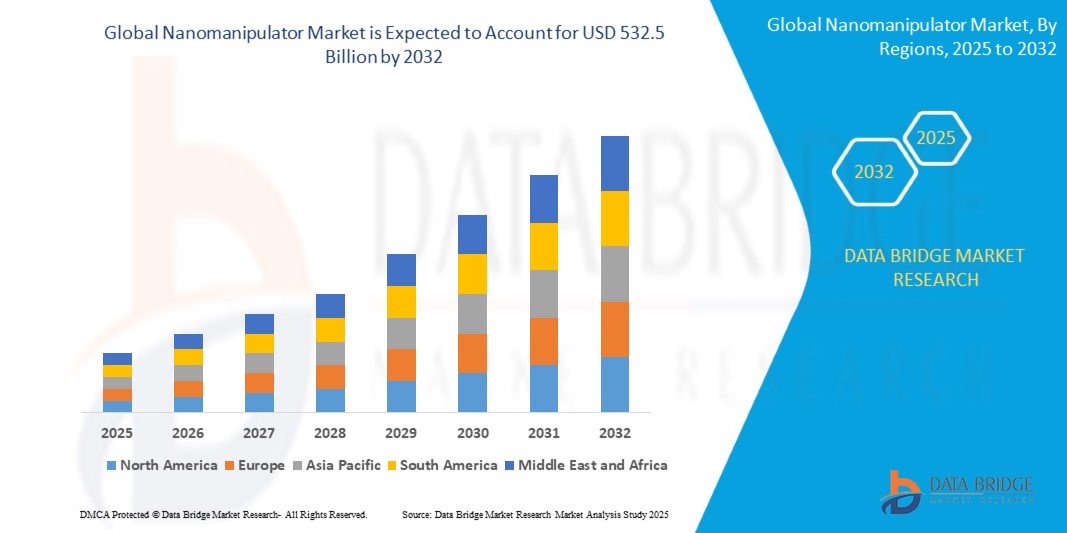
Nanomanipulator Market Size
- The Global Nanomanipulator Market was valued at USD 154.1 Million in 2025 and is projected to reach USD 532.5 Million by 2032, growing at a CAGR of 19.4% during the forecast period.
- Growth is driven by increasing demand for precision tools in nanotechnology research, semiconductor fabrication, and biomedical engineering. Nanomanipulators are essential in manipulating, positioning, and assembling nanoscale materials with ultra-high accuracy—enabling innovation in drug delivery systems, advanced materials, and miniaturized electronics.
Nanomanipulator Market Analysis
- Nanomanipulators are precision instruments designed to control objects at the nano-meter scale, often integrated with scanning electron microscopes (SEM), transmission electron microscopes (TEM), or atomic force microscopes (AFM). These tools are widely used in nanoscience, biotechnology, semiconductor testing, and data storage applications.
- The market is experiencing strong momentum as industries seek higher control and resolution in material analysis and nanofabrication. Advanced research in nano-robotics, quantum dots, carbon nanotubes, and DNA origami is further accelerating adoption of multi-axis nanomanipulators capable of ultra-fine manipulation and force feedback.
- North America leads the market in 2025, supported by well-established research institutions, government-funded nanotech programs, and the presence of key manufacturers and innovation hubs.
- Asia-Pacific is expected to exhibit the fastest CAGR due to increasing investments in semiconductor manufacturing, growing academic research, and rising focus on technological self-reliance in countries like China, Japan, and South Korea.
- Among types, electron microscope-based nanomanipulators dominate the market in 2025, due to their high-resolution capabilities in structural manipulation and nano assembly tasks. The biomedical application segment is projected to grow fastest as nanomanipulation tools are used in cellular engineering, targeted drug delivery, and biosensor development.
Report Scope and Precision harvesting market Segmentation
|
Attributes |
Nanomanipulator market Key Insights |
|
Segments Covered |
|
|
Countries Covered |
North America
Europe
Asia-Pacific
Middle East and Africa
South America
|
|
Key Market Players |
|
|
Market Opportunities |
Growing interest in cellular-level manipulation, nanorobotic surgery, and DNA modification is opening new opportunities in healthcare and life sciences. Nanomanipulators are being integrated with bioscanning systems to perform precision interventions in tissue engineering, intracellular diagnostics, and drug delivery research.
As the semiconductor industry moves toward sub-5 nm fabrication and quantum computing components, the need for ultra-precise, non-destructive material handling is rising. Nanomanipulators offer scalable solutions for lithography mask inspection, nanowire placement, and defect correction—creating strong demand in cleanroom environments and R&D labs. |
|
Value Added Data Infosets |
In addition to insights on market value, growth rate, segmentation, and regional analysis, the Global Nanomanipulator Market report provides detailed coverage of technological specifications, motion control precision benchmarking and instrument calibration standards. It includes analysis of microscope integration compatibility, force sensitivity ranges and multi-axis manipulability. Additional features include component sourcing analysis, regulatory frameworks for biomedical nanomanipulation, investment trends in nanorobotics, and comparative performance metrics across operating environments. Strategic tools such as PESTLE Analysis, Porter’s Five Forces, and global IP trends in nanoscale instrumentation are also incorporated to support long-term investment and product development decisions. |
Nanomanipulator Market Trends
“Precision, Miniaturization, and Cross-Disciplinary Integration Drive Next-Gen Nanomanipulation”
- A defining trend in the nanomanipulator market is the evolution of high-resolution, multi-degree-of-freedom manipulators capable of operating within scanning electron and atomic force microscopes for ultra-precise applications.
- Market leaders like Kleindiek, SmarAct, and Bruker are enhancing their platforms with real-time force feedback, automated positioning and remote nanomanipulation to meet the demands of advanced research and microassembly.
- In the biomedical space, nanomanipulators are being used to position nanoparticles inside living cells, guide nanosensors, and manipulate DNA strands. These applications are driving convergence between life sciences, nanorobotics, and analytical instrumentation.
- Semiconductor manufacturers are integrating manipulators into cleanroom inspection and quantum chip development workflows. Innovations in cryogenic-compatible manipulators are gaining attention in research related to superconducting materials and quantum photonics.
- The emergence of compact, modular nanomanipulation systems tailored for academic and startup laboratories is making high-precision nanoscale experimentation more accessible, supporting democratization of nanotech innovation.
Nanomanipulator Market Dynamics
Driver
“Rising Demand for Precision Nanotechnology Tools in Advanced Research and Manufacturing”
- The growing need for sub-nanometer accuracy in materials research, quantum device development, and nanoscale biological studies is a key driver boosting demand for nanomanipulators. As the boundaries of microengineering continue to shrink, industries and institutions are turning to sophisticated manipulation tools that can operate within high-resolution microscopes.
- Leading research labs, semiconductor manufacturers, and biomedical companies are integrating nanomanipulators with AFM, SEM, and TEM platforms to perform site-specific nanoprobing, manipulation of carbon nanotubes and assembly of nanoelectronic components.
- Companies like SmarAct, Bruker and Zeiss are advancing motion control systems to deliver precise, repeatable positioning for atomic-scale interactions, supporting breakthroughs in fields such as quantum computing, biomechanics, and photonics.
- As the commercialization of nano-enabled materials and biomedical devices accelerates, demand for reliable, flexible, and high-resolution nanomanipulators continues to grow across both research and industrial applications.
Restraint/Challenge
“High Cost of Equipment and Specialized Operational Requirements”
- One of the main challenges limiting wider adoption of nanomanipulators is their high capital cost, often exacerbated by the need for compatible high-resolution imaging platforms (SEM/TEM) and cleanroom-grade environments.
- These systems also require specialized training, ultra-stable lab conditions and advanced software skills for effective operation—making them less accessible to smaller institutions, startups, or resource-constrained laboratories.
- Additionally, integration complexity across microscope platforms and limited standardization in control interfaces can hinder cross-compatibility and scalability.
- Addressing these barriers will require continued development of modular, cost-efficient solutions, better user training, and standardization efforts to reduce entry barriers and encourage broader use across emerging research areas.
Nanomanipulator Market Scope
The market is segmented on the basis of type, application, and end user, reflecting the diverse instrumentation and cross-industry use of nanoscale manipulation systems.
- By Type
The nanomanipulator market includes electron microscope-based, optical microscope-based, and scanning probe microscope-based systems. Electron microscope-based nanomanipulators dominate in 2025 due to their widespread use in ultra-high-resolution environments such as SEM and TEM, where nanostructure assembly, defect analysis, and particle manipulation are critical.
Scanning probe microscope (SPM)-based nanomanipulators are expected to grow at the fastest CAGR from 2025 to 2032, supported by their increasing adoption in surface science, atomic force microscopy (AFM) applications, and advanced material characterization.
- By Application
The primary applications include nanomaterial handling, biomedical applications, semiconductor manufacturing, data storage, and others. Nanomaterial handling leads the market in 2025, driven by growing demand for nanoscale assembly, manipulation of nanowires and nanotubes, and high-precision sample transfer.
Biomedical applications are projected to witness the fastest growth during the forecast period due to increased use in single-cell manipulation, DNA handling, targeted drug delivery research, and biosensor development in academic and clinical settings.
- By End User
Key end users include research institutions, semiconductor industry, biotechnology & pharmaceutical companies, academic laboratories, and others. Research institutions dominate in 2025, owing to high investments in nanotechnology R&D and the need for precise, multifunctional tools integrated with electron and scanning probe microscopes.
The semiconductor industry is expected to grow rapidly, as nanomanipulators are increasingly used in quantum device fabrication, defect analysis, and the miniaturization of next-generation chips and photonic systems.
Nanomanipulator Market Regional Analysis
- North America dominates the global nanomanipulator market in 2025, driven by strong R&D investments, world-class nanotechnology research institutions, and the presence of major industry players such as Bruker and Thermo Fisher Scientific. The U.S. leads with advanced infrastructure for semiconductor research, biomedical nanotechnology, and university-led innovations, supported by funding from organizations like the NSF and NIH.
- Europe holds a significant market share, fueled by sustained investment in nanorobotics, quantum technologies and academic research programs. Countries like Germany, Switzerland, and France are leading adopters, with companies such as Kleindiek Nanotechnik, SmarAct and Imina Technologies headquartered in the region. EU-wide initiatives in microelectronics and nanoscale material development further support market growth.
- Asia-Pacific is expected to register the fastest CAGR from 2025 to 2032, led by growing demand for precision tools in semiconductor manufacturing, biotech research, and university collaborations. Countries like China, Japan, and South Korea are heavily investing in nanotech infrastructure to reduce import dependency and strengthen domestic innovation, especially in nanoelectronics and MEMS fabrication.
- Middle East and Africa (MEA) is an emerging market with growing interest in nanoscience research and biomedical innovation. Nations such as UAE and Saudi Arabia are investing in research parks and nanotech incubators, while South Africa shows growth potential through academic research expansion.
- South America demonstrates steady adoption, particularly in Brazil and Argentina, where nanotechnology is being integrated into academic institutions and public research organizations. Government programs supporting nanomaterial innovation and bioengineering are gradually creating demand for advanced nanomanipulation tools.
United States Nanomanipulator Market Insight
The U.S. leads globally in nanomanipulator adoption, backed by world-renowned universities, national labs, and industrial R&D centers. Demand is strongest in the biomedical, aerospace and semiconductor sectors, where atomic-scale precision is critical. Ongoing public funding and commercial partnerships continue to drive innovation in both multi-axis manipulators and AI-integrated platforms.
Germany Nanomanipulator Market Insight
Germany is at the forefront of precision instrumentation in Europe, driven by its advanced manufacturing base and deep focus on materials science. Home to leaders like SmarAct and Kleindiek, the country supports the development and export of modular, high-resolution manipulators used in microscopy and nanomechanical testing.
Japan Nanomanipulator Market Insight
Japan shows robust growth due to its leadership in nanomaterials, biosensors and electronic miniaturization. Companies such as Hitachi and JEOL are enhancing their nanomanipulation systems to support applications in biotech and semiconductors. The country’s government-backed research grants continue to support academic and industrial adoption.
China Nanomanipulator Market Insight
China is rapidly scaling its nanomanipulation capabilities, especially for semiconductor R&D, quantum materials and biomedical research. Government investment in domestic nanotech production and the rising number of nanotechnology-focused labs are fueling demand for locally manufactured and imported precision tools.
Switzerland Nanomanipulator Market Insight
Switzerland, though smaller in scale, plays a strategic role in the nanomanipulator market through its innovation hubs and companies like Imina Technologies, which specialize in compact, high-precision robotic systems. Its academic institutions are actively engaged in cell manipulation, DNA nanotech, and nanoscale drug delivery research.
Nanomanipulator Market
The competitive landscape includes analysis of company profiles, revenue contributions, global R&D investments, product specialization, and strategic collaborations. Leading players such as Kleindiek Nanotechnik, SmarAct and Bruker command significant market share due to their innovation in ultra-precise motion control systems, microscope compatibility, and modular product architecture.
Companies are evaluated based on criteria such as product portfolio depth, end-user customization, geographical reach, interface integration and aftermarket support.
Startups and emerging firms are gaining traction through compact nanomanipulation modules, affordable academic kits and software-driven enhancements aimed at increasing accessibility and user control. Market dynamics reflect a mix of industrial applications and niche research-focused deployments across multiple continents.
The following companies are recognized as major players in the Global Nanomanipulator Market:
- Kleindiek Nanotechnik GmbH (Germany)
- Narishige Group (Japan)
- SmarAct GmbH (Germany)
- Klocke Nanotechnik GmbH (Germany)
- Bruker Corporation (United States)
- Thermo Fisher Scientific Inc. (United States)
- Carl Zeiss AG (Germany)
- Hitachi High-Tech Corporation (Japan)
- Jeol Ltd. (Japan)
- Imina Technologies SA (Switzerland)
- Attocube Systems AG (Germany)
Latest Developments in Global Nanomanipulator Market
- In April 2025, SmarAct GmbH launched a new generation of ultra-compact nanomanipulators with sub-nanometer resolution designed for in-situ SEM applications, enabling real-time manipulation and nanowire placement in ultra-high vacuum environments.
- In March 2025, Kleindiek Nanotechnik introduced a robotic micro-gripper system with enhanced force-feedback technology, allowing for more delicate nanostructure assembly and biomedical manipulations at the sub-cellular level.
- In February 2025, Imina Technologies collaborated with Swiss academic institutions to develop AI-assisted automation features for nanomanipulators, aimed at simplifying operation for high-throughput biological experiments.
- In January 2025, Bruker Corporation integrated its nanomanipulation systems into its latest AFM platform, providing seamless nanomechanical testing, 3D nanoscale assembly, and molecular-level sample manipulation in a unified system.
- In December 2024, Thermo Fisher Scientific expanded its SEM-compatible nanomanipulator product line to support electron beam lithography and semiconductor defect probing with enhanced positional accuracy and software automation tools.

- Interactive Data Analysis Dashboard
- Company Analysis Dashboard for high growth potential opportunities
- Research Analyst Access for customization & queries
- Competitor Analysis with Interactive dashboard
- Latest News, Updates & Trend analysis
- Harness the Power of Benchmark Analysis for Comprehensive Competitor Tracking
Global Nanomanipulator Market, Supply Chain Analysis and Ecosystem Framework
To support market growth and help clients navigate the impact of geopolitical shifts, DBMR has integrated in-depth supply chain analysis into its Global Nanomanipulator Market research reports. This addition empowers clients to respond effectively to global changes affecting their industries. The supply chain analysis section includes detailed insights such as Global Nanomanipulator Market consumption and production by country, price trend analysis, the impact of tariffs and geopolitical developments, and import and export trends by country and HSN code. It also highlights major suppliers with data on production capacity and company profiles, as well as key importers and exporters. In addition to research, DBMR offers specialized supply chain consulting services backed by over a decade of experience, providing solutions like supplier discovery, supplier risk assessment, price trend analysis, impact evaluation of inflation and trade route changes, and comprehensive market trend analysis.
Data collection and base year analysis are done using data collection modules with large sample sizes. The stage includes obtaining market information or related data through various sources and strategies. It includes examining and planning all the data acquired from the past in advance. It likewise envelops the examination of information inconsistencies seen across different information sources. The market data is analysed and estimated using market statistical and coherent models. Also, market share analysis and key trend analysis are the major success factors in the market report. To know more, please request an analyst call or drop down your inquiry.
The key research methodology used by DBMR research team is data triangulation which involves data mining, analysis of the impact of data variables on the market and primary (industry expert) validation. Data models include Vendor Positioning Grid, Market Time Line Analysis, Market Overview and Guide, Company Positioning Grid, Patent Analysis, Pricing Analysis, Company Market Share Analysis, Standards of Measurement, Global versus Regional and Vendor Share Analysis. To know more about the research methodology, drop in an inquiry to speak to our industry experts.
Data Bridge Market Research is a leader in advanced formative research. We take pride in servicing our existing and new customers with data and analysis that match and suits their goal. The report can be customized to include price trend analysis of target brands understanding the market for additional countries (ask for the list of countries), clinical trial results data, literature review, refurbished market and product base analysis. Market analysis of target competitors can be analyzed from technology-based analysis to market portfolio strategies. We can add as many competitors that you require data about in the format and data style you are looking for. Our team of analysts can also provide you data in crude raw excel files pivot tables (Fact book) or can assist you in creating presentations from the data sets available in the report.













