


What is the Global Nanofibers Market Size and Growth Rate?
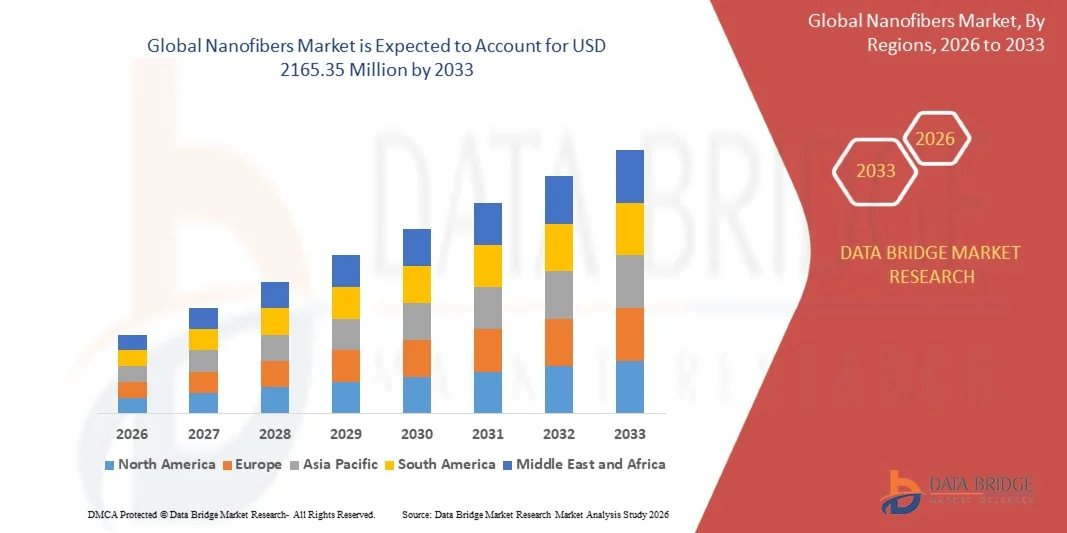
- As per Data Bridge Market Research Analysis the global nanofibers market size was valued at USD 597.95 million in 2025 and is expected to reach USD 2165.35 million by 2033, at a CAGR of 17.5% during the forecast period
- The factors such as increasing chemical production, growing demand in filtration technology, rising demand for medical, life science, and pharmaceutical applications, developing use of nanofibers in the textile sector are the root cause fueling up the market growth rate
- The factors expected to cushion the growth of the market are wide range of applications of nanotechnology and inclination of population towards achieving sustainable and eco-friendly products
Market Size & Forecast
Global Market Value (2025): USD 597.95 million
Expected Market Value (2033): USD 2165.35 million
Forecast CAGR (2026–2033): 17.5%
What are the Major Takeaways of Nanofibers Market?
- The factors such as high initial cost and less technical knowledge of these systems are expected to impede the growth of the nanofibers market. Furthermore, difficulty in shift of carbon nanofibers from lab scale to plant scale due to small size and complexity is also expected to hamper the market’s growth within the forecasted period
- The increased investment in research and development and new manufacturing techniques are estimated to generate numerous opportunities for the market. On the flip side, the strict regulatory policies for nanofibers in few end-use industries and the low usage of these nanofibers as compared to the usage of regular N95 masks are projected to pose as a major challenge to the growth of the nanofibers market
- North America dominated the Nanofibers market with a 40.7% revenue share in 2025, driven by strong growth in advanced filtration, healthcare textiles, aerospace composites, energy storage materials, and industrial manufacturing across the U.S. and Canada
- Asia-Pacific is projected to register the fastest CAGR of 9.02% from 2026 to 2033, driven by rapid expansion in electronics manufacturing, automotive production, healthcare infrastructure, textile processing, and water treatment systems across China, Japan, India, South Korea, and Southeast Asia
- The Polymer Nanofibers segment dominated the market with a 34.8% share in 2025, as it remains widely preferred across filtration, medical textiles, wound dressings, and protective clothing applications due to its flexibility, lightweight structure, and ease of large-scale production
Report Scope and Nanofibers Market Segmentation
|
Attributes |
Nanofibers Key Market Insights |
|
Segments Covered |
|
|
Countries Covered |
North America
Europe
Asia-Pacific
Middle East and Africa
South America
|
|
Key Market Players |
|
|
Market Opportunities |
|
|
Value Added Data Infosets |
In addition to the insights on market scenarios such as market value, growth rate, segmentation, geographical coverage, and major players, the market reports curated by the Data Bridge Market Research also include in-depth expert analysis, pricing analysis, brand share analysis, consumer survey, demography analysis, supply chain analysis, value chain analysis, raw material/consumables overview, vendor selection criteria, PESTLE Analysis, Porter Analysis, and regulatory framework. |
What is the Key Trend in the Nanofibers Market?
“Increasing Shift Toward Lightweight, High-Performance, and Sustainable Fiber Technologies”
- The nanofibers market is witnessing strong adoption of ultra-fine, lightweight, and high-surface-area fiber materials designed to support filtration, medical textiles, energy storage, and advanced composite applications
- Manufacturers are increasingly introducing electrospun polymeric, carbon, ceramic, and composite nanofibers that offer enhanced mechanical strength, porosity, thermal stability, and functional performance
- Growing demand for cost-efficient, lightweight, and high-performance material solutions is driving usage across healthcare labs, filtration systems, industrial manufacturing, and research environments
- For instance, companies such as Toray Industries, DuPont, Donaldson Company, Asahi Kasei, and Johns Manville are expanding their nanofiber portfolios with advanced membrane, insulation, and high-efficiency filtration solutions
- Increasing need for air and liquid filtration, wound care products, battery separators, and lightweight structural materials is accelerating the shift toward advanced nanofiber technologies
- As industries continue to focus on sustainability, material efficiency, and high-performance engineering, nanofibers will remain vital for next-generation industrial and biomedical applications
What are the Key Drivers of Nanofibers Market?
- Rising demand for high-efficiency filtration materials, medical textiles, and lightweight reinforcement fibers is a major growth driver for the market
- For instance, in 2025, leading companies such as Toray Industries, DuPont, and Donaldson Company expanded their nanofiber product portfolios to support filtration media, healthcare materials, and advanced industrial applications
- Growing adoption across healthcare, automotive, electronics, aerospace, energy storage, and water treatment sectors is significantly boosting market demand across the U.S., Europe, and Asia-Pacific
- Advancements in electrospinning technology, fiber diameter control, surface functionalization, and scalable manufacturing processes have strengthened product performance, durability, and commercial viability
- Rising use of nanofibers in battery separators, tissue engineering, protective clothing, and air purification systems is creating strong demand globally
- Supported by steady investments in materials R&D, healthcare innovation, and industrial filtration infrastructure, the Nanofibers market is expected to witness strong long-term growth
Which Factor is Challenging the Growth of the Nanofibers Market?
- High costs associated with advanced production equipment, electrospinning systems, and specialized raw materials restrict adoption among small manufacturers and academic institutions
- For instance, during 2024–2025, fluctuations in polymer prices, carbon precursor costs, and high manufacturing complexity increased production expenses for several global vendors
- Complexity in achieving uniform fiber diameter, scalability, structural consistency, and large-scale commercialization increases the need for skilled engineers and technical expertise
- Limited awareness in emerging markets regarding nanofiber applications, material benefits, and advanced production technologies slows adoption
- Competition from traditional fibers, nonwoven fabrics, and alternative filtration materials creates pricing pressure and reduces product differentiation
- To address these issues, companies are focusing on cost-optimized production, sustainable raw materials, and enhanced application-specific product development to increase global adoption of nanofibers
How is the Nanofibers Market Segmented?
The market is segmented on the basis of product type, category, technology, application, and end use.
• By Product Type
On the basis of product type, the nanofibers market is segmented into Polymer Nanofibers, Carbon Nanofibers, Glass Nanofibers, Composite Nanofibers, and Others. The Polymer Nanofibers segment dominated the market with a 34.8% share in 2025, as it remains widely preferred across filtration, medical textiles, wound dressings, and protective clothing applications due to its flexibility, lightweight structure, and ease of large-scale production. These nanofibers provide excellent porosity, high surface area, and strong compatibility with electrospinning processes, making them highly suitable for advanced material applications. Their cost-effectiveness and broad commercial availability continue to support strong deployment across healthcare, industrial filtration, and research environments.
The Carbon Nanofibers segment is expected to grow at the fastest CAGR from 2026 to 2033, driven by rising demand for lightweight conductive materials in energy storage systems, aerospace structures, automotive components, and electronics applications.
• By Category
On the basis of category, the market is segmented into Carbon, Ceramic, Composite, Glass, Polymeric, and Others. The Polymeric segment dominated the market with a 31.9% share in 2025, supported by rapid growth in medical applications, air filtration, textiles, and industrial membranes. Polymeric nanofibers are extensively used in drug delivery systems, tissue engineering, filtration media, and high-performance fabrics due to their flexibility and processability.
The Composite segment is projected to grow at the fastest CAGR from 2026 to 2033, driven by increasing demand for multi-functional materials combining strength, conductivity, and durability across automotive, aerospace, and advanced industrial applications.
• By Technology
On the basis of technology, the market is segmented into Magneto Spinning, Force Spinning, Rotary Jet Spinning, and Others. The Force Spinning segment dominated the market with a 36.2% share in 2025, driven by its high production efficiency, scalability, and lower operational cost compared to conventional electrospinning. It is widely adopted for commercial-scale nanofiber production across filtration and medical applications.
The Rotary Jet Spinning segment is expected to grow at the fastest CAGR from 2026 to 2033, propelled by increasing use in mass production environments and industrial fiber manufacturing systems.
• By Application
On the basis of application, the market is segmented into Water and Air Filtration, Automotive and Transportation, Textiles, Medical, Electronics, Energy Storage, and Others. The Water and Air Filtration segment dominated the market with a 29.6% share in 2025, driven by extensive use in HEPA filters, industrial membranes, and purification systems.
The Energy Storage segment is expected to grow at the fastest CAGR from 2026 to 2033, supported by rising use in battery separators, supercapacitors, and fuel cell applications.
• By End Use
On the basis of end use, the market is segmented into Mechanical, Chemical and Environment (MCE), Medical, Life Science and Pharmaceutical (MLP), Electronics, and Others. The Medical segment dominated the market with a 33.4% share in 2025, supported by strong use in wound care, tissue engineering, regenerative medicine, and protective medical textiles.
The Electronics segment is expected to grow at the fastest CAGR from 2026 to 2033, driven by increasing demand for conductive membranes, sensors, and flexible electronic materials.
Which Region Holds the Largest Share of the Nanofibers Market?
- North America dominated the Nanofibers market with a 40.7% revenue share in 2025, driven by strong growth in advanced filtration, healthcare textiles, aerospace composites, energy storage materials, and industrial manufacturing across the U.S. and Canada. High adoption of nanofiber-based membranes, wound care products, protective fabrics, and battery separators continues to fuel demand across research laboratories, medical device facilities, automotive component plants, and industrial filtration systems
- Leading companies in North America are introducing advanced electrospinning technologies, high-efficiency filtration membranes, and functional nanofiber composites, strengthening the region’s technological advantage. Continuous investment in healthcare innovation, air purification infrastructure, and advanced materials R&D drives long-term market expansion
- Strong innovation ecosystems, high concentration of engineering talent, and sustained investments in material science and healthcare infrastructure further reinforce regional market leadership
U.S. Nanofibers Market Insight
The U.S. is the largest contributor in North America, supported by strong R&D in medical textiles, advanced filtration systems, battery materials, and aerospace composites. Increasing development of high-performance air filters, wound dressing materials, EV battery separators, and lightweight reinforcement fibers intensifies market demand. Presence of major players such as DuPont, Donaldson Company, and Johns Manville further drives market growth.
Canada Nanofibers Market Insight
Canada contributes significantly to regional growth, driven by expanding healthcare material research, industrial filtration systems, and sustainable textile innovation. Universities and engineering labs increasingly utilize nanofibers for advanced membrane and biomedical applications.
Asia-Pacific Nanofibers Market
Asia-Pacific is projected to register the fastest CAGR of 9.02% from 2026 to 2033, driven by rapid expansion in electronics manufacturing, automotive production, healthcare infrastructure, textile processing, and water treatment systems across China, Japan, India, South Korea, and Southeast Asia. High-volume production of consumer electronics, EV batteries, industrial filters, and advanced textiles increases demand for nanofiber-based materials. Growth in energy storage, medical products, smart textiles, and environmental filtration systems continues to accelerate market expansion across the region
China Nanofibers Market Insight
China is the largest contributor to Asia-Pacific due to massive investments in textile manufacturing, filtration products, EV batteries, and industrial materials innovation. Rising development of nanofiber membranes and advanced composites significantly drives demand.
Japan Nanofibers Market Insight
Japan shows steady growth supported by advanced healthcare systems, automotive engineering, precision textiles, and energy storage technologies. Strong focus on quality materials and product reliability reinforces long-term market expansion.
India Nanofibers Market Insight
India is emerging as a major growth hub, driven by expanding textile industries, healthcare infrastructure, water purification projects, and government-backed manufacturing initiatives. Growing demand for medical and industrial filtration materials fuels market penetration.
South Korea Nanofibers Market Insight
South Korea contributes significantly due to strong demand for advanced batteries, electronics components, medical materials, and smart textiles. Continuous innovation and strong manufacturing infrastructure support sustained market growth.
Which are the Top Companies in Nanofibers Market?
The nanofibers industry is primarily led by well-established companies, including:
- eSpin Technologies (U.S.)
- apsci (U.S.)
- TORAY INDUSTRIES, INC. (Japan)
- Johns Manville (U.S.)
- Grupo Antolin (Spain)
- Pragyanam (India)
- MDPI (Switzerland)
- UnB (Brazil)
- Nanofiber Solutions (U.S.)
- Electrovac AG (Switzerland)
- NANOVAL GmbH & Co. KG (Germany)
- nafenindia (India)
- Donaldson Company, Inc. (U.S.)
- DuPont (U.S.)
- Applied Science, Inc. (U.S.)
- Asahi Kasei Corporation (Japan)
- Relationship Science LLC (U.S.)
What are the Recent Developments in Global Nanofibers Market?
- In November 2024, the University College London research team introduced a greener method for producing nanofibers directly from starch-rich materials such as flour, commonly used in pasta manufacturing, thereby supporting sustainable production technologies and strengthening future growth opportunities in eco-friendly nanofiber applications
- In October 2024, Cellevate announced plans to launch the first nanofiber microcarrier for gene therapy at CPHI Milan, with its Cellevat3d® technology offering up to 60 times greater surface area for cell expansion compared with conventional systems, thereby enhancing bioprocessing productivity and accelerating innovation in life science and pharmaceutical applications
- In July 2024, researchers at the University of Maine utilized an electrostatic contact dewatering technique to accelerate the drying process of cellulose nanofibers, supporting faster commercialization of sustainable packaging materials, thereby advancing the use of bio-based alternatives to fossil-fuel-derived plastics and strengthening market growth in green packaging solutions
- In June 2024, Ahlstrom introduced a new range of filtration materials featuring innovative fluoro-free technology and enhanced durability for demanding environments, targeting gas turbine air intake, air pollution control, and HVAC applications, thereby reinforcing its position in high-performance filtration solutions and expanding nanofiber adoption in industrial applications
- In June 2024, Toray Industries announced the launch of three new Toraysee design cloth variants, with the 24-square-centimeter microfiber cleaning cloths made available through optician stores in Japan and online retail platforms, thereby strengthening its consumer product portfolio and expanding commercial opportunities in advanced microfiber and nanofiber materials

- Interactive Data Analysis Dashboard
- Company Analysis Dashboard for high growth potential opportunities
- Research Analyst Access for customization & queries
- Competitor Analysis with Interactive dashboard
- Latest News, Updates & Trend analysis
- Harness the Power of Benchmark Analysis for Comprehensive Competitor Tracking
Table of Content
1 INTRODUCTION
1.1 OBJECTIVES OF THE STUDY
1.2 MARKET DEFINITION
1.3 OVERVIEW OF GLOBAL NANOFIBERS MARKET
1.4 CURRENCY AND PRICING
1.5 LIMITATION
1.6 MARKETS COVERED
2 MARKET SEGMENTATION
2.1 KEY TAKEAWAYS
2.2 ARRIVING AT THE GLOBAL NANOFIBERS MARKET SIZE
2.3 VENDOR POSITIONING GRID
2.4 MARKETS COVERED
2.5 GEOGRAPHIC SCOPE
2.6 YEARS CONSIDERED FOR THE STUDY
2.7 RESEARCH METHODOLOGY
2.8 TECHNOLOGY LIFE LINE CURVE
2.9 MULTIVARIATE MODELLING
2.1 PRIMARY INTERVIEWS WITH KEY OPINION LEADERS
2.11 DBMR MARKET POSITION GRID
2.12 MARKET APPLICATION COVERAGE GRID
2.13 DBMR MARKET CHALLENGE MATRIX
2.14 SECONDARY SOURCES
2.15 GLOBAL NANOFIBERS MARKET: RESEARCH SNAPSHOT
2.16 ASSUMPTIONS
3 MARKET OVERVIEW
3.1 DRIVERS
3.2 RESTRAINTS
3.3 OPPORTUNITIES
3.4 CHALLENGES
4 EXECUTIVE SUMMARY
5 PREMIUM INSIGHTS
5.1 LIST OF KEY PATENTS LAUNCHED
5.2 TECHNOLOGICAL ADVANCEMENT BY MANUFACTURERS
5.3 PORTER’S FIVE FORCES
5.4 VENDOR SELECTION CRITERIA
5.5 PESTEL ANALYSIS
5.6 REGULATION COVERAGE
5.6.1 PRODUCT CODES
5.6.2 CERTIFIED STANDARDS
5.6.3 SAFETY STANDARDS
5.6.3.1. MATERIAL HANDLING & STORAGE
5.6.3.2. TRANSPORT & PRECAUTIONS
5.6.3.3. HARAD IDENTIFICATION
6 SUPPLY CHAIN ANALYSIS
6.1 OVERVIEW
6.2 LOGISTIC COST SCENARIO
6.3 IMPORTANCE OF LOGISTICS SERVICE PROVIDERS
7 CLIMATE CHANGE SCENARIO
7.1 ENVIRONMENTAL CONCERNS
7.2 INDUSTRY RESPONSE
7.3 GOVERNMENT’S ROLE
7.4 ANALYST RECOMMENDATIONS
8 GLOBAL NANOFIBERS MARKET, BY PRODUCT TYPE
8.1 OVERVIEW
8.2 POLYMER NANOFIBERS
8.2.1 POLYMER NANOFIBERS, BY TYPE
8.2.2 SYNTHETIC POLYMER NANOFIBERS
8.2.2.1. NYLON
8.2.2.2. ACRYLIC
8.2.2.3. POLYCARBONATE
8.2.2.4. POLYSULFONES
8.2.2.5. FLUROPOLYMERS
8.2.2.6. OTHER POLYMERS
8.2.3 BIOLOGICAL POLYMER NANOFIBERS
8.2.3.1. POLYCAPROLACTUM
8.2.3.2. CHITOSAN
8.2.3.3. POLYLACTIC ACID
8.2.3.4. COPOLYMER OF POLYLACTIC/GLYCOLIC ACID
8.2.3.5. OTHER
8.3 CARBON NANOFIBERS
8.4 GLASS NANOFIBERS
8.5 CERAMIC NANOFIBERS
8.6 COMPOSITE NANOFIBERS
8.7 METALLIC NANOFIBER
8.8 OTHERS
9 GLOBAL NANOFIBERS MARKET, BY TECHNOLOGY
9.1 OVERVIEW
9.2 MAGNETO SPINNING
9.3 ELECTROSPINNING TECHNOLOGY
9.4 FORCE SPINNING
9.5 ROTARY JET SPINNING
9.6 OTHERS
10 GLOBAL NANOFIBERS MARKET, BY APPLICATION
10.1 OVERVIEW
10.2 WATER AND AIR FILTRATION
10.2.1 WATER AND AIR FILTRATION, BY PRODUCT TYPE
10.2.1.1. POLYMER NANOFIBERS
10.2.1.2. CARBON NANOFIBERS
10.2.1.3. GLASS NANOFIBERS
10.2.1.4. CERAMIC NANOFIBERS
10.2.1.5. COMPOSITE NANOFIBERS
10.2.1.6. METALLIC NANOFIBER
10.2.1.7. OTHERS
10.3 AUTOMOTIVE AND TRANSPORTATION
10.3.1 AUTOMOTIVE AND TRANSPORTATION, BY PRODUCT TYPE
10.3.1.1. POLYMER NANOFIBERS
10.3.1.2. CARBON NANOFIBERS
10.3.1.3. GLASS NANOFIBERS
10.3.1.4. CERAMIC NANOFIBERS
10.3.1.5. COMPOSITE NANOFIBERS
10.3.1.6. METALLIC NANOFIBERS
10.3.1.7. OTHERS
10.4 TEXTILES
10.4.1 TEXTILES, BY PRODUCT TYPE
10.4.1.1. POLYMER NANOFIBERS
10.4.1.2. CARBON NANOFIBERS
10.4.1.3. GLASS NANOFIBERS
10.4.1.4. CERAMIC NANOFIBERS
10.4.1.5. COMPOSITE NANOFIBERS
10.4.1.6. METALLIC NANOFIBERS
10.4.1.7. OTHERS
10.5 MEDICAL
10.5.1 MEDICAL, BY PRODUCT TYPE
10.5.1.1. POLYMER NANOFIBERS
10.5.1.2. CARBON NANOFIBERS
10.5.1.3. GLASS NANOFIBERS
10.5.1.4. CERAMIC NANOFIBERS
10.5.1.5. COMPOSITE NANOFIBERS
10.5.1.6. METALLIC NANOFIBERS
10.5.1.7. OTHERS
10.6 ELECTRONICS
10.6.1 ELECTRONICS, BY PRODUCT TYPE
10.6.1.1. POLYMER NANOFIBERS
10.6.1.2. CARBON NANOFIBERS
10.6.1.3. GLASS NANOFIBERS
10.6.1.4. CERAMIC NANOFIBERS
10.6.1.5. COMPOSITE NANOFIBERS
10.6.1.6. METALLIC NANOFIBERS
10.6.1.7. OTHERS
10.7 ENERGY STORAGE
10.7.1 ENERGY STORAGE, BY PRODUCT TYPE
10.7.1.1. POLYMER NANOFIBERS
10.7.1.2. CARBON NANOFIBERS
10.7.1.3. GLASS NANOFIBERS
10.7.1.4. CERAMIC NANOFIBERS
10.7.1.5. COMPOSITE NANOFIBERS
10.7.1.6. METALLIC NANOFIBERS
10.7.1.7. OTHERS
10.8 SOUND ABSORPTIVE MATERIALS
10.8.1 SOUND ABSORPTIVE MATERIALS, BY PRODUCT TYPE
10.8.1.1. POLYMER NANOFIBERS
10.8.1.2. CARBON NANOFIBERS
10.8.1.3. GLASS NANOFIBERS
10.8.1.4. CERAMIC NANOFIBERS
10.8.1.5. COMPOSITE NANOFIBERS
10.8.1.6. METALLIC NANOFIBERS
10.8.1.7. OTHERS
10.9 OTHERS
10.9.1 OTHERS, BY PRODUCT TYPE
10.9.1.1. POLYMER NANOFIBERS
10.9.1.2. CARBON NANOFIBERS
10.9.1.3. GLASS NANOFIBERS
10.9.1.4. CERAMIC NANOFIBERS
10.9.1.5. COMPOSITE NANOFIBERS
10.9.1.6. METALLIC NANOFIBERS
10.9.1.7. OTHERS
11 GLOBAL NANOFIBERS MARKET, BY END USE
11.1 OVERVIEW
11.2 MECHANICAL/METAL INDUSTRY
11.3 CHEMICAL INDUSTRY
11.4 MEDICAL
11.5 LIFE SCIENCE AND PHARMACEUTICAL (MLP)
11.6 AEROSPACE & DEFENSE
11.7 OTHERS
12 GLOBAL NANOFIBERS MARKET, BY REGION
GLOBAL NANOFIBERS MARKET, (ALL SEGMENTATION PROVIDED ABOVE IS REPRESENTED IN THIS CHAPTER BY COUNTRY)
12.1 NORTH AMERICA
12.1.1 U.S.
12.1.2 CANADA
12.1.3 MEXICO
12.2 EUROPE
12.2.1 GERMANY
12.2.2 U.K.
12.2.3 ITALY
12.2.4 FRANCE
12.2.5 SPAIN
12.2.6 RUSSIA
12.2.7 SWITZERLAND
12.2.8 TURKEY
12.2.9 BELGIUM
12.2.10 NETHERLANDS
12.2.11 REST OF EUROPE
12.3 ASIA-PACIFIC
12.3.1 JAPAN
12.3.2 CHINA
12.3.3 SOUTH KOREA
12.3.4 INDIA
12.3.5 SINGAPORE
12.3.6 THAILAND
12.3.7 INDONESIA
12.3.8 MALAYSIA
12.3.9 PHILIPPINES
12.3.10 AUSTRALIA & NEW ZEALAND
12.3.11 REST OF ASIA-PACIFIC
12.4 SOUTH AMERICA
12.4.1 BRAZIL
12.4.2 ARGENTINA
12.4.3 REST OF SOUTH AMERICA
12.5 MIDDLE EAST AND AFRICA
12.5.1 SOUTH AFRICA
12.5.2 EGYPT
12.5.3 SAUDI ARABIA
12.5.4 UNITED ARAB EMIRATES
12.5.5 ISRAEL
12.5.6 REST OF MIDDLE EAST AND AFRICA
13 GLOBAL NANOFIBERS MARKET, COMPANY LANDSCAPE
13.1 COMPANY SHARE ANALYSIS: GLOBAL
13.2 COMPANY SHARE ANALYSIS: NORTH AMERICA
13.3 COMPANY SHARE ANALYSIS: EUROPE
13.4 COMPANY SHARE ANALYSIS: ASIA-PACIFIC
13.5 MERGERS AND ACQUISITIONS
13.6 NEW PRODUCT DEVELOPMENT AND APPROVALS
13.7 EXPANSIONS
13.8 PARTNERSHIP AND OTHER STRATEGIC DEVELOPMENTS
14 SWOT AND DATA BRIDGE MARKET RESEARCH ANALYSIS
15 GLOBAL NANOFIBERS MARKET - COMPANY PROFILES
15.1 ESPIN TECHNOLOGIES
15.1.1 COMPANY SNAPSHOT
15.1.2 REVENUE ANALYSIS
15.1.3 PRODUCT PORTFOLIO
15.1.4 RECENT UPDATES
15.2 APSCI
15.2.1 COMPANY SNAPSHOT
15.2.2 REVENUE ANALYSIS
15.2.3 PRODUCT PORTFOLIO
15.2.4 RECENT UPDATES
15.3 STORAY INDUSTRIES, INC.
15.3.1 COMPANY SNAPSHOT
15.3.2 REVENUE ANALYSIS
15.3.3 PRODUCT PORTFOLIO
15.3.4 RECENT UPDATES
15.4 JOHNS MANVILLE
15.4.1 COMPANY SNAPSHOT
15.4.2 REVENUE ANALYSIS
15.4.3 PRODUCT PORTFOLIO
15.4.4 RECENT UPDATES
15.5 GRUPO ANTOLIN
15.5.1 COMPANY SNAPSHOT
15.5.2 REVENUE ANALYSIS
15.5.3 PRODUCT PORTFOLIO
15.5.4 RECENT UPDATES
15.6 NANOFIBER SOLUTIONS.
15.6.1 COMPANY SNAPSHOT
15.6.2 REVENUE ANALYSIS
15.6.3 PRODUCT PORTFOLIO
15.6.4 RECENT UPDATES
15.7 DONALDSON COMPANY, INC.
15.7.1 COMPANY SNAPSHOT
15.7.2 REVENUE ANALYSIS
15.7.3 PRODUCT PORTFOLIO
15.7.4 RECENT UPDATES
15.8 DUPONT
15.8.1 COMPANY SNAPSHOT
15.8.2 REVENUE ANALYSIS
15.8.3 PRODUCT PORTFOLIO
15.8.4 RECENT UPDATES
15.9 ASAHI KASEI CORPORATION
15.9.1 COMPANY SNAPSHOT
15.9.2 REVENUE ANALYSIS
15.9.3 PRODUCT PORTFOLIO
15.9.4 RECENT UPDATES
15.1 ELMARCO S.R.O
15.10.1 COMPANY SNAPSHOT
15.10.2 REVENUE ANALYSIS
15.10.3 PRODUCT PORTFOLIO
15.10.4 RECENT UPDATES
15.11 MEMPRO LTD
15.11.1 COMPANY SNAPSHOT
15.11.2 REVENUE ANALYSIS
15.11.3 PRODUCT PORTFOLIO
15.11.4 RECENT UPDATES
15.12 REVOLUTION FIBERS LTD
15.12.1 COMPANY SNAPSHOT
15.12.2 REVENUE ANALYSIS
15.12.3 PRODUCT PORTFOLIO
15.12.4 RECENT UPDATES
15.13 SNC FIBERS.
15.13.1 COMPANY SNAPSHOT
15.13.2 REVENUE ANALYSIS
15.13.3 PRODUCT PORTFOLIO
15.13.4 RECENT UPDATES
15.14 INMED LLC
15.14.1 COMPANY SNAPSHOT
15.14.2 REVENUE ANALYSIS
15.14.3 PRODUCT PORTFOLIO
15.14.4 RECENT UPDATES
15.15 M-TECHX INC.
15.15.1 COMPANY SNAPSHOT
15.15.2 REVENUE ANALYSIS
15.15.3 PRODUCT PORTFOLIO
15.15.4 RECENT UPDATES
15.16 ZETTA.LTD.
15.16.1 COMPANY SNAPSHOT
15.16.2 REVENUE ANALYSIS
15.16.3 PRODUCT PORTFOLIO
15.16.4 RECENT UPDATES
15.17 VERDEX
15.17.1 COMPANY SNAPSHOT
15.17.2 REVENUE ANALYSIS
15.17.3 PRODUCT PORTFOLIO
15.17.4 RECENT UPDATES
15.18 BIG-NANO.
15.18.1 COMPANY SNAPSHOT
15.18.2 REVENUE ANALYSIS
15.18.3 PRODUCT PORTFOLIO
15.18.4 RECENT UPDATES
*NOTE: THE COMPANIES PROFILED IS NOT EXHAUSTIVE LIST AND IS AS PER OUR PREVIOUS CLIENT REQUIREMENT. WE PROFILE MORE THAN 100 COMPANIES IN OUR STUDY AND HENCE THE LIST OF COMPANIES CAN BE MODIFIED OR REPLACED ON REQUEST
16 RELATED REPORTS
17 QUESTIONNAIRE
18 CONCLUSION
19 ABOUT DATA BRIDGE MARKET RESEARCH

Global Nanofibers Market, Supply Chain Analysis and Ecosystem Framework
To support market growth and help clients navigate the impact of geopolitical shifts, DBMR has integrated in-depth supply chain analysis into its Global Nanofibers Market research reports. This addition empowers clients to respond effectively to global changes affecting their industries. The supply chain analysis section includes detailed insights such as Global Nanofibers Market consumption and production by country, price trend analysis, the impact of tariffs and geopolitical developments, and import and export trends by country and HSN code. It also highlights major suppliers with data on production capacity and company profiles, as well as key importers and exporters. In addition to research, DBMR offers specialized supply chain consulting services backed by over a decade of experience, providing solutions like supplier discovery, supplier risk assessment, price trend analysis, impact evaluation of inflation and trade route changes, and comprehensive market trend analysis.
Data collection and base year analysis are done using data collection modules with large sample sizes. The stage includes obtaining market information or related data through various sources and strategies. It includes examining and planning all the data acquired from the past in advance. It likewise envelops the examination of information inconsistencies seen across different information sources. The market data is analysed and estimated using market statistical and coherent models. Also, market share analysis and key trend analysis are the major success factors in the market report. To know more, please request an analyst call or drop down your inquiry.
The key research methodology used by DBMR research team is data triangulation which involves data mining, analysis of the impact of data variables on the market and primary (industry expert) validation. Data models include Vendor Positioning Grid, Market Time Line Analysis, Market Overview and Guide, Company Positioning Grid, Patent Analysis, Pricing Analysis, Company Market Share Analysis, Standards of Measurement, Global versus Regional and Vendor Share Analysis. To know more about the research methodology, drop in an inquiry to speak to our industry experts.
Data Bridge Market Research is a leader in advanced formative research. We take pride in servicing our existing and new customers with data and analysis that match and suits their goal. The report can be customized to include price trend analysis of target brands understanding the market for additional countries (ask for the list of countries), clinical trial results data, literature review, refurbished market and product base analysis. Market analysis of target competitors can be analyzed from technology-based analysis to market portfolio strategies. We can add as many competitors that you require data about in the format and data style you are looking for. Our team of analysts can also provide you data in crude raw excel files pivot tables (Fact book) or can assist you in creating presentations from the data sets available in the report.













