


Military Aerospace Coatings Market Size
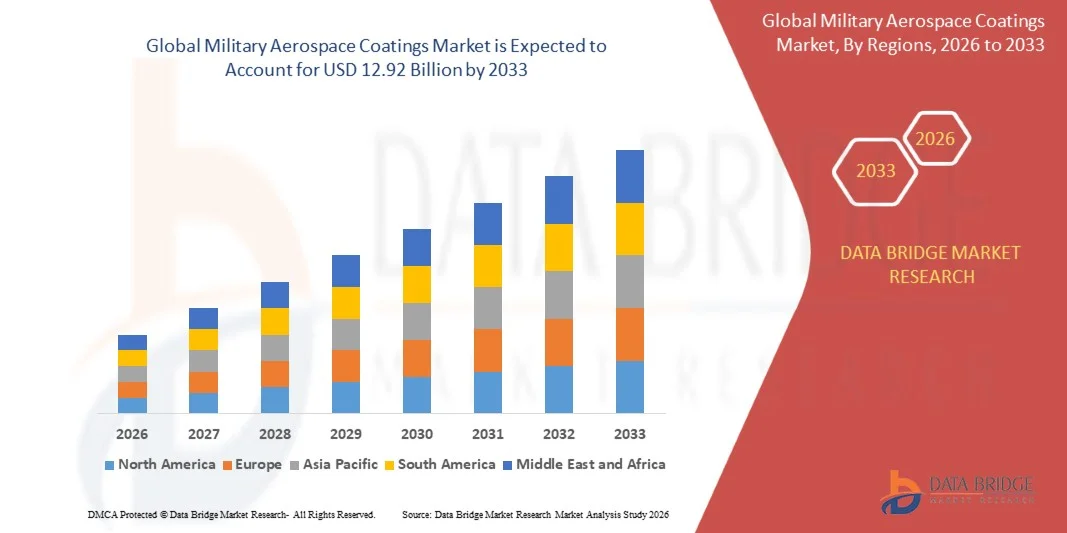
- The global military aerospace coatings market size was valued at USD 7.52 billion in 2025 and is expected to reach USD 12.92 billion by 2033, at a CAGR of 7.00% during the forecast period
- The market growth is largely fuelled by the increasing defense expenditure across major economies and the rising demand for advanced protective coatings to enhance aircraft durability, corrosion resistance, and stealth performance
- Growing modernization programs for military aircraft fleets and the development of next-generation fighter jets, transport aircraft, and unmanned aerial vehicles are further accelerating the adoption of high-performance aerospace coatings
Military Aerospace Coatings Market Analysis
- Military aerospace coatings are widely used to protect aircraft structures from extreme environmental conditions such as high temperatures, UV radiation, corrosion, and chemical exposure, ensuring operational reliability and longer service life of defense aircraft
- Continuous advancements in coating formulations, such as radar-absorbing coatings, thermal barrier coatings, and low-VOC technologies, are enhancing aircraft performance while supporting regulatory compliance and sustainability initiatives within the aerospace defense industry
- North America dominated the military aerospace coatings market with the largest revenue share in 2025, driven by rising defense expenditure, continuous modernization of military aircraft fleets, and strong presence of leading aerospace manufacturers
- Asia-Pacific region is expected to witness the highest growth rate in the global military aerospace coatings market, driven by increasing defense procurement, rapid expansion of military aviation fleets, and growing investments in aerospace manufacturing and maintenance infrastructure across emerging economies
- The polyurethane segment held the largest market revenue share in 2025 driven by its superior durability, chemical resistance, and ability to provide long-lasting protection against harsh environmental conditions. Polyurethane coatings are widely used on aircraft exteriors due to their excellent gloss retention, weather resistance, and ability to maintain structural integrity during extreme flight conditions
Report Scope and Military Aerospace Coatings Market Segmentation
|
Attributes |
Military Aerospace Coatings Key Market Insights |
|
Segments Covered |
|
|
Countries Covered |
North America
Europe
Asia-Pacific
Middle East and Africa
South America
|
|
Key Market Players |
• Akzo Nobel N.V. (Netherlands) |
|
Market Opportunities |
|
|
Value Added Data Infosets |
In addition to the insights on market scenarios such as market value, growth rate, segmentation, geographical coverage, and major players, the market reports curated by the Data Bridge Market Research also include import export analysis, production capacity overview, production consumption analysis, price trend analysis, climate change scenario, supply chain analysis, value chain analysis, raw material/consumables overview, vendor selection criteria, PESTLE Analysis, Porter Analysis, and regulatory framework. |
Military Aerospace Coatings Market Trends
“Increasing Demand for Advanced Protective and Stealth Coatings”
• The growing need for enhanced aircraft durability and performance is significantly shaping the military aerospace coatings market, as defense organizations increasingly prioritize coatings that offer corrosion resistance, thermal protection, and stealth capabilities. Military aerospace coatings are gaining traction due to their ability to protect aircraft surfaces from extreme environmental conditions such as high temperatures, UV radiation, moisture, and chemical exposure. This trend is strengthening their adoption across fighter jets, transport aircraft, helicopters, and unmanned aerial vehicles, encouraging manufacturers to develop high-performance and multifunctional coating formulations
• Increasing global defense modernization programs and investments in next-generation aircraft platforms have accelerated the demand for advanced aerospace coatings. Military forces are actively upgrading aging fleets and introducing new aircraft equipped with improved materials and technologies, prompting coating manufacturers to deliver solutions that enhance operational lifespan and reduce maintenance requirements. This has also led to collaborations between defense contractors and coating manufacturers to improve durability, stealth performance, and fuel efficiency
• Sustainability and regulatory trends are influencing purchasing decisions, with defense agencies and manufacturers emphasizing low-VOC formulations, environmentally compliant coatings, and improved lifecycle performance. These factors are helping suppliers differentiate their offerings in a competitive market while ensuring compliance with evolving environmental regulations. Companies are increasingly investing in research and innovation to develop coatings that combine environmental responsibility with high operational performance
• For instance, in 2024, AkzoNobel in the Netherlands and PPG Industries in the U.S. expanded their aerospace coatings portfolios by introducing advanced military-grade coating systems designed to improve corrosion protection and radar signature management for defense aircraft. These developments were launched to support military modernization programs and were supplied to defense manufacturers and maintenance providers globally, strengthening long-term service performance and operational efficiency
• While demand for military aerospace coatings continues to grow, sustained market expansion depends on ongoing research, advanced material development, and maintaining high durability standards under extreme operational environments. Manufacturers are focusing on improving coating longevity, reducing maintenance cycles, and enhancing compatibility with lightweight aircraft materials to support long-term adoption
Military Aerospace Coatings Market Dynamics
Driver
“Growing Defense Modernization And Military Aircraft Production”
• Rising global defense expenditure and modernization initiatives are major drivers for the military aerospace coatings market. Governments are increasingly investing in the development and procurement of advanced fighter aircraft, helicopters, and unmanned aerial vehicles, which require specialized coatings to ensure protection, performance, and longevity. This trend is also encouraging research into innovative coating technologies that improve aircraft efficiency and survivability
• Expanding applications across fighter jets, transport aircraft, surveillance aircraft, and military drones are influencing market growth. Military aerospace coatings help enhance corrosion resistance, reduce radar visibility, and protect aircraft surfaces from harsh operational environments, enabling defense organizations to maintain mission readiness and reduce maintenance costs. The increasing deployment of advanced aircraft platforms globally further reinforces this trend
• Aerospace and defense manufacturers are actively promoting advanced coating technologies through product innovation, long-term defense contracts, and collaborative development programs. These efforts are supported by rising demand for durable and high-performance materials in defense aviation. Strategic partnerships between coating suppliers and aircraft manufacturers are also helping improve product performance and operational reliability
• For instance, in 2023, The Sherwin-Williams Company in the U.S. and Hempel in Denmark reported increased adoption of advanced aerospace coatings for military aircraft maintenance and refurbishment programs. These developments followed increased military fleet upgrades and modernization initiatives, driving demand for high-performance coatings that enhance aircraft protection and operational lifespan
• Although rising defense investments support market growth, wider adoption depends on continuous innovation, strict compliance with military standards, and cost-efficient manufacturing processes. Investment in advanced materials research, sustainable coating technologies, and supply chain efficiency will be critical for meeting global defense requirements and maintaining competitive advantage
Restraint/Challenge
“High Development Costs And Strict Regulatory Requirements”
• The relatively high cost of developing and applying military aerospace coatings compared to conventional industrial coatings remains a key challenge, limiting adoption among smaller defense suppliers. Advanced coating formulations require specialized materials, extensive testing, and compliance with strict military specifications, which increases overall production costs. In addition, complex application processes may require specialized equipment and skilled technicians
• Regulatory compliance and certification requirements remain stringent across the aerospace defense sector. Coating manufacturers must meet rigorous performance standards related to durability, chemical resistance, environmental impact, and safety. These regulatory frameworks can slow down product approvals and increase development timelines, particularly for new technologies and materials
• Supply chain and production challenges also impact market growth, as aerospace coatings require high-quality raw materials and precise manufacturing processes. Disruptions in the supply of specialty chemicals or pigments can affect production schedules and cost structures. Companies must also maintain strict quality control and traceability to ensure compliance with defense industry standards
• For instance, in 2024, aerospace maintenance providers in Canada and Australia reported delays in coating procurement due to strict certification requirements and limited suppliers for certain specialty coating materials used in military aircraft. These challenges increased project timelines for aircraft refurbishment and maintenance programs, affecting operational planning for some defense operators
• Overcoming these challenges will require cost-efficient manufacturing, advanced formulation technologies, and stronger collaboration between defense agencies, aircraft manufacturers, and coating suppliers. Investment in sustainable materials, streamlined certification processes, and enhanced supply chain resilience will help unlock the long-term growth potential of the global military aerospace coatings market
Military Aerospace Coatings Market Scope
The market is segmented on the basis of resin type, technology, user type, end-user industry, and application.
• By Resin Type
On the basis of resin type, the military aerospace coatings market is segmented into epoxy, polyurethane, and other. The polyurethane segment held the largest market revenue share in 2025 driven by its superior durability, chemical resistance, and ability to provide long-lasting protection against harsh environmental conditions. Polyurethane coatings are widely used on aircraft exteriors due to their excellent gloss retention, weather resistance, and ability to maintain structural integrity during extreme flight conditions.
The epoxy segment is expected to witness the fastest growth rate from 2026 to 2033, driven by its strong adhesion properties and exceptional corrosion resistance. Epoxy coatings are commonly used as primers in military aircraft to provide a protective base layer that enhances the performance and lifespan of topcoats. Their compatibility with advanced coating systems and ability to withstand chemical exposure make them increasingly preferred in defense aviation applications.
• By Technology
On the basis of technology, the market is segmented into liquid coatings and powder coating. The liquid coatings segment held the largest market revenue share in 2025 due to their widespread use in aerospace applications and their ability to deliver uniform coverage across complex aircraft surfaces. Liquid coatings provide high-performance protection against corrosion, UV radiation, and environmental degradation, making them a preferred solution for military aircraft structures.
The powder coating segment is expected to witness the fastest growth rate from 2026 to 2033, driven by increasing demand for environmentally friendly coating technologies and low volatile organic compound (VOC) emissions. Powder coatings offer improved durability and material efficiency while reducing environmental impact. Their growing adoption in aerospace component manufacturing and ground support equipment is supporting market expansion.
• By User Type
On the basis of user type, the market is segmented into MRO and OEM. The OEM segment held the largest market revenue share in 2025 driven by increasing production of advanced military aircraft and modernization programs across defense forces globally. Aircraft manufacturers integrate specialized coatings during the production phase to ensure enhanced durability, stealth performance, and long-term protection against operational wear and corrosion.
The MRO segment is expected to witness the fastest growth rate from 2026 to 2033 due to the increasing need for aircraft maintenance, repair, and refurbishment activities. Military aircraft fleets require regular inspection and recoating to maintain performance and safety standards. As global defense fleets age, demand for MRO services and high-performance coating solutions is expected to grow significantly.
• By End-User Industry
On the basis of end-user industry, the market is segmented into commercial aviation, military aviation, and general aviation, power boats, sailboats, cruise ships, cargo vessels, naval boats, jet boats, personal watercraft and others. The military aviation segment held the largest market revenue share in 2025 driven by rising defense budgets, increasing procurement of advanced fighter jets and surveillance aircraft, and the growing need for protective coatings that enhance aircraft survivability and operational efficiency.
The naval boats segment is expected to witness the fastest growth rate from 2026 to 2033, driven by increasing investments in naval defense programs and the need for corrosion-resistant coatings for marine environments. Advanced coating technologies are being used to improve vessel durability, reduce maintenance requirements, and enhance operational performance in harsh maritime conditions.
• By Application
On the basis of application, the market is segmented into interior and exterior. The exterior segment held the largest market revenue share in 2025 driven by the critical need to protect aircraft surfaces from corrosion, temperature fluctuations, UV radiation, and chemical exposure. Exterior coatings also contribute to aerodynamic performance and stealth characteristics, making them essential in military aviation.
The interior segment is expected to witness the fastest growth rate from 2026 to 2033 driven by increasing demand for lightweight, fire-resistant, and durable coatings used within aircraft cabins and structural components. These coatings help improve safety, reduce maintenance costs, and enhance the overall operational lifespan of military aircraft interiors.
Military Aerospace Coatings Market Regional Analysis
• North America dominated the military aerospace coatings market with the largest revenue share in 2025, driven by rising defense expenditure, continuous modernization of military aircraft fleets, and strong presence of leading aerospace manufacturers
• Defense agencies in the region highly prioritize advanced coating technologies that enhance aircraft durability, corrosion resistance, and stealth capabilities under extreme operational conditions
• This widespread adoption is further supported by advanced defense infrastructure, ongoing investments in next-generation fighter aircraft and unmanned aerial vehicles, and increasing focus on improving aircraft lifecycle performance and maintenance efficiency
U.S. Military Aerospace Coatings Market Insight
The U.S. military aerospace coatings market captured the largest revenue share in 2025 within North America, fueled by strong defense budgets and extensive aircraft modernization programs. The country continues to invest heavily in advanced fighter jets, surveillance aircraft, and unmanned aerial vehicles, which require specialized coatings for corrosion protection, thermal resistance, and radar signature reduction. In addition, strong collaboration between defense contractors and coating manufacturers, along with continuous technological advancements in aerospace materials, further supports the expansion of the military aerospace coatings market in the U.S.
Europe Military Aerospace Coatings Market Insight
The Europe military aerospace coatings market is expected to witness the fastest growth rate from 2026 to 2033, primarily driven by rising defense modernization initiatives and the increasing demand for high-performance coatings for military aircraft. Governments across the region are investing in advanced aerospace technologies to strengthen defense capabilities. In addition, the presence of major aircraft manufacturers and a strong focus on environmentally compliant coating technologies are encouraging innovation and adoption across defense aviation applications.
U.K. Military Aerospace Coatings Market Insight
The U.K. military aerospace coatings market is expected to witness the fastest growth rate from 2026 to 2033, driven by increasing investments in defense aviation and modernization of military aircraft fleets. The country’s focus on strengthening national security and improving aircraft operational efficiency is encouraging the adoption of advanced protective coatings. Furthermore, strong collaboration between defense agencies, aerospace manufacturers, and coating suppliers is supporting the development of high-performance coating technologies for military aviation.
Germany Military Aerospace Coatings Market Insight
The Germany military aerospace coatings market is expected to witness the fastest growth rate from 2026 to 2033, fueled by the country’s strong aerospace manufacturing capabilities and growing focus on defense modernization. Germany is increasingly investing in advanced aircraft technologies and maintenance programs, which require durable and high-performance coatings to ensure aircraft longevity and operational readiness. The emphasis on sustainable and environmentally friendly coating technologies is also supporting market growth across aerospace applications.
Asia-Pacific Military Aerospace Coatings Market Insight
The Asia-Pacific military aerospace coatings market is expected to witness the fastest growth rate from 2026 to 2033, driven by rising defense budgets, rapid expansion of military aviation fleets, and increasing investments in indigenous aircraft development in countries such as China, India, and Japan. Governments across the region are strengthening defense capabilities and investing in advanced aerospace technologies, which is accelerating the demand for specialized coatings that enhance aircraft durability and performance.
Japan Military Aerospace Coatings Market Insight
The Japan military aerospace coatings market is expected to witness the fastest growth rate from 2026 to 2033 due to increasing defense modernization initiatives and rising investments in advanced aircraft technologies. Japan is focusing on strengthening its air defense capabilities and upgrading existing military aircraft fleets, which is driving the demand for advanced coating systems. The country’s strong technological expertise and emphasis on high-quality aerospace materials further support the growth of the military aerospace coatings market.
China Military Aerospace Coatings Market Insight
The China military aerospace coatings market accounted for the largest market revenue share in Asia-Pacific in 2025, attributed to rapid expansion of military aviation capabilities and increasing investment in indigenous aircraft development programs. China is focusing on strengthening its defense infrastructure and modernizing its fighter jet and surveillance aircraft fleets. The growing domestic aerospace manufacturing sector and increasing demand for advanced protective coatings are key factors supporting the growth of the military aerospace coatings market in the country.
Military Aerospace Coatings Market Share
The Military Aerospace Coatings industry is primarily led by well-established companies, including:
• Akzo Nobel N.V. (Netherlands)
• CREATIVE COATINGS (U.K.)
• Valspar (U.S.)
• Klinge Enameling, Inc. (U.S.)
• CHASE CORPORATION (U.S.)
• Mankiewicz Gebr. & Co. (GmbH & Co. KG) (Germany)
• Cloverdale Paint Inc. (Canada)
• Marpol Private Limited (India)
• Hentzen Coatings, Inc. (U.S.)
• Kansai Paint Co., Ltd. (Japan)
• Evonik Industries AG (Germany)
• Klinge Coatings (U.S.)
• Argosy International Inc. (U.S.)
• BryCoat Inc. (U.S.)
• Henkel AG & Company KGaA (Germany)
• BASF SE (Germany)
• 3Chem (U.S.)
• The Sherwin-Williams Company (U.S.)
• PPG Industries, Inc. (U.S.)
• IHI Ionbond AG (Switzerland)
Latest Developments in Global Military Aerospace Coatings Market
- In September 2025, The Sherwin-Williams Company, product launch, introduced a new range of high-performance coatings specifically engineered for military aerospace applications. These coatings are designed to provide enhanced corrosion resistance, environmental protection, and long-term durability for defense aircraft operating in extreme conditions. The development aims to support evolving military performance requirements while aligning with sustainability initiatives in defense procurement. This launch strengthens the company’s technological leadership and is expected to expand its presence in the global military aerospace coatings market
- In July 2025, Akzo Nobel N.V., capacity expansion, announced the expansion of its manufacturing capabilities in North America to increase production of advanced aerospace coatings. The initiative is intended to address rising demand for high-performance coatings used in military aircraft manufacturing and maintenance programs. By strengthening regional production capacity, the company aims to improve supply chain reliability and reduce operational costs. This strategic expansion enhances competitiveness and supports growing demand within the defense aerospace coatings market

- Interactive Data Analysis Dashboard
- Company Analysis Dashboard for high growth potential opportunities
- Research Analyst Access for customization & queries
- Competitor Analysis with Interactive dashboard
- Latest News, Updates & Trend analysis
- Harness the Power of Benchmark Analysis for Comprehensive Competitor Tracking
Global Military Aerospace Coatings Market, Supply Chain Analysis and Ecosystem Framework
To support market growth and help clients navigate the impact of geopolitical shifts, DBMR has integrated in-depth supply chain analysis into its Global Military Aerospace Coatings Market research reports. This addition empowers clients to respond effectively to global changes affecting their industries. The supply chain analysis section includes detailed insights such as Global Military Aerospace Coatings Market consumption and production by country, price trend analysis, the impact of tariffs and geopolitical developments, and import and export trends by country and HSN code. It also highlights major suppliers with data on production capacity and company profiles, as well as key importers and exporters. In addition to research, DBMR offers specialized supply chain consulting services backed by over a decade of experience, providing solutions like supplier discovery, supplier risk assessment, price trend analysis, impact evaluation of inflation and trade route changes, and comprehensive market trend analysis.
Data collection and base year analysis are done using data collection modules with large sample sizes. The stage includes obtaining market information or related data through various sources and strategies. It includes examining and planning all the data acquired from the past in advance. It likewise envelops the examination of information inconsistencies seen across different information sources. The market data is analysed and estimated using market statistical and coherent models. Also, market share analysis and key trend analysis are the major success factors in the market report. To know more, please request an analyst call or drop down your inquiry.
The key research methodology used by DBMR research team is data triangulation which involves data mining, analysis of the impact of data variables on the market and primary (industry expert) validation. Data models include Vendor Positioning Grid, Market Time Line Analysis, Market Overview and Guide, Company Positioning Grid, Patent Analysis, Pricing Analysis, Company Market Share Analysis, Standards of Measurement, Global versus Regional and Vendor Share Analysis. To know more about the research methodology, drop in an inquiry to speak to our industry experts.
Data Bridge Market Research is a leader in advanced formative research. We take pride in servicing our existing and new customers with data and analysis that match and suits their goal. The report can be customized to include price trend analysis of target brands understanding the market for additional countries (ask for the list of countries), clinical trial results data, literature review, refurbished market and product base analysis. Market analysis of target competitors can be analyzed from technology-based analysis to market portfolio strategies. We can add as many competitors that you require data about in the format and data style you are looking for. Our team of analysts can also provide you data in crude raw excel files pivot tables (Fact book) or can assist you in creating presentations from the data sets available in the report.













