


Medical Robots Transforming Healthcare Market Size
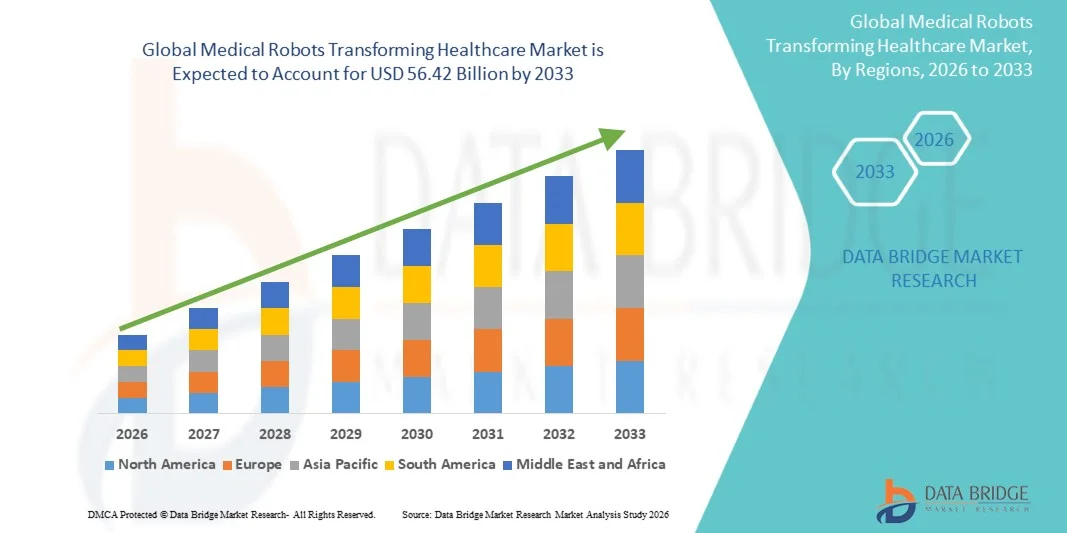
- The global medical robots transforming healthcare market size was valued at USD 15.53 billion in 2025 and is expected to reach USD 56.42 billion by 2033, at a CAGR of 17.50% during the forecast period
- The market growth is largely fueled by the increasing adoption of robotic-assisted technologies in healthcare and continuous technological advancements in surgical, rehabilitation, and hospital automation systems, leading to improved precision and efficiency in medical procedures
- Furthermore, rising demand for minimally invasive surgeries, enhanced patient outcomes, and improved workflow efficiency in hospitals is establishing medical robots as a key component of modern healthcare delivery. These converging factors are accelerating the adoption of robotic solutions in healthcare, thereby significantly boosting the industry's growth
Medical Robots Transforming Healthcare Market Analysis
- Medical robots, designed to assist in surgical procedures, rehabilitation therapies, hospital logistics, and patient care, are becoming increasingly essential components of modern healthcare systems due to their ability to enhance surgical precision, improve patient outcomes, and support minimally invasive procedures across a wide range of medical specialties
- The growing demand for medical robots is primarily driven by the rising adoption of robotic-assisted surgeries, increasing prevalence of chronic diseases, and the need for improved operational efficiency in hospitals and healthcare facilities
- North America dominated the medical robots transforming healthcare market with the largest revenue share of 41.8% in 2025, characterized by strong healthcare infrastructure, high adoption of advanced medical technologies, and the presence of leading robotics developers, with the U.S. experiencing significant growth in robotic-assisted surgical procedures supported by ongoing technological innovation and increasing investments in healthcare automation
- Asia-Pacific is expected to be the fastest growing region in the medical robots transforming healthcare market during the forecast period due to expanding healthcare infrastructure, growing medical tourism, and increasing government initiatives supporting advanced healthcare technologies
- Surgical robots segment dominated the medical robots transforming healthcare market with a market share of 49.6% in 2025, driven by the growing preference for minimally invasive procedures and the increasing adoption of robotic-assisted systems in complex surgical interventions across hospitals and specialty clinics
Report Scope and Medical Robots Transforming Healthcare Market Segmentation
|
Attributes |
Medical Robots Transforming Healthcare Key Market Insights |
|
Segments Covered |
|
|
Countries Covered |
North America
Europe
Asia-Pacific
Middle East and Africa
South America
|
|
Key Market Players |
|
|
Market Opportunities |
|
|
Value Added Data Infosets |
In addition to the insights on market scenarios such as market value, growth rate, segmentation, geographical coverage, and major players, the market reports curated by the Data Bridge Market Research also include in-depth expert analysis, patient epidemiology, pipeline analysis, pricing analysis, and regulatory framework |
Medical Robots Transforming Healthcare Market Trends
“Advancing Surgical Precision Through AI-Enabled Robotic Systems”
- A significant and accelerating trend in the global medical robots transforming healthcare market is the growing integration of artificial intelligence (AI), advanced imaging, and data analytics into robotic platforms used across surgical and clinical environments. This combination of technologies is significantly enhancing surgical precision and operational efficiency in healthcare systems
- For instance, the da Vinci Surgical System developed by Intuitive Surgical enables surgeons to perform complex minimally invasive procedures with enhanced visualization and robotic-assisted control. Similarly, the Mako Robotic-Arm Assisted Surgery System by Stryker Corporation assists orthopedic surgeons in performing joint replacement procedures with improved accuracy
- AI integration in medical robots enables features such as real-time surgical guidance, improved imaging interpretation, and enhanced motion control that assists surgeons in performing delicate operations. For instance, some robotic surgery platforms utilize AI-driven analytics to help optimize surgical workflows and support data-driven decision making during procedures. Furthermore, robotic technologies provide clinicians with enhanced dexterity and precision, allowing them to perform minimally invasive interventions with greater confidence
- The seamless integration of robotic systems with hospital information systems, imaging technologies, and digital healthcare platforms facilitates coordinated patient care across healthcare facilities. Through centralized digital interfaces, healthcare professionals can manage robotic systems alongside imaging equipment, patient data systems, and surgical planning software, creating a more connected healthcare environment
- This trend toward more intelligent, precise, and digitally connected robotic technologies is fundamentally reshaping the delivery of modern healthcare services. Consequently, companies such as Medtronic are developing advanced robotic-assisted surgery platforms with features such as AI-enabled analytics, real-time surgical insights, and improved surgeon control mechanisms
- The demand for medical robots that integrate AI, imaging, and advanced automation capabilities is growing rapidly across hospitals and specialty clinics, as healthcare providers increasingly prioritize improved surgical outcomes, enhanced precision, and operational efficiency
- Furthermore, the development of compact and modular robotic platforms designed for outpatient and ambulatory surgical centers is expanding the accessibility of robotic-assisted healthcare technologies
Medical Robots Transforming Healthcare Market Dynamics
Driver
“Growing Demand for Minimally Invasive Procedures and Surgical Precision”
- The increasing demand for minimally invasive surgical procedures and the need for improved clinical precision, coupled with the growing adoption of advanced healthcare technologies, is a significant driver for the heightened demand for medical robots
- For instance, in March 2024, Medtronic announced expanded clinical adoption of its Hugo Robotic-Assisted Surgery System, designed to support minimally invasive surgical procedures across multiple specialties. Such strategies by key companies are expected to drive the medical robots transforming healthcare market growth in the forecast period
- As healthcare providers increasingly focus on improving surgical outcomes and reducing complications, medical robots provide enhanced visualization, precision, and control, offering a significant advantage over conventional surgical techniques
- Furthermore, the growing burden of chronic diseases and rising demand for complex surgical interventions are encouraging hospitals to adopt robotic technologies that support safer and more efficient procedures
- The ability of robotic systems to enable minimally invasive procedures, shorten recovery times, and enhance surgical accuracy are key factors propelling the adoption of medical robots in hospitals and specialized healthcare centers. The ongoing expansion of robotic surgery training programs and increasing investments in healthcare automation further contribute to market growth
- Increasing government and private investments in healthcare robotics research and development are further accelerating innovation and the commercialization of next-generation medical robotic systems
- In addition, the expanding aging population globally is driving demand for advanced surgical and rehabilitation solutions, encouraging healthcare institutions to adopt robotic technologies to manage rising patient volumes
Restraint/Challenge
“High System Costs and Regulatory Approval Challenges”
- Concerns surrounding the high cost of robotic surgical systems and complex regulatory approval requirements pose a significant challenge to broader market penetration. As medical robots involve sophisticated hardware, software, and clinical validation processes, their development and deployment require substantial investment and compliance with strict healthcare regulations
- For instance, delays in regulatory approvals for new robotic surgical platforms in several countries have slowed the commercialization of innovative systems, affecting the speed of market expansion
- Addressing these regulatory and financial challenges through streamlined approval processes, clinical validation, and improved cost efficiency is crucial for wider adoption. Companies such as Johnson & Johnson and Medtronic are investing heavily in research and development to enhance robotic capabilities while ensuring compliance with evolving medical device regulations. In addition, the high initial cost of robotic systems compared to traditional surgical tools can limit adoption for smaller hospitals and healthcare centers
- While the long-term benefits of robotic surgery are widely recognized, the substantial upfront investment required for robotic platforms and training programs can slow adoption in cost-sensitive healthcare systems, particularly in developing regions
- Overcoming these challenges through technological innovation, cost reduction strategies, expanded clinical evidence, and supportive healthcare policies will be vital for sustained growth in the medical robots transforming healthcare market
- In addition, the need for specialized training for surgeons and medical staff to operate robotic systems effectively can create operational challenges for healthcare institutions
- Concerns related to system maintenance costs, software updates, and integration with existing hospital infrastructure may also restrict adoption among smaller healthcare facilities
Medical Robots Transforming Healthcare Market Scope
The market is segmented on the basis of product, application, and end user.
- By Product
On the basis of product, the medical robots transforming healthcare market is segmented into surgical robots, non-invasive radiosurgery robotic systems, rehabilitation robotic system, and hospital and pharmacy robotic systems. The surgical robots segment dominated the market with the largest market revenue share of 49.6% in 2025, primarily driven by the growing adoption of robotic-assisted minimally invasive surgeries across multiple medical specialties. These robotic systems allow surgeons to perform complex procedures with greater precision, improved visualization, and enhanced control compared with conventional surgical techniques. Hospitals are increasingly investing in advanced robotic surgery platforms to improve clinical outcomes, reduce surgical complications, and shorten patient recovery time. The rising prevalence of chronic diseases requiring surgical intervention and the expanding number of robotic-assisted procedures are further strengthening the segment’s dominance. In addition, continuous technological advancements in robotic platforms and increasing surgeon training programs are contributing to the strong demand for surgical robots worldwide.
The rehabilitation robotic system segment is anticipated to witness the fastest growth rate during the forecast period, fueled by the increasing demand for advanced rehabilitation solutions for patients recovering from neurological injuries, strokes, and musculoskeletal disorders. Rehabilitation robots assist patients in performing repetitive therapeutic movements with precision and consistency, supporting faster recovery and improved mobility outcomes. These systems are increasingly being used in physiotherapy centers, rehabilitation clinics, and hospitals to enhance patient engagement and treatment effectiveness. The rising aging population and the growing incidence of mobility-related disorders are further accelerating the demand for robotic rehabilitation technologies. Moreover, technological innovations such as AI-enabled therapy systems and wearable robotic exoskeletons are expanding the capabilities of rehabilitation robotics, contributing to rapid segment growth.
- By Application
On the basis of application, the medical robots transforming healthcare market is segmented into orthopedics, laparoscopy, neurology, cardiology, gynecology, and others. The laparoscopy segment dominated the market with the largest market revenue share in 2025, primarily due to the increasing preference for minimally invasive surgical procedures across hospitals worldwide. Robotic systems enable surgeons to perform laparoscopic procedures with enhanced precision, improved visualization, and greater control over surgical instruments. The rising prevalence of gastrointestinal disorders and abdominal surgeries is driving the demand for robotic-assisted laparoscopic procedures. Healthcare providers are increasingly adopting robotic platforms for laparoscopic surgeries to reduce surgical complications, minimize patient trauma, and shorten recovery time. In addition, ongoing advancements in robotic surgical systems are enabling surgeons to perform more complex laparoscopic procedures, further strengthening the segment’s leadership in the market.
The orthopedics segment is expected to witness the fastest growth rate during the forecast period, driven by the increasing demand for robotic-assisted joint replacement procedures and orthopedic surgeries. Robotic technologies are being widely adopted for knee and hip replacement surgeries due to their ability to enhance surgical accuracy and improve implant positioning. These systems assist surgeons with real-time data, 3D imaging, and precise bone preparation, leading to improved patient outcomes. The growing aging population and increasing prevalence of degenerative bone disorders such as osteoarthritis are further accelerating the demand for robotic-assisted orthopedic procedures. Furthermore, the rising number of orthopedic surgeries globally and continuous innovation in robotic orthopedic systems are supporting the rapid expansion of this segment.
- By End User
On the basis of end user, the medical robots transforming healthcare market is segmented into hospitals and ambulatory surgical centers. The hospitals segment dominated the market with the largest market revenue share in 2025, primarily due to the high adoption of robotic-assisted surgical systems in large healthcare institutions. Hospitals possess the necessary infrastructure, financial resources, and skilled medical professionals required to operate advanced robotic platforms. These facilities are increasingly investing in robotic technologies to enhance surgical precision, improve patient safety, and expand their range of minimally invasive procedures. In addition, hospitals perform a higher volume of complex surgical procedures compared with other healthcare settings, further contributing to the widespread adoption of medical robots. The presence of specialized surgical departments and robotic training programs in hospitals also supports the strong growth of this segment.
The ambulatory surgical centers segment is expected to witness the fastest growth rate during the forecast period, driven by the increasing shift toward outpatient surgical procedures and cost-effective healthcare delivery models. Ambulatory surgical centers are adopting compact and advanced robotic systems to perform minimally invasive procedures efficiently in outpatient settings. These facilities offer shorter hospital stays, reduced healthcare costs, and faster patient recovery, making them an attractive option for both patients and healthcare providers. Technological advancements in smaller and more flexible robotic platforms are further enabling ambulatory centers to adopt robotic-assisted surgical technologies. Moreover, the growing demand for same-day surgical procedures and the expansion of outpatient care services are expected to significantly boost the adoption of medical robots in ambulatory surgical centers.
Medical Robots Transforming Healthcare Market Regional Analysis
- North America dominated the medical robots transforming healthcare market with the largest revenue share of 41.8% in 2025, characterized by strong healthcare infrastructure, high adoption of advanced medical technologies, and the presence of leading robotics developers
- Healthcare providers in the region highly value the precision, improved clinical outcomes, and operational efficiency offered by robotic medical systems used in procedures such as minimally invasive surgery, orthopedic operations, and neurosurgical interventions
- This widespread adoption is further supported by strong healthcare infrastructure, high healthcare spending, and the presence of leading robotics developers such as Intuitive Surgical and Medtronic, along with a growing preference for advanced surgical technologies, establishing medical robots as a critical solution for modern healthcare delivery across hospitals and specialty clinics
U.S. Medical Robots Transforming Healthcare Market Insight
The U.S. medical robots transforming healthcare market captured the largest revenue share of 79% in 2025 within North America, fueled by the rapid adoption of robotic-assisted surgical systems and the growing demand for minimally invasive procedures. Healthcare providers are increasingly prioritizing advanced robotic technologies to enhance surgical precision and improve patient outcomes. The expanding number of robotic surgery programs across hospitals and specialty centers, combined with strong investment in healthcare innovation, further propels the industry. Moreover, the increasing integration of AI-enabled surgical platforms and advanced imaging technologies is significantly contributing to the market's expansion.
Europe Medical Robots Transforming Healthcare Market Insight
The Europe medical robots transforming healthcare market is projected to expand at a substantial CAGR throughout the forecast period, primarily driven by increasing adoption of robotic-assisted surgeries and the rising demand for advanced healthcare technologies. The growth of healthcare infrastructure, coupled with the need for improved surgical outcomes, is fostering the adoption of medical robots. European healthcare providers are also drawn to the efficiency and precision these robotic systems offer in complex surgical procedures. The region is experiencing significant growth across hospitals and specialty clinics, with medical robots being incorporated into both established surgical departments and newly developed healthcare facilities.
U.K. Medical Robots Transforming Healthcare Market Insight
The U.K. medical robots transforming healthcare market is anticipated to grow at a noteworthy CAGR during the forecast period, driven by the increasing demand for minimally invasive surgeries and advancements in robotic surgical technologies. In addition, the need to improve patient outcomes and reduce hospital stays is encouraging healthcare institutions to adopt robotic-assisted procedures. The country’s strong healthcare system and increasing focus on innovation are expected to continue to stimulate market growth.
Germany Medical Robots Transforming Healthcare Market Insight
The Germany medical robots transforming healthcare market is expected to expand at a considerable CAGR during the forecast period, fueled by increasing investment in healthcare technology and the growing demand for advanced surgical solutions. Germany’s well-developed healthcare infrastructure, combined with its emphasis on medical innovation and research, promotes the adoption of robotic systems in hospitals and specialized clinics. The integration of robotic-assisted surgery with advanced imaging and digital healthcare platforms is also becoming increasingly prevalent, with a strong preference for high-precision and technologically advanced medical solutions aligning with local healthcare requirements.
Asia-Pacific Medical Robots Transforming Healthcare Market Insight
The Asia-Pacific medical robots transforming healthcare market is poised to grow at the fastest CAGR of 23.5% during the forecast period of 2026 to 2033, driven by expanding healthcare infrastructure, rising healthcare expenditures, and technological advancements in countries such as China, Japan, and India. The region's increasing focus on improving surgical outcomes and expanding access to advanced medical treatments is driving the adoption of medical robots. Furthermore, as APAC emerges as a major hub for medical device manufacturing and innovation, the affordability and accessibility of robotic systems are expanding to a wider healthcare network.
Japan Medical Robots Transforming Healthcare Market Insight
The Japan medical robots transforming healthcare market is gaining momentum due to the country’s advanced technological capabilities, strong healthcare infrastructure, and demand for high-precision medical technologies. The Japanese market places a significant emphasis on innovation in healthcare, and the adoption of medical robots is driven by the growing number of robotic-assisted surgeries. The integration of robotic technologies with digital health platforms and advanced imaging systems is fueling growth. Moreover, Japan's aging population is expected to spur demand for advanced surgical and rehabilitation solutions in both hospitals and specialized healthcare facilities.
India Medical Robots Transforming Healthcare Market Insight
The India medical robots transforming healthcare market accounted for the largest market revenue share in Asia Pacific in 2025, attributed to the country’s rapidly expanding healthcare sector, increasing healthcare investments, and rising adoption of advanced medical technologies. India stands as one of the fastest growing markets for robotic-assisted surgical systems, and medical robots are becoming increasingly popular in hospitals and specialty healthcare centers. The expansion of private healthcare infrastructure and the increasing availability of advanced robotic surgical platforms, alongside growing medical tourism, are key factors propelling the market in India.
Medical Robots Transforming Healthcare Market Share
The Medical Robots Transforming Healthcare industry is primarily led by well-established companies, including:
- Intuitive Surgical Operations, Inc. (U.S.)
- Medtronic (Ireland)
- CMR Surgical Ltd. (U.K.)
- Stryker (U.S.)
- Zimmer Biomet (U.S.)
- Smith & Nephew (U.K.)
- Accuray Incorporated (U.S.)
- Medrobotics Corporation (U.S.)
- Renishaw plc (U.K.)
- Think Surgical, Inc. (U.S.)
- Distalmotion SA (Switzerland)
- Capstan Medical, Inc. (U.S.)
- Noah Medical, Inc. (U.S.)
- Momentis Surgical, Inc. (U.S.)
- Monteris Medical Corporation (U.S.)
- Health Robotics SLR (Spain)
- Titan Medical Inc. (Canada)
- Corindus Vascular Robotics, Inc. (U.S.)
- Medrobotics Corp. (U.S.)
- Hansen Medical, Inc. (U.S.)
What are the Recent Developments in Global Medical Robots Transforming Healthcare Market?
- In January 2026, Intuitive Surgical announced that the U.S. FDA granted clearance for its da Vinci 5 surgical system to be used in selected cardiac surgery procedures, expanding the platform’s clinical applications to include mitral valve repair and other minimally invasive cardiac operations. This milestone further solidifies robotic‑assisted surgery as a mainstream option for complex care
- In October 2025, All India Institute of Medical Sciences (AIIMS), New Delhi performed five robot‑aided kidney transplant surgeries using the da Vinci Xi surgical system, representing a notable expansion of robotic procedures in India’s public healthcare sector and reflecting broader adoption of robotic technology in complex clinical interventions
- In September 2025, HMI Medical launched Japan’s hinotori™ robotic‑assisted surgical system at Mahkota Medical Centre in Malaysia, marking the first deployment of this advanced multi‑specialty surgical robot in Southeast Asia and enhancing access to precision care across urology, gynecology, colorectal, and general surgery
- In September 2025, WeMed Medical debuted its independently developed endovascular robotic systems at CIFTIS 2025, showcasing “made‑in‑China” innovation in interventional surgery robots and signing major leasing agreements that demonstrate commercial traction in automated surgical technologies
- In January 2025, SS Innovations International performed the world’s first robotic cardiac telesurgery using its SSi Mantra 3 robotic system in India, successfully completing robotic beating heart coronary procedures over a remote connection a breakthrough for telesurgery and long‑distance robotic operations

- Interactive Data Analysis Dashboard
- Company Analysis Dashboard for high growth potential opportunities
- Research Analyst Access for customization & queries
- Competitor Analysis with Interactive dashboard
- Latest News, Updates & Trend analysis
- Harness the Power of Benchmark Analysis for Comprehensive Competitor Tracking
Data collection and base year analysis are done using data collection modules with large sample sizes. The stage includes obtaining market information or related data through various sources and strategies. It includes examining and planning all the data acquired from the past in advance. It likewise envelops the examination of information inconsistencies seen across different information sources. The market data is analysed and estimated using market statistical and coherent models. Also, market share analysis and key trend analysis are the major success factors in the market report. To know more, please request an analyst call or drop down your inquiry.
The key research methodology used by DBMR research team is data triangulation which involves data mining, analysis of the impact of data variables on the market and primary (industry expert) validation. Data models include Vendor Positioning Grid, Market Time Line Analysis, Market Overview and Guide, Company Positioning Grid, Patent Analysis, Pricing Analysis, Company Market Share Analysis, Standards of Measurement, Global versus Regional and Vendor Share Analysis. To know more about the research methodology, drop in an inquiry to speak to our industry experts.
Data Bridge Market Research is a leader in advanced formative research. We take pride in servicing our existing and new customers with data and analysis that match and suits their goal. The report can be customized to include price trend analysis of target brands understanding the market for additional countries (ask for the list of countries), clinical trial results data, literature review, refurbished market and product base analysis. Market analysis of target competitors can be analyzed from technology-based analysis to market portfolio strategies. We can add as many competitors that you require data about in the format and data style you are looking for. Our team of analysts can also provide you data in crude raw excel files pivot tables (Fact book) or can assist you in creating presentations from the data sets available in the report.













