Global Medical Microcontrollers Market
Market Size in USD Billion
CAGR :
% 
 USD
41.82 Billion
USD
97.07 Billion
2025
2033
USD
41.82 Billion
USD
97.07 Billion
2025
2033
 Forecast Period Forecast Period |
2026 - 2033 |
 Market Size (Base Year) Market Size (Base Year) |
USD 41.82 Billion |
 Market Size (Forecast Year) Market Size (Forecast Year) |
USD 97.07 Billion |
 CAGR CAGR |
% |
| Major Markets Players |
|
Medical Microcontrollers Market Overview
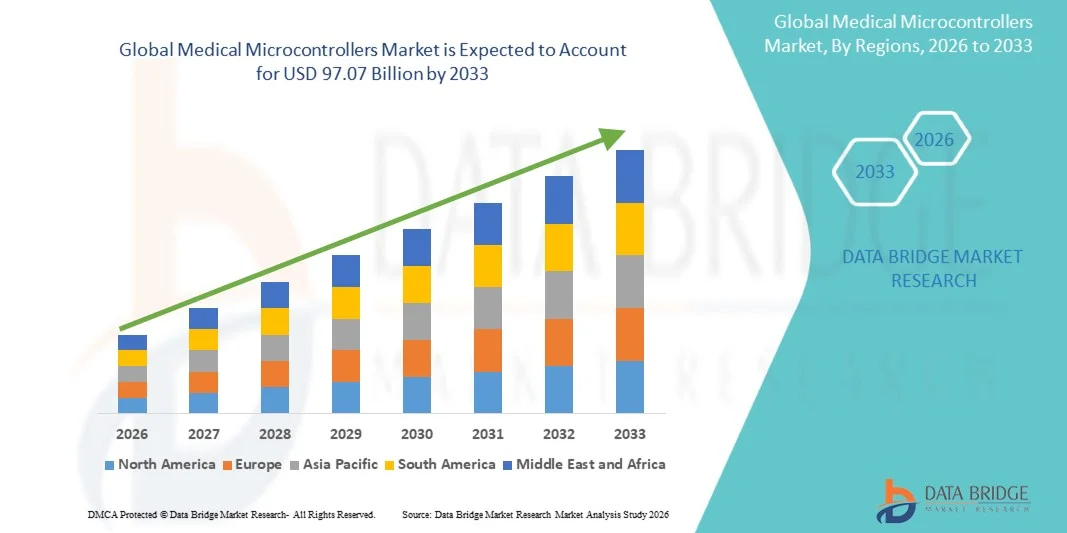
The Medical Microcontrollers Market was valued at USD 41.82 billion in 2025 and is projected to reach USD 97.07 billion by 2033, growing at a CAGR of 11.10% from 2026 to 2033. The market is experiencing steady growth driven by the rising adoption of advanced electronic medical devices, increasing demand for miniaturized and energy-efficient healthcare systems, and rapid integration of smart technologies in diagnostic and therapeutic equipment. Medical microcontrollers are becoming a core component in devices such as patient monitoring systems, wearable health trackers, infusion pumps, ventilators, and implantable medical devices due to their ability to deliver precise control, low power consumption, and high reliability.
The growing prevalence of chronic diseases, increasing geriatric population, and rising demand for remote patient monitoring are further accelerating the adoption of microcontroller-based medical devices. In addition, advancements in IoT-enabled healthcare systems, AI-integrated medical electronics, and connected medical devices are enhancing real-time data processing and device automation. Healthcare providers are increasingly investing in smart hospital infrastructure and digital health ecosystems, where medical microcontrollers play a critical role in enabling efficient, accurate, and continuous patient care across both developed and emerging markets.
Key Market Trends & Insights
- North America dominated the Medical Microcontrollers Market with the largest revenue share of 34.12% in 2025, supported by advanced healthcare electronics infrastructure, strong semiconductor design capabilities, and increasing integration of embedded systems in medical devices. The region benefits from robust R&D investments, strict medical device regulations ensuring high-quality electronic components, and growing adoption of smart healthcare technologies across hospitals and diagnostic centers.
- The 32-bit microcontrollers segment dominated the market with a share of 12% in 2025, owing to their high processing capability, large memory support, and suitability for complex medical device operations.
- Asia-Pacific is expected to be the fastest-growing region at a CAGR of 8.4% from 2026 to 2033, fueled by expanding healthcare infrastructure, rising medical device manufacturing, increasing adoption of digital health technologies, and growing investments in hospitals across China, India, Japan, and South Korea. The region’s strong electronics manufacturing ecosystem and cost-effective production capabilities further support market expansion.
- The 16-Bit Microcontrollers segment is expected to witness steady demand across mid-range medical devices, particularly in diagnostic and portable healthcare equipment where moderate processing power and energy efficiency are required.
- The Detection and Diagnosis application segment is projected to grow at a CAGR from 2026 to 2033, supported by increasing adoption of point-of-care diagnostic devices, imaging systems, and laboratory automation equipment. Advancements in AI-enabled diagnostics and portable medical technologies are further accelerating growth in this segment.
Market Size & Forecast
- Global Market Value (2025): USD 41.82 Billion
- Expected Market Value (2033): USD 97.07 Billion
- Forecast CAGR (2026–2033): 11.10%
- Leading Region in 2025: North America
- Fastest Growing Region: Asia-Pacific
Report Scope and Medical Microcontrollers Market Segmentation
|
Attributes |
Medical Microcontrollers Key Market Insights |
|
Segments Covered |
|
|
Countries Covered |
North America · U.S. · Canada · Mexico Europe · Germany · France · U.K. · Netherlands · Switzerland · Belgium · Russia · Italy · Spain · Turkey · Rest of Europe Asia-Pacific · China · Japan · India · South Korea · Singapore · Malaysia · Australia · Thailand · Indonesia · Philippines · Rest of Asia-Pacific Middle East and Africa · Saudi Arabia · U.A.E. · South Africa · Egypt · Israel · Rest of Middle East and Africa South America · Brazil · Argentina · Rest of South America |
|
Key Market Players |
• Texas Instruments Incorporated (U.S.) |
|
Market Opportunities |
· Rising adoption of wearable and remote patient monitoring devices · Expansion of IoT-enabled and AI-integrated healthcare systems · Growth in implantable and miniaturized medical devices |
|
Value Added Data Infosets |
In addition to the insights on market scenarios such as market value, growth rate, segmentation, geographical coverage, and major players, the market reports curated by the Data Bridge Market Research also include in-depth expert analysis, geographically represented company-wise production and capacity, network layouts of distributors and partners, detailed and updated price trend analysis and deficit analysis of supply chain and demand. |
Medical Microcontrollers Market Trends
Trend: Rising Adoption of Smart and Connected Medical Devices
The Medical Microcontrollers Market is witnessing strong growth due to increasing integration of embedded electronics in next-generation healthcare devices. Medical microcontrollers are increasingly being used in diagnostic equipment, patient monitoring systems, infusion pumps, wearable medical devices, and portable treatment solutions to enable real-time data processing, connectivity, and improved device intelligence. The growing shift toward digital healthcare, remote patient monitoring, and IoT-enabled medical devices is significantly driving demand for low-power, high-efficiency microcontrollers. In addition, advancements in 32-bit high-performance microcontroller architectures are enabling complex medical applications such as AI-assisted diagnostics, real-time ECG monitoring, and smart imaging systems. Healthcare manufacturers are increasingly adopting miniaturized and energy-efficient microcontrollers to support compact device designs, especially in wearable health monitors and portable diagnostic tools. The rising prevalence of chronic diseases such as cardiovascular disorders, diabetes, and respiratory illnesses is further accelerating demand for continuous monitoring devices powered by advanced microcontrollers.
Medical Microcontrollers Market Dynamics
Key Market Driver: Expanding Use of Embedded Electronics in Advanced Healthcare Systems
The growing adoption of smart medical devices and increasing digitization of healthcare infrastructure are major drivers of the Medical Microcontrollers Market. Hospitals and medical device manufacturers are integrating microcontroller-based systems into monitoring equipment, diagnostic platforms, and treatment devices to improve accuracy, automation, and real-time responsiveness. For instance, the increasing deployment of ICU monitoring systems and portable diagnostic devices in both developed and emerging economies is driving demand for high-performance 32-bit microcontrollers, which offer enhanced processing power and connectivity capabilities. In addition, government healthcare modernization initiatives across regions such as Europe, North America, and Asia-Pacific are supporting the adoption of advanced electronic medical systems. The growing trend of home healthcare and telemedicine is further increasing the need for compact, low-power microcontroller-based devices that can transmit patient data securely to cloud-based healthcare platforms.
Key Restraint/Challenge: High Design Complexity and Strict Regulatory Requirements
A major challenge in the Medical Microcontrollers Market is the high design complexity associated with developing medical-grade embedded systems. Medical microcontrollers must comply with strict regulatory standards such as IEC 60601 and FDA safety requirements, increasing the time and cost required for product development and certification. In addition, ensuring cybersecurity, data integrity, and real-time reliability in connected medical devices adds further complexity to system design. Any failure in embedded medical electronics can directly impact patient safety, making reliability testing and validation extremely critical. Smaller medical device manufacturers often face challenges in integrating advanced microcontrollers due to limited R&D budgets and lack of specialized semiconductor design expertise. Moreover, long product approval cycles and stringent compliance requirements can delay commercialization, restricting faster adoption of innovative microcontroller-based healthcare solutions.
Key Market Opportunity: Integration of AI, IoT, and Edge Computing in Medical Electronics
The integration of artificial intelligence (AI), Internet of Medical Things (IoMT), and edge computing technologies presents a significant opportunity for the Medical Microcontrollers market. AI-enabled microcontroller systems can process patient data locally, enabling faster diagnostics, predictive alerts, and improved real-time decision-making in critical care environments. For instance, modern wearable ECG monitors and smart insulin pumps increasingly rely on embedded microcontrollers capable of executing edge-based analytics, reducing dependence on centralized systems and improving response times. In 2024, the expansion of next-generation healthcare IoT platforms by companies such as STMicroelectronics highlighted the growing focus on ultra-low-power microcontrollers designed specifically for medical and wearable applications. These advancements are enabling longer device battery life, improved wireless connectivity, and enhanced data processing capabilities.
Medical Microcontrollers Market Scope
The Medical Microcontrollers market is segmented on the basis of simulation type and application.
- By Type
On the basis of type, the Medical Microcontrollers Market is segmented into 8-bit microcontrollers, 16-bit microcontrollers, and 32-bit microcontrollers. The 32-bit microcontrollers segment dominated the market with a share of 54.12% in 2025, owing to their high processing capability, large memory support, and suitability for complex medical device operations. These MCUs are widely used in advanced healthcare equipment such as patient monitoring systems, diagnostic imaging devices, ventilators, and infusion pumps. Increasing adoption of connected medical devices and IoT-based healthcare solutions is further strengthening demand. Their ability to support real-time data processing, wireless connectivity, and AI-enabled applications makes them highly preferred in modern medical electronics. Growing investments in smart hospitals and digital healthcare infrastructure are also supporting segment dominance.
The 16-bit microcontrollers segment is expected to witness the fastest CAGR of 7.4% from 2026 to 2033, driven by rising demand for cost-effective and energy-efficient medical devices. These MCUs are widely used in portable diagnostic tools, mid-range monitoring systems, and basic therapeutic equipment. Increasing healthcare access in emerging economies is boosting adoption. Their balanced performance and lower power consumption make them suitable for compact medical devices. Expanding home healthcare and ambulatory care services are further supporting growth. Continuous improvements in processing efficiency and integration capabilities are also accelerating adoption.
- By Application
On the basis of application, the Medical Microcontrollers Market is segmented into detection and diagnosis, monitoring equipment, and treatment equipment. The monitoring equipment segment dominated the market with a share of 46.38% in 2025, due to rising demand for continuous patient monitoring in hospitals and homecare settings. Devices such as ECG monitors, pulse oximeters, and wearable health trackers rely heavily on microcontrollers for real-time data processing. Increasing prevalence of chronic diseases is further driving demand. Growing adoption of remote patient monitoring systems is supporting segment expansion. Integration of IoT and wireless connectivity in monitoring devices is strengthening performance efficiency. Rising focus on preventive healthcare and early intervention is also contributing to dominance.
The detection and diagnosis segment is projected to register the fastest CAGR of 7.9% from 2026 to 2033, driven by increasing demand for early disease detection and precision diagnostics. Growing use of AI-based diagnostic systems and portable testing devices is accelerating adoption. Expansion of point-of-care testing solutions is further supporting growth. Rising burden of chronic and infectious diseases is increasing diagnostic requirements. Improvements in imaging and biosensor technologies are enhancing accuracy. Expanding healthcare infrastructure in emerging markets is also boosting demand significantly.
Medical Microcontrollers Market Regional Analysis
North America dominated the Medical Microcontrollers Market with the largest revenue share of 34.12% in 2025, supported by advanced healthcare electronics infrastructure, strong semiconductor design capabilities, and increasing integration of embedded systems in medical devices. The region benefits from robust R&D investments, strict medical device regulations ensuring high-quality electronic components, and growing adoption of smart healthcare technologies across hospitals and diagnostic centers. The rising demand for connected medical devices, wearable health monitors, ICU monitoring systems, and portable diagnostic equipment is further accelerating the adoption of advanced microcontroller solutions. Increasing focus on real-time patient monitoring, digital healthcare transformation, and AI-enabled medical electronics is strengthening the region’s leadership in the global market.
U.S. Medical Microcontrollers Market Insight
The U.S. Medical Microcontrollers market is witnessing strong growth, driven by rapid adoption of advanced medical electronics, increasing prevalence of chronic diseases, and rising demand for smart healthcare solutions. Hospitals and healthcare providers are increasingly integrating microcontroller-based systems into monitoring equipment, diagnostic devices, and therapeutic systems to improve accuracy and operational efficiency. The country’s strong presence of semiconductor companies, medical device manufacturers, and healthcare technology innovators is supporting continuous product development. In addition, growing investments in remote patient monitoring, telehealth platforms, and wearable medical devices are further boosting demand for high-performance medical microcontrollers.
Europe Medical Microcontrollers Market Insight
The Europe Medical Microcontrollers market remains a major contributor to global revenue, supported by strong healthcare infrastructure, advanced semiconductor research capabilities, and increasing adoption of digital healthcare systems. The region is witnessing growing integration of embedded microcontroller technologies in diagnostic equipment, monitoring devices, and treatment systems across hospitals and clinics. Increasing focus on precision healthcare, strict regulatory standards for medical electronics, and rising investments in smart hospital infrastructure are driving market expansion. Collaboration between healthcare providers, semiconductor companies, and research institutions is further strengthening innovation in medical microcontroller technologies across Europe.
U.K. Medical Microcontrollers Market Insight
The U.K. Medical Microcontrollers market is experiencing steady growth, supported by rising adoption of digital healthcare technologies, increasing demand for portable medical devices, and strong research and development activities in biomedical engineering. Healthcare institutions are increasingly deploying microcontroller-based systems for patient monitoring, diagnostics, and wearable health applications. The country’s strong academic research base, coupled with government support for healthcare innovation and digital transformation, is contributing to market expansion. Growing use of connected healthcare systems and AI-enabled medical devices is further enhancing demand for advanced microcontroller solutions in the U.K.
Germany Medical Microcontrollers Market Insight
The Germany Medical Microcontrollers market is expanding steadily, driven by the country’s strong medical device manufacturing base, advanced engineering capabilities, and increasing adoption of smart healthcare technologies. Germany is witnessing growing integration of embedded systems in diagnostic equipment, monitoring devices, and therapeutic medical systems. Rising investments in healthcare digitalization, precision medicine, and advanced electronics manufacturing are supporting market growth. The presence of leading semiconductor and medical technology companies further strengthens Germany’s position in the European medical microcontrollers landscape.
Asia-Pacific Medical Microcontrollers Market Insight
Asia-Pacific is expected to be the fastest-growing region in the Medical Microcontrollers Market, registering a CAGR of 8.4% from 2026 to 2033, fueled by expanding healthcare infrastructure, rising medical device manufacturing, increasing adoption of digital health technologies, and growing investments in hospitals across China, India, Japan, and South Korea. The region benefits from a strong electronics manufacturing ecosystem, cost-effective production capabilities, and increasing demand for advanced healthcare devices. Rapid urbanization, rising prevalence of chronic diseases, and expanding access to healthcare services are further accelerating adoption of medical microcontroller-based systems.
Japan Medical Microcontrollers Market Insight
The Japan Medical Microcontrollers market is witnessing consistent growth, supported by advanced healthcare infrastructure, strong focus on medical innovation, and increasing adoption of digital healthcare technologies. Hospitals and medical device manufacturers are integrating microcontroller-based systems into diagnostic, monitoring, and therapeutic equipment to enhance precision and efficiency. Japan’s aging population and rising demand for advanced healthcare solutions are driving adoption of wearable medical devices and remote monitoring systems. Continuous advancements in electronics and healthcare robotics are further supporting market expansion.
China Medical Microcontrollers Market Insight
The China Medical Microcontrollers market is growing rapidly, driven by expanding healthcare infrastructure, increasing medical device production, and rising government investments in digital healthcare transformation. Hospitals are increasingly adopting microcontroller-based systems in diagnostic and monitoring equipment to improve efficiency and patient care outcomes. The country’s strong semiconductor manufacturing ecosystem, combined with rapid adoption of smart healthcare technologies and wearable medical devices, is significantly boosting market demand. Rising healthcare modernization initiatives and increasing focus on chronic disease management are positioning China as a key growth market for medical microcontrollers globally.
Medical Microcontrollers Market Share
The Medical Microcontrollers industry is primarily led by well-established companies, including:
- Texas Instruments Incorporated (U.S.)
- STMicroelectronics N.V. (Switzerland)
- Microchip Technology Inc. (U.S.)
- NXP Semiconductors N.V. (Netherlands)
- Renesas Electronics Corporation (Japan)
- Infineon Technologies AG (Germany)
- Analog Devices Inc. (U.S.)
- Cypress Semiconductor Corporation (U.S.)
- Toshiba Electronic Devices & Storage Corporation (Japan)
- ON Semiconductor Corporation (U.S.)
- Nuvoton Technology Corporation (Taiwan)
- Silicon Laboratories Inc. (U.S.)
- Maxim Integrated (U.S.)
- Qualcomm Technologies Inc. (U.S.)
- Espressif Systems (China)
- Holtek Semiconductor Inc. (Taiwan)
- Nordic Semiconductor ASA (Norway)
- ROHM Semiconductor (Japan)
- Panasonic Holdings Corporation (Japan)
- Sony Semiconductor Solutions Corporation (Japan)
- Atmel Corporation (U.S.)
- Broadcom Inc. (U.S.)
- Dialog Semiconductor (U.K.)
- Zilog Inc. (U.S.)
Latest Developments in Medical Microcontrollers Market
- In February 2021, STMicroelectronics, a global semiconductor leader, announced the expansion of its STM32 microcontroller portfolio with enhanced medical-grade capabilities, targeting portable and connected healthcare devices. The new MCUs were designed to support low-power operation, high processing efficiency, and secure wireless connectivity for applications such as patient monitoring systems and wearable medical devices. This development strengthened the company’s position in embedded healthcare electronics and supported the growing demand for IoT-enabled medical solutions
- In June 2021, Microchip Technology Inc. introduced new 32-bit PIC and SAM microcontroller families optimized for medical and industrial applications. These microcontrollers featured enhanced safety certification support, improved real-time performance, and integrated security features for medical device compliance. The launch addressed increasing demand for reliable control systems in infusion pumps, diagnostic equipment, and life-support devices, reinforcing Microchip’s role in the medical embedded systems market
- In March 2022, NXP Semiconductors announced advancements in its Arm-based LPC and i.MX RT crossover microcontroller platforms, targeting healthcare and wearable device applications. The upgraded MCUs offered improved processing performance, edge computing capability, and secure connectivity features. These enhancements supported real-time health data processing in portable diagnostic systems and next-generation patient monitoring devices
- In September 2022, Renesas Electronics Corporation expanded its RA and RX microcontroller families with enhanced low-power and high-reliability features suitable for medical applications. The company emphasized applications in medical instrumentation, including blood glucose meters, portable diagnostic devices, and monitoring equipment. This expansion aligned with growing demand for energy-efficient and compact embedded solutions in healthcare electronics
- In May 2023, STMicroelectronics announced further enhancements to its STM32U series ultra-low-power microcontrollers, specifically targeting battery-operated medical devices and wearable healthcare technologies. The MCUs were designed to extend battery life while maintaining high processing efficiency, making them suitable for continuous monitoring systems and portable medical diagnostics. This development supported increasing adoption of remote patient monitoring solutions
- In November 2023, Texas Instruments launched new ultra-low-power MSPM0 microcontroller series aimed at cost-sensitive medical and healthcare applications. The devices were designed to deliver efficient performance for compact medical instruments such as pulse oximeters, portable monitors, and handheld diagnostic devices. This launch strengthened TI’s presence in energy-efficient embedded medical electronics
- In April 2024, Infineon Technologies expanded its PSOC and XMC microcontroller offerings with enhanced safety, security, and connectivity features targeting healthcare applications. The updated MCUs were designed for high-reliability medical systems including infusion pumps, imaging support systems, and patient monitoring equipment. The development aligned with rising demand for secure and connected medical device ecosystems
- In August 2024, Microchip Technology further strengthened its medical embedded portfolio by introducing advanced safety-certified MCU solutions supporting IEC 62304-compliant medical device development. These microcontrollers were optimized for real-time control in critical healthcare equipment, ensuring reliability in surgical systems and life-support devices
- In March 2025, Renesas Electronics announced continued expansion of its RA family microcontrollers with enhanced AI-capable edge processing features for healthcare devices. The upgraded MCUs were designed to support predictive diagnostics, smart monitoring systems, and connected medical applications. This development reflected the increasing integration of AI and IoT in medical electronics
- In July 2025, STMicroelectronics introduced next-generation STM32 microcontrollers with enhanced AI acceleration and advanced connectivity options for medical and wearable devices. These MCUs were aimed at supporting intelligent health monitoring systems, real-time analytics, and connected hospital infrastructure, further strengthening the adoption of smart healthcare technologies globally
SKU-
Get online access to the report on the World's First Market Intelligence Cloud

- Interactive Data Analysis Dashboard
- Company Analysis Dashboard for high growth potential opportunities
- Research Analyst Access for customization & queries
- Competitor Analysis with Interactive dashboard
- Latest News, Updates & Trend analysis
- Harness the Power of Benchmark Analysis for Comprehensive Competitor Tracking
Research Methodology
Data collection and base year analysis are done using data collection modules with large sample sizes. The stage includes obtaining market information or related data through various sources and strategies. It includes examining and planning all the data acquired from the past in advance. It likewise envelops the examination of information inconsistencies seen across different information sources. The market data is analysed and estimated using market statistical and coherent models. Also, market share analysis and key trend analysis are the major success factors in the market report. To know more, please request an analyst call or drop down your inquiry.
The key research methodology used by DBMR research team is data triangulation which involves data mining, analysis of the impact of data variables on the market and primary (industry expert) validation. Data models include Vendor Positioning Grid, Market Time Line Analysis, Market Overview and Guide, Company Positioning Grid, Patent Analysis, Pricing Analysis, Company Market Share Analysis, Standards of Measurement, Global versus Regional and Vendor Share Analysis. To know more about the research methodology, drop in an inquiry to speak to our industry experts.
Customization Available
Data Bridge Market Research is a leader in advanced formative research. We take pride in servicing our existing and new customers with data and analysis that match and suits their goal. The report can be customized to include price trend analysis of target brands understanding the market for additional countries (ask for the list of countries), clinical trial results data, literature review, refurbished market and product base analysis. Market analysis of target competitors can be analyzed from technology-based analysis to market portfolio strategies. We can add as many competitors that you require data about in the format and data style you are looking for. Our team of analysts can also provide you data in crude raw excel files pivot tables (Fact book) or can assist you in creating presentations from the data sets available in the report.