Global Master Card Market
Market Size in USD Billion
CAGR :
% 
 USD
364.93 Billion
USD
923.09 Billion
2025
2033
USD
364.93 Billion
USD
923.09 Billion
2025
2033
 Forecast Period Forecast Period |
2026 –2033 |
 Market Size (Base Year) Market Size (Base Year) |
USD 364.93 Billion |
 Market Size (Forecast Year) Market Size (Forecast Year) |
USD 923.09 Billion |
 CAGR CAGR |
% |
| Major Markets Players |
|
Master Card Market Size
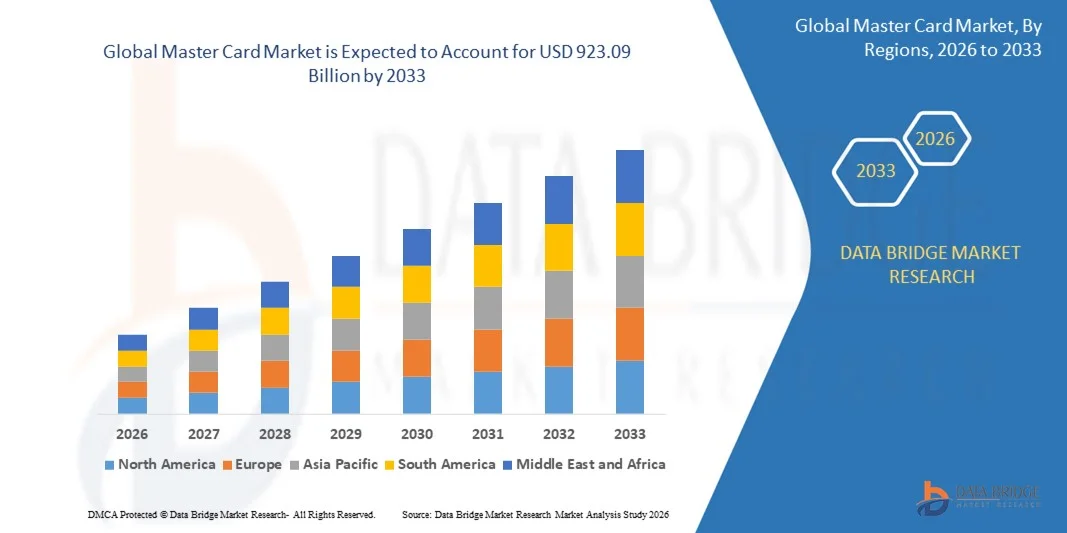
- The global master card market size was valued at USD 364.93 billion in 2025 and is expected to reach USD 923.09 billion by 2033, at a CAGR of 12.3% during the forecast period
- The market growth is largely fueled by the growing adoption of digital payments and the expansion of e-commerce and mobile commerce platforms, leading to increased demand for secure, seamless, and convenient payment solutions across consumer and business segments
- Furthermore, rising consumer preference for cashless transactions, coupled with financial institutions and fintechs seeking innovative, integrated payment solutions, is establishing MasterCard as a preferred global payment network. These converging factors are accelerating the uptake of MasterCard solutions, thereby significantly boosting the industry’s growth
Master Card Market Analysis
- MasterCard, offering secure, global digital payment solutions across cards, mobile, and online platforms, is increasingly vital for consumers, businesses, and financial institutions due to its enhanced security features, widespread acceptance, and integration with emerging fintech ecosystems
- The escalating demand for MasterCard solutions is primarily fueled by the growth of digital commerce, rising smartphone penetration, increasing cross-border transactions, and the need for reliable, fast, and transparent payment processing
- Asia-Pacific dominated the master card market with a share of 40.1% in 2025, due to rapid digitization, increasing adoption of e-commerce platforms, and growing demand for secure and seamless payment solutions
- North America is expected to be the fastest growing region in the master card market during the forecast period due to high adoption of digital payment solutions, advanced banking infrastructure, and rising e-commerce and fintech innovations
- Pro/self-hosted payment gateways segment dominated the market with a market share of 42% in 2025, due to its robust security features, seamless integration capabilities, and control over transaction processes. Businesses often prefer self-hosted gateways for their ability to customize payment experiences and ensure compliance with internal security protocols. The growing adoption of e-commerce and digital payment platforms further boosts demand for self-hosted solutions, which offer advanced fraud detection, recurring payment options, and multi-currency support
Report Scope and Master Card Market Segmentation
|
Attributes |
Master Card Key Market Insights |
|
Segments Covered |
|
|
Countries Covered |
North America
Europe
Asia-Pacific
Middle East and Africa
South America
|
|
Key Market Players |
|
|
Market Opportunities |
|
|
Value Added Data Infosets |
In addition to the market insights such as market value, growth rate, market segments, geographical coverage, market players, and market scenario, the market report curated by the Data Bridge Market Research team includes in-depth expert analysis, import/export analysis, pricing analysis, production consumption analysis, and pestle analysis. |
Master Card Market Trends
Rising Adoption of Digital and Contactless Payments
- A prominent trend in the MasterCard market is the accelerating adoption of digital and contactless payment solutions, driven by consumers’ preference for faster, secure, and convenient transactions across retail, e-commerce, and travel sectors. This shift is reshaping payment behavior and driving the development of innovative transaction technologies
- For instance, MasterCard has partnered with Apple Pay and Google Wallet to enable seamless contactless payments at millions of merchants worldwide. Such collaborations strengthen digital payment ecosystems and improve transaction speed and convenience for users
- The surge in mobile banking and digital wallets is supporting broader adoption of NFC-enabled cards and QR code-based payments, which enhances consumer flexibility and reduces reliance on cash. This trend positions MasterCard as a key player in facilitating modern payment infrastructures
- Increasing integration of biometric authentication and tokenization is enhancing security in digital payments, allowing users to authorize transactions with fingerprints, facial recognition, or secure digital tokens. These measures are reinforcing trust and accelerating consumer acceptance of contactless transactions
- The COVID-19 pandemic further accelerated digital payment adoption as consumers and businesses sought contactless and remote transaction options. MasterCard’s initiatives to expand virtual card offerings and digital-first solutions are directly supporting this ongoing transformation
- The market is also witnessing a growing role of AI and data analytics in personalizing payment experiences, detecting fraud, and optimizing transaction flows. This integration is driving more secure, efficient, and user-centric payment systems globally
Master Card Market Dynamics
Driver
Expansion of E-Commerce and Mobile Commerce Platforms
- The growing proliferation of e-commerce and m-commerce platforms is driving demand for secure and seamless payment processing solutions. Consumers increasingly rely on digital payment options for online shopping, subscription services, and app-based purchases, which is expanding transaction volumes and revenue streams for MasterCard
- For instance, MasterCard has partnered with Shopify and PayPal to integrate card-based payments directly into merchant platforms, simplifying checkout processes and improving conversion rates. These partnerships are enabling smoother transactions and broader reach for digital commerce
- The rise of global online marketplaces and cross-border e-commerce is increasing the need for multi-currency, fraud-resistant payment solutions. MasterCard’s infrastructure supports international transactions, ensuring efficiency and reliability for consumers and merchants
- Mobile commerce growth, particularly in emerging markets, is encouraging card issuers to offer contactless and mobile-optimized payment solutions. MasterCard is actively collaborating with banks and fintech firms to enhance accessibility and promote cashless ecosystems
- Digital payment adoption across sectors such as travel, entertainment, and retail continues to reinforce the demand for secure and convenient payment methods. This widespread adoption underpins MasterCard’s role as a leading facilitator of global digital commerce
Restraint/Challenge
Stringent Regulatory Compliance and Data Security Requirements
- The MasterCard market faces challenges due to increasingly complex regulations surrounding data privacy, transaction security, and anti-money laundering practices. Compliance with global standards such as GDPR, PSD2, and PCI DSS requires continuous investment and robust monitoring
- For instance, MasterCard has implemented advanced encryption and tokenization protocols to meet regulatory requirements and protect cardholder information. These measures, while essential, increase operational complexity and compliance costs
- Maintaining secure digital payment networks involves constant vigilance against evolving cyber threats, requiring sophisticated fraud detection and risk management systems. This ongoing requirement imposes additional operational and technological burdens
- Varying regulations across regions can complicate global payment operations, requiring adaptation to local rules while maintaining a unified service experience. These challenges necessitate coordination among financial institutions, regulators, and technology partners
- The market continues to navigate the balance between innovation and compliance, as implementing cutting-edge payment solutions must align with stringent legal and security standards. This constraint shapes strategic planning and operational priorities for MasterCard and associated stakeholders
Master Card Market Scope
The market is segmented on the basis of type and application.
- By Type
On the basis of type, the MasterCard market is segmented into Pro/Self-Hosted Payment Gateways, Local Bank Integrates, Platform-Based Payment Gateway Solutions, and Others. The Pro/Self-Hosted Payment Gateway segment dominated the market with the largest market revenue share of 42% in 2025, driven by its robust security features, seamless integration capabilities, and control over transaction processes. Businesses often prefer self-hosted gateways for their ability to customize payment experiences and ensure compliance with internal security protocols. The growing adoption of e-commerce and digital payment platforms further boosts demand for self-hosted solutions, which offer advanced fraud detection, recurring payment options, and multi-currency support.
The Platform-Based Payment Gateway Solution segment is anticipated to witness the fastest growth rate from 2026 to 2033, fueled by the increasing reliance of businesses on cloud-based, scalable payment solutions. Platform-based gateways enable quick onboarding, easy integration with existing enterprise systems, and access to value-added services such as analytics, loyalty programs, and digital wallets. Their flexibility, cost-effectiveness, and continuous software updates attract SMEs and startups looking for reliable, low-maintenance payment solutions in competitive markets.
- By Application
On the basis of application, the MasterCard market is segmented into Micro and Small Enterprises, Large Enterprises, and Mid-Size Enterprises. The Large Enterprises segment dominated the market in 2025, driven by high transaction volumes, diverse payment requirements, and the need for advanced reporting and reconciliation capabilities. Large organizations often prioritize MasterCard solutions for their global acceptance, robust security protocols, and seamless integration with enterprise resource planning systems. The demand is further strengthened by businesses expanding their digital sales channels and adopting multi-currency and cross-border payment options.
The Micro and Small Enterprises segment is expected to witness the fastest growth from 2026 to 2033, fueled by the rising digitization of small businesses and increasing adoption of e-commerce and online payment methods. SMEs often seek cost-effective, easy-to-implement payment solutions that provide quick transaction processing, mobile compatibility, and integration with accounting and inventory systems. The growth is supported by fintech initiatives, simplified onboarding processes, and the rising availability of pre-integrated MasterCard payment solutions tailored to smaller enterprises.
Master Card Market Regional Analysis
- Asia-Pacific dominated the master card market with the largest revenue share of 40.1% in 2025, driven by rapid digitization, increasing adoption of e-commerce platforms, and growing demand for secure and seamless payment solutions
- The region’s cost-effective digital infrastructure, rising fintech investments, and expanding SME base are accelerating market growth
- Increasing smartphone penetration, government initiatives supporting digital payments, and growing awareness of cashless transactions are contributing to robust adoption across both urban and semi-urban areas
China MasterCard Market Insight
China held the largest share in the Asia-Pacific MasterCard market in 2025, owing to its advanced fintech ecosystem, strong e-commerce growth, and widespread adoption of digital banking solutions. The country’s government policies promoting cashless transactions, investments in secure payment infrastructure, and large consumer base are major growth drivers. Demand is further supported by increasing integration of MasterCard solutions in retail, travel, and digital services.
India MasterCard Market Insight
India is witnessing the fastest growth in the Asia-Pacific region, fueled by the rapid expansion of micro and small enterprises, rising e-commerce penetration, and growing digital payment adoption. Government initiatives such as the Digital India campaign, increasing smartphone usage, and incentives for cashless transactions are strengthening demand for MasterCard solutions. In addition, the surge in fintech startups and growing acceptance of online and mobile payments is contributing to robust market expansion.
Europe MasterCard Market Insight
The Europe MasterCard market is expanding steadily, supported by high consumer adoption of digital payments, advanced banking infrastructure, and increasing cross-border transactions. The region emphasizes security, regulatory compliance, and innovation in payment solutions, particularly for large enterprises and e-commerce platforms. Growing integration with contactless and mobile payment technologies is further enhancing market growth.
Germany MasterCard Market Insight
Germany’s MasterCard market is driven by strong adoption of digital banking services, a highly developed retail and e-commerce sector, and increasing preference for cashless transactions. The country has well-established fintech collaborations and government-backed initiatives promoting secure and efficient payment systems. Demand is particularly strong among large enterprises and tech-savvy consumers seeking advanced payment solutions.
U.K. MasterCard Market Insight
The U.K. market is supported by a mature financial services ecosystem, high penetration of digital banking, and increasing adoption of contactless and mobile payments. Post-Brexit focus on localizing payment infrastructure and fostering fintech innovation is further boosting the MasterCard market. In addition, growing e-commerce activity, integration with loyalty programs, and investments in secure digital transaction technologies are supporting market growth.
North America MasterCard Market Insight
North America is projected to grow at the fastest CAGR from 2026 to 2033, driven by high adoption of digital payment solutions, advanced banking infrastructure, and rising e-commerce and fintech innovations. A strong focus on contactless, mobile, and cross-border payments is fueling demand. In addition, growing collaboration between banks, payment service providers, and large enterprises is accelerating MasterCard adoption across multiple sectors.
U.S. MasterCard Market Insight
The U.S. accounted for the largest share in the North America market in 2025, underpinned by its advanced financial services industry, extensive digital payment adoption, and strong investment in fintech solutions. The country’s emphasis on security, regulatory compliance, and innovative payment technologies is encouraging widespread use of MasterCard solutions. Presence of major banks, fintech companies, and a mature consumer base further solidifies the U.S.'s leading position in the region.
Master Card Market Share
The master card industry is primarily led by well-established companies, including:
- Fiserv, Inc. (U.S.)
- Adyen (Netherlands)
- Stripe (U.S.)
- GMO Payment Gateway, Inc. (Japan)
- Verizon (U.S.)
- Alibaba Group Holding Limited (China)
- 2Checkout (U.S.)
- Visa (U.S.)
- CCBill, LLC (U.S.)
- SecurePay Pty Ltd. (Australia)
- PayPal (U.S.)
- NASPERS (South Africa)
- Global Payments Inc. (U.S.)
Latest Developments in Global Master Card Market
- In February 2026, Mastercard announced the launch of Mastercard Fleet: Next Gen in Asia-Pacific, a portfolio of innovative solutions expanding fleet payments beyond fuel to cover the full range of mobility needs for fleet operators. This development strengthens Mastercard’s position in the commercial and logistics payments market by addressing diverse customer segments, from SMEs with small fleets to large logistics operators. By offering solutions tailored to varying market maturities, Mastercard is enhancing operational efficiency, cost management, and digital payment adoption across the fleet management ecosystem in the region
- In January 2026, Mastercard introduced a new accreditation programme for BIN sponsors, targeting established financial institutions that support fintechs and businesses entering the payments space. This initiative impacts the market by accelerating the launch of card programmes, increasing market accessibility for fintechs, and fostering innovation in digital payments. By simplifying onboarding and providing structured support, Mastercard is enabling faster market penetration for emerging players, expanding its footprint in the card issuance and payments ecosystem globally
- In July 2025, Mastercard unveiled the AI Card Design Studio, a platform allowing issuers to create customized, brand-compliant card designs in minutes. This advancement enhances Mastercard’s value proposition in the issuer and fintech segments by improving creative flexibility, reducing design timelines, and strengthening brand engagement. The platform is expected to drive adoption among banks and financial institutions seeking faster go-to-market strategies, while supporting customer personalization trends in the card issuance market
- In February 2025, Mastercard launched the Mastercard Mid-Market Accelerator, a suite of SME-focused solutions designed for financial providers to address the unique needs of middle-market customers. Initially available in the U.S., the initiative strengthens Mastercard’s presence in the SME payments market by combining digital payments technology with value-added services such as transparency, automation, and enhanced security. This development positions Mastercard as a key partner for banks and fintechs targeting the growing mid-market segment, enabling faster adoption of digital payment solutions
- In October 2024, Mastercard expanded its Product Express platform to include fintechs across Africa, the Middle East, Europe, North America, and additional markets in Latin America. This expansion impacts the global fintech and card issuance market by simplifying access to Mastercard’s payment infrastructure, accelerating time-to-market, and supporting innovation across emerging and established markets. The move enhances Mastercard’s competitive positioning as a facilitator of global fintech growth and cross-border digital payment adoption
SKU-
Get online access to the report on the World's First Market Intelligence Cloud
- Interactive Data Analysis Dashboard
- Company Analysis Dashboard for high growth potential opportunities
- Research Analyst Access for customization & queries
- Competitor Analysis with Interactive dashboard
- Latest News, Updates & Trend analysis
- Harness the Power of Benchmark Analysis for Comprehensive Competitor Tracking
Research Methodology
Data collection and base year analysis are done using data collection modules with large sample sizes. The stage includes obtaining market information or related data through various sources and strategies. It includes examining and planning all the data acquired from the past in advance. It likewise envelops the examination of information inconsistencies seen across different information sources. The market data is analysed and estimated using market statistical and coherent models. Also, market share analysis and key trend analysis are the major success factors in the market report. To know more, please request an analyst call or drop down your inquiry.
The key research methodology used by DBMR research team is data triangulation which involves data mining, analysis of the impact of data variables on the market and primary (industry expert) validation. Data models include Vendor Positioning Grid, Market Time Line Analysis, Market Overview and Guide, Company Positioning Grid, Patent Analysis, Pricing Analysis, Company Market Share Analysis, Standards of Measurement, Global versus Regional and Vendor Share Analysis. To know more about the research methodology, drop in an inquiry to speak to our industry experts.
Customization Available
Data Bridge Market Research is a leader in advanced formative research. We take pride in servicing our existing and new customers with data and analysis that match and suits their goal. The report can be customized to include price trend analysis of target brands understanding the market for additional countries (ask for the list of countries), clinical trial results data, literature review, refurbished market and product base analysis. Market analysis of target competitors can be analyzed from technology-based analysis to market portfolio strategies. We can add as many competitors that you require data about in the format and data style you are looking for. Our team of analysts can also provide you data in crude raw excel files pivot tables (Fact book) or can assist you in creating presentations from the data sets available in the report.