


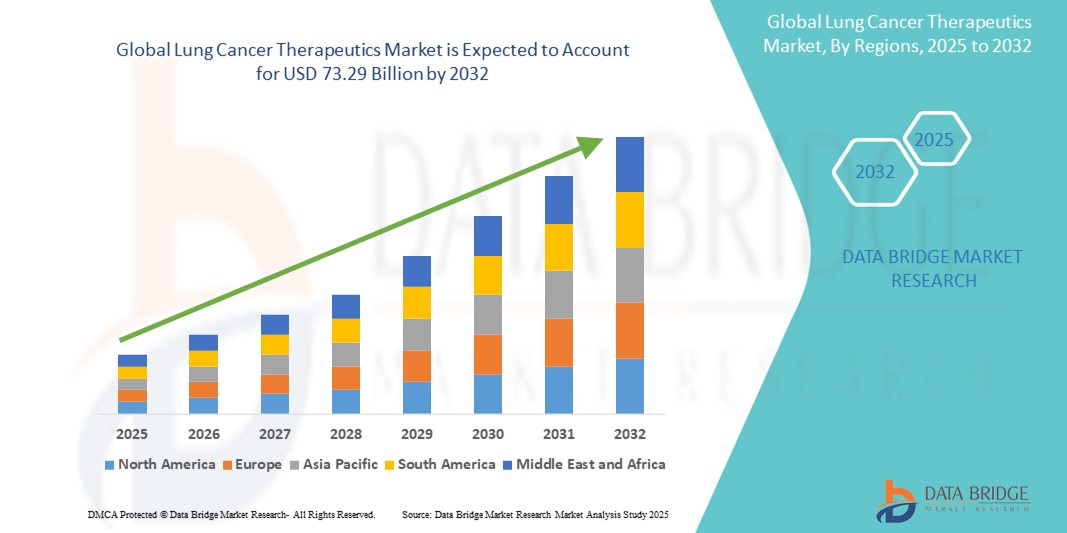
Lung Cancer Therapeutics Market Size
- The global lung cancer therapeutics market size was valued at USD 33.19 billion in 2024 and is expected to reach USD 73.29 billion by 2032, at a CAGR of 10.41% during the forecast period
- The market's expansion is primarily driven by the increasing global incidence of lung cancer, fueled by factors such as rising smoking rates and exposure to second hand smoke
- Furthermore, advancements in treatment technologies, including the development of targeted therapies and immunotherapies, are significantly contributing to market growth. The rising awareness of lung cancer and the growing investments in research and development of novel therapeutics are also key factors propelling market expansion
Lung Cancer Therapeutics Market Analysis
- The global lung cancer therapeutics market, offering pharmaceutical and biological interventions for the treatment of lung cancer, is increasingly vital for addressing the growing global health burden of this disease in both early and advanced stages due to their enhanced efficacy, improved patient outcomes, and potential for integration with personalized medicine approaches
- The escalating demand for lung cancer therapeutics is primarily fueled by the widespread increase in lung cancer incidence linked to factors such as smoking and pollution, growing concerns among healthcare providers and patients regarding effective treatment options, and a rising preference for the convenience and precision of modern therapies such as targeted and immunotherapies
- North America dominates the lung cancer therapeutics market with the largest revenue share of 31.5% in 2025, characterized by early adoption of advanced treatment modalities, high healthcare expenditure, and a strong presence of key pharmaceutical and biotechnology companies
- Asia-Pacific is expected to be the fastest growing region in the lung cancer therapeutics market with CAGR of 12.8% during the forecast period due to increasing urbanization and rising disposable incomes leading to improved healthcare access and a growing patient population
- Targeted therapy segment is expected to dominate the lung cancer therapeutics market with a market share of 50.5% in 2025, driven by its effectiveness in treating specific genetic mutations prevalent in lung cancer, leading to improved patient outcomes and reduced off-target toxicities compared to traditional chemotherapy
Report Scope and Lung Cancer Therapeutics Market Segmentation
|
Attributes |
Lung Cancer Therapeutics Key Market Insights |
|
Segments Covered |
|
|
Countries Covered |
North America
Europe
Asia-Pacific
Middle East and Africa
South America
|
|
Key Market Players |
|
|
Market Opportunities |
|
|
Value Added Data Infosets |
In addition to the insights on market scenarios such as market value, growth rate, segmentation, geographical coverage, and major players, the market reports curated by the Data Bridge Market Research also include in-depth expert analysis, pricing analysis, brand share analysis, consumer survey, demography analysis, supply chain analysis, value chain analysis, raw material/consumables overview, vendor selection criteria, PESTLE Analysis, Porter Analysis, and regulatory framework. |
Lung Cancer Therapeutics Market Trends
“Enhanced Precision Through Advanced Diagnostics and Personalized Medicine"
- A significant and accelerating trend in the global lung cancer therapeutics market is the deepening integration with advanced diagnostic tools and personalized medicine approaches, mirroring the convenience and control seen in smart home systems. This fusion of technologies is significantly enhancing treatment precision and patient outcomes
- For instance, the increasing use of next-generation sequencing (NGS) allows for comprehensive genomic profiling of a patient's tumor, identifying specific genetic mutations that can be targeted with tailored therapies. Similarly, liquid biopsy techniques enable the monitoring of treatment response and detection of resistance mechanisms through simple blood draws, offering a less invasive and more dynamic approach to disease management
- The integration of advanced diagnostics in lung cancer therapeutics enables features such as predicting treatment response based on individual tumor characteristics and providing more intelligent treatment decisions based on real-time monitoring of disease progression
- The seamless integration of lung cancer therapeutics with sophisticated diagnostic platforms and comprehensive patient data facilitates centralized and informed treatment planning across various stages of the disease. Through a unified approach, oncologists can manage treatment strategies alongside diagnostic results, imaging data, and patient-reported outcomes, creating a more holistic and adaptive treatment experience
- This trend towards more intelligent, intuitive, and interconnected treatment strategies is fundamentally reshaping user expectations for cancer care. Consequently, companies such as Guardant Health are developing liquid biopsy platforms with AI-powered analytics to provide comprehensive genomic insights, and pharmaceutical companies are investing heavily in developing targeted therapies and immunotherapies guided by these advanced diagnostics
- The demand for lung cancer therapeutics that offer seamless integration with advanced diagnostics and personalized approaches is growing rapidly across both early and advanced stages of the disease, as clinicians and patients increasingly prioritize precision and comprehensive disease management
Lung Cancer Therapeutics Market Dynamics
Driver
“Growing Need Due to Rising Lung Cancer Incidence”
- The increasing prevalence of lung cancer globally, coupled with the accelerating advancements in personalized treatment approaches, is a significant driver for the heightened demand for lung cancer therapeutics
- For instance, in May 2024, the American Society of Clinical Oncology (ASCO) highlighted the growing importance of early detection and biomarker-driven therapies in improving lung cancer survival rates. Such emphasis on proactive strategies and tailored treatments by leading oncology organizations is expected to drive the lung cancer therapeutics industry growth in the forecast period
- As healthcare providers and patients become more aware of the limitations of traditional chemotherapy and seek more effective and less toxic treatment options, targeted therapies and immunotherapies offer advanced features such as specific molecular targeting and immune system modulation, providing a compelling upgrade over conventional approaches
- Furthermore, the growing understanding of the molecular heterogeneity of lung cancer and the desire for more precise interventions are making advanced therapeutics an integral component of modern oncology care, offering seamless integration with sophisticated diagnostic tools and patient data
- The improved survival rates, enhanced quality of life, and the potential for long-term disease control offered by targeted and immunotherapies are key factors propelling their adoption in both early and advanced stages of lung cancer. The trend towards multidisciplinary cancer care and the increasing availability of comprehensive genomic profiling further contribute to market growth
Restraint/Challenge
“Concerns Regarding Treatment Resistance and High Costs of Novel Therapies”
- Concerns surrounding the development of treatment resistance and the high initial costs of advanced lung cancer therapies pose a significant challenge to broader market access and patient benefit. As lung cancer cells can evolve and develop mechanisms to evade the effects of even the most innovative drugs, this limits the long-term efficacy and necessitates the development of next-generation treatments
- For instance, the emergence of resistance to EGFR inhibitors and ALK inhibitors is a well-documented phenomenon in NSCLC, often requiring subsequent lines of therapy with varying degrees of success
- Addressing these resistance mechanisms through the development of novel agents targeting resistance mutations, exploring combination therapies, and employing sophisticated monitoring strategies is crucial for improving long-term patient outcomes. Companies are actively researching and developing third-generation EGFR inhibitors and novel ALK inhibitors to overcome resistance
- While prices may eventually decrease with increased competition and the entry of biosimilars or generics (for some therapies), the current premium for cutting-edge lung cancer treatments can still hinder widespread adoption and equitable access, especially for those who may benefit most from these innovations
- Overcoming these challenges through sustained research into resistance mechanisms, the development of more cost-effective treatment options, and improved healthcare funding and access initiatives will be vital for maximizing the impact of advancements in lung cancer therapeutics
Lung Cancer Therapeutics Market Scope
The market is segmented on the basis of cancer type, molecule type, drug class, treatment type, therapy type, end user, and distribution channel.
- By Cancer Type
On the basis of cancer type, the lung cancer therapeutics market is segmented into non-small cell lung cancer (NSCLC), metastatic lung cancer, pulmonary neuroendocrine tumours, mediastinal tumours, mesothelioma, and chest wall tumours. The non-small cell lung cancer (NSCLC) segment dominates the largest market revenue share in 2025, driven by its high prevalence, accounting for approximately 83% of all lung cancer cases, and the significant advancements in targeted therapies and immunotherapies specifically for this type.
The metastatic lung cancer segment is anticipated to witness substantial and sustained growth due to the inherent challenges in treating advanced-stage disease and the ongoing development of novel agents aimed at improving survival and quality of life in this patient population.
- By Molecule Type
On the basis of molecule type, the lung cancer therapeutics market is segmented into small molecules and biologics. Biologics held the largest market revenue share in 2025, driven by the success of monoclonal antibodies in targeted therapy and the revolutionary impact of immune checkpoint inhibitors, which are primarily biologics.
The small molecules segment is expected to continue to be significant, particularly with the development of novel oral targeted therapies that offer convenience and efficacy for specific genetic mutations.
- By Drug Class
On the basis of drug class, the lung cancer therapeutics market is segmented into alkylating agents, antimetabolites, EGFR inhibitors, mitotic inhibitors, multikinase inhibitors, and others. EGFR Inhibitors held a substantial market revenue share in 2025, driven by their proven efficacy in patients with EGFR-mutated NSCLC, a significant subset of the overall lung cancer population.
The immunotherapy class is anticipated to witness the fastest growth rate, fueled by its ability to provide durable responses in a subset of patients across different lung cancer subtypes and stages.
- By Treatment Type
On the basis of treatment type, the lung cancer therapeutics market is segmented into chemotherapy, radiation therapy, targeted therapy, immunotherapy, and others. Targeted therapy accounted for the largest market revenue share of 50.5% in 2025, driven by the increasing identification of actionable genomic alterations and the development of highly effective drugs targeting these specific mutations.
Immunotherapy is expected to witness the fastest CAGR, driven by its paradigm-shifting impact on survival in various lung cancer settings and the ongoing research into new immunotherapeutic agents and combinations.
- By Therapy Type
On the basis of therapy type, the lung cancer therapeutics market is segmented into single drug therapy and combination therapy. Combination therapy held the largest market revenue share in 2025, reflecting the growing trend of using multiple agents with different mechanisms of action to overcome resistance, improve response rates, and target multiple pathways simultaneously.
Combination therapy is also expected to see continued growth as researchers explore synergistic effects between different drug classes, such as combining immunotherapy with targeted therapy or chemotherapy
- By End User
On the basis of end user, the lung cancer therapeutics market is segmented into hospitals, homecare, specialty clinics, and others. Hospitals accounted for the largest market revenue share in 2025, due to their role as primary centers for cancer diagnosis, treatment administration (especially for intravenous therapies), and management of complex cases.
Specialty clinics are expected to witness a significant growth rate, driven by their focus on specialized cancer care, increasing adoption of outpatient treatment models, and expertise in administering advanced therapies.
- By Distribution Channel
On the basis of distribution channel, the lung cancer therapeutics market is segmented into hospital pharmacy, retail pharmacy, online, and others. Hospital pharmacy held the largest market revenue share in 2025, as most advanced lung cancer therapies, particularly biologics and infused drugs, are primarily dispensed within hospital settings.
Online channels are expected to see increasing growth, driven by the convenience of mail-order pharmacies and the growing acceptance of online prescription services, although regulatory frameworks and the nature of many lung cancer drugs may moderate this growth compared to other pharmaceutical markets.
Lung Cancer Therapeutics Market Regional Analysis
- North America dominates the lung cancer therapeutics market with the largest revenue share of 31.5% in 2024, driven by a strong healthcare infrastructure, high adoption rates of advanced therapies, and significant investment in research and development
- Consumers in the region highly value access to cutting-edge treatments, personalized medicine approaches, and the availability of comprehensive cancer care services
- This widespread adoption is further supported by favorable reimbursement policies, a technologically advanced healthcare system, and a strong presence of leading pharmaceutical and biotechnology companies, establishing North America as a key market for innovative lung cancer therapies
U.S. Lung Cancer Therapeutics Market Insight
The U.S. lung cancer therapeutics market captured the largest revenue share of 29.8%, within North America in 2025, fueled by the rapid adoption of innovative therapies and the expanding trend of personalized medicine. Oncologists and patients are increasingly prioritizing the enhancement of treatment outcomes through intelligent, biomarker-driven therapeutic strategies. The growing preference for multidisciplinary cancer care, combined with robust demand for targeted agents and immunotherapies, further propels the lung cancer therapeutics industry. Moreover, the increasing integration of advanced diagnostic technologies, such as NGS and liquid biopsies, is significantly contributing to the market's expansion by guiding treatment decisions.
Europe Lung Cancer Therapeutics Market Insight
The European lung cancer therapeutics market is projected to expand at a substantial CAGR throughout the forecast period, primarily driven by stringent regulatory frameworks supporting access to novel therapies and the escalating need for enhanced treatment efficacy in various healthcare systems. The increase in lung cancer incidence, coupled with the demand for more personalized and less toxic treatments, is fostering the adoption of advanced therapeutics. European patients are also drawn to the potential for improved survival and quality of life these therapies offer. The region is experiencing significant growth across NSCLC and SCLC, with innovative treatments being incorporated into both first-line and subsequent-line settings.
U.K. Lung Cancer Therapeutics Market Insight
The U.K. lung cancer therapeutics market is anticipated to grow at a noteworthy CAGR during the forecast period, driven by the escalating trend of adopting advanced oncology treatments and a desire for heightened efficacy and reduced side effects. In addition, concerns regarding cancer mortality and the pursuit of better patient outcomes are encouraging both healthcare providers and patients to choose innovative therapeutic solutions. The UK’s embrace of clinical trials and its established pharmaceutical infrastructure are expected to continue to stimulate market growth.
Germany Lung Cancer Therapeutics Market Insight
The German lung cancer therapeutics market is expected to expand at a considerable CAGR during the forecast period, fueled by increasing awareness of personalized medicine and the demand for technologically advanced, patient-centric treatment solutions. Germany’s well-developed healthcare system, combined with its emphasis on innovation and quality of care, promotes the adoption of advanced lung cancer therapies, particularly in comprehensive cancer centers and university hospitals. The integration of molecular diagnostics with treatment decisions is also becoming increasingly prevalent, with a strong preference for evidence-based and guideline-adherent approaches aligning with local clinical expectations.
Asia-Pacific Lung Cancer Therapeutics Market Insight
The Asia-Pacific lung cancer therapeutics market is poised to grow at the fastest CAGR of CAGR of 12.8% in 2025, driven by increasing urbanization, rising disposable incomes leading to improved healthcare access, and technological advancements in countries such as China, Japan, and India. The region's growing inclination towards Westernized healthcare models, supported by government initiatives improving cancer care infrastructure, is driving the adoption of advanced lung cancer therapies. Furthermore, as APAC emerges as a significant consumer market for pharmaceuticals, the affordability and accessibility of novel treatments are expanding to a wider patient base
Japan Lung Cancer Therapeutics Market Insight
The Japan lung cancer therapeutics market is gaining momentum due to the country’s high-tech healthcare system, rapid aging population with a higher cancer risk, and demand for convenience and efficacy in treatment. The Japanese market places a significant emphasis on advanced medical technologies, and the adoption of targeted therapies and immunotherapies is driven by the increasing number of lung cancer diagnoses and the pursuit of better survival outcomes. The integration of sophisticated diagnostics with treatment strategies, alongside a strong focus on patient well-being, is fueling growth. Moreover, Japan's aging population is likely to spur demand for easier-to-administer and more tolerable treatment solutions in both hospital and outpatient settings
India Lung Cancer Therapeutics Market Insight
The India lung cancer therapeutics market accounted for the largest market revenue share in Asia Pacific in 2025, attributed to the country's expanding middle class, rapid urbanization leading to increased pollution and smoking rates, and high rates of technological adoption in healthcare. India stands as one of the largest potential markets for pharmaceuticals, and advanced lung cancer therapies are becoming increasingly popular in tertiary care hospitals and specialized cancer centers. The push towards universal healthcare and the increasing availability of more affordable generic versions of some targeted therapies, alongside a growing number of domestic manufacturers, are key factors propelling the market in India
Lung Cancer Therapeutics Market Share
The lung cancer therapeutics industry is primarily led by well-established companies, including:
- AstraZeneca (U.K.)
- F. Hoffmann-La Roche Ltd (U.S.)
- Bristol-Myers Squibb Company (U.S.)
- Merck & Co., Inc., (U.S.)
- Novartis AG (Switzerland)
- Pfizer Inc. (U.S.)
- Lilly (U.S.)
- Johnson & Johnson Services, Inc. (U.S.)
- Sanofi (France)
- Takeda Pharmaceutical Company Limited (Japan)
- Amgen Inc. (U.S.)
- Boehringer Ingelheim International GmbH (Germany)
- AbbVie Inc. (U.S.)
- GSK plc (U.K.)
- Astellas Pharma Inc. (Japan)
- Daiichi Sankyo Company, Limited (Japan)
- Lupin Pharmaceuticals (India)
- Sun Pharmaceutical Industries Limited (India)
- Teva Pharmaceutical Industries Ltd. (Israel)
- Moderna (U.S.)
Latest Developments in Global Lung Cancer Therapeutics Market
- In April 2025, AstraZeneca reported positive Phase III trial outcomes in South Africa for a novel combination therapy aimed at improving treatment responses for patients with advanced non-small cell lung cancer in the region. This initiative highlights their commitment to addressing specific local healthcare needs
- In March 2025, NeoImmuneTech introduced an enhanced formulation of their immunotherapy candidate, NT-I7, designed to work more effectively in combination with checkpoint inhibitors for patients with relapsed small cell lung cancer, offering a potential new option for this challenging disease
- In March 2025, Novartis presented real-world evidence from their partnership with the Bengaluru Cancer Centre, showcasing the impact of their targeted therapies and data analytics in delivering more personalized and improved treatment results for lung cancer patients in a real-world setting
- In February 2025, Genentech (Roche) announced a strategic collaboration with the Chesapeake Oncology Network, focusing on creating a more efficient pathway for oncologists to access crucial biomarker testing and the most appropriate targeted therapies for their lung cancer patients
- In January 2025, Bristol Myers Squibb presented updated long-term survival data from a significant study evaluating their combination immunotherapy regimen as a first-line treatment for non-small cell lung cancer, demonstrating the potential for durable benefits in this patient population

- Interactive Data Analysis Dashboard
- Company Analysis Dashboard for high growth potential opportunities
- Research Analyst Access for customization & queries
- Competitor Analysis with Interactive dashboard
- Latest News, Updates & Trend analysis
- Harness the Power of Benchmark Analysis for Comprehensive Competitor Tracking
Data collection and base year analysis are done using data collection modules with large sample sizes. The stage includes obtaining market information or related data through various sources and strategies. It includes examining and planning all the data acquired from the past in advance. It likewise envelops the examination of information inconsistencies seen across different information sources. The market data is analysed and estimated using market statistical and coherent models. Also, market share analysis and key trend analysis are the major success factors in the market report. To know more, please request an analyst call or drop down your inquiry.
The key research methodology used by DBMR research team is data triangulation which involves data mining, analysis of the impact of data variables on the market and primary (industry expert) validation. Data models include Vendor Positioning Grid, Market Time Line Analysis, Market Overview and Guide, Company Positioning Grid, Patent Analysis, Pricing Analysis, Company Market Share Analysis, Standards of Measurement, Global versus Regional and Vendor Share Analysis. To know more about the research methodology, drop in an inquiry to speak to our industry experts.
Data Bridge Market Research is a leader in advanced formative research. We take pride in servicing our existing and new customers with data and analysis that match and suits their goal. The report can be customized to include price trend analysis of target brands understanding the market for additional countries (ask for the list of countries), clinical trial results data, literature review, refurbished market and product base analysis. Market analysis of target competitors can be analyzed from technology-based analysis to market portfolio strategies. We can add as many competitors that you require data about in the format and data style you are looking for. Our team of analysts can also provide you data in crude raw excel files pivot tables (Fact book) or can assist you in creating presentations from the data sets available in the report.













