


Light Vehicles Market Size
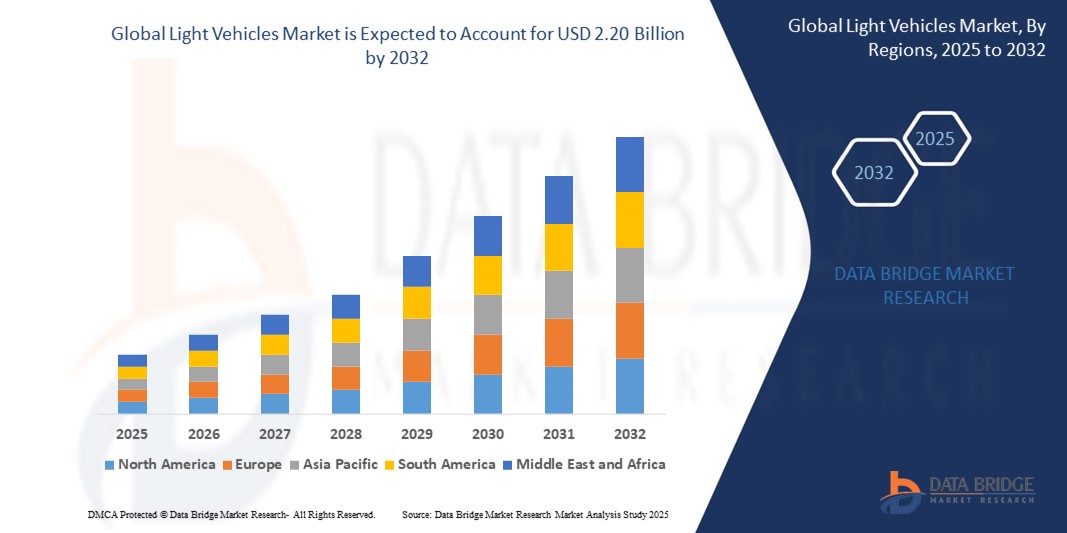
- The global Light Vehicles market size was valued at USD 1.36 Billion in 2024 and is expected to reach USD 2.20 Billion by 2032, at a CAGR of 7.1% during the forecast period
- Increasing research and development activities in the market and rising technological advancements and modernization in the production techniques will further create new opportunities for light vehicles market in the forecast period mentioned above.
Light Vehicles Market Analysis
- Light vehicles are termed as the vehicles that are lighter in weight, resulting in improved fuel efficiency but without compensating on the capabilities and power of the vehicles. These vehicles constitute of lighter-weight metals and lower engine power which significantly affects the overall weight of the vehicle, but due to the usage of advanced alloys in the production, the stability and capacity to operate is not lost.
- Rising advancements in the technology used resulting in innovative product launches that are highly fuel-efficient without compensating on the designated carry load is a crucial factor accelerating the market growth, also rising adoption of electric vehicle in line with the government initiatives favoring the development and adoption of electric vehicle and the rollout of electric vehicle charging, rising stringent regulations aimed at reducing vehicular emissions are expected to encourage the adoption of electric light duty trucks and rising adoption of light duty trucks for inland cargo transports are the major factors among others boosting the light vehicles market.
- Asia Pacific is expected to dominate the Light Vehicles Market due to rapid urbanization, rising disposable incomes, and the expansion of automotive manufacturing hubs in countries like China, India, and Japan. Additionally, the growing demand for fuel-efficient and environmentally friendly vehicles will further propel market growth in the region during the forecast period.
- North America is anticipated to be the fastest-growing region in the Light Vehicles Market, driven by increased consumer preference for electric and hybrid light vehicles, government incentives for green mobility, and robust investments in automotive innovation and smart vehicle technologies.
- The Diesel segment is predicted to hold the largest market share of 41.9% in the Light Vehicles Market during the forecast period. This dominance is attributed to the strong performance and fuel efficiency of diesel-powered vehicles, especially in commercial and utility applications, despite the gradual shift toward cleaner energy alternatives.
Report Scope and Light Vehicles Market Segmentation
|
Attributes |
Light Vehicles Key Market Insights |
|
Segments Covered |
|
|
Countries Covered |
North America
Europe
Asia-Pacific
Middle East and Africa
South America
|
|
Key Market Players |
|
|
Market Opportunities |
|
|
Value Added Data Infosets |
In addition to the insights on market scenarios such as market value, growth rate, segmentation, geographical coverage, and major players, the market reports curated by the Data Bridge Market Research also include import export analysis, production capacity overview, production consumption analysis, price trend analysis, climate change scenario, supply chain analysis, value chain analysis, raw material/consumables overview, vendor selection criteria, PESTLE Analysis, Porter Analysis, and regulatory framework. |
Light Vehicles Market Trends
“Rise of Electric and Autonomous Light Vehicles”
- The Light Vehicles market is witnessing a strong shift toward electrification and autonomous technologies. Automakers are integrating AI, machine learning, and sensor-based systems to enhance vehicle performance, safety, and fuel efficiency, meeting both environmental regulations and consumer expectations.
- Electric and self-driving light vehicles are transforming urban mobility, with increased adoption in ride-sharing services, last-mile delivery, and personal commuting. These innovations are enabling more sustainable and connected transportation ecosystems.
- For instance, in February 2025, Tesla announced the expansion of its autonomous electric light vehicle fleet for urban delivery services in key U.S. cities, significantly reducing carbon emissions and improving delivery times.
This trend is fueled by rising environmental awareness, government incentives for EV adoption, and the demand for safer, smarter transportation solutions.
Light Vehicles Market Dynamics
Driver
“Rising Demand for Fuel-Efficient and Environmentally Friendly Vehicles”
- Consumers are increasingly favoring light vehicles with better fuel economy and reduced emissions. This trend is pushing automakers to invest in lightweight materials, hybrid systems, and fully electric platforms.
- Government regulations and environmental policies are further driving the adoption of cleaner technologies in the light vehicle segment. Automakers are accelerating R&D efforts to comply with stringent emission standards.
For instance,
- For instance, in March 2025, Toyota launched a new line of hybrid light vehicles that exceed Euro 7 emissions standards, targeting eco-conscious urban consumers.
- As fuel prices rise and environmental concerns grow, demand for efficient light vehicles is expected to remain a strong market driver.
Opportunity
“Expansion of Mobility-as-a-Service (MaaS) and Shared Light Vehicle Fleets”
- The increasing preference for flexible transportation options is driving demand for shared mobility services. This trend allows light vehicle manufacturers and fleet operators to tap into new revenue streams, especially in urban areas where ownership costs and space constraints limit private vehicle use.
- Municipal governments are incorporating light vehicles into Mobility-as-a-Service (MaaS) ecosystems to enhance urban mobility. These platforms promote seamless travel by combining public transport, bike-sharing, and car-sharing, enabling users to plan, book, and pay for multimodal journeys using a single digital interface.
For instance,
- For instance, in April 2025, Berlin introduced a government-backed shared electric light vehicle program that integrates with public transport apps, enhancing last-mile connectivity for commuters.
- Consumer demand for cleaner, more efficient transport is driving the adoption of shared light vehicles. Digital platforms simplify booking and access, making car-sharing and rentals more attractive, while aligning with sustainability goals and reducing the environmental footprint of urban transportation.
Restraint/Challenge
“Infrastructure Limitations and Charging Network Gaps”
- The growth of electric light vehicles is significantly hindered by insufficient charging infrastructure. This issue is especially critical in rural and underdeveloped regions, where the absence of reliable, accessible charging stations limits EV usability and discourages potential buyers from making the switch.
- Inadequate charging availability leads to range anxiety—concerns over running out of power without nearby charging options. This fear undermines consumer confidence and deters adoption of electric light vehicles, even when market trends and government policies actively promote EV transition.
For instance,
- For instance, in January 2025, a national survey in India revealed that 64% of potential EV buyers were hesitant due to limited access to fast-charging stations.
- Accelerating the light vehicles market requires significant investments from both public and private sectors in charging station networks and modernizing power grids. These improvements are essential for supporting long-term EV growth, enabling faster adoption, and meeting future transportation and sustainability goals.
Light Vehicles Market Scope
The market is segmented on the fuel type, transmission, drivetrain and vehicle type.
|
Segmentation |
Sub-Segmentation |
|
By Fuel Type |
|
|
By Transmission |
|
|
By Drivetrain |
|
|
By Vehicle Type |
|
In 2025, the Diesel is projected to dominate the market with a largest share in by fuel type segment
The technology segment is expected to dominate the Light Vehicles market, with a market share of 41.9% during the forecast period. The diesel segment remains dominant due to its superior fuel efficiency and torque performance, especially for long-distance and commercial applications. Diesel engines offer lower running costs and better mileage, making them ideal for fleet operators and users in fuel-sensitive markets.
The Manual is expected to account for the largest share during the forecast period in Light Vehicles market
In 2025, the Manual segment in the Light Vehicles Market is projected to hold the largest share of approximately 51.5%. The manual transmission segment is driven by its affordability, mechanical simplicity, and greater control over vehicle performance. It remains popular in cost-conscious regions and among driving enthusiasts who prefer manual gear shifting for fuel economy and a more engaged driving experience.
Light Vehicles Market Regional Analysis
“Asia-Pacific Holds the Largest Share in the Light Vehicles Market”
- Asia-Pacific dominates the Light Vehicles Market, fueled by rapid urbanization, increasing adoption of smart city initiatives, and the growing demand for innovative transportation technologies across countries like China, Japan, and India.
- China and India are key contributors to the market, driven by their large populations, rapid infrastructure expansion, and extensive investments in IoT solutions for real-time asset tracking, navigation, and environmental monitoring.
- Japan’s leadership in robotics, AI, and advanced technologies is propelling the adoption of Light Vehicles, particularly in automated retail environments, healthcare asset tracking, and smart buildings, enhancing urban mobility solutions.
- Regional dominance is further strengthened by favorable government policies that support smart city development and innovation in IoT and wireless communications, which drive the adoption of indoor location-based services and contribute to the growth of the Light Vehicles Market.
“North America is Projected to Register the Highest CAGR in the Light Vehicles Market”
- North America is projected to experience the highest growth rate in the Light Vehicles Market, driven by increasing demand for real-time navigation, IoT solutions, and smart building systems in sectors like retail, logistics, and healthcare.
- The U.S. is a market leader, with major technology giants like Google, Apple, and IBM investing in IoT, AI, and indoor positioning systems for smart homes, autonomous vehicles, and digital signage applications.
- The integration of Light Vehicles technologies into smart office spaces, airports, shopping malls, and urban areas is accelerating demand, focusing on enhancing customer experiences, boosting operational efficiency, and improving safety measures.
- The region’s emphasis on innovation, advanced infrastructure, and a growing appetite for connected services is expected to drive the long-term growth of the Light Vehicles Market in North America.
Light Vehicles Market Share
The market competitive landscape provides details by competitor. Details included are company overview, company financials, revenue generated, market potential, investment in research and development, new market initiatives, global presence, production sites and facilities, production capacities, company strengths and weaknesses, product launch, product width and breadth, application dominance. The above data points provided are only related to the companies' focus related to market.
The Major Market Leaders Operating in the Market Are:
- Toyota Motor Corporation
- Volkswagen AG
- HYUNDAI MOTOR GROUP
- Fiat Chrysler Automobiles
- Honda Motor Co., Ltd.
- Groupe Renault
- Nissan
- Groupe PSA
- Zhejiang Geely Holding Group
- ASHOK LEYLAND
- suzuki motor corporation
- Tata Motors
- MITSUBISHI MOTORS CORPORATION
Latest Developments in Global Light Vehicles Market
- In January 2025, Tesla announced plans to significantly ramp up production of its Model 3 and Model Y to meet growing global demand. Tesla's target is to increase global production to over 2 million vehicles per year by 2026.
- In February 2025, Tesla introduced major upgrades to its Full Self-Driving (FSD) technology, pushing closer to fully autonomous driving with features like automatic lane-changing and city driving capabilities.

- Interactive Data Analysis Dashboard
- Company Analysis Dashboard for high growth potential opportunities
- Research Analyst Access for customization & queries
- Competitor Analysis with Interactive dashboard
- Latest News, Updates & Trend analysis
- Harness the Power of Benchmark Analysis for Comprehensive Competitor Tracking
Data collection and base year analysis are done using data collection modules with large sample sizes. The stage includes obtaining market information or related data through various sources and strategies. It includes examining and planning all the data acquired from the past in advance. It likewise envelops the examination of information inconsistencies seen across different information sources. The market data is analysed and estimated using market statistical and coherent models. Also, market share analysis and key trend analysis are the major success factors in the market report. To know more, please request an analyst call or drop down your inquiry.
The key research methodology used by DBMR research team is data triangulation which involves data mining, analysis of the impact of data variables on the market and primary (industry expert) validation. Data models include Vendor Positioning Grid, Market Time Line Analysis, Market Overview and Guide, Company Positioning Grid, Patent Analysis, Pricing Analysis, Company Market Share Analysis, Standards of Measurement, Global versus Regional and Vendor Share Analysis. To know more about the research methodology, drop in an inquiry to speak to our industry experts.
Data Bridge Market Research is a leader in advanced formative research. We take pride in servicing our existing and new customers with data and analysis that match and suits their goal. The report can be customized to include price trend analysis of target brands understanding the market for additional countries (ask for the list of countries), clinical trial results data, literature review, refurbished market and product base analysis. Market analysis of target competitors can be analyzed from technology-based analysis to market portfolio strategies. We can add as many competitors that you require data about in the format and data style you are looking for. Our team of analysts can also provide you data in crude raw excel files pivot tables (Fact book) or can assist you in creating presentations from the data sets available in the report.













