Global Jojoba Oil Derivatives Market
Market Size in USD Million
CAGR :
% 
 USD
44.74 Million
USD
79.80 Million
2025
2033
USD
44.74 Million
USD
79.80 Million
2025
2033
 Forecast Period Forecast Period |
2026 –2033 |
 Market Size (Base Year) Market Size (Base Year) |
USD 44.74 Million |
 Market Size (Forecast Year) Market Size (Forecast Year) |
USD 79.80 Million |
 CAGR CAGR |
% |
| Major Markets Players |
|
What is the Global Jojoba Oil Derivatives Market Size and Growth Rate?
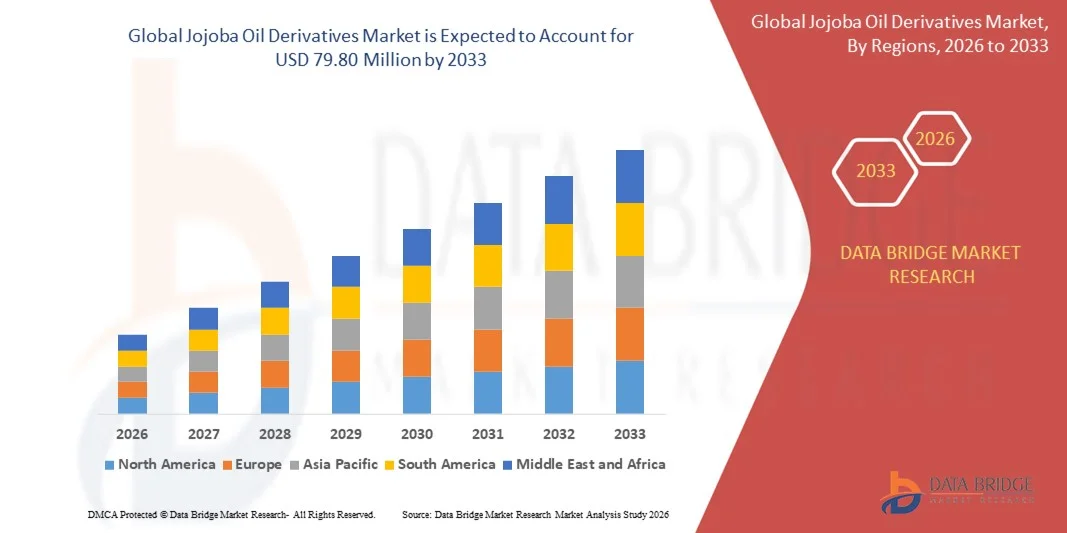
- The global jojoba oil derivatives market size was valued at USD 44.74 million in 2025 and is expected to reach USD 79.80 million by 2033, at a CAGR of7.50% during the forecast period
- The expansion of business of the cosmetics industry across the globe acts as one of the major factors driving the growth of jojoba oil derivatives market
- The rise in the use of jojoba oil derivatives, especially esters and wax, in skincare and hair care products, and increase in awareness regarding the benefits of jojoba oil derivatives, such as treating dry scalp, stimulating hair growth, healing sunburns, stimulating hair growth, and eczema, accelerate the market growth
What are the Major Takeaways of Jojoba Oil Derivatives Market?
- The increase in preference for plant-sourced and renewable alternatives towards paraffin waxes, petrolatum, and mineral oils, and high demand for reducing premature aging signs and stretch marks further influence the market
- In addition, increasing expenditure of parents on personal hygiene products for infants and children, rapid urbanization, and favorable regulatory scenario positively affect the jojoba oil derivatives market
- North America dominated the jojoba oil derivatives market with a 39.35% revenue share in 2025, driven by strong demand from the personal care & cosmetics industry, rising preference for natural and organic ingredients, and well-established cosmetic manufacturing ecosystems across the U.S. and Canada
- Asia-Pacific is projected to register the fastest CAGR of 8.36% from 2026 to 2033, driven by rapid expansion of the cosmetics and personal care industry, rising disposable incomes, and growing awareness of natural beauty ingredients across China, Japan, India, South Korea, and Southeast Asia
- The Jojoba Esters segment dominated the market with a 41.6% share in 2025, owing to their widespread use as natural emollients, texture enhancers, and silicone alternatives in skincare, haircare, and color cosmetics
Report Scope and Jojoba Oil Derivatives Market Segmentation
|
Attributes |
Jojoba Oil Derivatives Key Market Insights |
|
Segments Covered |
|
|
Countries Covered |
North America
Europe
Asia-Pacific
Middle East and Africa
South America
|
|
Key Market Players |
|
|
Market Opportunities |
|
|
Value Added Data Infosets |
In addition to the insights on market scenarios such as market value, growth rate, segmentation, geographical coverage, and major players, the market reports curated by the Data Bridge Market Research also include in-depth expert analysis, pricing analysis, brand share analysis, consumer survey, demography analysis, supply chain analysis, value chain analysis, raw material/consumables overview, vendor selection criteria, PESTLE Analysis, Porter Analysis, and regulatory framework. |
What is the Key Trend in the Jojoba Oil Derivatives Market?
Growing Shift Toward Natural, Bio-Based, and Functional Jojoba Oil Derivatives
- The jojoba oil derivatives market is witnessing rising adoption of bio-based, multifunctional derivatives such as jojoba esters, hydrogenated jojoba oil, and jojoba waxes across cosmetics, personal care, and pharmaceutical formulations
- Manufacturers are increasingly developing high-purity, odorless, and oxidation-stable derivatives that enhance texture, emolliency, and shelf life in skincare, haircare, and color cosmetics
- Growing consumer preference for clean-label, vegan, and sustainable ingredients is accelerating demand for plant-based alternatives to petroleum-derived emollients and silicones
- For instance, companies such as Purcell Jojoba, Ecooil, Primavera Life, and Jurlique are expanding portfolios of jojoba oil derivatives for premium skincare and organic beauty applications
- Rising use of jojoba esters in anti-aging, sun care, and sensitive-skin formulations is driving innovation in functional ingredient design
- As sustainability and performance converge, jojoba oil derivatives are becoming a core ingredient platform for next-generation natural cosmetic formulations
What are the Key Drivers of Jojoba Oil Derivatives Market?
- Increasing demand for natural and sustainable cosmetic ingredients, driven by rising awareness of skin health and environmental impact
- For instance, in 2024–2025, major personal care brands incorporated jojoba-based emollients and conditioning agents to replace synthetic oils and microplastics
- Expanding use of jojoba oil derivatives in skincare, haircare, lip care, and nail care products due to their excellent compatibility with human sebum
- Superior properties such as thermal stability, long shelf life, non-greasy texture, and oxidative resistance are boosting adoption across premium formulations
- Rising demand from pharmaceutical, aromatherapy, and wellness products further supports market expansion
- Supported by growing investments in sustainable agriculture and green chemistry, the Jojoba Oil Derivatives market is expected to witness steady long-term growth
Which Factor is Challenging the Growth of the Jojoba Oil Derivatives Market?
- High raw material costs and limited jojoba seed cultivation regions restrict large-scale supply and price stability
- For instance, climatic dependence and yield fluctuations in key producing regions such as the U.S., Argentina, and Australia impact derivative availability
- Processing complexity and capital-intensive refining technologies increase production costs for high-purity derivatives
- Limited awareness among small manufacturers regarding functional benefits of advanced jojoba derivatives slows adoption
- Competition from lower-cost synthetic emollients and alternative plant oils creates pricing pressure
- To address these challenges, companies are focusing on supply-chain optimization, expanded cultivation, derivative innovation, and cost-efficient processing technologies to improve global accessibility of jojoba oil derivatives
How is the Jojoba Oil Derivatives Market Segmented?
The market is segmented on the basis of product and application.
- By Product
On the basis of product, the jojoba oil derivatives market is segmented into Jojoba Butter, Jojoba Alcohol, Jojoba Esters, Jojoba Proteins, Jojoba Wax, and Others. The Jojoba Esters segment dominated the market with a 41.6% share in 2025, owing to their widespread use as natural emollients, texture enhancers, and silicone alternatives in skincare, haircare, and color cosmetics. Jojoba esters offer excellent oxidative stability, non-greasy feel, and compatibility with human sebum, making them highly preferred in premium and clean-label formulations. Their ability to improve spreadability, moisture retention, and sensory performance drives strong demand from cosmetic manufacturers.
The Jojoba Butter segment is expected to grow at the fastest CAGR from 2026 to 2033, driven by rising demand for rich, nourishing ingredients in lip care, body butters, balms, and sensitive-skin products. Increasing consumer preference for plant-based, deeply moisturizing, and sustainable cosmetic ingredients is accelerating adoption of jojoba butter globally.
- By Application
On the basis of application, the jojoba oil derivatives market is segmented into Personal Care & Cosmetics, Food & Beverage, Industrial, Pharmaceutical, and Others. The Personal Care & Cosmetics segment dominated the market with a 58.9% share in 2025, supported by extensive use of jojoba-derived emollients, conditioners, and stabilizers in skincare, haircare, nail care, and cosmetic formulations. Jojoba oil derivatives are highly valued for their non-comedogenic nature, long shelf life, thermal stability, and ability to enhance product texture and performance, making them a staple ingredient in natural and organic beauty products.
The Pharmaceutical segment is projected to grow at the fastest CAGR from 2026 to 2033, driven by increasing use of jojoba derivatives in topical drug formulations, ointments, carrier oils, and dermatological products. Growing focus on bio-compatible, non-irritating, and stable excipients is further boosting adoption within pharmaceutical and medical applications.
Which Region Holds the Largest Share of the Jojoba Oil Derivatives Market?
- North America dominated the jojoba oil derivatives market with a 39.35% revenue share in 2025, driven by strong demand from the personal care & cosmetics industry, rising preference for natural and organic ingredients, and well-established cosmetic manufacturing ecosystems across the U.S. and Canada. High consumer awareness regarding clean-label beauty products, sustainable sourcing, and skin-friendly formulations continues to fuel adoption of jojoba esters, waxes, and butters across skincare, haircare, and cosmetic applications
- Leading manufacturers in North America are investing in advanced refining technologies, sustainable cultivation practices, and certified organic jojoba derivatives, strengthening regional supply capabilities and product innovation
- Strong R&D infrastructure, high purchasing power, and the presence of global cosmetic brands further reinforce North America’s leadership in the jojoba oil derivatives market
U.S. Jojoba Oil Derivatives Market Insight
The U.S. is the largest contributor in North America, supported by strong demand for premium skincare, haircare, and cosmetic formulations using plant-based emollients and stabilizers. Rising adoption of clean beauty, vegan cosmetics, and dermatologist-recommended products accelerates demand for jojoba esters and waxes. Presence of leading cosmetic brands, contract manufacturers, and ingredient suppliers drives sustained market growth.
Canada Jojoba Oil Derivatives Market Insight
Canada contributes steadily, driven by growing demand for natural personal care products and increased focus on sustainable and organic cosmetic formulations. Expansion of indie beauty brands, wellness-focused consumers, and supportive regulatory frameworks strengthens adoption of jojoba oil derivatives across skincare and haircare segments.
Asia-Pacific Jojoba Oil Derivatives Market
Asia-Pacific is projected to register the fastest CAGR of 8.36% from 2026 to 2033, driven by rapid expansion of the cosmetics and personal care industry, rising disposable incomes, and growing awareness of natural beauty ingredients across China, Japan, India, South Korea, and Southeast Asia. Increasing production of skincare, haircare, and color cosmetics, along with strong demand for moisturizing, anti-aging, and sensitive-skin formulations, is accelerating adoption of jojoba-derived ingredients. Growth in e-commerce beauty platforms, local manufacturing, and global brand penetration further boosts regional market expansion.
China Jojoba Oil Derivatives Market Insight
China leads Asia-Pacific due to massive cosmetics manufacturing capacity, strong domestic beauty brands, and rising demand for natural and multifunctional cosmetic ingredients. Government support for sustainable sourcing and rapid innovation in skincare formulations drives market growth.
Japan Jojoba Oil Derivatives Market Insight
Japan shows steady growth, supported by high demand for premium skincare, minimalistic formulations, and high-quality cosmetic ingredients. Strong emphasis on skin compatibility, product safety, and advanced formulation science boosts adoption of jojoba oil derivatives.
India Jojoba Oil Derivatives Market Insight
India is emerging as a high-growth market, driven by increasing demand for herbal, Ayurvedic, and natural personal care products. Rising local manufacturing, startup activity, and government initiatives supporting cosmetics production strengthen market penetration.
South Korea Jojoba Oil Derivatives Market Insight
South Korea contributes significantly due to its global leadership in skincare innovation and K-beauty trends. High demand for lightweight, nourishing, and multifunctional cosmetic ingredients drives strong adoption of jojoba esters and waxes.
Which are the Top Companies in Jojoba Oil Derivatives Market?
The jojoba oil derivatives industry is primarily led by well-established companies, including:
- PRIMAVERA LIFE GMBH (Germany)
- Jurlique (Australia)
- SkinFood. (South Korea)
- EC21 Inc. (South Korea)
- U.S. International Trading Corporation (U.S.)
- Eve Taylor (U.K.)
- KENDO HOLDINGS INC (U.S.)
- Roonka. (India)
- JE International Corporation (U.S.)
- Purcell Jojoba (Australia)
- Ecooil (Australia)
- W. ULRICH GmbH (Germany)
- Dun & Bradstreet, Inc. (U.S.)
- Innocosma Organics LLC (U.S.)
- Creative Nail Design, Inc. (U.S.)
What are the Recent Developments in Global Jojoba Oil Derivatives Market?
- In November 2023, Cargill Beauty launched its sustainability-focused initiative, the Jojoba Promise, aimed at improving the environmental performance of jojoba cultivation worldwide within the personal care industry, with the program applied to all jojoba sourcing and derivative production at its Arizona facilities, reinforcing the company’s long-term commitment to sustainable ingredient sourcing and responsible supply chains
SKU-
Get online access to the report on the World's First Market Intelligence Cloud
- Interactive Data Analysis Dashboard
- Company Analysis Dashboard for high growth potential opportunities
- Research Analyst Access for customization & queries
- Competitor Analysis with Interactive dashboard
- Latest News, Updates & Trend analysis
- Harness the Power of Benchmark Analysis for Comprehensive Competitor Tracking
Global Jojoba Oil Derivatives Market, Supply Chain Analysis and Ecosystem Framework
To support market growth and help clients navigate the impact of geopolitical shifts, DBMR has integrated in-depth supply chain analysis into its Global Jojoba Oil Derivatives Market research reports. This addition empowers clients to respond effectively to global changes affecting their industries. The supply chain analysis section includes detailed insights such as Global Jojoba Oil Derivatives Market consumption and production by country, price trend analysis, the impact of tariffs and geopolitical developments, and import and export trends by country and HSN code. It also highlights major suppliers with data on production capacity and company profiles, as well as key importers and exporters. In addition to research, DBMR offers specialized supply chain consulting services backed by over a decade of experience, providing solutions like supplier discovery, supplier risk assessment, price trend analysis, impact evaluation of inflation and trade route changes, and comprehensive market trend analysis.
Research Methodology
Data collection and base year analysis are done using data collection modules with large sample sizes. The stage includes obtaining market information or related data through various sources and strategies. It includes examining and planning all the data acquired from the past in advance. It likewise envelops the examination of information inconsistencies seen across different information sources. The market data is analysed and estimated using market statistical and coherent models. Also, market share analysis and key trend analysis are the major success factors in the market report. To know more, please request an analyst call or drop down your inquiry.
The key research methodology used by DBMR research team is data triangulation which involves data mining, analysis of the impact of data variables on the market and primary (industry expert) validation. Data models include Vendor Positioning Grid, Market Time Line Analysis, Market Overview and Guide, Company Positioning Grid, Patent Analysis, Pricing Analysis, Company Market Share Analysis, Standards of Measurement, Global versus Regional and Vendor Share Analysis. To know more about the research methodology, drop in an inquiry to speak to our industry experts.
Customization Available
Data Bridge Market Research is a leader in advanced formative research. We take pride in servicing our existing and new customers with data and analysis that match and suits their goal. The report can be customized to include price trend analysis of target brands understanding the market for additional countries (ask for the list of countries), clinical trial results data, literature review, refurbished market and product base analysis. Market analysis of target competitors can be analyzed from technology-based analysis to market portfolio strategies. We can add as many competitors that you require data about in the format and data style you are looking for. Our team of analysts can also provide you data in crude raw excel files pivot tables (Fact book) or can assist you in creating presentations from the data sets available in the report.