


Isopropyl Alcohol Market Size
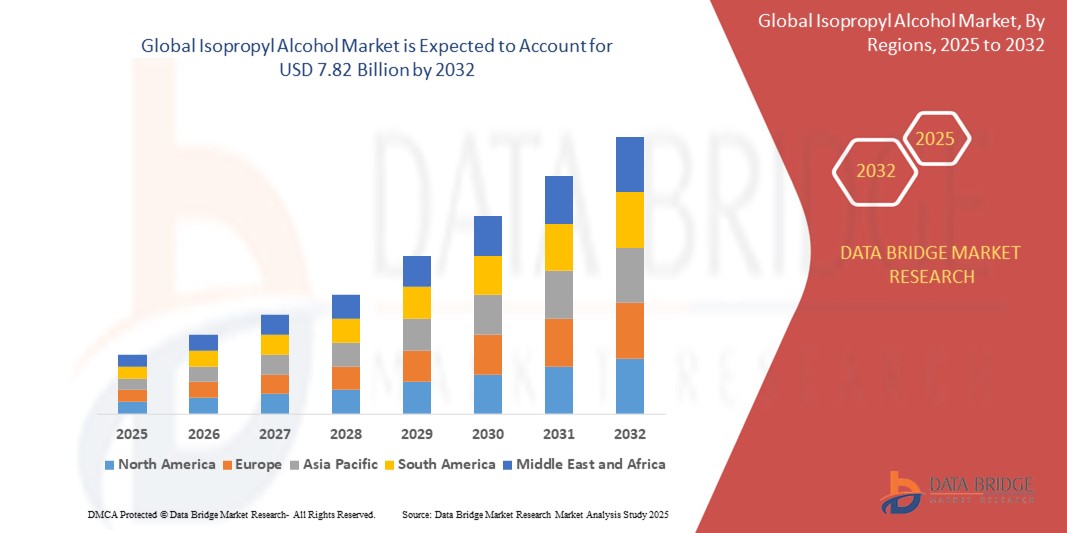
- The global Isopropyl Alcohol market size was valued at USD 5.8 billion in 2024 and is expected to reach USD 7.82 billion by 2032, at a CAGR of 3.80% during the forecast period
- The market growth is largely fueled by the increasing demand for isopropyl alcohol across pharmaceutical, personal care, and industrial sectors, especially as a solvent and disinfectant amid heightened hygiene awareness post-COVID-19
- Furthermore, expanding applications in electronics and semiconductors—particularly for cleaning and manufacturing processes—along with rising investments in healthcare infrastructure, are driving the consumption of high-purity isopropyl alcohol globally. These industry trends are significantly boosting market growth and adoption across multiple sectors
Isopropyl Alcohol Market Analysis
- Isopropyl alcohol, widely used as a solvent and disinfectant, plays a crucial role in pharmaceuticals, personal care, and industrial manufacturing due to its effective antiseptic and cleaning properties, making it indispensable in hygiene-sensitive environments
- The growing demand for sanitization and surface disinfection—particularly after the COVID-19 pandemic—has significantly accelerated the consumption of isopropyl alcohol across healthcare, food processing, and commercial cleaning sectors
- Asia-Pacific dominates the isopropyl alcohol market with the largest revenue share of 42.7% in 2025, supported by rapid industrialization, strong growth in the pharmaceutical and cosmetics industries, and increasing hygiene awareness in emerging economies such as China, India, and Indonesia
- North America is expected to witness steady growth in the isopropyl alcohol market during the forecast period due to high consumption in pharmaceutical manufacturing, laboratory usage, and surface disinfection, with the United States accounting for a major portion of regional demand
- The pharmaceutical segment is anticipated to dominate the isopropyl alcohol market with a significant share in 2025, fueled by its extensive use in drug formulation, equipment sterilization, and hand sanitizers, particularly with ongoing innovations in biosciences and increased global focus on health and wellness
Report Scope and Isopropyl Alcohol Market Segmentation
|
Attributes |
Isopropyl Alcohol Key Market Insights |
|
Segments Covered |
|
|
Countries Covered |
North America
Europe
Asia-Pacific
Middle East and Africa
South America
|
|
Key Market Players |
|
|
Market Opportunities |
|
|
Value Added Data Infosets |
In addition to the insights on market scenarios such as market value, growth rate, segmentation, geographical coverage, and major players, the market reports curated by the Data Bridge Market Research also include import export analysis, production capacity overview, production consumption analysis, price trend analysis, climate change scenario, supply chain analysis, value chain analysis, raw material/consumables overview, vendor selection criteria, PESTLE Analysis, Porter Analysis, and regulatory framework . |
Isopropyl Alcohol Market Trends
“Surging Demand for High-Purity Grades in Semiconductor and Electronics Manufacturing”
- A significant and accelerating trend in the global isopropyl alcohol market is the rising demand for ultra-high purity IPA in the semiconductor and electronics sectors, where it is widely used for wafer cleaning, lens polishing, and precision surface treatment due to its fast evaporation rate and residue-free finish
- For instance, in February 2024, LG Chem expanded its ultra-pure isopropyl alcohol production capacity in South Korea to meet increasing demand from global semiconductor manufacturers, driven by the rapid expansion of chip fabrication plants across Asia-Pacific
- High-purity isopropyl alcohol is critical in photolithography and microelectronics manufacturing, with companies investing in refining and purification technologies to produce electronics-grade IPA with minimal trace contaminants, ensuring consistent performance and quality control in cleanroom environments
- The increased adoption of AI-powered devices, electric vehicles (EVs), and IoT infrastructure is fueling growth in semiconductor output, thereby amplifying the need for semiconductor-grade IPA in countries such as Taiwan, South Korea, Japan, and China
- In April 2023, Avantor, Inc. announced enhancements to its semiconductor material purification processes to supply ultra-high purity IPA and solvents to fabrication facilities in the United States and Europe, reflecting the globalization of chip production and supply chain diversification
- This trend toward high-purity IPA for precision applications is fundamentally reshaping supplier strategies and R&D investments in the isopropyl alcohol industry. Consequently, companies such as Tokuyama Corporation and INEOS are scaling production of electronics-grade IPA through advanced distillation techniques and closed-loop recycling systems to meet stringent purity demands
- The demand for specialized, ultra-pure isopropyl alcohol is growing rapidly across electronics, aerospace, and advanced manufacturing sectors, as industries prioritize chemical precision, process efficiency, and contamination-free environments
Isopropyl Alcohol Market Dynamics
Driver
“Growing Demand Due to Rising Hygiene Awareness and Industrial Applications”
- The increasing global emphasis on hygiene and infection prevention across healthcare, pharmaceutical, and consumer environments is a significant driver for the heightened demand for isopropyl alcohol (IPA), particularly as a disinfectant and surface cleaner
- For instance, in March 2024, INEOS announced an expansion of its isopropyl alcohol production at its Grangemouth site in Scotland to meet surging demand across Europe for hospital-grade disinfectants and pharmaceutical-grade solvents, reflecting increased hygiene standards post-pandemic
- As consumers and industries become more focused on sanitation and contamination control, isopropyl alcohol offers effective antimicrobial action and quick evaporation properties, making it a preferred choice in medical wipes, hand sanitizers, and surgical scrubs
- Furthermore, the growing application of isopropyl alcohol in electronics and semiconductor manufacturing—where it is used for precision cleaning of wafers, lenses, and circuit boards—is accelerating demand, especially in Asia-Pacific and North America, where advanced manufacturing continues to expand
- The versatility of IPA as a solvent in the production of paints, inks, coatings, and adhesives is also contributing to its widespread adoption across industrial sectors. Additionally, increased demand from the cosmetics and personal care industry for safe and fast-drying ingredients in products such as perfumes, deodorants, and hair care formulations is further propelling market growth
Restraint/Challenge
“Health and Safety Concerns and Fluctuating Raw Material Prices”
- Health and safety concerns related to the flammability and toxicity of isopropyl alcohol (IPA) present significant challenges to its widespread use and handling, especially in industrial and consumer applications. Improper storage or handling can lead to fire hazards or exposure risks, which require strict adherence to safety regulations and protocols
- For example, regulatory bodies such as OSHA and the EPA have set stringent guidelines for IPA storage and usage to minimize workplace hazards, which can increase compliance costs for manufacturers and users alike
- In addition, fluctuating prices and availability of raw materials, such as propylene derived from petroleum refining, contribute to instability in production costs. Price volatility of crude oil and related feedstocks often leads to unpredictable IPA market pricing, affecting profit margins and supply chain reliability
- Major producers such as Dow Chemical and LyondellBasell have reported occasional supply constraints and cost pressures linked to raw material price swings, which can impact downstream industries such as pharmaceuticals, cosmetics, and electronics manufacturing
- While efforts to improve safety standards and explore alternative feedstocks are ongoing, overcoming these health, safety, and cost-related challenges will be essential to ensure steady growth and broader adoption of isopropyl alcohol across various sectors
Isopropyl Alcohol Market Scope
The market is segmented on the basis grade, production method, application, end-user industry, and type.
• By Grade
On the basis of grade, the isopropyl alcohol market is segmented into 70% IPA and 90% IPA. The 70% IPA segment dominates the largest market revenue share of 43.2% in 2025, driven by its established reputation for antiseptic applications and widespread use in healthcare.
The 90% IPA segment is anticipated to witness the fastest growth rate of 21.7% from 2025 to 2032, fueled by increasing demand in industrial cleaning and solvent applications.
• By Production Method
On the basis of production method, the market is segmented into indirect hydration and direct hydration. The indirect hydration segment holds the largest market revenue share in 2025, driven by its commercial-scale production efficiency and established infrastructure.
The direct hydration segment is expected to witness the fastest CAGR from 2025 to 2032, due to its cost-effectiveness and environmental benefits.
• By Application
On the basis of application, the isopropyl alcohol market is segmented into antiseptic and astringent, cleaning agent, solvent, chemical intermediate, and others. The antiseptic and astringent segment accounted for the largest market revenue share in 2024, driven by rising demand from healthcare and personal hygiene sectors.
The solvent segment is anticipated to witness the fastest CAGR from 2025 to 2032, fueled by growth in pharmaceutical, paints, and coatings industries.
• By End-User Industry
On the basis of end-user industry, the market is segmented into cosmetics and personal care, pharmaceutical, food and beverages, paints and coatings, chemical, and other end-user industries. The pharmaceutical segment accounted for the largest market revenue share in 2024, driven by the increasing requirement for disinfectants and sanitizers.
The cosmetics and personal care segment is expected to witness the fastest CAGR from 2025 to 2032, due to rising consumer awareness and product innovation.
• By Type
On the basis of type, the isopropyl alcohol market is segmented into industrial grade and medical grade. The industrial grade segment holds the largest market revenue share in 2025, attributed to its extensive application in manufacturing, cleaning, and chemical processes.
The medical grade segment is expected to witness significant growth during the forecast period, fueled by expanding healthcare infrastructure and increased hygiene awareness.
Isopropyl Alcohol Market Regional Analysis
- Asia-Pacific dominates the isopropyl alcohol market with the largest revenue share of 42.7% in 2025, driven by rapid industrialization and growing demand from pharmaceutical, personal care, and electronics manufacturing sectors
- Consumers and industries in the region highly value isopropyl alcohol for its use in antiseptics, sanitizers, cleaning agents, and solvents, especially amid rising health awareness and expanding electronics production hubs in countries such as China, India, and South Korea
- This widespread adoption is further supported by increasing healthcare expenditures, expanding pharmaceutical manufacturing capabilities, and growing urbanization, establishing Asia-Pacific as a critical growth market for isopropyl alcohol globally
Japan Isopropyl Alcohol Market Insight
The Japan isopropyl alcohol market is gaining momentum due to the country’s advanced pharmaceutical industry, high hygiene standards, and growing demand for personal care and disinfectant products. The Japanese market emphasizes quality and safety, with increased usage in hospitals, clinics, and household sanitizers. In addition, Japan’s aging population is likely to boost demand for antiseptics and easy-to-use disinfectant solutions in both residential and healthcare sectors.
China Isopropyl Alcohol Market Insight
The China isopropyl alcohol market accounted for the largest market revenue share in Asia-Pacific in 2025, driven by rapid industrialization, expanding pharmaceutical manufacturing, and increased personal care product consumption. China’s robust electronics manufacturing sector also significantly contributes to demand for IPA as a cleaning solvent. Government initiatives supporting healthcare infrastructure and rising urbanization further accelerate market growth.
North America Isopropyl Alcohol Market Insight
The U.S. isopropyl alcohol market captured the largest revenue share of 80% within North America in 2025, fueled by strong demand in healthcare, pharmaceutical, and personal care industries. Consumers and institutions are prioritizing hygiene and sanitization products, especially post-pandemic, which drives IPA usage in hand sanitizers and disinfectants. The U.S. market also benefits from technological advancements and stringent regulatory frameworks ensuring high product standards.
Europe Isopropyl Alcohol Market Insight
The European isopropyl alcohol market is projected to expand at a substantial CAGR throughout the forecast period, primarily driven by stringent regulations around hygiene and healthcare standards. Rising demand from pharmaceutical and personal care sectors, coupled with the region’s focus on sustainable and eco-friendly products, supports growth. Countries such as Germany and the U.K. are key contributors, with increased IPA use in antiseptics, cleaning, and industrial applications.
U.K. Isopropyl Alcohol Market Insight
The U.K. isopropyl alcohol market is expected to grow steadily due to rising consumer awareness about hygiene and safety, especially in medical and household applications. The market benefits from a strong pharmaceutical sector and growing demand for personal care and cleaning products. Moreover, the increasing adoption of disinfectants in commercial establishments and institutions propels market expansion.
Germany Isopropyl Alcohol Market Insight
The Germany isopropyl alcohol market is anticipated to grow considerably, supported by the country’s well-developed pharmaceutical and chemical manufacturing industries. German consumers and industries emphasize product safety and efficacy, leading to high demand for IPA in antiseptics and industrial solvents. The integration of IPA in sustainable manufacturing processes also aligns with Germany’s eco-conscious market trends.
Asia-Pacific Isopropyl Alcohol Market Insight
The Asia-Pacific isopropyl alcohol market is poised to grow at the fastest CAGR of over 23% in 2025, driven by increasing urbanization, rising disposable incomes, and expanding pharmaceutical and electronics manufacturing sectors in countries such as China, Japan, and India. Government initiatives promoting healthcare infrastructure and hygiene awareness further boost demand. The region’s growing personal care market and industrial applications also contribute significantly to market expansion.
Isopropyl Alcohol Market Share
The isopropyl alcohol industry is primarily led by well-established companies, including:
- Exxon Mobil Corporation (U.S.)
- Shell (Netherlands)
- Dow (U.S.)
- China Petrochemical Corporation (China)
- Mitsubishi Chemical Corporation (Japan)
- Tokuyama Corporation (Japan)
- LG Chem (South Korea)
- Jiangsu Denoir Technology Co. Ltd (China)
- Avantor, Inc (U.S.)
- INEOS AG (Germany)
- LyondellBasell Industries Holdings B.V. (U.S.)
- Huntsman International LLC. (U.S.)
- Hefei TNJ Chemical Industry Co., Ltd (China)
- GALAXY (Egypt)
- DuPont (U.S.)
- Clariant (Switzerland)
- Carboclor SA (Argentina)
Latest Developments in Global Isopropyl Alcohol Market
-
In August 2024, Eastman launched a new electronic-grade isopropyl alcohol (IPA) as part of its EastaPure™ line, designed to meet the high-purity standards required by U.S. semiconductor manufacturers. This domestically produced solvent ensures reliable supply and superior quality, supporting wafer fabrication and advanced packaging processes. Eastman’s state-of-the-art manufacturing facilities and dedicated storage systems help maintain 99.99% purity, addressing industry concerns over contamination and supply chain stability. This innovation strengthens Eastman’s position in the electronic chemicals market
- In June 2024, Cepsa initiated the construction of Spain’s first isopropyl alcohol (IPA) plant, marking a significant expansion in its chemicals business. Located in Palos de la Frontera, Huelva, the facility will produce 80,000 tons of IPA annually, catering to applications in hydroalcoholic gels, household, and industrial cleaning products. With a €75 million investment, the plant integrates green hydrogen and renewable raw materials, reinforcing Cepsa’s commitment to sustainability and supply autonomy. This milestone aligns with Spain’s broader energy transition strategy
- In April 2024, Shell PLC reaffirmed its commitment to achieving net-zero emissions by 2050, outlining its Energy Transition Strategy 2024. This plan focuses on reducing carbon intensity, investing in low-carbon solutions, and expanding carbon capture and storage (CCS) technologies. Shell’s strategy could influence its isopropyl alcohol (IPA) production, encouraging more sustainable processes to minimize environmental impact. The company has already allocated $10-15 billion for low-carbon investments between 2023 and 2025, reinforcing its dedication to cleaner energy solutions
- In October 2023, INEOS launched a new initiative to advance the circular economy in the chemical industry, focusing on recycling and reuse strategies for various materials, including isopropyl alcohol (IPA). The company has been integrating bio-based and recycled feedstocks into its production processes, commissioning new facilities to incorporate pyrolysis oil from recycled plastic waste. This effort aligns with INEOS’ broader sustainability goals, including its 2025 and 2030 polymer pledges, aimed at reducing environmental impact while maintaining industry-leading standards
- In January 2023, Dow unveiled plans to invest in a new propylene production facility on the U.S. Gulf Coast, aiming to strengthen its supply chain and production capabilities. Since propylene is a key feedstock for isopropyl alcohol (IPA), this expansion could indirectly influence IPA availability and pricing. The project aligns with Dow’s broader strategy to enhance domestic manufacturing and support downstream chemical industries

- Interactive Data Analysis Dashboard
- Company Analysis Dashboard for high growth potential opportunities
- Research Analyst Access for customization & queries
- Competitor Analysis with Interactive dashboard
- Latest News, Updates & Trend analysis
- Harness the Power of Benchmark Analysis for Comprehensive Competitor Tracking
Global Isopropyl Alcohol Market, Supply Chain Analysis and Ecosystem Framework
To support market growth and help clients navigate the impact of geopolitical shifts, DBMR has integrated in-depth supply chain analysis into its Global Isopropyl Alcohol Market research reports. This addition empowers clients to respond effectively to global changes affecting their industries. The supply chain analysis section includes detailed insights such as Global Isopropyl Alcohol Market consumption and production by country, price trend analysis, the impact of tariffs and geopolitical developments, and import and export trends by country and HSN code. It also highlights major suppliers with data on production capacity and company profiles, as well as key importers and exporters. In addition to research, DBMR offers specialized supply chain consulting services backed by over a decade of experience, providing solutions like supplier discovery, supplier risk assessment, price trend analysis, impact evaluation of inflation and trade route changes, and comprehensive market trend analysis.
Data collection and base year analysis are done using data collection modules with large sample sizes. The stage includes obtaining market information or related data through various sources and strategies. It includes examining and planning all the data acquired from the past in advance. It likewise envelops the examination of information inconsistencies seen across different information sources. The market data is analysed and estimated using market statistical and coherent models. Also, market share analysis and key trend analysis are the major success factors in the market report. To know more, please request an analyst call or drop down your inquiry.
The key research methodology used by DBMR research team is data triangulation which involves data mining, analysis of the impact of data variables on the market and primary (industry expert) validation. Data models include Vendor Positioning Grid, Market Time Line Analysis, Market Overview and Guide, Company Positioning Grid, Patent Analysis, Pricing Analysis, Company Market Share Analysis, Standards of Measurement, Global versus Regional and Vendor Share Analysis. To know more about the research methodology, drop in an inquiry to speak to our industry experts.
Data Bridge Market Research is a leader in advanced formative research. We take pride in servicing our existing and new customers with data and analysis that match and suits their goal. The report can be customized to include price trend analysis of target brands understanding the market for additional countries (ask for the list of countries), clinical trial results data, literature review, refurbished market and product base analysis. Market analysis of target competitors can be analyzed from technology-based analysis to market portfolio strategies. We can add as many competitors that you require data about in the format and data style you are looking for. Our team of analysts can also provide you data in crude raw excel files pivot tables (Fact book) or can assist you in creating presentations from the data sets available in the report.













