


Internal Neuromodulation Devices Market Size
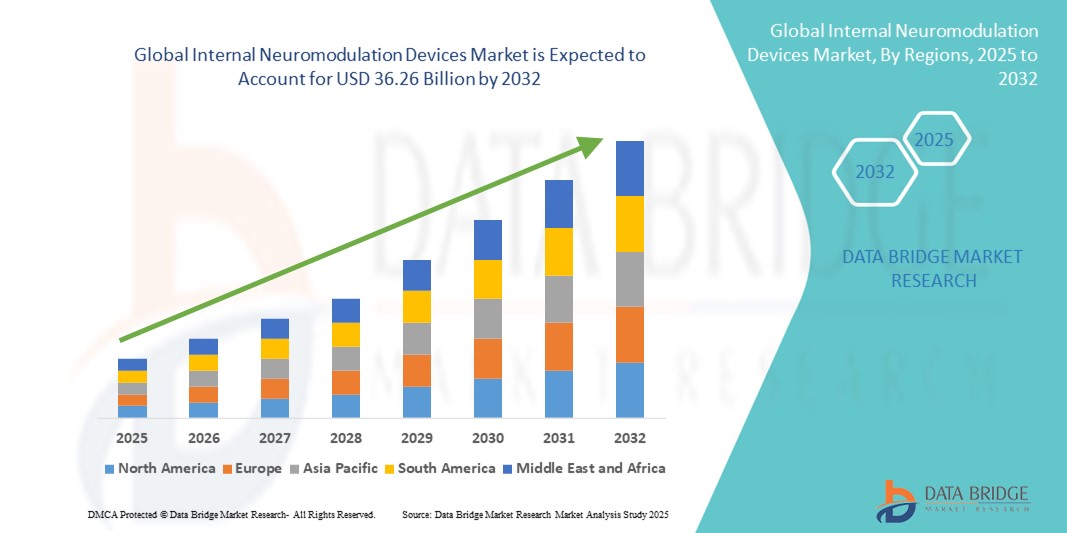
- The global internal neuromodulation devices market size was valued at USD 11.77 billion in 2024 and is expected to reach USD 36.26 billion by 2032, at a CAGR of 15.10% during the forecast period
- The market growth is largely fueled by the growing adoption and technological advancements in internal neuromodulation devices, driving increased digitalization and innovation in healthcare settings
- Furthermore, rising patient and clinician demand for effective, minimally invasive, and integrated neuromodulation solutions for managing chronic conditions is establishing these devices as a preferred therapeutic option. These converging factors are accelerating the uptake of internal neuromodulation devices, thereby significantly boosting the industry's growth
Internal Neuromodulation Devices Market Analysis
- Internal neuromodulation devices, which deliver targeted electrical or chemical stimulation to specific areas of the nervous system, are becoming increasingly critical in managing chronic pain, movement disorders, and neurological conditions due to their minimally invasive nature, long-term therapeutic efficacy, and compatibility with advanced imaging and programming technologies
- The accelerating demand for internal neuromodulation devices is primarily driven by the growing prevalence of neurological disorders, rising adoption of minimally invasive surgical procedures, technological advancements in implantable pulse generators, and increasing healthcare investments in both developed and emerging markets
- North America dominated the internal neuromodulation devices market with the largest revenue share of 41.5% in 2024, supported by early adoption of advanced neuromodulation therapies, favorable reimbursement frameworks, high awareness among healthcare providers, and the strong presence of leading device manufacturers. The U.S. continues to lead regional growth due to robust R&D activity, an expanding patient base for chronic pain and Parkinson’s disease, and the introduction of AI-enabled and MRI-compatible implants
- Asia-Pacific is expected to be the fastest-growing region in the internal neuromodulation devices market during the forecast period, propelled by rising healthcare infrastructure investments, increasing neurological disease burden, and expanding access to specialized surgical procedures in countries such as China, Japan, and India
- The percutaneous dominated the internal neuromodulation devices market with a revenue share of 57.8% in 2024, supported by its less invasive implantation process, shorter recovery times, and reduced surgical complications. These leads are particularly preferred for initial trial stimulations, allowing clinicians to assess effectiveness before permanent implantation. Enhanced flexibility, insulation, and durability have further increased their clinical success rates and patient satisfaction
Report Scope and Internal Neuromodulation Devices Market Segmentation
|
Attributes |
Internal Neuromodulation Devices Key Market Insights |
|
Segments Covered |
|
|
Countries Covered |
North America
Europe
Asia-Pacific
Middle East and Africa
South America
|
|
Key Market Players |
|
|
Market Opportunities |
|
|
Value Added Data Infosets |
In addition to the insights on market scenarios such as market value, growth rate, segmentation, geographical coverage, and major players, the market reports curated by the Data Bridge Market Research also include in-depth expert analysis, pricing analysis, brand share analysis, consumer survey, demography analysis, supply chain analysis, value chain analysis, raw material/consumables overview, vendor selection criteria, PESTLE Analysis, Porter Analysis, and regulatory framework. |
Internal Neuromodulation Devices Market Trends
Advancements in Closed-Loop and MRI-Compatible Neuromodulation Systems
- A significant and accelerating trend in the global internal neuromodulation devices market is the growing adoption of closed-loop neuromodulation systems and MRI-compatible implantable devices. These innovations are enhancing treatment precision, patient safety, and long-term device usability
- For instance, new-generation spinal cord stimulators and deep brain stimulation systems now incorporate real-time physiological feedback, enabling automatic adjustments to stimulation parameters based on patient activity or neural responses. This ensures optimal therapeutic outcomes while minimizing side effects
- MRI compatibility is becoming a critical feature, allowing patients with implanted neuromodulation devices to undergo essential imaging without device removal or functionality disruption. Major manufacturers have launched systems capable of safe full-body MRI scans under specific conditions, which significantly improves post-implant monitoring and follow-up care
- Advanced programming interfaces now allow clinicians to fine-tune stimulation settings with greater precision, often using wireless telemetry for secure and efficient device management. This reduces the need for repeated surgical interventions and shortens adjustment times during follow-up visits
- The integration of rechargeable battery technology in internal neuromodulation devices is reducing the frequency of replacement surgeries, lowering long-term costs, and enhancing patient convenience. Many devices now support multi-year battery life, even under high-power settings
- Demand for these technologically advanced systems is rapidly increasing across both developed and emerging markets as healthcare providers and patients recognize the benefits of personalized therapy, reduced complication risks, and improved quality of life
Internal Neuromodulation Devices Market Dynamics
Driver
Growing Need Due to Rising Prevalence of Neurological Disorders and Advancements in Treatment Technologies
- The increasing prevalence of chronic neurological conditions such as Parkinson’s disease, epilepsy, and failed back surgery syndrome, coupled with the growing demand for minimally invasive treatment solutions, is a significant driver for the heightened adoption of internal neuromodulation devices
- For instance, in April 2024, Medtronic announced advancements in closed-loop spinal cord stimulation systems, integrating AI-driven algorithms to optimize therapy delivery. Such strategic developments by key companies are expected to drive the internal neuromodulation devices industry growth during the forecast period
- As patients and healthcare providers increasingly seek effective alternatives to long-term pharmacological treatments, internal neuromodulation devices offer targeted, adjustable, and reversible therapeutic options, providing substantial improvement in quality of life
- Furthermore, the growing integration of wireless connectivity, remote monitoring, and rechargeable battery technology is enhancing device usability and treatment personalization, making internal neuromodulation devices a more attractive solution for managing complex neurological conditions
- The convenience of reduced hospital visits, long-lasting implant life, and tailored therapy adjustments are key factors propelling adoption across hospitals, specialty clinics, and even home healthcare settings. The increasing availability of user-friendly device programming interfaces and patient-centric designs further contributes to market expansion
Restraint/Challenge
Concerns Regarding High Initial Costs and Surgical Risks
- The relatively high initial cost of internal neuromodulation device systems, coupled with the expense of surgical implantation, poses a significant challenge to broader market penetration, particularly in cost-sensitive healthcare systems and developing economies
- For instance, advanced systems incorporating adaptive stimulation technology and MRI compatibility often come with higher price tags, creating financial barriers for both healthcare providers and patients without comprehensive insurance coverage
- Addressing these concerns through favorable reimbursement policies, cost-optimization in manufacturing, and the development of more affordable device options will be crucial for expanding adoption
- In addition, surgical implantation carries inherent risks such as infection, lead migration, and post-operative complications, which can make some patients hesitant to pursue these treatments. Manufacturers are increasingly investing in minimally invasive surgical techniques, biocompatible materials, and improved lead anchoring systems to mitigate these risks and improve patient outcomes
- Overcoming these challenges through technological innovation, physician training, and wider patient education on the benefits and safety of neuromodulation therapies will be vital for sustained market growth
Internal Neuromodulation Devices Market Scope
The market is segmented on the basis of product type, lead type, biomaterial, application, and end-user.
- By Product Type
On the basis of product type, the internal neuromodulation devices market is segmented into spinal cord stimulator, deep brain stimulator, vagus nerve stimulator, sacral nerve stimulator, and gastric nerve stimulator. The spinal cord stimulator segment dominated the market with the largest revenue share of 44.3% in 2024, primarily due to its strong clinical track record in managing chronic pain, failed back surgery syndrome, and complex regional pain syndrome. These devices offer minimally invasive implantation, reversibility, and programmable therapy adjustments, making them appealing for long-term use. Innovations such as high-frequency stimulation, burst therapy, and closed-loop feedback are improving patient comfort, precision, and overall clinical outcomes, boosting adoption in both developed and emerging markets.
The deep brain stimulator segment is anticipated to witness the fastest growth rate of 8.9% from 2025 to 2032, fueled by increasing prevalence of Parkinson’s disease, dystonia, and essential tremor. Advancements in directional lead technology, real-time neural signal monitoring, and rechargeable systems are making DBS devices more efficient and accessible. Growing neurosurgical expertise and broader awareness campaigns in emerging economies are also contributing to the segment’s expansion.
- By Lead Type
On the basis of lead type, the internal neuromodulation devices market is segmented into percutaneous and paddle lead. The percutaneous lead segment held the largest revenue share of 57.8% in 2024, supported by its less invasive implantation process, shorter recovery times, and reduced surgical complications. These leads are particularly preferred for initial trial stimulations, allowing clinicians to assess effectiveness before permanent implantation. Enhanced flexibility, insulation, and durability have further increased their clinical success rates and patient satisfaction.
The paddle lead segment is expected to record the fastest CAGR of 9.4% from 2025 to 2032, due to its superior stability, targeted stimulation capabilities, and reduced migration risk. Although implantation requires more invasive surgery, paddle leads are ideal for complex cases requiring high precision and long-term reliability. Their energy efficiency and ability to cover broader stimulation areas are also driving adoption.
- By Biomaterial
On the basis of biomaterial, the internal neuromodulation devices market is segmented into metallic, polymeric, and ceramic. The metallic segment dominated the market with a share of 49.6% in 2024, largely because titanium housings offer exceptional biocompatibility, corrosion resistance, and mechanical strength, ensuring device longevity. This makes metallic materials the preferred choice for protecting sensitive electronic components within implantable devices.
The polymeric segment is projected to grow at the fastest CAGR of 8.7% from 2025 to 2032, driven by their flexibility, lightweight structure, and moldability for leads and electrode arrays. Innovations in polymer coatings enhance electrical insulation, reduce tissue irritation, and improve patient comfort, making polymeric components increasingly popular in next-generation devices.
- By Application
On the basis of application, the internal neuromodulation devices market is segmented into failed back surgery syndrome (FBSS), Parkinson’s disease, urinary incontinence, epilepsy, and gastroparesis. The FBSS segment accounted for the largest market revenue share of 36.4% in 2024, as spinal cord stimulation has emerged as the preferred therapeutic approach for long-term pain relief in patients where conventional treatments have proven ineffective. The dominance of this segment is reinforced by the rising prevalence of chronic back pain, an increasing shift toward non-opioid pain management solutions, and favorable reimbursement policies that make these treatments more accessible. In addition, the technological evolution of devices offering improved patient comfort, adjustable stimulation patterns, and minimally invasive implantation techniques is further contributing to the segment’s growth.
The Parkinson’s disease segment is projected to register the fastest CAGR of 9.1% from 2025 to 2032, driven by the proven benefits of deep brain stimulation in enhancing motor function, reducing tremors, and improving the overall quality of life for patients. This rapid growth is supported by increasing global awareness of advanced neuromodulation therapies, broader treatment indications, and robust R&D efforts focused on precision targeting technologies that allow for more personalized therapy. Furthermore, expanding access to specialized neurological care in emerging markets is expected to accelerate adoption.
- By End-User
On the basis of end-user, the internal neuromodulation devices market is segmented into hospitals, clinics, home healthcare, and community healthcare. The hospitals segment led the market with a 58.9% revenue share in 2024, primarily due to their advanced surgical infrastructure, availability of highly skilled neurosurgeons, and capacity to perform complex implantation procedures with comprehensive pre- and post-operative care. Hospitals also play a leading role in adopting the latest neuromodulation technologies through collaborations with medical device companies, enabling early access to innovative treatment options. Their integrated care approach, including diagnostic, surgical, and rehabilitative services, further strengthens their position in the market.
The home healthcare segment is anticipated to experience the fastest CAGR of 8.8% from 2025 to 2032, fueled by the increasing adoption of remotely programmable, rechargeable neuromodulation devices that empower patients to manage their therapy independently. This growth is further supported by the global shift toward telehealth and remote patient monitoring, which reduces the need for frequent hospital visits. The rise of patient-centric care models and advancements in user-friendly, minimally invasive devices are making home-based therapy a more viable and appealing option, particularly for elderly patients and those in remote locations.
Internal Neuromodulation Devices Market Regional Analysis
- North America dominated the internal neuromodulation devices market, accounting for the largest revenue share of 41.5% in 2024. This leadership position is attributed to a combination of high disease prevalence, advanced healthcare infrastructure, and strong patient awareness of emerging base of specialized neurosurgeons, and continuous research and development investments by major players such as Medtronic, Abbott, and Boston Scientific
- Increasing cases of chronic pain, movement disorders, epilepsy, and urinary incontinence are driving demand for devices such as spinal cord stimulators, deep brain stimulators, and vagus nerve stimulators
- Furthermore, the rapid integration of next-generation features—such as closed-loop feedback systems, wireless programming, and MRI compatibility—is enhancing treatment precision, improving patient comfort, and fostering long-term adoption
U.S. Internal Neuromodulation Devices Market Insight
The U.S. internal neuromodulation devices market accounted for 66% of North America’s market revenue in 2024, maintaining its position as the region’s largest contributor. The country’s strong market performance is fueled by high healthcare spending, a strong clinical research ecosystem, and favorable reimbursement coverage for neuromodulation therapies. The U.S. market is witnessing a rapid shift toward minimally invasive implantation procedures, driven by rising demand for alternatives to opioid-based pain management and long-term pharmacological therapies. Companies are increasingly incorporating artificial intelligence into programming algorithms, enabling personalized treatment that adapts to patients’ physiological responses in real time. The growing network of specialized neuromodulation clinics and increasing patient education initiatives are further boosting adoption rates.
Europe Internal Neuromodulation Devices Market Insight
The Europe’s internal neuromodulation devices market is projected to expand at a substantial CAGR throughout the forecast period, supported by government healthcare initiatives, patient access to advanced neurological treatments, and strong investment in medical technology innovation. Countries such as Germany, the U.K., France, and the Netherlands are at the forefront, benefiting from early adoption of advanced implantable systems and established clinical training programs. The market is also being propelled by Europe’s emphasis on evidence-based medicine, which has accelerated the inclusion of neuromodulation therapies in treatment guidelines for chronic pain, epilepsy, and movement disorders. The increasing availability of MRI-compatible devices and biocompatible materials is improving safety profiles and reducing complication risks, leading to greater acceptance among both patients and clinicians.
U.K. Internal Neuromodulation Devices Market Insight
The U.K. internal neuromodulation devices market is anticipated to grow at a noteworthy CAGR over the forecast period, driven by the National Health Service’s (NHS) adoption of neuromodulation devices in treating complex neurological conditions. Rising incidences of chronic pain syndromes and degenerative neurological disorders have increased demand for advanced implantable solutions. Furthermore, the presence of dedicated neuromodulation research centers, coupled with clinician training programs, has expanded the skill base for implantation procedures. Patient-centric innovations, such as rechargeable and adaptive stimulation devices, are also gaining traction, offering long-term therapy with reduced maintenance requirements.
Germany Internal Neuromodulation Devices Market Insight
The Germany’s internal neuromodulation devices market is expected to expand at a considerable CAGR, supported by the country’s strong medical device manufacturing capabilities and well-developed healthcare infrastructure. The adoption rate is high in both public and private hospital settings, with spinal cord stimulators and deep brain stimulators being the most in-demand product types. Germany’s emphasis on sustainable, eco-friendly medical technologies is encouraging the use of devices with longer life cycles and lower energy consumption. In addition, government and private sector funding for neurological research is enabling faster clinical adoption of cutting-edge neuromodulation systems.
Asia-Pacific Internal Neuromodulation Devices Market Insight
The Asia-Pacific internal neuromodulation devices market is poised to register the fastest CAGR of between 2025 and 2032, making it the most dynamic growth region for internal neuromodulation devices. Factors driving this expansion include rising disposable incomes, a growing geriatric population, and rapid improvements in healthcare infrastructure across key economies such as China, Japan, and India. Government-backed digital health initiatives, combined with increasing specialist training programs, are expanding access to advanced neurostimulation therapies. The region is also emerging as a manufacturing hub for neuromodulation components, lowering costs and improving affordability. As awareness of neurological disease management grows, patient acceptance of implantable devices is increasing rapidly, particularly in urban areas.
Japan Internal Neuromodulation Devices Market Insight
The Japan’s internal neuromodulation devices market is gaining momentum due to its technology-driven healthcare system and high prioritization of advanced neurological care. The country faces a rapidly aging population, with rising prevalence of Parkinson’s disease, essential tremor, and chronic pain disorders. Japanese hospitals are early adopters of compact, energy-efficient neuromodulation devices with remote programming capabilities, enabling physicians to fine-tune therapy without repeated hospital visits. In addition, cultural acceptance of high-tech medical solutions is driving rapid integration of neuromodulation therapies into standard care pathways.
China Internal Neuromodulation Devices Market Insight
The China internal neuromodulation devices market accounted for the largest revenue share in Asia-Pacific in 2024, driven by rapid urbanization, a growing middle class, and significant investments in high-tech medical devices. The country is witnessing a surge in demand for spinal cord and deep brain stimulation therapies, fueled by rising awareness of non-pharmacological treatment options for chronic pain and neurological conditions. Domestic manufacturers are expanding production capabilities, making devices more affordable for local healthcare providers. The government’s focus on building smart hospitals and expanding access to specialized neurological care is further strengthening the market outlook.
Internal Neuromodulation Devices Market Share
The internal neuromodulation devices industry is primarily led by well-established companies, including:
- Medtronic (Ireland)
- Boston Scientific Corporation (US)
- NEVRO CORP (US)
- Cyberonics, Inc. (US)
- Inspire Medical Systems, Inc. (US)
- SPR Therapeutics (US)
- ALEVA NEUROTHERAPEUTICS SA (Switzerland)
- Bioness Inc. (US)
- ReShape Lifesciences, Inc. (US)
- LivaNova PLC (UK)
- NeuroPace, Inc. (US)
- Synapse Biomedical Inc. (US)
- Soterix Medical Inc. (US)
- Accellent Technologies, Inc. (US)
- Abbott (US)
- Bioventus (US)
- Integer Holdings Corporation (US)
Latest Developments in Global Internal Neuromodulation Devices Market
- In January 2025, Medtronic launched its Intellis Neurostimulator in the U.S. and Europe—a next-generation, AI-powered closed-loop spinal cord stimulator. It adapts stimulation in real time based on patient activity and posture, and offers advanced data analytics and remote programming for enhanced personalized pain management
- In October 2024, Boston Scientific showcased cutting-edge neuromodulation technologies at the North American Neuromodulation Society (NANS) 2024 meeting, including the WaveWriter Alpha SCS System, which delivers customizable multiple waveforms for pain relief, and the Vercise Genus DBS System for sophisticated Parkinson’s care—supported by pivotal long-term clinical data
- In September 2024, Nevro Corp unveiled the HFX iQ Spinal Cord Stimulation System, the world's first AI-powered spinal cord stimulator. It employs machine learning to dynamically optimize stimulation based on real-time patient feedback, enhancing personalized and precise pain control
- In July 2024, the ReActiv8 Restorative Neurostimulation system received full-body MRI conditional labeling across the EU, the U.K., and Australia—enabling patients with 45 cm leads to safely undergo 1.5T MRI scans, significantly improving diagnostic access and monitoring
- In February 2024, Boston Scientific obtained FDA approval for an expanded indication of its WaveWriter SCS System, now cleared for treating non-surgical back pain (chronic low back and leg pain in patients without prior back surgery), broadening its therapeutic reach

- Interactive Data Analysis Dashboard
- Company Analysis Dashboard for high growth potential opportunities
- Research Analyst Access for customization & queries
- Competitor Analysis with Interactive dashboard
- Latest News, Updates & Trend analysis
- Harness the Power of Benchmark Analysis for Comprehensive Competitor Tracking
Data collection and base year analysis are done using data collection modules with large sample sizes. The stage includes obtaining market information or related data through various sources and strategies. It includes examining and planning all the data acquired from the past in advance. It likewise envelops the examination of information inconsistencies seen across different information sources. The market data is analysed and estimated using market statistical and coherent models. Also, market share analysis and key trend analysis are the major success factors in the market report. To know more, please request an analyst call or drop down your inquiry.
The key research methodology used by DBMR research team is data triangulation which involves data mining, analysis of the impact of data variables on the market and primary (industry expert) validation. Data models include Vendor Positioning Grid, Market Time Line Analysis, Market Overview and Guide, Company Positioning Grid, Patent Analysis, Pricing Analysis, Company Market Share Analysis, Standards of Measurement, Global versus Regional and Vendor Share Analysis. To know more about the research methodology, drop in an inquiry to speak to our industry experts.
Data Bridge Market Research is a leader in advanced formative research. We take pride in servicing our existing and new customers with data and analysis that match and suits their goal. The report can be customized to include price trend analysis of target brands understanding the market for additional countries (ask for the list of countries), clinical trial results data, literature review, refurbished market and product base analysis. Market analysis of target competitors can be analyzed from technology-based analysis to market portfolio strategies. We can add as many competitors that you require data about in the format and data style you are looking for. Our team of analysts can also provide you data in crude raw excel files pivot tables (Fact book) or can assist you in creating presentations from the data sets available in the report.













