Global Infrastructure As A Service Iaas Hosting Infrastructure Service Market
Market Size in USD Billion
CAGR :
% 
 USD
56.58 Billion
USD
412.88 Billion
2025
2033
USD
56.58 Billion
USD
412.88 Billion
2025
2033
 Forecast Period Forecast Period |
2026 –2033 |
 Market Size (Base Year) Market Size (Base Year) |
USD 56.58 Billion |
 Market Size (Forecast Year) Market Size (Forecast Year) |
USD 412.88 Billion |
 CAGR CAGR |
% |
| Major Markets Players |
|
Infrastructure as a Service (Iaas)/ Hosting Infrastructure Service Market Size
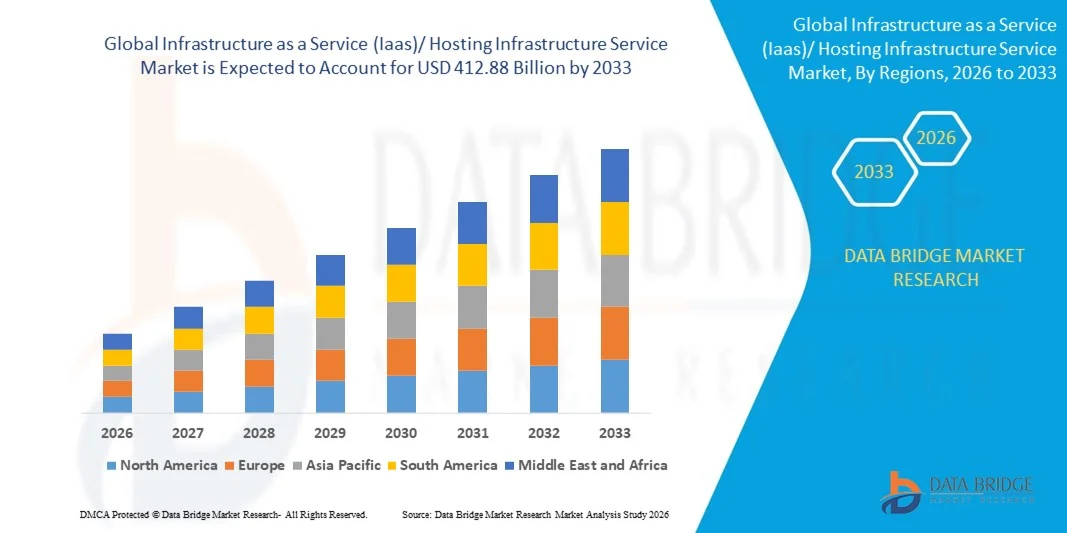
- The global Infrastructure as a Service (Iaas)/ hosting infrastructure service market size was valued at USD 56.58 billion in 2025 and is expected to reach USD 412.88 billion by 2033, at a CAGR of 28.20% during the forecast period
- The market growth is largely driven by accelerating cloud adoption, rapid digital transformation across enterprises, and the increasing shift from on-premises infrastructure to scalable, on-demand hosting environments, enabling organizations to improve operational agility and cost efficiency
- Furthermore, rising demand for secure, high-availability, and flexible IT infrastructure to support data-intensive workloads, remote work models, and advanced technologies such as AI and big data analytics is strengthening reliance on IaaS and hosting infrastructure services, thereby significantly boosting overall market growth
Infrastructure as a Service (Iaas)/ Hosting Infrastructure Service Market Analysis
- IaaS and hosting infrastructure services, providing virtualized computing resources, storage, networking, and managed environments, have become foundational to modern enterprise IT strategies across industries due to their scalability, reliability, and ability to support mission-critical applications
- The growing adoption of cloud-native applications, increasing focus on IT modernization, and the need for resilient infrastructure to ensure business continuity and data security are key factors driving sustained demand for IaaS and hosting infrastructure services globally
- North America dominated the Infrastructure as a Service (Iaas)/ hosting infrastructure service market with a share of around 45% in 2025, due to early cloud adoption, strong presence of hyperscale data centers, and high enterprise spending on digital infrastructure
- Asia-Pacific is expected to be the fastest growing region in the Infrastructure as a Service (Iaas)/ hosting infrastructure service market during the forecast period due to rapid digitalization, expanding cloud adoption, and rising enterprise IT spending
- Managed hosting segment dominated the market with a market share of 40.5% in 2025, due to enterprises increasingly outsourcing infrastructure management to reduce internal IT complexity and operational risk. Organizations across BFSI, healthcare, and large-scale digital platforms favor managed hosting due to guaranteed uptime, enhanced security monitoring, and compliance support
Report Scope and Infrastructure as a Service (Iaas)/ Hosting Infrastructure Service Market Segmentation
|
Attributes |
Infrastructure as a Service (Iaas)/ Hosting Infrastructure Service Key Market Insights |
|
Segments Covered |
|
|
Countries Covered |
North America
Europe
Asia-Pacific
Middle East and Africa
South America
|
|
Key Market Players |
|
|
Market Opportunities |
|
|
Value Added Data Infosets |
In addition to the insights on market scenarios such as market value, growth rate, segmentation, geographical coverage, and major players, the market reports curated by the Data Bridge Market Research also include in-depth expert analysis, geographically represented company-wise production and capacity, network layouts of distributors and partners, detailed and updated price trend analysis and deficit analysis of supply chain and demand. |
Infrastructure as a Service (Iaas)/ Hosting Infrastructure Service Market Trends
Rising Adoption of Hybrid and Multi-Cloud Infrastructure
- A major trend in the Infrastructure as a Service (IaaS)/Hosting Infrastructure Service market is the accelerating adoption of hybrid and multi-cloud architectures as enterprises seek flexibility, scalability, and workload optimization across public and private environments. Organizations are increasingly distributing applications and data across multiple cloud platforms to improve resilience, avoid vendor lock-in, and support diverse performance requirements
- For instance, enterprises widely deploy hybrid cloud solutions combining Amazon Web Services and on-premise infrastructure using AWS Outposts, while Microsoft Azure Arc enables unified management of hybrid and multi-cloud environments. These offerings allow organizations to maintain control over sensitive workloads while benefiting from the scalability of public cloud platforms
- Large enterprises are adopting multi-cloud strategies to ensure business continuity and improve disaster recovery capabilities by spreading workloads across different cloud providers. This approach enhances uptime and reduces dependency risks associated with single-provider infrastructure disruptions
- Regulated industries such as banking, healthcare, and government are leveraging hybrid cloud models to comply with data residency and regulatory mandates while still modernizing legacy systems. This trend is strengthening demand for hosting infrastructure services that support seamless integration between private data centers and public cloud platforms
- Cloud-native technologies such as containers and Kubernetes are further accelerating hybrid and multi-cloud adoption by enabling consistent application deployment across environments. These technologies simplify workload portability and operational management across distributed infrastructures
- The continued shift toward hybrid and multi-cloud strategies is reinforcing the evolution of IaaS and hosting services into more integrated, flexible, and enterprise-ready infrastructure solutions that align with long-term digital transformation goals
Infrastructure as a Service (Iaas)/ Hosting Infrastructure Service Market Dynamics
Driver
Accelerating Enterprise Digital Transformation and Cloud Migration
- The rapid pace of enterprise digital transformation is a key driver for the IaaS/Hosting Infrastructure Service market, as organizations migrate core applications and workloads from traditional on-premise systems to cloud-based infrastructure. This transition enables businesses to improve operational efficiency, scalability, and speed of deployment across digital initiatives
- For instance, companies such as Netflix rely extensively on Amazon Web Services to support global content delivery, data analytics, and scalable application performance. This migration demonstrates how cloud infrastructure enables enterprises to handle massive workloads while maintaining service reliability
- The growing adoption of data analytics, artificial intelligence, and Internet of Things applications is increasing the need for flexible and high-performance infrastructure services. IaaS platforms provide the computing power and storage capacity required to support data-intensive workloads without heavy upfront capital investment
- Small and medium-sized enterprises are also accelerating cloud migration to reduce infrastructure management complexity and focus resources on core business operations. This shift is expanding the customer base for hosting infrastructure providers across diverse industry verticals
- The sustained momentum of digital transformation initiatives is positioning IaaS and hosting infrastructure services as foundational components of modern enterprise IT strategies, supporting continuous innovation and operational agility
Restraint/Challenge
Data Security, Compliance, and Data Sovereignty Concerns
- Data security and regulatory compliance remain significant challenges for the Infrastructure as a Service (IaaS)/Hosting Infrastructure Service market, as organizations handle increasing volumes of sensitive and mission-critical data in cloud environments. Concerns related to unauthorized access, data breaches, and regulatory non-compliance can slow cloud adoption decisions
- For instance, compliance requirements under regulations such as the General Data Protection Regulation have led companies using Google Cloud Platform and Microsoft Azure to carefully assess data residency and processing locations. These regulations impose strict obligations on how and where data is stored and managed
- Enterprises operating across multiple geographies face complexity in aligning cloud deployments with varying national data sovereignty laws. This creates additional compliance burdens and increases the cost of managing distributed infrastructure environments
- The perception of reduced control over data in shared cloud environments continues to influence risk assessments among large enterprises. Addressing these concerns requires continuous investment by service providers in security certifications, compliance frameworks, and transparent governance models
- These ongoing security, compliance, and sovereignty challenges collectively act as a restraint on market growth, requiring IaaS and hosting providers to balance innovation with stringent regulatory and trust requirements across global markets
Infrastructure as a Service (Iaas)/ Hosting Infrastructure Service Market Scope
The market is segmented on the basis of service type and end user.
- By Service Type
On the basis of service type, the Infrastructure as a Service (IaaS)/Hosting Infrastructure market is segmented into managed hosting, colocation services, hybrid hosting, shared hosting, website hosting, virtual dedicated servers, virtual private servers, and others. The managed hosting segment dominated the market with the largest revenue share of 40.5% in 2025, supported by enterprises increasingly outsourcing infrastructure management to reduce internal IT complexity and operational risk. Organizations across BFSI, healthcare, and large-scale digital platforms favor managed hosting due to guaranteed uptime, enhanced security monitoring, and compliance support. The segment also benefits from rising adoption of cloud-integrated managed services that ensure scalability and performance optimization. Strong service-level agreements and predictable cost structures further reinforce its dominance among mid-sized and large enterprises.
The hybrid hosting segment is anticipated to witness the fastest growth rate from 2026 to 2033, driven by enterprises seeking flexibility between on-premise control and cloud scalability. Businesses with sensitive workloads increasingly deploy hybrid models to balance data sovereignty requirements with performance efficiency. Hybrid hosting enables seamless workload migration, disaster recovery, and peak-load management, making it attractive for data-intensive and regulated industries. The growing complexity of enterprise IT environments and multi-cloud strategies continues to accelerate demand for hybrid hosting solutions.
- By End User
On the basis of end user, the IaaS/Hosting Infrastructure market is segmented into IT and telecom, BFSI, healthcare, retail, manufacturing, government, utilities, and others. The IT and telecom segment accounted for the largest market revenue share in 2025, driven by continuous expansion of data centers, cloud-native applications, and network virtualization initiatives. Telecom operators and IT service providers rely heavily on scalable hosting infrastructure to support 5G deployment, edge computing, and high-volume data traffic. The segment’s dominance is reinforced by consistent investments in high-availability infrastructure to ensure uninterrupted digital services. Rapid digital transformation across enterprise clients further sustains long-term demand from this end user group.
The healthcare segment is expected to register the fastest growth during the forecast period, supported by accelerating adoption of digital health platforms, electronic health records, and telemedicine services. Healthcare providers increasingly require secure and compliant hosting environments to manage sensitive patient data and real-time analytics. The rising integration of AI-driven diagnostics and remote monitoring solutions increases infrastructure workload requirements. Regulatory compliance needs and demand for high data reliability continue to position healthcare as the fastest-growing end user in the IaaS and hosting infrastructure market.
Infrastructure as a Service (Iaas)/ Hosting Infrastructure Service Market Regional Analysis
- North America dominated the Infrastructure as a Service (Iaas)/ hosting infrastructure service market with the largest revenue share of around 45% in 2025, driven by early cloud adoption, strong presence of hyperscale data centers, and high enterprise spending on digital infrastructure
- Enterprises in the region strongly prioritize scalability, data security, and high availability, accelerating the adoption of managed hosting, colocation, and hybrid hosting models
- The region benefits from advanced IT infrastructure, high cloud maturity, and continuous investments in AI, big data, and edge computing, positioning North America as the leading hub for hosting infrastructure services across commercial and public sectors
U.S. Infrastructure as a Service (Iaas)/ Hosting Infrastructure Service Market Insight
The U.S. market captured the largest revenue share within North America in 2025, supported by rapid cloud migration across enterprises and strong demand for scalable hosting solutions. Organizations increasingly rely on managed and hybrid hosting to support SaaS platforms, remote work environments, and data-intensive workloads. The presence of major cloud and hosting providers, combined with rising adoption of automation and DevOps practices, continues to propel market growth. Strong demand from BFSI, healthcare, and technology companies further strengthens the U.S. market position.
Europe Infrastructure as a Service (Iaas)/ Hosting Infrastructure Service Market Insight
The Europe market is expected to expand at a steady CAGR during the forecast period, driven by strict data protection regulations and rising demand for secure, compliant hosting environments. Enterprises are increasingly adopting colocation and hybrid hosting to meet data sovereignty and regulatory requirements. Growing digital transformation initiatives across industries, along with expanding cloud infrastructure investments, are supporting regional growth. The demand for energy-efficient and sustainable data centers is also shaping market dynamics across Europe.
U.K. Infrastructure as a Service (Iaas)/ Hosting Infrastructure Service Market Insight
The U.K. market is anticipated to grow at a notable CAGR, fueled by increasing adoption of cloud-based business applications and digital services. Enterprises are shifting toward managed hosting and hybrid models to enhance operational efficiency and ensure data security. Growth in e-commerce, fintech, and digital media sectors continues to drive demand for scalable hosting infrastructure. The U.K.’s strong digital ecosystem and supportive regulatory framework further contribute to market expansion.
Germany Infrastructure as a Service (Iaas)/ Hosting Infrastructure Service Market Insight
The Germany market is projected to grow at a considerable CAGR, supported by rising demand for secure, high-performance hosting solutions across manufacturing and industrial sectors. German enterprises emphasize data privacy, reliability, and compliance, encouraging adoption of colocation and private cloud hosting. The country’s advanced industrial base and growing Industry 4.0 initiatives are increasing infrastructure workload requirements. Investments in green data centers and energy-efficient hosting solutions are further strengthening market growth.
Asia-Pacific Infrastructure as a Service (Iaas)/ Hosting Infrastructure Service Market Insight
The Asia-Pacific market is expected to register the fastest CAGR from 2026 to 2033, driven by rapid digitalization, expanding cloud adoption, and rising enterprise IT spending. Increasing internet penetration and growth of SMEs are accelerating demand for cost-effective hosting solutions. Government-led digital transformation initiatives and the expansion of hyperscale data centers are supporting regional growth. The region’s emergence as a global data center hub continues to enhance market scalability and competitiveness.
China Infrastructure as a Service (Iaas)/ Hosting Infrastructure Service Market Insight
China accounted for the largest market revenue share in Asia-Pacific in 2025, driven by rapid cloud adoption across enterprises and strong government support for digital infrastructure development. The growth of e-commerce, fintech, and smart city initiatives is significantly increasing demand for hosting and cloud services. Domestic hosting providers and large-scale data center investments are improving service accessibility and affordability. Continuous expansion of digital platforms further accelerates market growth in China.
Japan Infrastructure as a Service (Iaas)/ Hosting Infrastructure Service Market Insight
The Japan market is witnessing steady growth due to increasing enterprise focus on modernization of legacy IT systems and adoption of cloud-based hosting. Japanese organizations prioritize reliability, disaster recovery, and high data availability, driving demand for managed and hybrid hosting services. Growth in AI, IoT, and smart manufacturing applications is increasing infrastructure requirements. The country’s advanced technological ecosystem continues to support long-term market expansion.
Infrastructure as a Service (Iaas)/ Hosting Infrastructure Service Market Share
The Infrastructure as a Service (Iaas)/ hosting infrastructure service industry is primarily led by well-established companies, including:
- AT&T Intellectual Property (U.S.)
- CenturyLink (U.S.)
- Colt Technology Services Group Limited (U.K.)
- CoreSite (U.S.)
- Google Cloud (U.S.)
- IBM (U.S.)
- Microsoft (U.S.)
- NetApp (U.S.)
- NTT Communications Corporation (Japan)
- Wipro Limited (India)
- Amazon Web Services, Inc. (U.S.)
- Hewlett Packard Enterprise Development LP (U.S.)
- Akamai Technologies (U.S.)
- VMware Inc. (U.S.)
- Oracle (U.S.)
- Rackspace Technology (U.S.)
- Zayo Group, LLC. (U.S.)
- GoDaddy Operating Company, LLC. (U.S.)
- Fujitsu (Japan)
- Accenture (Ireland)
Latest Developments in Global Infrastructure as a Service (Iaas)/ Hosting Infrastructure Service Market
- In June 2025, SK Group and AWS revealed plans to build South Korea’s largest AI-focused data center in Ulsan, equipped with 60,000 GPUs and a scalable 1 GW power roadmap, substantially expanding regional hyperscale infrastructure capacity. This development strengthens the IaaS and hosting infrastructure market by enabling advanced AI training, high-performance computing, and cloud-based workloads. It also reinforces South Korea’s position as a strategic AI and cloud hub in Asia-Pacific, attracting global enterprises seeking reliable, large-scale compute resources
- In June 2025, Ericsson and Google Cloud introduced carrier-grade 5G Core-as-a-Service across 42 regions, accelerating the shift toward cloud-native telecom infrastructure. This launch reduces capital expenditure for telecom operators while increasing reliance on scalable IaaS and managed hosting platforms. The initiative supports rapid 5G rollout, network flexibility, and service innovation, driving sustained demand for cloud-based hosting infrastructure globally
- In March 2025, BlackRock expanded its AI Infrastructure Partnership to USD 100 billion with NVIDIA and xAI joining the initiative, highlighting rising institutional investment in AI-driven data center ecosystems. This expansion enhances funding availability for large-scale IaaS, hyperscale data centers, and high-density computing infrastructure. The partnership is expected to accelerate global deployment of AI-ready hosting environments, strengthening long-term market growth
- In February 2025, Vantage Data Centers allocated EUR 1.4 billion for expansion across the EMEA region, addressing increasing enterprise and cloud provider demand for colocation and hyperscale facilities. This investment supports the development of energy-efficient, high-capacity data centers, reinforcing infrastructure resilience and scalability. The expansion is expected to improve service availability and drive competition within the regional hosting infrastructure market
- In January 2024, Accenture Plc acquired Navisite to expand its cloud-managed services and infrastructure engineering capabilities, enabling more comprehensive IaaS and hosting offerings. The acquisition strengthens Accenture’s ability to support enterprise cloud migration, modernization, and multi-cloud management. It also enhances competitive positioning in North America by delivering integrated, end-to-end infrastructure and managed hosting solutions
SKU-
Get online access to the report on the World's First Market Intelligence Cloud
- Interactive Data Analysis Dashboard
- Company Analysis Dashboard for high growth potential opportunities
- Research Analyst Access for customization & queries
- Competitor Analysis with Interactive dashboard
- Latest News, Updates & Trend analysis
- Harness the Power of Benchmark Analysis for Comprehensive Competitor Tracking
Global Infrastructure As A Service Iaas Hosting Infrastructure Service Market, Supply Chain Analysis and Ecosystem Framework
To support market growth and help clients navigate the impact of geopolitical shifts, DBMR has integrated in-depth supply chain analysis into its Global Infrastructure As A Service Iaas Hosting Infrastructure Service Market research reports. This addition empowers clients to respond effectively to global changes affecting their industries. The supply chain analysis section includes detailed insights such as Global Infrastructure As A Service Iaas Hosting Infrastructure Service Market consumption and production by country, price trend analysis, the impact of tariffs and geopolitical developments, and import and export trends by country and HSN code. It also highlights major suppliers with data on production capacity and company profiles, as well as key importers and exporters. In addition to research, DBMR offers specialized supply chain consulting services backed by over a decade of experience, providing solutions like supplier discovery, supplier risk assessment, price trend analysis, impact evaluation of inflation and trade route changes, and comprehensive market trend analysis.
Research Methodology
Data collection and base year analysis are done using data collection modules with large sample sizes. The stage includes obtaining market information or related data through various sources and strategies. It includes examining and planning all the data acquired from the past in advance. It likewise envelops the examination of information inconsistencies seen across different information sources. The market data is analysed and estimated using market statistical and coherent models. Also, market share analysis and key trend analysis are the major success factors in the market report. To know more, please request an analyst call or drop down your inquiry.
The key research methodology used by DBMR research team is data triangulation which involves data mining, analysis of the impact of data variables on the market and primary (industry expert) validation. Data models include Vendor Positioning Grid, Market Time Line Analysis, Market Overview and Guide, Company Positioning Grid, Patent Analysis, Pricing Analysis, Company Market Share Analysis, Standards of Measurement, Global versus Regional and Vendor Share Analysis. To know more about the research methodology, drop in an inquiry to speak to our industry experts.
Customization Available
Data Bridge Market Research is a leader in advanced formative research. We take pride in servicing our existing and new customers with data and analysis that match and suits their goal. The report can be customized to include price trend analysis of target brands understanding the market for additional countries (ask for the list of countries), clinical trial results data, literature review, refurbished market and product base analysis. Market analysis of target competitors can be analyzed from technology-based analysis to market portfolio strategies. We can add as many competitors that you require data about in the format and data style you are looking for. Our team of analysts can also provide you data in crude raw excel files pivot tables (Fact book) or can assist you in creating presentations from the data sets available in the report.